plants
Amateur Radio for Emergency Communication
Amateur Radio for Emergency Communication - comprehensive guide from Nored Farms.
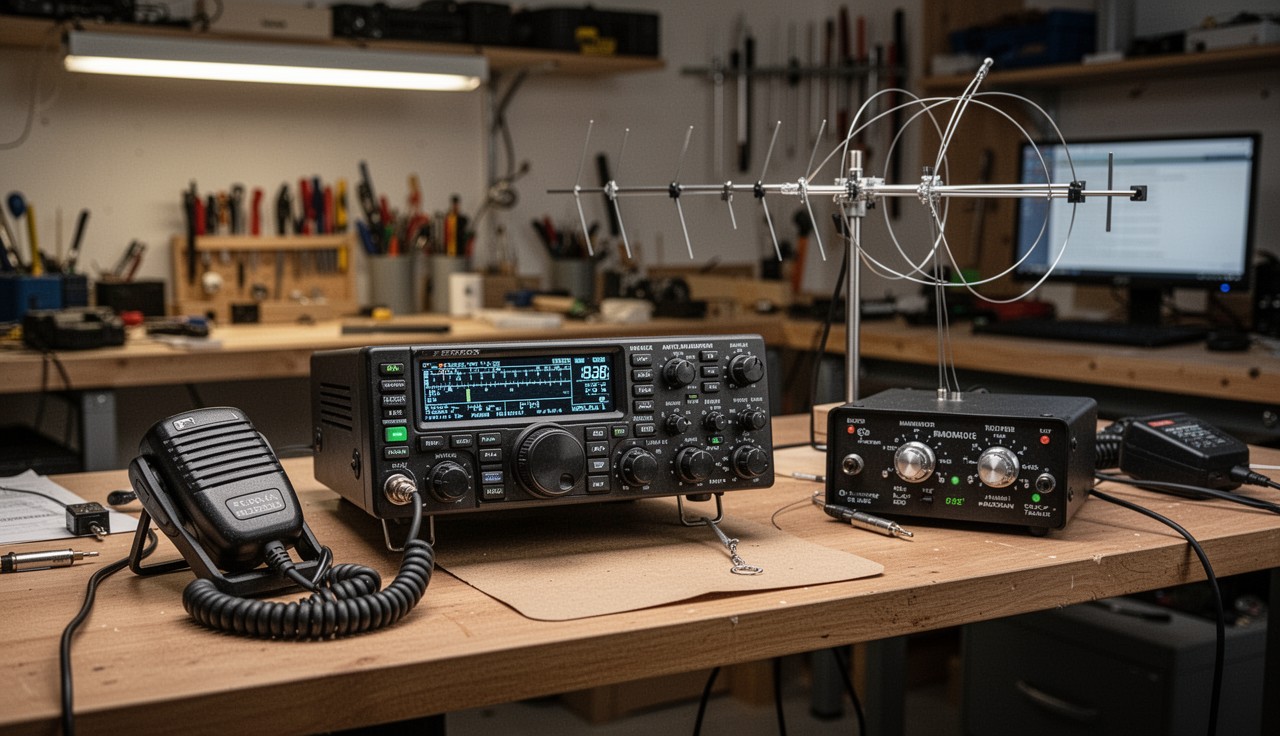
**Content Extraction Summary:** Complete guide to amateur (ham) radio as a resilient emergency communication system. Covers FCC licensing tiers, radio propagation physics, VHF/UHF repeater operations, HF long-distance communication, digital modes (APRS, Winlink, JS8Call), emergency nets and served agencies (ARES/RACES/SKYWARN), buildable antenna projects including NVIS for 100-300 mile regional coverage, off-grid power systems, and a deployable go-kit checklist. Written for anyone from zero-experience to newly licensed operators who want a communication system that functions when all infrastructure fails.
1. Introduction
Cell towers have 8 hours of battery backup. Most have less. During Hurricane Maria in 2017, 95.6% of Puerto Rico's cell sites went offline (FCC Communications Status Report, Sept. 2017). Landlines failed. Internet failed. The only communication network that kept working was amateur radio — because it doesn't depend on any infrastructure that can be destroyed.
Amateur radio — ham radio — is the only widely available communication system where you own every component from microphone to antenna. No cell tower. No internet backbone. No satellite subscription. No monthly bill. Your radio talks directly to another radio using physics that have worked since Marconi's first transmission in 1895 and will work identically after any disaster.
The misconception is that ham radio is a nostalgic hobby for retirees. The reality: FEMA, the Red Cross, and the National Weather Service all depend on volunteer amateur radio operators as their backup communication layer. After every major U.S. disaster — Katrina, Sandy, the 2011 Joplin tornado, the 2023 Maui wildfire — amateur radio operators provided the first reliable communication when professional systems failed.
The barrier to entry is low. The FCC Technician license exam is 35 multiple-choice questions drawn from a published pool. Every question and answer is available free online. The exam fee is $15 (some clubs waive it). Study time for most people: 2-4 weeks. No Morse code requirement since 2007.
What you get for that effort: legal access to radio frequencies that can reach across a room or across an ocean, the technical knowledge to build and operate your own communication infrastructure, and membership in a global network of 770,000+ U.S. licensees who practice emergency communication year-round (ARRL Annual Report, 2023).
2. Licensing
The FCC issues three amateur radio license classes. Each one unlocks more frequencies and more capability.
Technician Class
The entry license. 35-question exam covering basic regulations, operating procedures, electronics fundamentals, and safety. Grants full access to all amateur frequencies above 30 MHz — the VHF and UHF bands. This is where local and regional emergency communication happens. Also grants limited privileges on some HF bands (portions of 10m, 15m, 40m, 80m) for long-distance work.
Practical value: Full repeater access, APRS, local emergency nets, SKYWARN storm spotting, digital modes on VHF/UHF. Enough for most emergency communication within a 50-mile radius.
General Class
Adds broad access to the HF bands (3-30 MHz). 35-question exam covering more advanced regulations, operating practices, and technical concepts. This is the license that unlocks long-distance communication — across states, across continents.
Practical value: HF voice and digital, Winlink email over radio, NVIS regional emergency communication, nationwide emergency nets. The sweet spot for emergency operators.
Amateur Extra
Full access to every amateur frequency. 50-question exam covering advanced electronics, antenna theory, and regulations. The additional frequencies are narrow segments at the bottom of HF bands where experienced operators congregate.
Practical value: Marginal for emergency purposes. Worth pursuing for the technical education, not for emergency access.
Study Resources (All Free)
- **HamStudy.org** — Adaptive flashcard system for all three exams. Tracks weak areas. Free.
- **ARRL Ham Radio License Manual** — The official textbook. Available at libraries.
- **KB6NU Study Guides** — Free PDF study guides for Technician and General.
- **Ham Radio Prep / YouTube** — Video walkthroughs of every question pool topic.
Exam Process
Exams are administered by Volunteer Examiner Coordinators (VECs). ARRL-VEC and W5YI-VEC are the two largest. Sessions run weekly in most metro areas, monthly in rural areas. Many sessions are now available online via remote proctoring.
Steps: Register for an FRN (FCC Registration Number) at the FCC CORES website. Find a session at hamstudy.org/sessions. Bring government-issued ID and the exam fee. Results are immediate. Your callsign appears in the FCC ULS database within 1-10 business days.
You can take multiple exams in one session. Pass Technician, immediately sit for General, and if you pass that, sit for Extra. One fee covers all attempts that day.
3. Radio Fundamentals
Frequency and Wavelength
Radio is electromagnetic energy — the same physics as light, just at lower frequencies. Frequency is measured in Hertz (cycles per second). Amateur radio operates from 1.8 MHz to above 275 GHz.
Wavelength and frequency are inversely related: wavelength (meters) = 300 / frequency (MHz). A signal at 146 MHz has a wavelength of about 2 meters. A signal at 7 MHz has a wavelength of about 40 meters. This matters because antenna length is directly related to wavelength.
Propagation — How Signals Travel
This is the single most important concept in emergency radio. Different frequencies travel differently, and understanding this determines whether your message gets through.
**Line of Sight (VHF/UHF, above 30 MHz).** Signals travel in straight lines. Range is limited by the curvature of the earth and terrain. From a handheld radio at ground level, expect 1-5 miles. From a hilltop or tall building, 20-50 miles. From a mountaintop repeater, 50-100+ miles. Higher frequency = more line-of-sight behavior. UHF (70cm) penetrates buildings better than VHF (2m) but is more easily blocked by terrain.
**Ground Wave (lower HF and MF).** Signals follow the curvature of the earth along the surface. Effective on 160m and 80m bands. Range: 50-200 miles depending on soil conductivity and power. Useful but limited.
**Skywave / Ionospheric Propagation (HF, 3-30 MHz).** The ionosphere — layers of ionized gas 50-400 miles above earth — acts as a mirror for HF signals. A signal transmitted upward at the right angle reflects off the ionosphere and returns to earth hundreds or thousands of miles away. This is how amateur radio achieves worldwide communication with 100 watts and a wire antenna.
The ionosphere changes constantly. Solar radiation ionizes the upper atmosphere during the day; the ionization fades at night. Different layers (D, E, F1, F2) form and dissipate on a daily cycle. This is why certain HF bands work during the day and others work at night.
**NVIS — Near Vertical Incidence Skywave.** Critical for emergency communication. Covered in detail in Section 8. The short version: transmit nearly straight up, bounce off the ionosphere nearly straight down. Covers a radius of 0-300 miles with no skip zone. The primary technique for state-level and regional emergency communication on HF.
Bands and Their Uses
| Band | Frequency Range | Wavelength | Primary Use | |------|----------------|------------|-------------| | 160m | 1.8-2.0 MHz | 160 meters | Nighttime regional, ground wave | | 80m | 3.5-4.0 MHz | 80 meters | Nighttime regional, NVIS | | 40m | 7.0-7.3 MHz | 40 meters | Day/night regional and medium distance, NVIS | | 20m | 14.0-14.35 MHz | 20 meters | Daytime long distance, primary DX band | | 15m | 21.0-21.45 MHz | 15 meters | Daytime long distance, solar cycle dependent | | 10m | 28.0-29.7 MHz | 10 meters | Daytime long distance when solar activity high | | 6m | 50-54 MHz | 6 meters | "Magic band" — sporadic propagation | | 2m | 144-148 MHz | 2 meters | Primary VHF band, repeaters, local emergency | | 70cm | 420-450 MHz | 70 centimeters | Secondary UHF band, repeaters, digital |
4. VHF/UHF — Local and Regional Communication
The 2-meter (144-148 MHz) and 70-centimeter (420-450 MHz) bands are where most new operators start and where most local emergency communication happens.
Repeaters
A repeater is a radio station — usually on a hilltop, tower, or tall building — that receives a signal on one frequency and simultaneously retransmits it on another. This extends the range of a low-power handheld radio from a few miles to 50-100+ miles.
How they work: A repeater listens on its input frequency and transmits on its output frequency. The offset (difference between input and output) is standardized: +/- 600 kHz on 2m, +/- 5 MHz on 70cm. When you program a repeater into your radio, you set the output frequency, the offset direction, and any required access tone (CTCSS/PL tone — a sub-audible tone that tells the repeater you're authorized to use it).
Finding local repeaters: RepeaterBook.com is the most comprehensive directory. Filter by your location and band. Most areas have dozens of 2m and 70cm repeaters. Many are linked into systems covering entire states or regions.
During emergencies, specific repeaters are designated for emergency traffic. Your local ARES (Amateur Radio Emergency Service) group will know which ones. Program them into your radio before you need them.
Handheld Radios (HTs)
The entry point for most operators. Recommendations by tier:
**Budget ($25-40).** Baofeng UV-5R or BF-F8HP. Dual-band (2m/70cm). Functional but limited receiver filtering. Program them with CHIRP software (free) rather than the keypad. Adequate for getting started. Not ideal for dense RF environments.
**Mid-range ($80-200).** Yaesu FT-65R or FT-60R. Better receivers, more durable, easier to program. The FT-60R has been a standard recommendation for 20+ years for a reason — it works.
**Serious ($200-500).** Yaesu FT-5DR, Kenwood TH-D75A, Icom ID-52A. These include digital capabilities (System Fusion, D-STAR, or APRS built in), GPS, Bluetooth, better audio, and significantly better receive performance.
For emergency use, the critical features are: rubber duck antenna replacement capability (aftermarket antennas double or triple your range), battery capacity, and the ability to use AA batteries (the Yaesu FT-60R accepts an AA battery case).
Mobile Radios
Installed in vehicles, these run 25-75 watts versus a handheld's 5-8 watts. Connected to a proper antenna on the vehicle roof, a mobile radio is dramatically more capable than a handheld.
Solid choices: Yaesu FT-2980R (2m, 80W, simple), Icom IC-2730A (dual-band, 50W), Yaesu FT-8900R (quad-band, versatile). For a dedicated emergency vehicle installation, the IC-2730A with a detachable head is hard to beat.
Antenna Basics for VHF/UHF
The antenna matters more than the radio. A $25 Baofeng with a good antenna outperforms a $500 HT with a rubber duck.
**Rubber duck antenna.** The short factory antenna on an HT. Compromised design for portability. Expect 1-3 miles range in flat terrain.
**Aftermarket whip.** A 15-19 inch replacement antenna (Nagoya NA-771 or Signal Stick). Immediate improvement — 3-8 miles.
**Magnetic mount mobile antenna.** Stick it on a car roof, cookie sheet, or any metal surface. 5-20+ mile range from a handheld.
**J-pole or slim jim.** Hang from a tree branch, window, or mast. Excellent portable antenna. Can be built from 450-ohm ladder line for under $10. 10-30+ mile range with a handheld.
5. HF — Long-Distance Communication
HF (High Frequency, 3-30 MHz) is where amateur radio reaches across continents. Signals bounce between the ionosphere and the earth, covering thousands of miles with modest equipment. A 100-watt transceiver and a wire antenna strung between two trees can communicate from Texas to Germany.
Bands by Time of Day
The ionosphere's behavior creates a daily pattern:
**Daytime bands (after sunrise, peak midday):** 20m (14 MHz) is the workhorse. Reliable long-distance communication during daylight hours. 15m (21 MHz) and 10m (28 MHz) open when solar activity is high (near the peak of the 11-year solar cycle — the current Cycle 25 peaked around 2024-2025).
**Nighttime bands (after sunset, peak late evening):** 40m (7 MHz) transitions from regional daytime to longer-distance nighttime. 80m (3.5 MHz) is the primary nighttime regional band — excellent for NVIS. 160m (1.8 MHz) for nighttime short-range.
**Transition band:** 40m works both day and night, making it the most versatile single HF band. If you could only have one HF antenna, make it a 40m antenna.
Wire Antennas
HF antennas are large because wavelengths are long. A half-wave dipole for 40m is about 66 feet tip to tip. The good news: wire antennas are cheap, light, and effective.
**Half-wave dipole.** Two equal lengths of wire, fed at the center with coaxial cable. Total length (feet) = 468 / frequency (MHz). For 40m (7.15 MHz): 468 / 7.15 = 65.4 feet total, each side 32.7 feet. Hang it as high as possible, in an inverted-V shape if needed (center high, ends sloping down). Cost: $15-30 in wire and a center insulator.
**End-fed half-wave (EFHW).** A half-wavelength wire fed at one end through an impedance-matching transformer (49:1 or 64:1 unun). One support point needed instead of two. Easier to deploy in the field. Commercially available from LNR Precision, MyAntennas, and others, or buildable for $20-40.
**NVIS antenna.** A dipole or inverted-V hung low — 1/10 to 1/4 wavelength above ground (10-25 feet for 40m/80m). Concentrates radiation upward for regional coverage. Detailed build in Section 8.
Antenna Tuners
An antenna tuner (more accurately, an impedance matching device) compensates for antennas that aren't perfectly resonant on the desired frequency. This lets you use one antenna on multiple bands. Internal auto-tuners are built into many modern transceivers (Icom IC-7300, Yaesu FT-991A). External tuners like the LDG Z-100 handle larger mismatches.
For emergency deployments with improvised antennas, a tuner is essential. You may be throwing wire over a tree in a parking lot — it won't be resonant, and the tuner makes it work.
6. Digital Modes
Digital modes encode information as audio tones, transmitted over radio and decoded by software. They extract usable communication from signals too weak for voice. A computer or smartphone connects to the radio through an audio interface or built-in USB sound card.
APRS — Automatic Packet Reporting System
Transmits GPS position, weather data, short messages, and telemetry on 144.390 MHz (North America). Stations appear on aprs.fi in real time. Digipeaters (digital repeaters) relay packets across wide areas. IGates bridge APRS packets to the internet and back.
Emergency value: Real-time position tracking of field teams. A shelter operator can see exactly where every deployed team is. Weather stations feed data to the National Weather Service. Short messages (max 67 characters) provide basic text communication.
Equipment: Many modern HTs have APRS built in (Yaesu FT-5DR, Kenwood TH-D75A). Budget option: any 2m radio + smartphone running APRSdroid (Android) or APRS.fi app + a Mobilinkd TNC (terminal node controller) interface ($70).
Winlink — Email Over Radio
A global radio-to-email system. Compose an email on your laptop, connect to a Winlink gateway (a station with internet access) via HF or VHF radio, and the email travels to any standard email address. Replies come back the same way. Handles attachments (compressed).
Emergency value: The primary method for sending structured reports (ICS-213 forms, situation reports, resource requests) when internet is down. FEMA and SHARES (government HF network) both use Winlink.
Software: Winlink Express (free download from winlink.org). Works on HF (Pactor or VARA modem), VHF (VARA FM or packet), and Telnet (internet — for practice).
Equipment: Any HF or VHF transceiver with audio interface to a computer. For HF, a VARA modem license ($69) provides good performance. The Signalink USB ($120) handles the audio interface.
JS8Call — Keyboard-to-Keyboard Weak Signal
Built on the FT8 engine but designed for conversation rather than brief signal reports. JS8Call allows keyboard-to-keyboard text communication using extremely weak signals — usable at signal levels 10-20 dB below what voice requires. Messages relay through other JS8Call stations automatically (store and forward).
Emergency value: When propagation is marginal and voice won't get through, JS8Call often will. Heartbeat mode lets others know you're on frequency without constant operation. Group messaging capability.
FT8
The dominant weak-signal digital mode. Exchanges callsigns, signal reports, and grid squares in 15-second transmission cycles. Not conversational — it's designed for making contacts and confirming propagation paths. Useful for checking if a band is open before attempting voice or Winlink.
DMR — Digital Mobile Radio
A digital voice mode on UHF, using commercial-standard TDMA (time division multiple access). Radios are inexpensive (Anytone AT-D878UV, $150-200). Repeaters connect via the internet to talkgroups — worldwide digital channels organized by topic, region, or purpose. Emergency talkgroups exist for disaster communication.
Limitation: Most DMR repeaters require internet backhaul. If the internet is down, DMR repeaters become standalone — still useful locally but without wide-area linking.
7. Emergency Communication
ARES — Amateur Radio Emergency Service
Organized under the ARRL. Volunteers register with their local ARES group, participate in training and exercises, and deploy when activated by the Emergency Coordinator. ARES provides communication support to served agencies — the Red Cross, hospitals, shelters, emergency management offices.
Joining: Contact your ARRL Section Manager or local ARES Emergency Coordinator. Most groups meet monthly and conduct quarterly exercises. No cost to join. Technician license is sufficient.
RACES — Radio Amateur Civil Emergency Service
The governmental counterpart to ARES. RACES operators are enrolled with local, state, or federal civil defense agencies. RACES can only be activated by a civil defense official. Many operators are registered in both ARES and RACES.
SKYWARN
National Weather Service trained storm spotters. When severe weather threatens, NWS activates SKYWARN nets. Trained spotters report ground-truth weather observations (tornado sightings, hail size, wind damage, flooding) via amateur radio to the NWS. Free training available online and in-person through local NWS offices.
This is the easiest entry point into emergency communication. Take the free SKYWARN training, check into your local SKYWARN net during severe weather, and you're contributing immediately.
ICS Integration — Incident Command System
Modern emergency management uses ICS (Incident Command System) to organize response. Amateur radio operators function within ICS, typically under the Communications Unit. Understanding ICS structure, forms, and terminology is essential for effective emergency deployment.
Key ICS forms for radio operators:
- **ICS-205**: Incident Radio Communications Plan (frequency assignments)
- **ICS-213**: General Message Form (the standard for tactical message traffic)
- **ICS-214**: Activity Log (document everything)
FEMA offers free ICS courses online. IS-100, IS-200, and IS-700 are the minimum for emergency communicators. Available at training.fema.gov.
Emergency Traffic Handling
During emergencies, radio traffic is prioritized:
1. **Emergency** — Immediate threat to life or property. 2. **Priority** — Important information with time sensitivity. 3. **Welfare** — Health and welfare inquiries ("Is my family safe?"). 4. **Routine** — Everything else.
A directed net — one station acting as Net Control — manages the flow. You don't transmit until Net Control calls for you or acknowledges your request. This discipline prevents chaos on a busy frequency.
NTS Radiogram Format
The National Traffic System (NTS) uses a standardized message format — the radiogram — for passing formal written messages. A radiogram has a preamble (number, precedence, station of origin, check, place of origin, time, date), an address, a text (limited to 25 words for efficiency), and a signature.
This format ensures messages survive relay through multiple operators without losing content. During Katrina, NTS operators relayed thousands of welfare messages between affected areas and distant family members.
8. Antenna Projects
Project 1: 2-Meter Ground Plane Antenna
A simple, high-performance base station antenna for the 2m band. Four radials and a vertical element. Outperforms any rubber duck antenna by a wide margin.
**Materials:**
- 5 pieces of #10 or #12 copper wire, each 19.25 inches long
- 1 SO-239 UHF chassis-mount connector
- Solder, soldering iron
- Coaxial cable (RG-58 or RG-8X) with PL-259 connector
**Build:** 1. Solder one wire vertically to the center pin of the SO-239 connector. This is the radiating element. 2. Solder four wires to the ground tabs of the SO-239, spaced 90 degrees apart. These are the radials. 3. Bend the radials down at approximately 45 degrees from horizontal. 4. Weatherproof solder joints with liquid electrical tape or adhesive-lined heat shrink. 5. Mount the antenna vertically, radials pointing down. Use a PVC pipe mast, broom handle, or any non-conductive support.
**Performance:** Approximately 2.5 dBi gain over a rubber duck antenna. Omnidirectional pattern. Reliable repeater access from 20+ miles with 5 watts.
**Tuning:** Trim the vertical element 1/4 inch at a time until SWR is below 1.5:1 at 146 MHz (check with an SWR meter or NanoVNA — $50, indispensable tool).
Project 2: 20-Meter Dipole for HF
A half-wave dipole for the 20m band — the primary daytime long-distance band.
**Materials:**
- 33.5 feet of insulated wire (two pieces, each 16.75 feet)
- 1 center insulator (commercial, or build from a piece of acrylic/cutting board)
- 2 end insulators (dog-bone style, or use PVC)
- 50 feet of RG-8X coaxial cable with PL-259 connector
- Rope for supports
**Build:** 1. Connect one wire to each side of the center insulator. Solder or bolt to the coax connections — center conductor to one side, shield to the other. 2. Run each wire out to an end insulator. Attach rope beyond the insulators for hanging. 3. Hang the antenna as high as possible. An inverted-V configuration (center at 30+ feet, ends sloping to 8-10 feet) works well and requires only one support point. 4. Run coax from the center insulator down to your radio.
**Tuning:** Start with wires slightly long (17 feet each side). Check SWR at 14.150 MHz. Trim 1/2 inch at a time from each side equally until SWR is below 1.5:1.
Project 3: NVIS Antenna for Regional Emergency Communication
NVIS is the critical technique for emergency communication within a 0-300 mile radius. Standard HF antennas radiate toward the horizon for long-distance communication. NVIS antennas radiate upward, bouncing signals off the ionosphere at steep angles to fill in the "skip zone" — the area too far for ground wave but too close for conventional skywave.
The physics: When an HF signal hits the ionosphere at a steep angle (70-90 degrees from horizontal), it reflects nearly straight back down. The coverage area is a circle roughly 0-300 miles in radius from the transmitter, with no gap. Every station within that circle hears you, regardless of terrain. Mountains, valleys, forests — NVIS clears them all because the signal comes from above.
**Why NVIS matters for emergency communication:** A state emergency management office needs to communicate with county EOCs spread across a 200-mile radius. VHF repeaters may be damaged or lack coverage in rural areas. Standard HF would skip over the nearest counties. NVIS covers all of them simultaneously with a single transmission.
**Optimal frequencies:** 40m (7 MHz) during the day. 80m (3.5 MHz) at night. 60m (5 MHz, channelized) anytime — the government interoperability band. The critical frequency (highest frequency that reflects at vertical incidence) varies with solar conditions and time of day. Below the critical frequency, NVIS works. Above it, the signal passes through the ionosphere into space.
**NVIS Antenna Build — 40m/80m Dual-Band:**
Materials:
- 130 feet of insulated stranded wire (for an 80m dipole — also works on 40m with a tuner)
- Center insulator with SO-239 connector
- 2 end insulators
- RG-8X coaxial cable, 50-foot run
- 4 support stakes or short poles (8-12 feet)
- Rope
Build: 1. Cut two lengths of wire, each 65 feet (total 130 feet for an 80m half-wave dipole: 468 / 3.6 MHz = 130 feet). 2. Connect at the center insulator — center conductor to one wire, shield to the other. 3. String the antenna in an inverted-V or flat configuration at 10-15 feet above ground. This height is deliberate. Higher is not better for NVIS. At 1/4 wavelength above ground for the operating frequency (about 10-15 feet for 80m, 20-25 feet for 40m), maximum radiation goes straight up. 4. For a flat dipole, use four stakes or poles at the corners. For an inverted-V, one center mast at 12-15 feet with ends staked close to the ground. 5. Run coax to the operating position.
**Performance optimization:**
- A wire mesh or ground screen under the antenna improves performance. Even a few radial wires on the ground help.
- The antenna works on 40m without modification by using an antenna tuner.
- For dedicated 40m NVIS, cut the total length to 66 feet (33 feet per side) and hang at 8-10 feet.
- Horizontal polarization is standard for NVIS. This also rejects most man-made noise, which tends to be vertically polarized.
**Testing:** Conduct an on-air check with a station 50-100 miles away. Ask for a signal report. Then try a station 200 miles away. Both should hear you at similar strength. That's NVIS working — uniform coverage across the entire radius.
Project 4: Portable Antenna Kit
A deployable antenna system that fits in a backpack for emergency activation.
**Contents:**
- 150 feet of #26 AWG polystealth wire (lightweight, strong)
- 49:1 EFHW matching transformer (commercial or homemade)
- Arborist throw line and 8 oz weight (for getting wire over tree branches)
- 3 lightweight tent stakes
- 50 feet of RG-174 coaxial cable (thin, light)
- BNC-to-SO-239 adapters
- Laminated frequency/length reference card
- Stuff sack
This kit deploys in 15 minutes. Throw the weight over a branch at 25-40 feet, hoist the wire as an end-fed sloper, connect the matching transformer and coax, and you're on the air. The 150-foot wire covers 80m through 10m with a tuner.
9. Power — Operating Off-Grid
Grid power fails during emergencies. Plan for it.
Battery Requirements
A typical 100-watt HF transceiver draws 1-2 amps on receive and 18-22 amps on transmit at full power. At 50% duty cycle (transmitting half the time), average current is about 10-12 amps.
Battery sizing formula: Average current draw (amps) x operating hours x 1.2 (safety margin) = amp-hours needed. For 8 hours of operation at 10A average: 10 x 8 x 1.2 = 96 Ah.
**LiFePO4 batteries** are the current standard for portable radio. Lighter than lead-acid, tolerant of deep discharge, 2000+ cycle life, flat voltage curve. A 100Ah LiFePO4 battery weighs about 24 lbs versus 60+ lbs for an equivalent AGM lead-acid. Bioenno Power, Dakota Lithium, and others make radio-specific models with Anderson Powerpole connectors.
**Practical sizing:**
- QRP operation (5 watts): A 20Ah battery runs a KX2 or KX3 for 2+ days
- Portable HF (50-100 watts): 50Ah LiFePO4 provides a full day of active operation
- Base station (100 watts continuous): 100Ah LiFePO4 or parallel batteries
Solar Power
A solar panel recharges batteries during extended deployments.
**Panel sizing:** A 100-watt solar panel in good sun produces approximately 5-6 amps at 18V. With a charge controller, that puts 40-60 Ah into a 12V battery over a 6-8 hour sunny day — enough to sustain moderate radio operations indefinitely.
**Recommended setup for a portable solar-powered station:**
- 100W folding solar panel (Renogy, BougeRV, or similar) — $100-150
- 20A MPPT charge controller — $30-60
- 100Ah LiFePO4 battery — $250-400
- Anderson Powerpole distribution (RigRunner or equivalent) — $30-50
Total system weight: approximately 40-50 lbs. Fits in a tote bin. Provides indefinite radio operations with sun.
QRP — Low-Power Operation
QRP operation uses 5 watts or less. Modern transceivers like the Elecraft KX2 ($900) and Xiegu X6100 ($600) are complete HF stations weighing under 2 lbs. Paired with an EFHW wire antenna and a small battery, the entire station fits in a daypack.
The tradeoff is clear: less power means weaker signals. But digital modes compensate. At 5 watts on FT8 or JS8Call, worldwide communication is routine. Even voice contacts at 5 watts are common with good propagation and a resonant antenna.
For emergency communication, QRP is the backup to the backup — when you need to travel light and operate for days on a single charge.
10. Go-Kit — Portable Emergency Radio Station
A go-kit is a ready-to-deploy radio station packed and organized for immediate use. When an ARES activation comes, you grab it and go.
Tier 1: Walk-Out Kit (Backpack)
Grab this for local emergencies, shelter operations, or when deploying on foot.
| Item | Purpose | |------|---------| | Dual-band HT (Yaesu FT-65R or FT-5DR) | Primary VHF/UHF communication | | Spare battery pack + AA battery case | Extended operation | | Aftermarket antenna (Signal Stick or Nagoya NA-771) | Improved range over rubber duck | | Roll-up J-pole antenna + 25 ft coax | Base station performance from a handheld | | Earpiece/speaker-mic | Operational in noisy environments | | Frequency list (laminated) | Local repeaters, ARES, SKYWARN, simplex | | Notepad and pens | Message logging — ICS-214, ICS-213 | | USB battery bank (20,000+ mAh) | Charge HT via USB if applicable | | Headlamp | Night operations |
Tier 2: Drive-Up Kit (Pelican Case or Tote)
For extended deployments, EOC staffing, or when vehicle transport is available.
| Item | Purpose | |------|---------| | HF transceiver (Icom IC-7300 or Yaesu FT-991A) | Long-distance and NVIS communication | | 100Ah LiFePO4 battery | 8-12 hours of HF operation | | 100W folding solar panel + charge controller | Sustained off-grid power | | Portable antenna kit (Section 8, Project 4) | Deployable HF antenna system | | Laptop with Winlink Express, JS8Call, WSJT-X | Digital mode operation | | Audio interface (Signalink USB or built-in USB) | Radio-to-computer connection | | Anderson Powerpole distribution box | Clean power for all devices | | Mag-mount VHF/UHF antenna | Vehicle or metal-surface antenna | | Extension cord, power strip, adapters | Flexibility at fixed sites | | All Tier 1 items | VHF/UHF capability remains available |
Tier 3: Full Deployment (Vehicle Station)
For extended field operations or mobile command posts.
Add to Tier 2:
- Generator (Honda EU2200i or similar inverter type — clean power, quiet)
- Fuel supply (5-gallon can, stabilized)
- Pop-up shelter or tarp
- Folding table and chair
- Mast system (military surplus or Jackite fiberglass poles, 25-33 ft)
- Coax lightning arrestor (Polyphaser or Alpha Delta)
- Ground rod and clamp (8-foot copper-clad rod)
- Additional coax runs (100 ft RG-8X, 50 ft RG-58)
- Tool kit (wire cutters, crimpers, soldering iron, multimeter, SWR meter)
- Water, food, personal supplies for 72 hours
Deployment Checklist
Before leaving:
- [ ] Batteries charged (all of them)
- [ ] Radio programmed with current frequencies (verify repeater offsets and tones)
- [ ] Antenna system complete (no missing adapters or connectors)
- [ ] Coax cables tested (check with multimeter for shorts/opens)
- [ ] Digital modes tested (Winlink, JS8Call — did you send a test message this month?)
- [ ] ICS forms printed (ICS-205, 213, 214 — 20 copies each)
- [ ] Credentials and ID available (license copy, ARES ID, government ID)
- [ ] Weather and propagation checked (is the ionosphere cooperating today?)
After arriving on-site:
- [ ] Check in with Incident Command or Net Control
- [ ] Establish antenna (highest safe location, clear of power lines)
- [ ] Verify communications (test on designated frequencies)
- [ ] Begin logging all traffic (ICS-214 — every transmission, every message)
- [ ] Report operational status to your ARES EC or served agency
11. Sources
1. ARRL — The National Association for Amateur Radio. arrl.org. Operating resources, band plans, ARES information, licensing study materials. 2. FCC Part 97 — Title 47 CFR Part 97: Amateur Radio Service. Federal Communications Commission. Full text of amateur radio regulations. ecfr.gov. 3. FEMA Emergency Management Institute — Independent Study courses (IS-100, IS-200, IS-700, IS-800). training.fema.gov. 4. FCC Communications Status Reports — Hurricane Maria (September-October 2017). docs.fcc.gov. 5. HamStudy.org — Free adaptive exam study platform. All question pools current. 6. RepeaterBook.com — Comprehensive repeater directory for North America. 7. Winlink Development Team — Winlink Global Radio Email System. winlink.org. 8. ARRL ARES Manual — Amateur Radio Emergency Service guidelines and best practices. 9. NWS SKYWARN — Storm spotter training and activation procedures. weather.gov/skywarn. 10. ARRL Antenna Book — Reference for antenna design, propagation, and transmission lines. 25th Edition, ARRL, 2024. 11. Straw, R. Dean, ed. "NVIS Propagation at Low Frequencies." ARRL Antenna Compendium, Vol. 5. 12. Fiedler, David, and Nichols, Ed. "NVIS: Near Vertical Incidence Skywave Communication." ARRL Publication, 2019. 13. ARRL Annual Report (2023) — Membership statistics and emergency communication activity summaries.
`[practical-skills]` `[advanced]`