Growing
Aquaponics and Hydroponics
Build aquaponic and hydroponic systems: the nitrogen cycle, system designs, crop selection, and managing water chemistry for fish and plants.
On this page
Systems, Cycles, Crops, and Chemistry
Pure Euphoria Botanicals • Nored Farms • Austin, Texas

Introduction
Water is the most efficient growing medium on earth. Plants grown with their roots in oxygenated, nutrient-rich water, with no soil to compete for space, no compaction to restrict root expansion, and no drought cycles to interrupt growth. Can reach production rates two to four times faster than the same species grown in soil under the same light conditions. This is the documented consequence of giving roots continuous and unlimited access to both water and dissolved nutrients without the inefficiencies of soil chemistry, soil-bound pathogens, and drought stress.
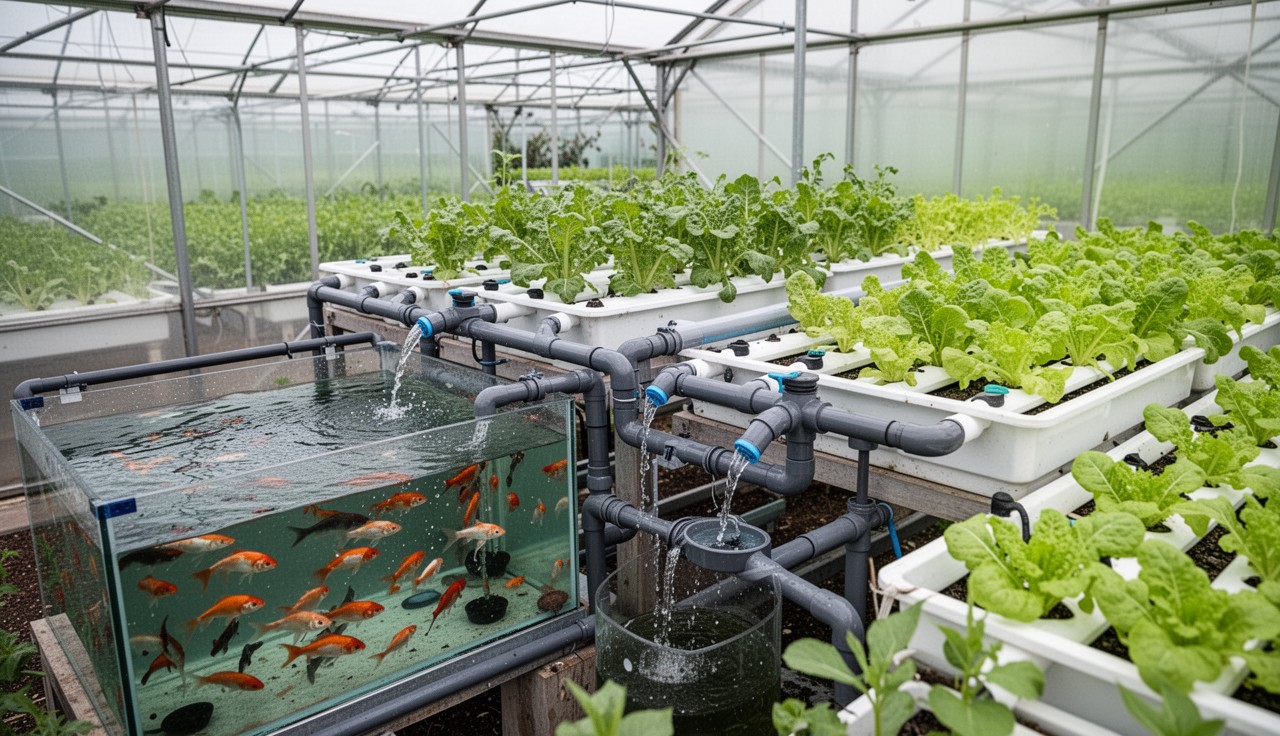
Hydroponics is the practice of growing plants in a nutrient solution without soil. Aquaponics is a specific form of hydroponics that replaces the mineral nutrient solution with water colonized by fish and the bacteria that process fish waste into plant-available nutrients. Both systems are worth understanding separately because they involve different chemistry, different management approaches, and different tradeoffs.
Part I: The Nitrogen Cycle
{ width=90% }
Why Nitrogen Governs Aquaponics
Every aquaponic system is a managed ecosystem built on a single biological process: the conversion of fish waste into plant-available nitrogen by bacteria. Fish excrete ammonia as their primary nitrogenous waste product. At concentrations above approximately 1 mg/L, ammonia is toxic to fish.
The nitrogen cycle has two distinct bacterial stages: 1. Nitrosomonas bacteria oxidize ammonia into nitrite 2. Nitrospira and Nitrobacter bacteria oxidize nitrite into nitrate
Nitrate is relatively benign to fish at concentrations below 100–200 mg/L and is the primary nitrogen source that plants absorb and convert into proteins, chlorophyll, and growth.
The Cycling Process
A new aquaponic system has no established bacterial colonies. Fishless cycling, using a pure ammonia source or fish food added to the water, allows bacterial colonies to build gradually without risking livestock. The cycle is complete when ammonia and nitrite readings consistently return to near zero within 24 hours of a feeding.
1. Fill the system with dechlorinated water; chlorine and chloramine kill the nitrifying bacteria you are trying to establish 2. Add ammonia source to bring ammonia to 2–4 ppm; maintain this level throughout the cycling period 3. Test ammonia and nitrite every 2–3 days; the first sign the cycle is working is a rise in nitrite 4. Nitrite will peak and then begin to fall as Nitrospira populations establish 5. The cycle is complete when both ammonia and nitrite return to near zero within 24 hours after an ammonia dose and nitrate is present and rising 6. Perform a 50% water change to bring nitrate below 40 ppm before adding fish
Water Chemistry Parameters
| Parameter | Optimal Range | Fish Tolerance | Plant Tolerance | Action if Out of Range | |---|---|---|---|---| | pH | 6.8–7.2 | 6.5–8.0 (most species) | 5.5–7.5 (most crops) | Lower with phosphoric acid; raise with potassium hydroxide or calcium carbonate | | Ammonia (NH3/NH4+) | < 1 ppm | < 1 ppm | Usable but nitrate preferred | Reduce feeding; increase biofiltration; partial water change | | Nitrite (NO2) | < 1 ppm | < 1 ppm | Negligible at low levels | Water change; add salt at 1g/L temporarily | | Nitrate (NO3) | < 150 ppm | < 200 ppm (most species) | Primary nitrogen source | Water change if above 100 ppm; increase plant density | | Dissolved oxygen | > 6 mg/L | > 5 mg/L | > 4 mg/L | Add aeration; lower water temperature; reduce fish density | | Temperature | 68–82°F | Species-dependent | Species-dependent | Heater or chiller; insulate system in cold climates | | Hardness (GH/KH) | 60–120 ppm | Moderate preferred | Needed for Ca and Mg | Supplement with calcium carbonate or magnesium sulfate |
| Parameter | Range / Tolerance |
|---|---|
| Water Temperature | 20–28°C (68–82°F) |
| System pH | 6.8–7.2 |
Part II: Aquaponic System Designs
{ width=90% }
Flood and Drain (Media Bed)
Media bed aquaponics is the most forgiving design for new growers and the most biologically diverse. Grow beds filled with expanded clay, gravel, or lava rock are alternately flooded with fish tank water and drained on a timed cycle. The media provides three distinct biological communities: nitrifying bacteria, heterotrophic bacteria and fungi that break down solid organic matter, and the plant root systems.
- Flood cycle: 15 minutes flooded, 45 minutes drained is a common starting point
- Media depth: Minimum 12 inches for most crops
- Media choice: Expanded clay (LECA) is the standard; avoid limestone media that buffers pH upward continuously
- Bell siphon: Creates a siphon that drains the bed fully once water reaches the trigger height, then resets automatically
- Ratio: 1 sq ft of grow bed per gallon of fish tank volume (conservative starting ratio)

Nutrient Film Technique (NFT)
A thin continuous film of nutrient solution flows through sloped channels, with plant roots lying in the channel base. The upper roots are exposed to air, providing the oxygen root systems require. NFT channels are cheap to fabricate from PVC pipe, making them popular for leafy greens and herbs.
Primary vulnerability: Power failure. Because there is no substrate holding water around roots, roots in an NFT system begin to dry within minutes of pump failure. A media bed system can coast for hours; an NFT system needs backup power to avoid crop loss.

Deep Water Culture (Raft)
Plant-filled foam boards float on the surface of a large reservoir of aerated nutrient solution. Roots hang directly into the water. The reservoir volume acts as a buffer against temperature swings, pH shifts, and nutrient fluctuations. The commercial standard for lettuce production at large scale.
- Aeration: Aggressive air pumping is essential; dissolved oxygen must stay above 6 mg/L at all times
- Reservoir temperature: 65–72°F optimal; warm water holds less oxygen and promotes root pathogens
- Best crops: Lettuce, spinach, kale, basil, watercress, mint
Dutch Bucket (Bato Bucket)
Individual plants in substrate-filled buckets with a continuous drip of nutrient solution from above and a shared drain line below. The commercial standard for large-fruiting crops: tomatoes, cucumbers, and peppers in greenhouse production worldwide are predominantly grown in Dutch buckets with coco coir or rockwool substrate.
Vertical Tower Systems
Nutrient solution pumped to the top flows down over root zones through staggered growing cups or a central wicking channel. Maximizes growing sites per square foot of floor area. Primary limitation: flow rates and nutrient concentration vary between top and bottom, requiring careful calibration.
| System Type | Best Crops | Management Complexity | Power Failure Risk | Aquaponic Compatible | |---|---|---|---|---| | Media bed (flood/drain) | Most vegetables, herbs, small fruiting crops | Low to moderate | Low (substrate holds water) | Yes; ideal for home aquaponics | | NFT channels | Leafy greens, herbs, strawberries | Moderate | High (roots dry quickly) | Yes with solids removal pre-channel | | Deep water culture (raft) | Lettuce, spinach, basil, watercress | Low to moderate | Moderate (reservoir buffers) | Yes; common in commercial aquaponics | | Dutch bucket | Tomatoes, cucumbers, peppers, eggplant | Moderate to high | Moderate | Yes with proper biofilter design | | Vertical towers | Leafy greens, herbs, strawberries | Moderate | Moderate | Yes with careful flow management | | Kratky (passive DWC) | Lettuce, herbs, microgreens | Very low (no pump) | None (no pump needed) | No; requires static nutrient solution |
Part III: Fish Selection for Aquaponics

Fish selection is constrained by three practical factors: temperature range, regulatory status, and the ratio of waste production to edible yield.
Tilapia
Dominant aquaponic fish species worldwide. Tolerates a wider range of water conditions than almost any other commonly farmed fish: pH 6.0–9.0, temperatures 60–95°F with optimal growth at 77–86°F.
Regulatory limitation: Classified as an invasive species in many U.S. states. Illegal to possess alive without a permit in Texas, Nevada, and Florida. Check local regulations before acquiring tilapia.
Channel Catfish
Excellent alternative to tilapia across much of the American South and Midwest. Tolerates temperatures from 55–95°F with optimal growth at 75–85°F. Legal to raise in most states. Ideal for Texas and southern systems. Their waste production per pound is somewhat lower than tilapia, meaning a slightly larger fish load is needed.
Trout
Rainbow trout require water temperatures between 55–65°F for optimal performance. Above 70°F their growth slows significantly; above 75°F they experience heat stress. In climates with cool well water or systems that can be chilled in summer, trout are an excellent choice with premium market value.
Ornamental Fish
Common goldfish and koi are practical, inexpensive, and legal everywhere. They produce adequate waste to fertilize a reasonable plant load and require no harvest if the operator prefers not to eat them.
| Fish Species | Optimal Temp | pH Tolerance | Feed Conversion | Legal Status | Notes | |---|---|---|---|---|---| | Nile / Blue Tilapia | 77–86°F | 6.0–9.0 | Excellent (1.5–2:1) | Restricted in TX and many states | Best all-around; always verify local laws before acquiring | | Channel catfish | 75–85°F | 6.5–8.5 | Good (2–2.5:1) | Legal in most U.S. states | Ideal for Texas and southern systems | | Rainbow trout | 55–65°F | 6.5–8.0 | Excellent (1.2–1.8:1) | Legal most states | Cold water only; premium eating quality | | Largemouth bass / bluegill | 65–80°F | 6.5–8.0 | Moderate (2.5–3:1) | May need sport fish permit | Native species; suitable for mixed systems | | Goldfish / Koi | 60–75°F | 6.5–8.5 | Poor for food | Legal everywhere | Ornamental and demonstration systems | | Yellow perch | 65–75°F | 6.5–8.0 | Good (1.8–2.5:1) | Check state regulations | Fast-growing; excellent flavor; popular in northern U.S. |
Part IV: Hydroponic Nutrient Management
The Essential Elements
Plants require 16 essential elements. Carbon, hydrogen, and oxygen come from air and water. The remaining 13 must be supplied in the nutrient solution.
| Nutrient | Primary Role | Deficiency Symptom | Excess Symptom | |---|---|---|---| | Nitrogen (N) | Protein, chlorophyll, cell growth | Yellowing from oldest leaves upward; slow growth | Dark green leaves; delayed flowering; disease-susceptible soft growth | | Phosphorus (P) | Energy transfer, root development, flowering | Purple tints on leaf undersides; poor root growth | Zinc and iron lockout | | Potassium (K) | Stomatal regulation, disease resistance, fruit quality | Leaf edge burn starting on older leaves | Interferes with calcium and magnesium uptake | | Calcium (Ca) | Cell wall structure, tip growth, stress tolerance | Tip burn on young leaves; blossom end rot | Can reduce magnesium uptake at very high levels | | Magnesium (Mg) | Chlorophyll production; enzyme activation | Interveinal yellowing on older leaves with veins staying green | Interferes with calcium at high ratios | | Iron (Fe) | Chlorophyll synthesis; enzyme function | Interveinal yellowing on young leaves; most common micro deficiency | Rare; chelated forms preferred | | Manganese, Zinc, Boron, Copper, Molybdenum | Enzyme activation; pollen viability; cell wall synthesis | Distorted young growth or poor flowering | Toxicity possible; common with unchelated formulas in alkaline solution |
Two-Part and Three-Part Nutrient Systems
Complete hydroponic nutrient formulas come in concentrated form, diluted to working strength in the reservoir.
- Part A typically contains calcium and nitrogen; Part B contains phosphorus, potassium, and magnesium
- Always add Part A to reservoir water before Part B. Adding them together as concentrates causes immediate precipitation
- Chelated micronutrients remain soluble across a wider pH range than unchelated forms
- Target EC by growth stage: Seedlings 0.8–1.2 mS/cm; vegetative 1.6–2.2; flowering and fruiting 2.2–3.5
pH Management in Hydroponics
pH is the single most critical parameter in hydroponic systems because it directly governs the solubility of every mineral ion in solution. At pH 7.5 and above, iron, manganese, zinc, and copper precipitate out of solution and become unavailable to roots even when present at adequate concentration. The optimal range is 5.5–6.5.
Test pH at every reservoir change and after any significant addition to the solution. Phosphoric acid is a common pH-down product; potassium hydroxide and potassium bicarbonate are common pH-up products.
EC and TDS Monitoring
Electrical conductivity measures the total dissolved ionic concentration in the nutrient solution. As plants consume nutrients, EC drops. As water evaporates, EC rises. Monitoring EC at least daily and topping up with fresh water or nutrient solution as needed keeps the plant's nutritional environment consistent.
Part V: Plant Selection for Both Systems
| Crop | System Best Suited To | Days to Harvest | Notes | |---|---|---|---| | Butterhead and loose-leaf lettuce | Raft DWC; NFT | 25–35 | Highest-value crop per square foot per day in both systems | | Basil | Raft DWC; NFT; media bed | 30–40 to first harvest | Harvest aggressively above node sets to delay bolting | | Spinach, arugula, kale | Raft DWC; NFT | 28–45 | Bolt-resistant varieties recommended for year-round production | | Watercress | Raft DWC; stream-fed media bed | 25–35 | Prefers cool water; excellent aquaponic crop | | Mint, cilantro, parsley | Media bed; NFT; DWC | 30–60 | Aggressive spreaders in media beds; contain in net pots in other systems | | Tomatoes (determinate) | Dutch bucket; media bed | 70–90 | Compact varieties outperform indeterminate types in all indoor water systems | | Cucumbers and peppers | Dutch bucket | 60–80 | Require high EC and careful nutrient management during fruit development | | Strawberries | NFT; vertical towers | 60 days from transplant to first fruit | Excellent long-season crop; runners propagate new plants | | Ginger and turmeric | Media bed aquaponics | 8–10 months | Warm water essential; media bed provides rhizome support and biological environment |
{ width=90% }

Part VI: Building a Home Aquaponic System
Minimum Viable System
A functional home aquaponic system requires five components: a fish tank, a grow bed, a pump, plumbing connecting them, and an aeration source. A 100-gallon stock tank or IBC tote as the fish tank, a media bed built from food-grade containers filled with expanded clay, a small submersible pump, PVC plumbing, and an air pump with airstones can be assembled for under $400 and will produce a meaningful and continuous food output once established.
- Fish tank: 50–300 gallons; dark or opaque to prevent algae growth; food-grade container
- Grow bed: Volume equal to 50–100% of fish tank volume; minimum 12-inch depth
- Media: Expanded clay or lava rock; rinse thoroughly before filling
- Pump: Sized to turn over the fish tank volume once per hour minimum
- Bell siphon or timed pump: Controls flood and drain cycle
Stocking and Feeding
Starting ratio: 1 pound of fish per 10 gallons during establishment; increase to 1 pound per 5 gallons once the system is fully cycled and stable.
Feed at 1–2% of fish body weight per day. Two to four small feedings daily produce more consistent ammonia levels and faster fish growth than one large daily feeding. Do not feed if fish appear stressed or if ammonia is elevated.
Common Problems and Solutions
| Problem | Likely Cause | Immediate Response | Long-Term Solution | |---|---|---|---| | Elevated ammonia > 1 ppm | Overfeeding; insufficient biofiltration; new system | Reduce feeding; 20–30% water change | Increase biofilter media volume; reduce fish density | | Elevated nitrite > 1 ppm | Nitrosomonas active but Nitrospira not yet established | Add aquarium salt at 1g/L; water change | Allow cycle to complete; do not add fish until nitrite falls | | pH below 6.5 | CO2 from fish respiration; acidic fish waste | Add potassium hydroxide or calcium carbonate in small amounts | Buffer with crushed coral in sump; increase aeration | | pH above 7.8 | Limestone media; hard water; low CO2 | Add phosphoric acid carefully in small increments | Switch to non-limestone media | | Yellow plant leaves (interveinal) | Iron deficiency common in high-pH systems | Lower pH to 6.8–7.0 to restore iron solubility | Supplement with chelated iron (Fe-EDTA) at 2–3 ppm | | Fish gasping at surface | Low dissolved oxygen | Immediate aeration increase; reduce feeding | Add more airstones; reduce fish density; lower water temperature | | Root rot in grow bed | Anaerobic conditions; insufficient drain cycle | Increase drain frequency; check bell siphon function | Improve system aeration; reduce flood duration |

Part VII: Scaling Up
A well-managed NFT lettuce system in a 1,000-square-foot greenhouse can produce 2,000–3,000 heads of lettuce per month on a continuous harvest schedule. The same footprint in raised beds might produce 200 heads per month. This density advantage is the economic foundation of commercial hydroponic and aquaponic production.
- Regulatory: USDA Good Agricultural Practices certification is typically required for wholesale accounts
- Market channels: Farmers markets, restaurant direct sales, CSA subscriptions, and grocery store direct accounts
- Crops for commercial scale: Lettuce, salad mix, basil, and microgreens, established wholesale prices, consistent demand, short cycles
- Aquaponic premium: Certified organic aquaponic produce commands a meaningful price premium at farmers markets and direct-to-restaurant channels
Scientific and Technical References
Aquaponics System Design and Nitrogen Cycle
- Rakocy, J.E., Masser, M.P., and Losordo, T.M. (2006). Recirculating aquaculture tank production systems: Aquaponics, integrating fish and plant culture. SRAC Publication No. 454. Southern Regional Aquaculture Center.
- Somerville, C., Cohen, M., Pantanella, E., Stankus, A., and Lovatelli, A. (2014). Small-Scale Aquaponic Food Production: Integrated Fish and Plant Farming. FAO Fisheries and Aquaculture Technical Paper 589. Rome: FAO.
- Timmons, M.B. and Ebeling, J.M. (2010). Recirculating Aquaculture (2nd ed.). Ithaca Publishing Company. ISBN 978-0971264601.
- Nelson, R.L. and Pade, J.S. (2008). Aquaponic Food Production. Nelson and Pade, Inc.
Hydroponic Systems and NFT
- Raviv, M. and Lieth, J.H. (Eds.) (2008). Soilless Culture: Theory and Practice. Elsevier. ISBN 978-0444521323.
- Hochmuth, G. and Hochmuth, R. (2012). Production of Hydroponic Vegetables in Florida. University of Florida IFAS Extension Circular HS 1252.
- Brechner, M. and Both, A.J. (1996). Hydroponic Lettuce Handbook. Cornell University Controlled Environment Agriculture Program.
- Lennard, W.A. and Leonard, B.V. (2006). A comparison of three different hydroponic sub-systems (gravel bed, floating and nutrient film technique) in an aquaponic test system. Aquaculture International, 14(6), 539–550. doi:10.1007/s10499-006-9053-2
Dissolved Oxygen and Fish Physiology
- [Dissolved oxygen >6 mg/L required for fish and nitrification bacteria in RAS] → [CITATION NEEDED: dissolved oxygen thresholds recirculating aquaculture, search terms: "minimum dissolved oxygen tilapia recirculating aquaculture system nitrification bacteria"]
*"Fish feed the plants. Plants clean the water. Nothing is wasted."*
Tags
- topic: aquaponics, hydroponics, nitrogen-cycle, water-systems, fish-production, soilless-growing
- type: growing-guide, educational
- audience: home-growers, market-gardeners, commercial-growers
- plant-species: general; ginger, turmeric (aquaponic notes)
- zone: all-zones (indoor/controlled environment)
Research on aquaponics hydroponics
Peer reviewed studies about aquaponics hydroponics, listed so you can read the original rather than take our word for it. They are background on the subject, not a source for any one sentence above.
- Environmental and Cultivation Effects on Growth and Phytochemical Profiles of Chicory (Cichorium intybus L.) in Soil, Hydroponics, and Aquaponics. (2026). doi:10.3390/plants15060974
- Nutrient film technique systems for coriander production: A comparison of aquaponics and hydroponics in UAE. (2026). doi:10.1371/journal.pone.0340364
Common questions
What is the active compound in aquaponics hydroponics?
Pure Euphoria Botanicals • Nored Farms • Austin, Texas . .
What is part i: the nitrogen cycle?
{ width=90% }. Why Nitrogen Governs Aquaponics. Every aquaponic system is a managed ecosystem built on a single biological process: the conversion of fish waste into plant-available nitrogen by bacteria. Fish excrete ammonia as their primary nitrogenous waste product. At concentrations above approximately 1 mg/L, ammonia is toxic to fish.
What are part ii: aquaponic system designs?
{ width=90% }. Flood and Drain (Media Bed). Media bed aquaponics is the most forgiving design for new growers and the most biologically diverse. Grow beds filled with expanded clay, gravel, or lava rock are alternately flooded with fish tank water and drained on a timed cycle. The media provides three distinct biological communities: nitrifying bacteria, heterotrophic bacteria and fungi that break down solid organic matter, and the plant root systems.
What are part iii: fish selection for aquaponics?
. Fish selection is constrained by three practical factors: temperature range, regulatory status, and the ratio of waste production to edible yield. Dominant aquaponic fish species worldwide. Tolerates a wider range of water conditions than almost any other commonly farmed fish: pH 6.0–9.0, temperatures 60–95°F with optimal growth at 77–86°F. Regulatory limitation: Classified as an invasive species in many U.S.
What is part iv: hydroponic nutrient management?
Plants require 16 essential elements. Carbon, hydrogen, and oxygen come from air and water. The remaining 13 must be supplied in the nutrient solution.
What is part vii: scaling up?
A well-managed NFT lettuce system in a 1,000-square-foot greenhouse can produce 2,000–3,000 heads of lettuce per month on a continuous harvest schedule. The same footprint in raised beds might produce 200 heads per month. This density advantage is the economic foundation of commercial hydroponic and aquaponic production. Regulatory: USDA Good Agricultural Practices certification is typically required for wholesale accounts. Market channels: Farmers markets, restaurant direct sales, CSA subscriptions, and grocery store direct accounts.