Growing
Ashwagandha (Withania somnifera): A Full Guide to Cultivation, Traditional Use, and Adaptogenic Research
Complete guide to ashwagandha cultivation covering Withania somnifera botany, climate adaptation, soil requirements, root harvesting.
On this page
Botanical Description and Classification
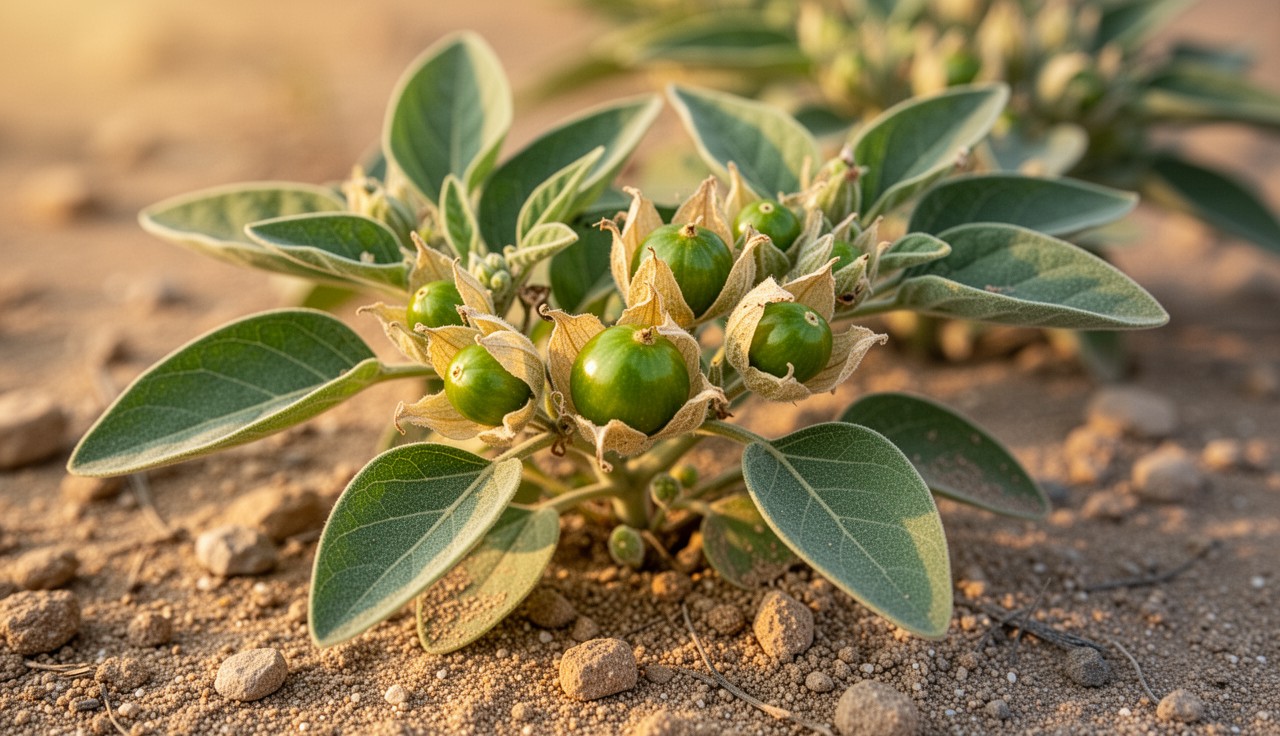
Ashwagandha (Withania somnifera) is a short-lived perennial shrub in the Solanaceae (nightshade) family, native to the dry regions of India, the Middle East, and parts of North Africa. The plant typically reaches 30–75 cm in height, producing oval, velvety leaves on woody stems and small, greenish-yellow flowers enclosed in a papery calyx that matures into a bright orange-red berry resembling a small cherry tomato.
The root system is the primary organ of interest, consisting of a stout central taproot with lateral branching. Fresh roots are whitish with a distinctive horsey smell, the Sanskrit name ashwagandha translates roughly to “smell of the horse,” referring both to this aroma and the traditional belief that the herb imparts the vitality and strength of a horse.
Nightshade Family Context
As a member of Solanaceae, ashwagandha shares taxonomic kinship with tomatoes, peppers, and eggplants. However, unlike its edible relatives, the berries and leaves of ashwagandha are not commonly consumed as food. The root is the primary part used in traditional preparations, though the leaves also contain bioactive withanolides and are used in some regional practices.
Origin, History, and Traditional Use
Ashwagandha has been a cornerstone of Ayurvedic medicine for over 3,000 years, classified as a rasayana, a rejuvenating tonic intended to promote longevity, vitality, and overall resilience. Traditional texts describe it as a remedy for debility, nervous exhaustion, insomnia, and wasting conditions, often prescribed as a milk decoction or churna (powder).
In Unani medicine, it is known as asgand and is valued for similar restorative properties. Indigenous traditions in parts of Africa also employ related Withania species for sleep support and pain management. The plant reached Western botanical awareness by the 18th century but gained significant global attention only in the late 20th century with the emergence of “adaptogen” research.
The concept of adaptogens, substances that help the body resist physical, chemical, and biological stressors, was formalized by Soviet scientists in the 1960s, and ashwagandha was among the first non-Soviet herbs to be studied under this framework, alongside rhodiola and eleuthero.
Climate Adaptation and Growing Zones
Ashwagandha is fundamentally a warm-season, drought-adapted plant. It performs best under conditions that would stress most temperate garden herbs: hot days, cool nights, low humidity, and fast-draining soil. This makes it surprisingly well-suited to parts of the American Southwest, Texas Hill Country, and other semi-arid regions.
| Parameter | Range / Tolerance |
|---|---|
| USDA Hardiness Zones | 8–12 (perennial); grown as annual in zones 5–7 |
| Light Preference | Full sun (6–8 hours minimum) |
| Moisture | Low to moderate; highly drought-tolerant once established |
| Frost Tolerance | Low, dies back at first hard frost; roots survive to ~20°F in mulched beds |
| Heat Tolerance | Excellent; thrives in sustained 90–110°F conditions |
| Humidity Tolerance | Low; susceptible to fungal issues in high-humidity environments |
Growing in Humid Climates
Growers in the Southeast or Gulf Coast regions can still cultivate ashwagandha by using raised beds with excellent drainage, spacing plants widely for air circulation, and avoiding overhead watering. Fungal leaf spot and root rot are the primary risks in humid conditions. Treating as an annual and harvesting before fall rains is a practical strategy.
Soil, Propagation, and Cultivation
Ashwagandha demands well-drained, sandy or loamy soil with a slightly alkaline to neutral pH (6.5–8.0). Heavy clay soils must be amended heavily with sand and organic matter, or the plant should be grown in raised beds. Waterlogged roots will rot within days.
| Factor | Details |
|---|---|
| Preferred Soil | Sandy loam with good drainage; pH 6.5–8.0 |
| Propagation | Seed (primary); germination 10–14 days at 70–75°F |
| Seed Treatment | No scarification needed; direct sow after last frost or start indoors 6–8 weeks prior |
| Spacing | 18–24 inches apart; plants will bush out substantially |
| Fertilization | Minimal; excess nitrogen produces foliage at the expense of root compounds |
| Growth Habit | Bushy sub-shrub; reaches 2–3 feet tall in a single season |
An important cultivation note: ashwagandha is a photoperiod-sensitive plant. It flowers and sets fruit as days shorten in late summer and fall. In tropical regions with consistent day length, flowering may be less predictable. For root production, flowering is actually undesirable, as the plant redirects energy from root development to seed production once reproductive growth begins.
Harvesting and Processing
Root harvest timing significantly affects the concentration of bioactive withanolides. The optimal window varies by climate and cultivation method.
Root Harvest
Roots are typically harvested 150–180 days after transplanting, or when the plant begins to flower and the lower leaves start yellowing. In tropical regions, a full growing season may extend to 8–9 months. The entire root system is dug, washed free of soil, and cut into pieces for drying.
Drying and Processing
Traditional Indian processing involves shade-drying root pieces for 7–10 days, then further reducing moisture in well-ventilated areas. The dried roots should snap cleanly when bent (target moisture: 10–12%). Industrial processes may use controlled-temperature dehydration at 40–50°C. The dried root is then ground into the familiar yellowish-brown churna powder.
Leaf Harvest
Leaves can be harvested throughout the growing season for extraction purposes. Some commercial products now use standardized leaf extracts (such as the proprietary Sensoril formulation), which contain different ratios of withanolides compared to root-only preparations.
Root Quality Indicator
High-quality ashwagandha root has a strong, characteristic smell and a starchy, slightly bitter taste. Roots that are fibrous, woody, or lack the distinctive aroma may have been harvested too late or from poor-quality genetics. The best root comes from first-year plants grown in lean, well-drained soil under moderate water stress.
Phytochemical Profile and Key Compounds
Ashwagandha’s bioactivity is primarily attributed to a class of steroidal lactones called withanolides, with over 40 individual withanolides identified in the plant.
| Compound Class | Key Members and Notes |
|---|---|
| Withanolides | Withaferin A, withanolide D, withanoside IV/V; steroidal lactone structure |
| Alkaloids | Isopelletierine, anaferine, cuscohygrine, anahygrine |
| Sitoindosides | Sitoindosides VII, X; glycowithanolides with immunomodulatory research interest |
| Iron & Minerals | Notable iron content in roots; also calcium, zinc, and copper |
| Other | Saponins, steroidal compounds, condensed tannins |
Withanolide content varies dramatically depending on the plant part (root vs. leaf), genotype, growing conditions, and harvest timing. Commercial extracts are typically standardized to 2.5–10% withanolides, with full-spectrum root extracts (like KSM-66) targeting a 5% withanolide concentration through water-based extraction processes.
Traditional and Functional Uses
The scope of ashwagandha’s traditional applications is unusually broad, reflecting its status as a premier rasayana herb in Ayurvedic classification.
- Stress and resilience: The primary modern use, ashwagandha is classified as an adaptogen, taken to modulate the hypothalamic-pituitary-adrenal (HPA) axis and support healthy cortisol regulation under chronic stress conditions.
- Sleep support: The species name somnifera means “sleep-inducing.” Traditional use includes preparations for insomnia and restless sleep, typically taken as a warm milk decoction before bed.
- Cognitive function: Traditional texts describe ashwagandha as a medhya rasayana, a mind-rejuvenating herb, used to enhance memory, learning, and mental clarity.
- Physical performance: Used traditionally by wrestlers, laborers, and convalescents to rebuild strength and endurance.
- Reproductive health: Ayurvedic texts recommend ashwagandha for both male and female reproductive vitality, though applications differ significantly by gender and formulation.
Current Clinical Research
Research Context
Ashwagandha is one of the most clinically studied adaptogenic herbs, with multiple randomized, double-blind, placebo-controlled trials published. However, many studies use proprietary standardized extracts, have moderate sample sizes, and are of varying methodological quality. Results should be interpreted with appropriate scientific caution.
Unlike many traditional herbs where evidence remains predominantly preclinical, ashwagandha has accumulated a meaningful body of human clinical trial data across several domains:
- Stress and cortisol: Multiple RCTs demonstrate statistically significant reductions in perceived stress scores and serum cortisol levels in chronically stressed adults, with effect sizes ranging from moderate to large depending on the extract used and study population.
- Sleep quality: Clinical trials report improvements in sleep onset latency and overall sleep quality, particularly in individuals with insomnia. The triethylene glycol component is hypothesized to contribute to these effects.
- Muscle strength and recovery: Studies in resistance-trained adults show improvements in VO2 max, strength output, and recovery markers, suggesting ergogenic potential beyond traditional use.
- Cognitive performance: Preliminary RCTs show modest improvements in reaction time, task performance, and attention in healthy adults and those with mild cognitive impairment.
- Thyroid modulation: Some evidence suggests ashwagandha may support thyroid hormone production, particularly in subclinical hypothyroidism. This is a clinically significant finding that warrants medical supervision.
Health Precautions and Contraindications
Despite its long history of traditional use, ashwagandha is not appropriate for everyone, and several important cautions apply.
- Thyroid conditions: Ashwagandha may increase thyroid hormone levels. Individuals with hyperthyroidism or those on thyroid medication should use with medical supervision only.
- Autoimmune conditions: Due to immunomodulatory properties, caution is advised for those with autoimmune disorders such as lupus, rheumatoid arthritis, or multiple sclerosis.
- Pregnancy and lactation: Traditionally contraindicated during pregnancy. Some withanolides have shown abortifacient properties in animal studies.
- Sedative interactions: May potentiate the effects of sedatives, anxiolytics, and alcohol due to GABAergic activity.
- Gastrointestinal effects: High doses can cause stomach upset, diarrhea, or nausea in sensitive individuals. Starting with low doses and taking with food is standard practice.
Liver Safety Note
Rare cases of liver injury associated with ashwagandha supplementation have been reported in pharmacovigilance databases. While the overall incidence appears very low, individuals with pre-existing liver conditions should consult a healthcare provider before use and monitor liver function if taking ashwagandha long-term.
Ecological Role and Companion Planting
In its native habitat, ashwagandha grows as a scrubland pioneer plant in semi-arid regions, colonizing degraded and overgrazed land. Its deep root system helps stabilize loose, sandy soils and adds organic matter when plants die back seasonally.
- Drought-land restoration: Ashwagandha can be incorporated into dryland permaculture systems as a soil-stabilizing understory plant beneath taller leguminous trees.
- Companion planting: Grows well alongside other drought-tolerant herbs like holy basil, lemongrass, and vetiver. Avoid planting near moisture-loving species.
- Pollinator value: Flowers attract small bees and beneficial insects, though ashwagandha is not considered a major pollinator resource.
Scientific and Authoritative References
This article is informed by data and conclusions drawn from, but not limited to:
- Chandrasekhar et al., Indian Journal of Psychological Medicine (2012), RCT on stress and cortisol reduction
- Wankhede et al., Journal of the International Society of Sports Nutrition (2015), muscle strength and recovery
- Langade et al., Cureus (2019), sleep quality RCT
- Sharma et al., Journal of Alternative and Complementary Medicine, thyroid function study
- Panossian & Wikman, Pharmaceuticals (2010), adaptogen classification review
- Mirjalili et al., Pharmacognosy Reviews, withanolide chemistry and biosynthesis
- PFAF and USDA plant databases for cultivation parameters
- Ayurvedic Pharmacopoeia of India, Vol. I, traditional monograph
Common questions
What has ashwagandha traditionally been used for?
Ashwagandha has been a cornerstone of Ayurvedic medicine for over 3,000 years, classified as a rasayana , a rejuvenating tonic intended to promote longevity, vitality, and overall resilience. Traditional texts describe it as a remedy for debility, nervous exhaustion, insomnia, and wasting conditions, often prescribed as a milk decoction or churna (powder). In Unani medicine, it is known as asgand and is valued for similar restorative properties. Indigenous traditions in parts of Africa also employ related Withania species for sleep support and pain management.
What climate does ashwagandha tolerate?
Ashwagandha is fundamentally a warm-season, drought-adapted plant. It performs best under conditions that would stress most temperate garden herbs: hot days, cool nights, low humidity, and fast-draining soil. This makes it surprisingly well-suited to parts of the American Southwest, Texas Hill Country, and other semi-arid regions. USDA Hardiness Zones: 8–12 (perennial); grown as annual in zones 5–7. Light Preference: Full sun (6–8 hours minimum).
What soil does ashwagandha need?
Ashwagandha demands well-drained, sandy or loamy soil with a slightly alkaline to neutral pH (6.5–8.0). Heavy clay soils must be amended heavily with sand and organic matter, or the plant should be grown in raised beds. Waterlogged roots will rot within days. Preferred Soil: Sandy loam with good drainage; pH 6.5–8.0. Propagation: Seed (primary); germination 10–14 days at 70–75°F.
What can I make from ashwagandha?
Root harvest timing significantly affects the concentration of bioactive withanolides. The optimal window varies by climate and cultivation method. Roots are typically harvested 150–180 days after transplanting, or when the plant begins to flower and the lower leaves start yellowing. In tropical regions, a full growing season may extend to 8–9 months. The entire root system is dug, washed free of soil, and cut into pieces for drying.
What is the active compound in ashwagandha?
Ashwagandha’s bioactivity is primarily attributed to a class of steroidal lactones called withanolides, with over 40 individual withanolides identified in the plant. Withanolides: Withaferin A, withanolide D, withanoside IV/V; steroidal lactone structure. Alkaloids: Isopelletierine, anaferine, cuscohygrine, anahygrine. Sitoindosides: Sitoindosides VII, X; glycowithanolides with immunomodulatory research interest. Iron & Minerals: Notable iron content in roots; also calcium, zinc, and copper.
What is current clinical research?
Ashwagandha is one of the most clinically studied adaptogenic herbs, with multiple randomized, double-blind, placebo-controlled trials published. However, many studies use proprietary standardized extracts, have moderate sample sizes, and are of varying methodological quality. Results should be interpreted with appropriate scientific caution. Unlike many traditional herbs where evidence remains predominantly preclinical, ashwagandha has accumulated a meaningful body of human clinical trial data across several domains:.
Is ashwagandha safe?
Despite its long history of traditional use, ashwagandha is not appropriate for everyone, and several important cautions apply. Thyroid conditions: Ashwagandha may increase thyroid hormone levels. Individuals with hyperthyroidism or those on thyroid medication should use with medical supervision only. Autoimmune conditions: Due to immunomodulatory properties, caution is advised for those with autoimmune disorders such as lupus, rheumatoid arthritis, or multiple sclerosis. Pregnancy and lactation: Traditionally contraindicated during pregnancy.
How do I grow ashwagandha?
In its native habitat, ashwagandha grows as a scrubland pioneer plant in semi-arid regions, colonizing degraded and overgrazed land. Its deep root system helps stabilize loose, sandy soils and adds organic matter when plants die back seasonally. Drought-land restoration: Ashwagandha can be incorporated into dryland permaculture systems as a soil-stabilizing understory plant beneath taller leguminous trees. Companion planting: Grows well alongside other drought-tolerant herbs like holy basil, lemongrass, and vetiver. Avoid planting near moisture-loving species.