plants
Automotive Electrical Systems: Practical Diagnostics and Repair
Automotive Electrical Systems: Practical Diagnostics and Repair - comprehensive guide from Nored Farms.
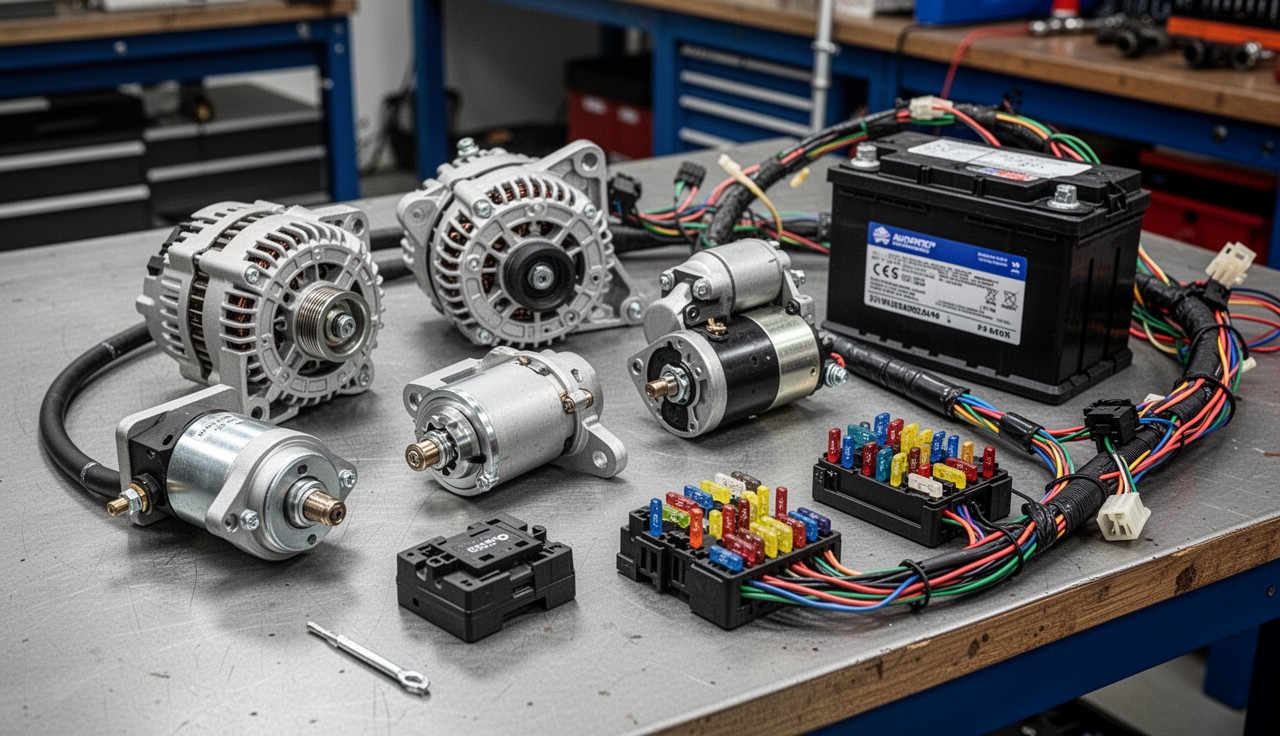
**Content Extraction Summary:** Complete guide to automotive electrical systems covering 12V fundamentals, Ohm's law applied to vehicles, voltage drop testing (the single most valuable diagnostic technique), battery and charging system diagnostics, starting and ignition systems, lighting upgrades, wiring repair, systematic troubleshooting, and common installation projects including auxiliary lighting, dual batteries, winches, and trailer brake controllers. Written for anyone who wants to stop guessing and start measuring.
1. Introduction
Most people think engines are what break. They're wrong. Electrical problems account for more shop visits than mechanical failures. A 2019 NAPA Auto Parts survey found electrical issues were the number one reason vehicles were towed to repair shops, ahead of engine and transmission problems combined. The average diagnostic fee runs $100-$150 before a single part is replaced.
Here's what the shop doesn't tell you: 90% of automotive electrical problems come down to three things — bad connections, failed grounds, and components drawing power when they shouldn't. You don't need a $5,000 scan tool to find them. A $30 multimeter and an understanding of how circuits work will solve most electrical problems faster than a parts-cannon approach ever will.
The parts cannon — replacing components until the problem stops — is the most expensive way to fix a car. A alternator costs $200-$400. A starter runs $150-$350. If the real problem was a $2 corroded ground wire, you just wasted hundreds of dollars and the problem will come back.
This guide teaches you to test, not guess. Every diagnostic method here uses tools available at any auto parts store. The single most important technique you'll learn is voltage drop testing — a method that finds bad connections the way nothing else can.
2. Fundamentals
The 12-Volt Negative Ground System
Every modern vehicle runs on a 12-volt negative ground system. The battery's negative terminal connects to the vehicle's frame and engine block. This makes the entire metal structure of the vehicle one big wire — the return path for every circuit.
This matters because a bad ground connection can cause bizarre symptoms that seem completely unrelated to the actual problem. Dim headlights that get brighter when you turn on the turn signal. A horn that honks when you hit the brakes. These aren't electrical gremlins. They're current finding alternative paths through shared ground connections.
**The actual battery voltage is 12.6V when fully charged.** Not 12V. That 0.6V matters. Each of the six cells in a lead-acid battery produces 2.1V. A battery reading 12.0V is roughly 50% discharged. At 11.9V, it's dead for starting purposes.
| State of Charge | Resting Voltage | |---|---| | 100% | 12.6V or higher | | 75% | 12.4V | | 50% | 12.2V | | 25% | 12.0V | | Dead | 11.9V or lower |
Circuits: Series, Parallel, and Series-Parallel
**Series circuits** connect components end-to-end. Current flows through each component in sequence. If one fails, the entire circuit stops. Christmas lights on a single string are series circuits — one bulb burns out, they all go dark. In vehicles, switches are wired in series with loads. The switch must pass all the current the load needs.
**Parallel circuits** connect components side-by-side across the same power source. Each component gets full voltage. If one fails, the others keep working. Most vehicle circuits are parallel — your headlights, radio, and wipers all operate independently because they each connect directly between battery positive and ground.
**Series-parallel circuits** combine both. A common example: two fog lights wired in parallel with each other, but in series with a single switch and fuse. The switch controls both lights, but each light operates independently of the other.
Ohm's Law Applied to Automotive
Three values define every electrical circuit:
- **Voltage (V)** — electrical pressure. Measured in volts.
- **Current (I)** — electrical flow. Measured in amps.
- **Resistance (R)** — opposition to flow. Measured in ohms.
The relationship: **V = I × R**
Rearranged: **I = V / R** and **R = V / I**
**Practical application:** A headlight bulb draws 5 amps at 12 volts. Its resistance is 12 / 5 = 2.4 ohms. If corrosion adds 1 ohm of resistance to the circuit, current drops to 12 / 3.4 = 3.5 amps. The headlight dims noticeably. That's a 30% reduction in current from a connection problem you can't see by looking at the wire.
**Watt's Law** ties it together: **P = V × I** (Power = Voltage × Current). That same headlight: 12V × 5A = 60 watts. With corrosion: 12V × 3.5A = 42 watts. The missing 18 watts converts to heat at the corroded connection — which is why melted connectors are a symptom, not a cause.
Voltage Drop Testing — The Most Valuable Diagnostic Technique
Voltage drop testing is the single most useful diagnostic skill in automotive electrical work. It finds problems that resistance testing and visual inspection cannot.
**Why it matters:** A wire or connection can measure 0 ohms with an ohmmeter and still cause problems. An ohmmeter sends milliamps through a circuit. A starter draws 200+ amps. A connection that looks fine at low current can't handle high current. Voltage drop testing measures resistance *under load* — with the circuit operating and current flowing.
**The method:** 1. Set your multimeter to DC volts (the lowest range that includes 1V) 2. Turn on the circuit being tested (lights on, starter cranking, etc.) 3. Place one lead at the power source end of the wire/connection 4. Place the other lead at the load end 5. Read the voltage
**What you're measuring:** The voltage consumed by the wire or connection itself. In a perfect conductor, this would be zero. In reality, every connection has some resistance and therefore some voltage drop.
**The spec:** Maximum allowable voltage drop:
- Wire or cable: 0.1V
- Connection or switch: 0.2V
- Ground circuit (total): 0.3V
- Entire circuit from battery to load: 0.5V
**If the voltage drop exceeds these values, you've found your problem.** Clean the connection, repair the wire, or replace the component. This technique finds corroded connections, crimps that look good but aren't making full contact, and ground straps that have oxidized internally.
A corroded battery cable terminal can show 0.0 ohms on a resistance test but drop 2V under starter load. That 2V is the difference between an engine that cranks strong and one that barely turns over.
3. Battery
CCA vs. Reserve Capacity
**Cold Cranking Amps (CCA)** — the number of amps a battery can deliver at 0°F (-18°C) for 30 seconds while maintaining at least 7.2V. This is the starting power rating. A battery with 600 CCA can deliver 600 amps under those conditions. Higher CCA means more starting power in cold weather.
**Reserve Capacity (RC)** — how many minutes a fully charged battery can deliver 25 amps at 80°F before dropping below 10.5V. This is the "how long can I run accessories with a dead alternator" rating. A battery with 120 minutes of reserve capacity gives you two hours of basic electrical operation.
**Which matters more depends on climate.** In Texas summers, reserve capacity matters more — heat kills batteries faster than cold, and a higher RC battery survives longer. In Minnesota, CCA is king.
**Battery group size** must match the vehicle. The group number (24, 35, 78, etc.) specifies physical dimensions and terminal position. Wrong group size means it won't fit the tray or the cables won't reach.
Load Testing
A battery can show 12.6V and still fail under load. Load testing reveals the truth.
**Carbon pile load test:** 1. Charge the battery fully (12.6V or higher, surface charge removed) 2. Apply a load equal to half the CCA rating 3. Maintain the load for 15 seconds 4. Read the voltage at 15 seconds
**Pass/fail:** Voltage must remain above 9.6V at 70°F. Subtract 0.1V for every 10°F below 70°F. A battery that drops below this threshold under load has a dead cell or sulfated plates. Replace it — no amount of charging will fix internal damage.
Parasitic Draw Testing — The Number One Cause of Dead Batteries
Parasitic draw is current flowing from the battery when everything is turned off. Every vehicle has some — the clock, alarm system, and computer memory need constant power. Normal parasitic draw is 25-50 milliamps (0.025-0.050A). Anything above 50mA will kill a battery over a few days.
**The test:** 1. Turn everything off. Close all doors. Wait 30-45 minutes for modules to go to sleep (this step is critical — many computers stay awake for up to 40 minutes after the key is removed) 2. Disconnect the negative battery cable 3. Set your multimeter to the 10A DC scale 4. Connect the meter in series between the negative cable and battery post 5. Read the current draw 6. If above 50mA, start pulling fuses one at a time until the draw drops
**When the draw drops, you've found the circuit.** The fuse label tells you which circuit. From there, trace the circuit to find the specific component staying awake.
Common culprits: aftermarket stereos with always-on memory wires connected to the wrong circuit, trunk or glove box lights that don't turn off, stuck relays, and failing body control modules.
**Important:** Never open a door or turn on any switch during this test. It wakes up modules and resets the draw.
Battery Cables and Connections
The battery cable is the most stressed electrical connection on the vehicle. It carries 200+ amps during cranking. Any resistance here wastes significant power.
**Signs of bad cables:** Slow cranking that improves when you wiggle the cable. Cables that feel hot after starting. Green or white corrosion at terminals.
**The fix:** Clean terminals with a battery terminal brush (wire brush specifically shaped for battery posts and clamps). For side-post batteries, use a wire brush that fits the bolt hole. Apply a thin coat of dielectric grease after cleaning to prevent future corrosion.
**Do not use felt washers treated with "anti-corrosion compound" as a substitute for clean connections.** They add resistance. Clean metal-to-metal contact is what matters.
If the cable itself is corroded internally (the insulation looks fine but the cable feels stiff instead of flexible), replace the entire cable. Internal corrosion creates resistance you can't clean.
4. Charging System
Alternator Operation
The alternator converts mechanical energy into electrical energy. A belt drives the rotor (an electromagnet) inside the stator (a set of three wire coils). The spinning magnetic field induces AC voltage in the stator coils.
**Three key components inside:**
**Field current** — controlled DC current fed to the rotor through brushes and slip rings. The voltage regulator adjusts field current to control alternator output. More field current = stronger magnetic field = more output voltage. The regulator targets 13.8-14.4V regardless of engine speed or electrical load.
**Rectifier (diode bridge)** — six diodes that convert three-phase AC to DC. Each phase has two diodes — one for the positive half of the wave, one for the negative. This produces relatively smooth DC power. A shorted diode causes AC ripple in the DC output, which can damage sensitive electronics and cause batteries to overcharge.
**Voltage regulator** — senses system voltage and adjusts field current to maintain 13.8-14.4V. On older vehicles, this is an external box bolted to the fender well or firewall. On modern vehicles, it's built into the alternator. Some late-model vehicles have the PCM (computer) controlling charging voltage directly.
Charging Voltage Specification
**With the engine running at 1,500+ RPM and no heavy loads, charging voltage should read 13.8-14.4V at the battery terminals.**
- Below 13.8V: undercharging. Battery will slowly discharge. Check belt tension, field circuit, and regulator.
- Above 14.4V: overcharging. Battery will boil electrolyte, shorten its life, and may bulge or crack. Usually a failed regulator.
- 12.6V or lower with engine running: alternator is not charging at all. Check belt, fuse, field wire, and alternator.
Ripple Testing for Bad Diodes
A healthy alternator produces smooth DC. A diode failure allows AC to leak into the DC output. This AC ripple can be measured.
**The test:** 1. Set your multimeter to AC volts 2. Connect across the battery with the engine running at 1,500 RPM 3. Read the AC voltage
**Specification:** AC ripple should be below 0.5V AC. Above 0.5V indicates one or more diodes have failed. The alternator will still charge, but output is reduced and the ripple can cause radio noise, erratic gauge readings, and premature battery failure.
**Three failed diodes (one phase dead) drops output by one-third.** The vehicle may still run fine during the day but die at night when headlights are on because the reduced output can't keep up with the load.
Belt Tension
A slipping belt can't transfer full power to the alternator. Symptoms mimic a failing alternator — low charging voltage, especially under heavy electrical load.
**Check:** Press the belt midway between pulleys with your thumb. Deflection should be about 1/2 inch per foot of span. A belt that squeals on startup or under heavy steering loads is slipping.
Modern serpentine belts use automatic tensioners. If the tensioner spring is weak, it can't maintain proper tension. Check the tensioner by watching it — it should hold steady, not bounce or oscillate. A bouncing tensioner is failing.
5. Starting System
Starter Motor Operation
The starter motor is a high-torque DC motor designed to spin the engine's flywheel fast enough to start combustion. It draws 150-300 amps in a typical passenger vehicle, and up to 500+ amps in diesel trucks.
**Components:**
- **Armature** — the rotating part, wound with heavy copper wire
- **Field coils** — stationary electromagnets that create the magnetic field the armature spins in
- **Commutator and brushes** — transfer current to the spinning armature
- **Drive gear (Bendix)** — a small gear that extends to engage the flywheel ring gear during cranking and retracts afterward
Solenoid
The starter solenoid does two things simultaneously: it pushes the drive gear into the flywheel, and it closes a heavy-duty internal switch that connects battery power to the starter motor.
**The ignition switch does not carry starter current.** It sends a small signal current (5-10 amps) to the solenoid. The solenoid then switches the 200+ amp circuit. This is a relay arrangement — a small current controls a large current.
A clicking sound when you turn the key — the solenoid is trying to engage but can't pull in fully. Usually a dead battery or bad connection, not a bad solenoid. If the battery tests good and connections are clean, then suspect the solenoid.
Voltage Drop Testing the Starter Circuit
This is where voltage drop testing proves its value. The starter circuit carries the highest current in the vehicle, making it the most sensitive to connection problems.
**Test the positive side:** 1. Set meter to DC volts 2. Crank the engine (have a helper or disable ignition so it doesn't start) 3. Connect positive lead to battery positive post (the post, not the clamp) 4. Connect negative lead to the starter motor battery terminal 5. Read voltage while cranking
**Specification:** 0.5V maximum for the entire positive cable run. Higher means resistance in the cable, connections, or solenoid contacts.
**Test the negative side:** 1. Connect positive lead to starter motor housing (bare metal) 2. Connect negative lead to battery negative post 3. Read voltage while cranking
**Specification:** 0.3V maximum. Higher means a bad ground cable, corroded engine ground strap, or poor frame ground.
**A 1V drop on the positive side at 200 amps wastes 200 watts — converted directly to heat at the bad connection.** That's enough to melt insulation and start a fire. This is not theoretical. Melted battery cables from corroded connections cause vehicle fires every year.
Bench Testing Starters
If voltage drop testing shows the circuit is good but cranking is still slow:
1. Remove the starter 2. Clamp it in a vise (securely — it will torque hard) 3. Connect jumper cables from a battery: positive to the starter's main terminal, negative to the starter housing 4. Briefly jump the solenoid trigger terminal to positive
The starter should spin forcefully and the drive gear should extend and retract cleanly. A starter that spins slowly, grinds, or doesn't spin is internally failed — worn brushes, shorted armature, or worn bushings.
6. Ignition System
Coil Operation
The ignition coil is a transformer. It takes 12V from the battery and steps it up to 20,000-40,000V to jump the spark plug gap.
**How:** Two windings share an iron core. The primary winding has a few hundred turns of heavy wire. The secondary winding has tens of thousands of turns of fine wire. When current flows through the primary and is suddenly interrupted, the collapsing magnetic field induces a high-voltage pulse in the secondary winding.
The voltage ratio equals the turns ratio. If the secondary has 100 times more turns than the primary, the output voltage is 100 times the input. With 12V input and a 100:1 ratio, the coil produces 12,000V — plus additional voltage from the energy stored in the magnetic field.
Distributor vs. Coil-on-Plug
**Distributor ignition (pre-1990s, some through mid-2000s):** One coil feeds all cylinders. The distributor mechanically directs the high-voltage pulse to each spark plug in firing order. A rotor inside the distributor cap spins and contacts each plug wire terminal in sequence.
**Advantages:** Simple, one coil to replace. **Disadvantages:** Mechanical wear, high-voltage distribution losses, and limited spark energy at high RPM because the coil has less time to charge between firings.
**Coil-on-plug (COP, most vehicles after 2000):** Each spark plug has its own dedicated coil mounted directly on top of it. No plug wires. No distributor.
**Advantages:** Each coil has the entire engine cycle to charge, producing stronger spark. No distribution losses. Individual cylinder misfire detection. **Disadvantages:** More coils to potentially fail, and replacing them requires removing the coil from the engine.
Timing
Ignition timing determines when the spark fires relative to piston position. The spark must fire before the piston reaches top dead center (TDC) because the fuel-air mixture takes time to burn. This advance is measured in degrees of crankshaft rotation before TDC (BTDC).
On older vehicles with distributors, timing is adjustable with a timing light. Typical base timing is 6-12 degrees BTDC. Total advance (mechanical + vacuum) may reach 34-38 degrees at cruising speed.
Modern vehicles use the PCM to control timing electronically. There's nothing to adjust. If timing is wrong, it's a sensor problem (crank position sensor, cam position sensor) or a PCM problem.
Spark Plug Reading
The spark plug tells you what's happening inside the combustion chamber.
| Appearance | Meaning | |---|---| | Light tan or gray insulator | Normal combustion | | Dry, black soot | Rich mixture or weak spark | | White or blistered insulator | Lean mixture or too much advance | | Oily, wet deposits | Oil entering combustion chamber | | Electrode erosion on one side | Misaligned plug or hot spot |
**The gap matters.** Spark plug gap is specified to thousandths of an inch. Too wide and the coil can't fire the plug at high RPM under compression. Too narrow and the spark kernel is too small for reliable ignition. Always gap new plugs — they're rarely correct out of the box.
Ignition Module Testing
The ignition module (or igniter) controls current flow through the coil primary winding. It's the electronic switch that replaces the mechanical breaker points used in older systems.
**Symptoms of failure:** No spark at any cylinder, engine cranks but won't start, intermittent stalling that occurs when the module heats up (heat-related failure is common).
**Testing:** With the coil wire held near a ground, crank the engine and watch for spark. No spark at the coil wire means the problem is in the primary circuit — module, coil primary, or the signal to the module. Spark at the coil wire but no spark at the plugs points to the distributor cap, rotor, or plug wires.
Many modules fail only when hot. If the engine stalls after warming up and won't restart until it cools down, but cranks and has fuel, suspect the module. Some technicians cool a suspected module with a damp rag — if it restarts, the module is heat-failing.
7. Lighting and Accessories
Headlight Circuits
Most vehicles route headlight power through the headlight switch and combination switch (turn signal stalk). On older vehicles, the full headlight current — 10-15 amps per side — flows through these switches. The switch contacts corrode over time, adding resistance. Headlights dim progressively. Owners blame the bulbs or alternator when the real problem is a 20-year-old switch.
Relay Upgrades for Better Headlights
A relay headlight upgrade bypasses the factory switch with relays. The factory switch now controls the relay coils (low current), while the relays send full battery voltage directly to the headlights through new, properly sized wires.
**Typical improvement:** 1-2 volts more at the headlights. On a halogen bulb, this translates to 20-30% more light output. The relationship between voltage and light output is exponential for halogen bulbs — small voltage increases produce significant brightness improvements.
**Components needed:**
- Two 30A relays (one for low beam, one for high beam)
- 10-gauge wire
- Inline fuse holders with 15A or 20A fuses
- Ring terminals and weatherproof connectors
Route new 10-gauge wire from the battery through the fuse directly to the relay, then from the relay output directly to each headlight. The factory headlight wiring now triggers the relay coils instead of carrying headlight current.
Trailer Wiring
Standard trailer connector pinouts:
**4-pin flat:** | Pin | Color | Function | |---|---|---| | 1 | White | Ground | | 2 | Brown | Tail/running lights | | 3 | Yellow | Left turn/brake | | 4 | Green | Right turn/brake |
**7-pin round (RV style):** | Pin | Color | Function | |---|---|---| | 1 | White | Ground | | 2 | Blue | Electric brakes | | 3 | Green | Right turn/brake | | 4 | Black | 12V battery charge | | 5 | Red | Left turn/brake | | 6 | Brown | Tail/running lights | | 7 | Yellow | Auxiliary/backup lights |
**Always run a dedicated ground wire to the trailer frame.** Never rely on the hitch ball for ground. The ball-and-socket joint is a terrible electrical connection — grease, rust, and movement prevent reliable contact. A bad trailer ground causes dim lights, combined signal behavior (brakes affect turn signals), and intermittent lighting.
Auxiliary Lighting and Accessory Circuit Installation
Any accessory drawing more than 5 amps should be relay-controlled and fused.
**Basic relay-controlled accessory circuit:** 1. Fused power from battery positive to relay pin 30 (common) 2. Relay pin 87 (normally open) to the accessory 3. Accessory ground to chassis 4. Relay pin 85 (coil) to switched power through a dashboard switch 5. Relay pin 86 (coil) to ground
**Wire sizing by current draw:**
| Current Draw | Minimum Wire Gauge (up to 10 ft) | |---|---| | Up to 10A | 16 AWG | | 10-15A | 14 AWG | | 15-20A | 12 AWG | | 20-35A | 10 AWG | | 35-50A | 8 AWG | | 50-65A | 6 AWG | | 65-100A | 4 AWG |
For runs longer than 10 feet, go up one gauge size. Undersized wire creates voltage drop and heat. The fuse protects the wire, not the accessory — always size the fuse to the wire's current capacity, not the accessory's draw.
8. Wiring Repair
Proper Splice Techniques
**The correct method: solder and heat shrink.** Not wire nuts. Not electrical tape. Not crimp connectors alone.
Wire nuts belong in buildings, not vehicles. Vibration loosens them. Moisture corrodes the connection. Electrical tape unravels in engine bay heat. Crimp connectors alone are acceptable only for temporary repairs — and they must be proper automotive-grade crimp connectors with an insulating sleeve, not the blue/red/yellow hardware store variety.
**Solder and heat shrink splice procedure:** 1. Strip 1/2 inch of insulation from each wire end 2. Slide a piece of adhesive-lined heat shrink tubing over one wire before splicing 3. Twist the bare wire strands together tightly — a Western Union splice (hook the ends, twist) is strongest 4. Apply rosin-core solder (never acid-core — acid flux corrodes copper over time) 5. Heat the wire with the soldering iron, touch solder to the wire — the wire melts the solder, not the iron. If you melt solder onto the iron and drip it onto the wire, you get a cold joint that will crack 6. Slide the heat shrink over the joint and shrink it with a heat gun 7. Adhesive-lined heat shrink seals the joint against moisture. Standard heat shrink does not — it leaves the ends open
**For engine bay repairs, use adhesive-lined heat shrink in every case.** Engine bays experience temperature cycling, moisture, and chemical exposure that will destroy any unsealed connection.
Connector Repair
Factory connectors use weather-sealed housings for a reason. When a connector fails:
1. **First choice:** Replace the connector with an identical OEM connector. Dealer parts departments sell them. So do online connector specialists. 2. **Second choice:** Replace with an equivalent weather-sealed aftermarket connector (Deutsch DT series connectors are the professional standard for aftermarket work — they're what the military and off-road racing use). 3. **Last resort:** Solder and heat shrink the wires directly, bypassing the connector entirely. This makes future service harder but is better than a bad connection.
**Never leave a repaired connector unsealed in an exposed location.** Moisture intrusion is the leading cause of electrical connector failure.
Wire Color Codes
There is no universal automotive wire color standard, but common conventions exist:
| Color | Common Use | |---|---| | Red | Battery positive / fused power | | Black | Ground | | White | Ground (sometimes) | | Yellow | Ignition-switched power | | Orange | Battery positive (sometimes) | | Green | Variable by manufacturer | | Blue | Variable by manufacturer |
**Always verify with a wiring diagram.** Color codes vary between manufacturers, model years, and even trim levels. A green wire on a Ford does not carry the same signal as a green wire on a Toyota.
Reading Wiring Diagrams
A wiring diagram is a map. It shows power sources, grounds, switches, connectors, splices, and loads. Learning to read one eliminates guesswork.
**Key symbols:**
- Battery symbol (two parallel lines of different lengths): power source
- Zigzag line: resistance (load)
- Triangle pointing at a line: diode (current flows toward the line)
- Coil symbol: relay coil or motor winding
- Connected dots at wire intersections: wires are electrically connected
- Wire crossing without a dot: wires pass over each other, not connected
**Start at the load (the component that doesn't work).** Trace backward to find power and forward to find ground. Check each connection, switch, and fuse along the way. The fault is somewhere in that path.
Factory service manuals have complete wiring diagrams. AllData and Mitchell are the professional subscription services. For DIY, most public libraries offer free access to Chilton or Haynes online databases.
9. Troubleshooting Method
Systematic Approach
**Step 1: Verify the complaint.** Before testing anything, confirm the symptom yourself. "My headlights are dim" could mean the headlights are actually dim, or it could mean one headlight is out and the customer thinks both are dim. Define the exact symptom before you start diagnosing.
**Step 2: Check simple things first.** Fuses. Connections. Battery voltage. A burned fuse takes 30 seconds to check. A corroded battery terminal takes 60 seconds to inspect. Check these before pulling out diagnostic equipment.
**Step 3: Test, don't guess.** Measure voltage. Measure current. Measure resistance. Measure voltage drop. Numbers don't lie. Hunches do. "It's probably the alternator" costs $300 when it's actually a $2 fusible link.
**Step 4: Understand the circuit before testing it.** Pull the wiring diagram. Identify power source, ground, switches, and loads. Know what the circuit should do before trying to figure out why it doesn't.
**Step 5: Test at the load first.** Does the component have power? Does it have ground? If yes to both and it still doesn't work, the component itself is bad. If it's missing power, trace backward. If it's missing ground, trace forward. This eliminates half the circuit in one test.
Using a Multimeter
A digital multimeter (DMM) is the primary diagnostic tool. Buy one that auto-ranges — it eliminates the need to guess the correct scale.
**DC Voltage:** Test battery voltage, charging voltage, voltage at components. Always test between the circuit and a known good ground, not just the nearest metal surface.
**AC Voltage:** Test alternator ripple. AC voltage at the battery with the engine running indicates diode problems.
**DC Current (Amps):** Test parasitic draw, component current draw. The meter must be connected in series — current flows through the meter. Never connect an ammeter in parallel (across a power source) — this creates a short circuit through the meter's near-zero internal resistance, blowing the fuse instantly and potentially damaging the meter.
**Resistance (Ohms):** Test components out of circuit. The circuit must be powered off. Never measure resistance in a live circuit — the circuit's voltage will give false readings and may damage the meter.
**Continuity:** Beep test. Checks if a wire is continuous from one end to the other. Useful for tracing wires and checking fuses.
Using a Test Light
A test light is faster than a multimeter for basic power/ground checks. It's a bulb in a handle with a sharp probe and a ground clip.
**To check for power:** Clip the ground lead to a known good ground. Touch the probe to the circuit. Light glows = power present.
**To check for ground:** Clip the ground lead to a known power source (battery positive or fused circuit). Touch the probe to the suspected ground point. Light glows = ground path is good.
**Limitation:** A test light cannot tell you how much voltage is present. It cannot distinguish between 9V (not enough to start a car) and 12.6V (full charge). For diagnosis beyond "is there power or not," use a multimeter.
**Never use a test light on computer circuits or air bag circuits.** The current draw of the test light bulb can damage sensitive electronics. Use a high-impedance multimeter (10 megohm input impedance, which is standard on modern DMMs) for these circuits.
Reading Codes — OBD-II Basics
Every vehicle sold in the US since 1996 has an OBD-II diagnostic port, usually under the dashboard on the driver's side. A code reader (as cheap as $20) plugs in and reads Diagnostic Trouble Codes (DTCs).
**A code is not a diagnosis.** A P0301 code means "Cylinder 1 Misfire Detected." It does not mean "replace the coil on cylinder 1." The misfire could be caused by a bad coil, spark plug, fuel injector, compression loss, vacuum leak, or wiring problem. The code tells you where to start testing, not what to replace.
**Code categories:**
- P0xxx: Powertrain (engine and transmission)
- B0xxx: Body (interior, HVAC, lighting)
- C0xxx: Chassis (ABS, stability control)
- U0xxx: Network communication
Pending codes are intermittent problems the computer has detected but hasn't confirmed. They're worth investigating — they often become hard codes eventually.
Freeze frame data shows engine conditions (RPM, temperature, speed, fuel trim) at the moment a code set. This data is diagnostic gold — it tells you what the engine was doing when the problem occurred, which narrows down the cause.
10. Common Jobs
Installing Auxiliary Lights
**Components:** Lights, relay, fuse, switch, wire, connectors.
**Procedure:** 1. Mount the lights securely. Vibration loosens bolts. Use lock nuts or Loctite on every fastener. 2. Run power wire from the battery through an inline fuse to relay pin 30 3. Run wire from relay pin 87 to the lights 4. Ground the lights to the chassis with a ring terminal on a clean, bare-metal bolt 5. Run a wire from the dashboard switch to relay pin 85 6. Ground relay pin 86 to the chassis 7. Connect the switch to ignition-switched power so the lights can only operate with the key on (prevents dead battery) 8. Fuse size: match to wire gauge capacity, slightly above the lights' draw. Two 55W lights draw about 9A total — use a 15A fuse with 14-gauge wire.
Adding a Second Battery
A second battery provides reserve power for accessories — winches, camping equipment, or audio systems — without risking the starting battery.
**Location:** The trunk, under a rear seat, or in the bed of a truck. Batteries produce hydrogen gas during charging. The enclosure must be vented to the outside, and the battery must be in a sealed battery box if it's inside the passenger compartment.
**Wiring:** Run a cable sized for the expected current from the main battery to the second battery. For a winch battery, use 2-gauge or larger. For accessory power, 4-gauge is usually sufficient. Include an inline fuse or fusible link at each battery — both ends of the cable need overcurrent protection.
Dual Battery Isolator
An isolator allows the alternator to charge both batteries but prevents the accessory battery from draining the starting battery.
**Types:**
**Diode isolator:** Simple, no moving parts. A high-current diode allows current to flow from the alternator to each battery but blocks current from flowing between batteries. Drawback: diodes drop 0.6-0.7V, meaning each battery charges at 13.1-13.8V instead of 13.8-14.4V. This undercharging can shorten battery life.
**Solenoid-based isolator (battery combiner):** A voltage-sensing relay connects the batteries when the alternator is charging (voltage above 13.3V) and disconnects them when the engine is off. No voltage drop during charging. More complex but better for battery health.
**DC-DC charger:** The most sophisticated option. Actively regulates charging voltage to the second battery regardless of the primary system voltage. Necessary for vehicles with smart alternators (most vehicles after 2015 that use variable-voltage charging). Costs more but charges the second battery optimally.
Wiring a Winch
A winch draws 300-500 amps under full load. This requires heavy cable and careful installation.
**Cable sizing:** 2-gauge minimum for runs up to 6 feet. 1/0 (one-ought) for longer runs. Use welding cable — it's more flexible and handles vibration better than standard battery cable.
**The circuit:** 1. Mount the winch and solenoid pack 2. Run positive cable from the battery to the winch solenoid (with a circuit breaker or mega-fuse rated for the winch's maximum draw) 3. Run negative cable from the winch motor to the battery negative post — do not rely on the frame for the ground return at these current levels 4. Run the control wiring from the solenoid to the cab 5. Ensure all connections are crimped with hydraulic crimpers (not pliers) and sealed with heat shrink
**Critical:** A winch draws enough current that a poor connection will melt cables and start fires. Every connection must be mechanically sound and properly sized. Test with a voltage drop test under partial load before using the winch at full capacity.
Trailer Brake Controller
Electric trailer brakes need a brake controller in the tow vehicle. The controller senses vehicle braking and sends proportional current to the trailer brakes.
**Types:**
**Time-delayed:** Applies trailer brakes on a preset ramp — starts light and increases over a set time. Simpler and cheaper. Works well for most towing.
**Proportional (inertia-sensing):** Detects vehicle deceleration rate and applies trailer brakes proportionally. Hard braking = hard trailer braking. Light braking = light trailer braking. Provides smoother, more natural braking feel.
**Installation:** 1. Mount the controller within reach of the driver (it has a manual slide for applying trailer brakes independently) 2. Connect power wire to a fused ignition-switched source (10-gauge, 30A fuse) 3. Connect the brake signal wire to the brake light switch circuit (this tells the controller when you're braking) 4. Connect the output wire to the blue wire on the 7-pin trailer connector 5. Connect ground to chassis 6. Calibrate per the controller's instructions — this adjusts the braking force to match the trailer's weight
**Test:** At 25 mph on a straight, level road with the trailer loaded, apply brakes moderately. The trailer should brake smoothly without locking wheels or pushing the tow vehicle. Adjust gain up or down until braking feels proportional.
11. Sources
1. Duffy, James E. *Auto Electricity and Electronics.* Goodheart-Willcox, 2020. 2. Halderman, James D. *Automotive Electricity and Electronics.* 6th ed., Pearson, 2020. 3. Society of Automotive Engineers. SAE J1171 — *External Ignition Protection of Marine Electrical Devices.* SAE International. 4. Bosch. *Automotive Electrics and Automotive Electronics.* 6th ed., Springer, 2014. 5. Santini, Al. *Automotive Electricity and Electronics.* Cengage, 2019. 6. Battery Council International. BCI *Battery Replacement Data Book.* Published annually. 7. National Electrical Manufacturers Association. ANSI/NEMA TC 2 — *Electrical Polyvinyl Chloride (PVC) Conduit.* 8. Society of Automotive Engineers. SAE J1128 — *Low-Tension Primary Cable.* SAE International. 9. NAPA Institute of Automotive Technology. *2019 Towing and Electrical Repair Trends Survey.* 10. Fluke Corporation. *Application Note: Automotive Voltage Drop Testing.* Fluke.com.
`[practical-skills]` `[beginner]`