science
Biodiesel From Waste Oil
A comprehensive guide covering ---.
1. Introduction — The Engine Was Designed For This
Rudolf Diesel's 1900 Paris Exposition engine ran on peanut oil. The diesel engine — invented in 1892, patented in 1893, demonstrated publicly in 1898, showcased before the world at the Paris Exposition in 1900 — was built from the ground up to burn vegetable oil, not petroleum distillate. In a 1912 speech Diesel wrote that "the use of vegetable oils for engine fuels may seem insignificant today, but such oils may in the course of time become as important as petroleum and the coal tar products of the present time." He was right about the trajectory and wrong only about the timeline. A century of cheap petroleum delayed what he predicted, but the engine itself never forgot what it was designed to burn.
That history is not a nostalgic aside. It is the reason a stock Kubota tractor, a 1985 Mercedes 300D, a Yanmar generator, or a John Deere 4020 will run on B100 biodiesel made from used fryer oil with zero mechanical modification — just a change of the first two fuel filters after switchover. Modern diesels rated for B20 by the manufacturer will run B50 or higher without problem. The engine does not care that the molecules came from a soybean instead of an oil well. It cares that the fuel has the right viscosity, the right cetane number, the right cold-flow properties, and no contaminants. Meet those four requirements and any diesel engine ever built will burn your fuel.
The supply chain problem. Every gallon of diesel on a working homestead arrives through a chain that starts at a foreign or deep-water oilfield, passes through a refinery, a pipeline, a wholesale terminal, and a retail station before it reaches the fuel tank on the tractor. Each step adds cost, delay, and a point of failure. When that chain is working, diesel is $4–$5 per gallon in town. When it isn't — and it periodically isn't — diesel doubles, rationing appears, rural operations that run on imported liquid energy get crushed, and the 5,000-gallon fuel tank behind the equipment shed empties faster than it refills.
Why biodiesel is the other half of homestead fuel independence. The sweet sorghum ethanol protocol covers the gasoline side of the operation: passenger vehicles, chainsaws, small engines, and the ranch pickup. Biodiesel covers the diesel side: the tractor, the skid steer, the backup generator, the larger farm truck, the water pump, the mower, and any stationary equipment running on compression ignition. These are two different fuels for two different families of engines, and a self-reliant operation needs both. Producing ethanol but still buying diesel leaves half the fuel budget exposed. Producing both closes the loop.
Cost reality. After a $400–$1,200 one-time build of a budget-tier Appleseed-style processor, biodiesel costs approximately $1.00–$1.25 per gallon in 2026 dollars. That figure assumes $0.50 per gallon for used cooking oil (which is now a real market price in 2026 — more on this in Section 2), plus methanol at roughly $3.50 per gallon, plus catalyst at $0.05 per gallon, plus labor and electricity at roughly $0.30 per gallon. A homestead running 1,000 gallons of diesel per year saves $3,000–$4,000 annually at current retail prices, breaking even on the equipment inside the first 6–18 months.
Build timeline. A budget Appleseed processor based on a repurposed water heater takes 1–3 weekends to build for an operator with basic plumbing and electrical skills. A homestead-scale jacketed reactor build takes 1–3 months depending on fabrication. The chemistry itself is simple enough that a first test batch can be produced within hours of finishing the build. The learning curve is the titration procedure and the wash discipline, not the reaction.
\begin{sectionopener} \textbf{What This Section Covers:} Why diesel is different from ethanol, why the engine was designed for vegetable oil, what fuel independence actually looks like for a diesel-heavy operation, and the cost and timeline reality for a budget build. \end{sectionopener}
\begin{figure}[!htbp] \centering \includegraphics[width=0.55\textwidth,height=0.28\textheight,keepaspectratio]{images/rudolf-diesel.jpg} \caption*{\small\itshape\color{norfarmsBronzeLight} Rudolf Diesel, inventor of the compression-ignition engine. His 1900 Paris Exposition demonstration ran on peanut oil --- petroleum diesel came later, as a cost optimization, not a design requirement.\\ \tiny\upshape\color{norfarmsBronze} Wikimedia Commons, public domain.} \end{figure}
A Brief History Of Vegetable Oil Fuel
Diesel's original 1893 patent specified "any fuel, including pulverized coal," but the working engines he built and demonstrated ran on liquid hydrocarbons — initially peanut oil, later mineral oils as they became available. The French colonial government funded Diesel's early engine development specifically because they hoped to use engines running on peanut oil grown in their African colonies, eliminating their dependence on imported coal and oil from competing empires. The vegetable-oil diesel was, from the beginning, an independence project.
Between 1900 and 1945 vegetable oil remained a viable emergency fuel for diesel engines across Europe. The German army used transesterified palm oil during World War II when petroleum supplies were cut off. Brazilian government research programs in the 1970s, responding to the OPEC embargo, developed the first modern biodiesel standards. Austrian and German research in the 1980s standardized the rapeseed methyl ester (RME) biodiesel that became EN 14214. American research at the University of Missouri and the Solar Energy Research Institute (SERI) in Colorado during the same period produced the initial ASTM standards that evolved into ASTM D6751, the current US specification.
The first widespread homestead-scale biodiesel movement in the United States dates to the late 1990s, built largely around Joshua Tickell's book From the Fryer to the Fuel Tank (1999) and the parallel "Veggie Van" publicity tour. The Mike Pelly processor design and the Maria "Girl Mark" Alovert Appleseed processor design emerged from this period and remain the reference builds for low-cost homestead systems. Utah Biodiesel Supply operated as the country's primary retail source for homestead biodiesel components from 2005 until closing in 2024; Springboard Biodiesel and a handful of smaller suppliers now fill that role.
The key lesson from a century of vegetable-oil fuel history is this: the hard part is not the chemistry. Transesterification has been a solved problem since the 1940s. The hard parts are sourcing feedstock reliably, handling free fatty acids in used oil, washing the product properly, and maintaining quality control. This document focuses on exactly those hard parts.
\begin{sidebar} \textbf{Why The Government Never Seriously Pursued Vegetable Oil Fuel.} When Rockefeller's Standard Oil achieved effective monopoly over US petroleum distribution in the 1890s and 1900s, vegetable oil fuel was priced out of most commercial applications. When OPEC constrained petroleum supply in 1973 and 1979, the Carter administration funded substantial biofuel research that produced the SERI manuals and the early ASTM standards --- then Reagan-era policies redirected that funding away from alternative fuels in 1981. The biodiesel and fuel ethanol movements of the 1990s onward were essentially grassroots rediscoveries of what the federal government already knew in 1980 and then deliberately forgot. The technical knowledge is not new. What is new is that the tools and feedstocks are now cheap enough that a single homestead can operate independently of the entire fuel infrastructure if it chooses to. \end{sidebar}
Cost And Timeline Overview
| Parameter | Budget Tier | Homestead Scale Tier |
|---|---|---|
| Equipment cost | $400–$1,200 | $2,500–$8,000 |
| Daily production (when running) | 5–20 gal biodiesel | 50–100 gal biodiesel |
| Annual production (part-time) | 200–800 gal | 2,000–5,000 gal |
| Operating cost per gallon | $1.10–$1.40/gal | $0.95–$1.20/gal |
| Breakeven (1,000 gal/yr homestead usage) | 2–8 months | 8–24 months |
| Build time | 1–3 weekends | 1–3 months |
| Workspace footprint | Corner of a garage or shop | Dedicated shed or barn bay |
| Operator skill required | Basic plumbing + chemistry | Same + welding + process control |
Both tiers produce fuel that meets ASTM D6751 specifications when operated correctly. The difference is throughput, automation, and labor per gallon — not final fuel quality.
2. Feedstocks — Used Cooking Oil And Its Alternatives
\begin{sectionopener} \textbf{What This Section Covers:} The real 2026 feedstock landscape for homestead biodiesel, why used cooking oil is no longer free, how to source it anyway, and the virgin oil and animal fat alternatives when waste oil is unavailable. \end{sectionopener}
Biodiesel is made from fats and oils. Any triglyceride — vegetable or animal — can be converted to biodiesel through transesterification. The question is which feedstock makes economic and practical sense for a homestead operation. There are four main categories: used cooking oil (UCO, also called waste vegetable oil or WVO), virgin vegetable oils, animal fats, and algae oil. In 2026 the realistic hierarchy for a homestead is: used cooking oil when you can contract for it, rendered animal fats when you have livestock, virgin oils when you grow your own oilseeds, and algae as a research project rather than a production option.
\begin{figure}[!htbp] \centering \includegraphics[width=0.55\textwidth,height=0.28\textheight,keepaspectratio]{images/canola-field.jpg} \caption*{\small\itshape\color{norfarmsBronzeLight} Canola in bloom. A single acre yields 100--125 gallons of oil and produces high-protein meal as a livestock feed byproduct. For operations that already grow oilseeds, the biodiesel loop closes entirely on-site.\\ \tiny\upshape\color{norfarmsBronze} Wikimedia Commons, public domain.} \end{figure}
Used Cooking Oil — The Primary Feedstock And Its 2026 Reality
Used cooking oil is the fryer oil discarded by restaurants, school cafeterias, institutional kitchens, and food manufacturers. It is typically a blend of soybean oil, canola oil, palm oil, and whatever other vegetable oils were cheapest on the wholesale market when the kitchen reordered. Typical fryer oil in the US food service industry is 70–90% soybean oil with the balance made up of canola, palm, or cottonseed. Beef tallow blends are rare today but occasionally appear in older operations and specialty restaurants.
Typical free fatty acid (FFA) content: 2–8% for lightly used oil, 8–15% for heavily used oil, up to 20% or more for oil that has been held too long or subjected to repeated high-temperature use. Fresh virgin oil has FFA below 0.5%. The FFA rises as the oil is used and as water, food particles, and air exposure promote hydrolysis of the triglycerides. The FFA level determines whether the oil can be transesterified directly or requires the two-stage acid-then-base process (Section 4).
Typical water content: 0.1–1% for well-drained restaurant oil, up to 3% for oil from sloppy operations or oil that has been stored in uncovered containers. All water must be removed before transesterification or the reaction will fail.
Typical solids content: fine particles of breading, batter, food matter. A 100-micron filter removes the obvious chunks; a 40-micron polishing filter removes the rest.
\begin{keyinsight} \textbf{Used Cooking Oil Is No Longer Free In 2026.} The single biggest outdated assumption in the older biodiesel literature is that waste oil is a free resource sitting in a dumpster behind every Chinese restaurant. It is not. The global used cooking oil market reached \textbf{\$7.94 billion in 2026}. Renewable diesel refineries, large biodiesel producers, and international UCO traders compete aggressively for every gallon. Restaurant Technologies alone collects from 37{,}000+ commercial kitchens in the US. Rendering companies pay $0.30--$0.80 per gallon at the dumpster for collection rights. A homestead operator walking into a restaurant in 2026 and asking for ``free used oil'' will usually find that a collector already has a contract --- or will have one within a month of the request. \textbf{Budget $0.50--$1.50 per gallon for feedstock, not zero.} \end{keyinsight}
Sourcing strategy that actually works in 2026:
- Target small independent restaurants — single-location operations with under $1M annual revenue are often too small to be worth a rendering company's collection route. Taquerias, donut shops, fish fry operations, small BBQ joints, Chinese and Vietnamese restaurants, and cafeteria-style diners are better sources than chains.
- Target rural school districts — most US public schools switched from trans-fat shortening to vegetable oil in the 2010s. A typical high school cafeteria generates 20–40 gallons of used oil per week during the school year. School districts often do not have contracts with collection services and will give the oil to a local producer for free or for a small donation to the cafeteria program.
- Target churches with full-service kitchens — fish fries, BBQs, chicken dinners, holiday events. A single large church event can generate 50–100 gallons of used oil that would otherwise be dumped down the drain (which is illegal in most jurisdictions and creates plumbing problems the church is glad to avoid).
- Target agricultural fairs and county events — funnel cake stands, corn dog vendors, fried food concessions. These are often one-time sources but in high volume when they appear.
- Build a relationship, not a transaction — the operator who shows up with clean 5-gallon jugs, switches them out on a reliable schedule, and never complains about contamination will get the oil that the rendering company's once-a-month pickup cannot compete with on responsiveness.
- Expect to pay $0.25–$0.50/gal even to small restaurants in most markets. Cash is appreciated.
\begin{figure}[!htbp] \centering \includegraphics[width=0.55\textwidth,height=0.28\textheight,keepaspectratio]{images/fryer.jpg} \caption*{\small\itshape\color{norfarmsBronzeLight} Commercial deep fryer --- the source of most homestead biodiesel feedstock. The color of used fryer oil is from caramelized food particles and oxidation products; the underlying oil is still 85\% or more usable triglyceride.\\ \tiny\upshape\color{norfarmsBronze} Wikimedia Commons, CC BY-SA.} \end{figure}
Storage and handling of collected oil:
- Collect in food-grade HDPE drums (15–55 gallon) with tight-sealing lids. Never galvanized, never aluminum, never copper.
- Keep collection drums under cover — rainwater is the single biggest quality problem for stored UCO.
- Label drums with collection date and source. Oil more than 60 days old has usually climbed in FFA to a point where acid pretreatment is required.
- Strain through a 100-micron stainless screen or cheesecloth at collection time if possible — it saves work downstream and lets you spot contamination early.
Virgin Vegetable Oils — When You Grow Your Own
For an operation with sufficient cropland, growing oilseeds and pressing them on-site eliminates the feedstock sourcing problem entirely. Several oilseeds work well at small scale:
\begin{figure}[!htbp] \centering \includegraphics[width=0.55\textwidth,height=0.28\textheight,keepaspectratio]{images/sunflower-field.jpg} \caption*{\small\itshape\color{norfarmsBronzeLight} \textbf{Sunflower field.} Drought tolerant, heat tolerant, grows well in the southern Great Plains and Texas Hill Country. A well-managed sunflower crop yields 80--120 gallons of oil per acre plus high-value bird and livestock feed from the seed heads.\\ \tiny\upshape\color{norfarmsBronze} Wikimedia Commons, public domain.} \end{figure}
- Canola / rapeseed (Brassica napus) — 100–125 gallons of oil per acre in US northern tier climates, 60–90 gallons per acre in more marginal areas. Germinates in cool soil, tolerates frost, rotates well with small grains. Press meal is high-protein livestock feed. The European biodiesel standard was built around canola methyl esters because canola was and is the dominant European oilseed.
- Sunflower (Helianthus annuus) — 80–120 gallons per acre. Drought tolerant, heat tolerant, grows well in the southern Great Plains and Texas Hill Country. High-oleic varieties produce oil with better cold-flow properties than standard sunflower. Seed heads also provide bird and livestock feed.
- Soybean (Glycine max) — 50–75 gallons per acre. Lower yield per acre than canola or sunflower but the dominant US oilseed crop by volume, so seed, equipment, and agronomic knowledge are widely available. Soy meal is the standard US livestock protein and is worth more than the oil in most commercial operations.
- Camelina (Camelina sativa) — 40–60 gallons per acre. Native to Europe, drought tolerant, low input, short growing season (85–100 days). Fits into wheat and small-grain rotations as a summer fallow replacement crop. USDA and Montana State University have published extensively on camelina as a farm-scale biodiesel feedstock.
- Mustard (Sinapis alba and Brassica juncea) — 60–80 gallons per acre. Shares camelina's short-season and low-input profile. Meal is too pungent for feed but works well as a biofumigant cover crop.
- Peanut (Arachis hypogaea) — 110–140 gallons per acre. This is Rudolf Diesel's original feedstock, and modern peanut biodiesel performs excellently. Requires warm soil, long growing season, and sandy well-drained ground. Best suited to the Deep South and South Texas.
- Cottonseed — 35–50 gallons per acre as a byproduct of cotton fiber production. If the operation already grows cotton, the seed is effectively free; if not, cotton is a poor choice as a primary oilseed.
Virgin oils vs used oil — the economic tradeoff: virgin oils are chemically simpler to work with (low FFA, no pretreatment, consistent composition) but the opportunity cost of land and seed is real. A rough rule for 2026: virgin vegetable oil at retail is $4–$8 per gallon (sunflower, canola, soybean). Used cooking oil at contracted rates is $0.25–$1.50 per gallon. Growing your own oil on land that is not otherwise productive can match or beat UCO pricing once the equipment investment is amortized, but growing it on land that could produce a higher-value crop is rarely economic unless the goal is closed-loop independence rather than cost minimization.
Animal Fats — The Rendered Fuel Stream
Rendered animal fats are viable biodiesel feedstocks and are often overlooked. A homestead with regular livestock slaughter produces significant quantities of inedible fat, trimming, and bone that can be rendered into tallow or lard. These fats have several useful properties:
- High cetane number — animal fat methyl esters have higher cetane than vegetable oil methyl esters, giving better ignition quality
- High energy density — animal fat biodiesel has slightly higher BTU content per gallon than soy-based biodiesel
- Free at the farm scale — there is no alternative market for unwanted slaughter fat on most small homesteads
The downsides are the higher saturated fat content (which raises the cloud point and cold filter plugging point significantly) and the high FFA content in rendered fats that have been held for any length of time. Animal fat biodiesel works well as a summer fuel and a blend component in winter; running B100 animal fat biodiesel in January in a cold climate will gel.
Typical gallons of oil from common animal sources:
| Source | Live weight | Fat yield | Oil yield (after rendering) |
|---|---|---|---|
| Beef (culled cow, 1,200 lb) | 1,200 lb | 120–200 lb | 15–25 gal |
| Hog (butcher hog, 250 lb) | 250 lb | 40–60 lb | 5–8 gal |
| Lamb / goat (80 lb carcass) | 80 lb | 6–10 lb | 0.8–1.3 gal |
| Poultry (chicken / turkey) | — | 3–5% of live weight | 0.3 gal per broiler |
| Deer / venison (hunter source) | 150 lb dressed | minimal | negligible |
Algae And Other Exotic Feedstocks — An Honest Assessment
The algae-to-biodiesel story has been oversold for two decades. Algae produces oil at very high rates per acre in laboratory conditions (1,000–5,000 gallons per acre per year in research facilities), but practical production at any scale — even industrial scale — has consistently failed to reach cost parity with conventional oilseeds. The capital cost of photobioreactors, the energy cost of dewatering the harvested biomass, the water cost, and the contamination management problems all scale poorly. Multiple commercial ventures (Sapphire Energy, Solazyme, Algenol) have quietly shut down or pivoted away from fuel production into higher-value nutraceuticals and specialty chemicals. For a homestead, algae biodiesel is a research project, not a production option. Do not build infrastructure around it.
\ornament
3. The Legal Situation
\begin{sectionopener} \textbf{What This Section Covers:} The federal rules (much simpler than ethanol), IRS road-use tax implications, state-level considerations with focus on Texas, and zoning and fire code basics for methanol storage. \end{sectionopener}
Federal. Home biodiesel production for personal use requires no federal permit. Unlike ethanol — which falls under TTB (Alcohol and Tobacco Tax and Trade Bureau) regulation and requires the small Alcohol Fuel Plant permit for any production — biodiesel is outside the TTB's jurisdiction entirely. TTB regulates distilled alcohol because alcohol is taxed as a beverage; biodiesel is not a beverage and not an alcohol in the TTB sense, so the agency has no regulatory interest. The EPA does regulate commercial biodiesel as a motor vehicle fuel under the Clean Air Act, but the EPA rules apply to fuels sold or offered for sale, not to fuel produced and consumed on the same property for personal use. A homesteader producing biodiesel to run their own tractor is not selling or offering the fuel, and is outside the EPA's registration requirements.
In practice this means: for personal-use on-farm biodiesel, there is no federal paperwork, no permit, no registration, no denaturing requirement, and no bond. You build the processor, you make the fuel, you burn it in your equipment.
Federal road-use fuel tax. The one federal wrinkle: if the biodiesel is used on public roads — meaning in a truck driven on public highways, not a tractor that only operates on your own property — then federal highway fuel taxes technically apply. The federal diesel fuel tax is $0.244 per gallon (2026 rate, set by statute). For a homestead operator producing and using 500–1,000 gallons per year in a truck used partly on public roads, this would be $120–$240 in federal tax liability per year. The IRS form is Form 720 (Quarterly Federal Excise Tax Return) with Schedule T for taxable fuel.
The practical reality is that the IRS does not have the resources to audit small producers and has publicly stated that personal-use farm biodiesel is not a compliance priority. Operators who use their fuel strictly for off-road equipment (tractors, generators, stationary engines, mowers, skid steers) have no road-tax liability and need file no paperwork. Operators who use biodiesel in a road truck should keep records and file Form 720 if volume exceeds 400 gallons per year used on public roads, per current IRS guidance.
Biodiesel blender's tax credit. The federal biodiesel blender's tax credit ($1.00 per gallon for B100 delivered into a vehicle tank) has been extended and expired several times over the past two decades. As of 2026 the credit is under consideration in pending legislation (the Biodiesel Tax Credit Extension Act introduced in the 119th Congress) but its current status should be verified with a tax professional before claiming. A homestead producer who produces and uses their own fuel is typically eligible for the credit on the portion used as a motor fuel, but the paperwork (Form 8864) is worth more in headache than the credit is worth in dollars for most small operators.
State (Texas). Texas Commission on Environmental Quality (TCEQ) regulates biodiesel manufacturing plants under the state air quality and waste management rules. The agency's RG-462 publication explicitly addresses on-farm biodiesel production and provides exemptions for personal-use operations. The practical summary:
- Under 10,000 gallons per year, personal use only: no TCEQ permit required
- Over 10,000 gallons per year or any commercial sale: TCEQ registration required, additional air quality and waste management compliance
- Storage: personal-use producers are exempt from the state tank registration rules that apply to commercial fuel storage, provided total on-site biodiesel storage stays under 1,100 gallons and methanol storage stays under 660 gallons at any one time
Other states vary. Some are equally hands-off (Missouri, Iowa, Oregon), others have layered on additional paperwork (California air quality rules are notably strict). Before building, check with your state's environmental agency for "on-farm biodiesel production" rules specifically.
County and local. The real regulatory friction is usually at the local level. Fire marshals care about methanol storage because methanol burns with an invisible flame and is moderately volatile. Zoning boards occasionally object to "industrial activity" in residential-agricultural zones. Homeowner associations (where they apply) can prohibit fuel production entirely. Before building anything visible, check:
- Local fire code — most US jurisdictions follow NFPA 30 or the International Fire Code, which classifies methanol as a Class IB flammable liquid. Storage over 25 gallons typically requires a flammable liquids cabinet and ventilation. Storage over 120 gallons usually requires a permit. Keep your methanol stock below 25 gallons at any one time and you avoid most of the code requirements.
- Zoning — biodiesel production on agricultural or agricultural-residential land is usually classified as an agricultural accessory use, which is by-right permitted. Check with your county planning office in writing before building.
- Homeowner association — if you have one, read the CC&Rs carefully. Some HOAs prohibit any fuel storage beyond a residential propane tank.
Legal note:
Federal — no permit required for personal use. TTB does not regulate biodiesel. EPA rules apply to commercial fuel sales only. IRS road-tax of $0.244/gal applies to fuel used on public roads (Form 720). State — Texas TCEQ exempts under 10{,}000 gal/yr personal-use production via RG-462; other states vary. Local — keep methanol storage under 25 gallons to stay under most fire code thresholds. The rest of this document is a technical manual and will not return to the regulatory side.
4. Chemistry — Transesterification, Titration, And The Two-Stage Path
\begin{sectionopener} \textbf{What This Section Covers:} The transesterification reaction, why methanol and KOH are the standard reagents, what titration is and why it is the most important skill in the whole process, and the two-stage acid-plus-base procedure for handling high-FFA oil. \end{sectionopener}
The Reaction
Biodiesel is produced by transesterification: a reaction in which the glycerol "backbone" of a triglyceride molecule is replaced with three methanol molecules, producing three methyl ester molecules (the biodiesel) and one free glycerol molecule (the byproduct).
Triglyceride + 3 Methanol → 3 Methyl Esters + Glycerol
(one "fat molecule" + three "alcohol molecules" → three "fuel molecules" + one "soap base")
The reaction is catalyzed by a strong base — typically potassium hydroxide (KOH) or sodium hydroxide (NaOH). The base pulls a proton off the methanol to form methoxide ions, which attack the ester linkages in the triglyceride one at a time, cleaving each of the three fatty acid chains off the glycerol backbone and bonding each one to a methanol molecule. The result is three separate methyl ester molecules (the fuel) and one glycerol molecule (the byproduct) that eventually separates out by density.
\begin{figure}[!htbp] \centering \includegraphics[width=0.55\textwidth,height=0.28\textheight,keepaspectratio]{images/transesterification.png} \caption*{\small\itshape\color{norfarmsBronzeLight} The transesterification reaction. A triglyceride molecule plus three methanol molecules, catalyzed by KOH, produces three fatty acid methyl ester molecules (biodiesel) and one glycerol molecule (byproduct).\\ \tiny\upshape\color{norfarmsBronze} Wikimedia Commons, public domain.} \end{figure}
Theoretical yield is approximately 1.0 gallon of methyl esters per 1.0 gallon of oil (plus 0.2 gallons of glycerol). Practical yield is 0.90–0.97 gallons of finished biodiesel per gallon of starting oil, depending on FFA content, wash losses, and separation losses. Budget for 0.90 on first batches and 0.95+ once the operator is experienced.
\begin{statsbox} \textbf{Biodiesel Numbers That Matter} \\ \textbf{1.0 gal oil $\rightarrow$ 0.95 gal biodiesel} (practical yield after wash losses) \\ \textbf{0.20 gal methanol} required per gallon of oil (20\% v/v, 6:1 molar ratio) \\ \textbf{3.5 g/L KOH} baseline catalyst dose, plus titration correction for FFA \\ \textbf{60 min reaction} at 55--60\textdegree C with continuous circulation \\ \textbf{8--24 hours settling} for glycerol phase separation \end{statsbox}
Why Methanol And Why KOH
Methanol vs ethanol. The reaction will run with either alcohol. Methanol is the overwhelming standard choice for four reasons: (1) methanol is roughly half the cost of ethanol per gallon in 2026 markets, (2) methanol drives the reaction to higher conversion than ethanol under identical conditions, (3) methanol is more tolerant of trace water in the feedstock (important for used cooking oil which always has some residual moisture), and (4) the resulting methyl esters have slightly better fuel properties than the equivalent ethyl esters. Ethyl biodiesel (using ethanol) is an option for operators who also produce their own fuel ethanol and want to close both loops on-farm, but the yield is 5–8% lower and the reaction is more finicky.
KOH vs NaOH. Either will work. KOH (potassium hydroxide) is preferred for homestead-scale production for three reasons: (1) KOH consistently produces higher conversion yields than NaOH under identical conditions (97% vs 81% in published comparisons), (2) the potassium-based byproducts wash out more cleanly than the sodium-based ones, (3) potassium is a nutrient rather than a contaminant in soil and water, so if wash water ends up in the garden or the compost pile, KOH-based residuals are less harmful than NaOH-based ones. NaOH is cheaper per pound and works fine as a backup; both are sold as drain cleaner and as laboratory reagent. For homestead use, buy food-grade KOH flakes from a soap-making supplier (Essential Depot, Bulk Apothecary, etc.) — approximately $15–$25 per 2 lb jar in 2026, enough for 500+ gallons of biodiesel.
Why not sodium methoxide or potassium methoxide directly. Commercial biodiesel plants buy pre-mixed sodium methoxide or potassium methoxide solutions in bulk because they are ready to use and do not require on-site mixing. For homestead scale, making your own methoxide from dry KOH flakes and methanol is simpler, safer (no concentrated liquid caustic to handle), and approximately 10× cheaper per gallon.
The Free Fatty Acid Problem
Fresh virgin vegetable oil has FFA content below 0.5%. Used cooking oil has FFA content from 2% to 20% or more, depending on how long it was used in the fryer and how it was stored afterward. FFA is the root cause of every quality problem in biodiesel production from waste oil, and the single most important skill in the whole process is measuring FFA accurately via titration and dosing the catalyst to compensate.
What FFA does in the reaction. When FFA molecules meet the KOH catalyst, they react to form soap (potassium soap of the fatty acid) and water. Both products are problems:
- Soap formation consumes catalyst that should be driving the transesterification reaction. If the catalyst dose is not increased to compensate for the FFA, the reaction will run out of catalyst before the triglycerides are fully converted, leaving unconverted mono- and di-glycerides in the finished fuel. These fail the 3/27 wash test and degrade fuel quality.
- Water generation from the FFA+KOH reaction creates a feedback loop: water plus the base catalyst generates more soap from any triglycerides it touches, which consumes more catalyst, which generates more water. A high-FFA batch can saponify (turn to soap) entirely if the catalyst dose is set for low-FFA oil.
- Emulsification — soaps and water together emulsify the methanol-oil mixture. Instead of a clean biphasic separation after the reaction (biodiesel on top, glycerin on bottom), a high-soap batch forms a thick uniform emulsion that will not separate even after 72 hours of settling.
The decision rule: oil with FFA under 2% can be processed with standard base-catalyzed transesterification using a titration-corrected catalyst dose. Oil with FFA above 5% must be pretreated with an acid-catalyzed esterification step that converts the FFA to methyl esters before the main base-catalyzed reaction runs. Oil between 2% and 5% is a judgment call — most operators proceed with base-only plus a larger catalyst dose for oil in this range; operators targeting maximum conversion preempt with acid pretreatment.
\begin{keyinsight} \textbf{Titration Is The One Skill That Separates Good Biodiesel From Failed Batches.} The reaction chemistry is simple. The equipment is off-the-shelf. The catalyst dose is a two-line calculation. But the catalyst dose depends on the FFA content of the starting oil, and FFA content is not visible --- you cannot look at a jar of used fryer oil and tell whether it is 2\% FFA or 12\% FFA. You must measure it every batch, using a titration. An operator who titrates every batch will make consistently good biodiesel forever. An operator who guesses the catalyst dose will make one good batch in four and will never understand why. \end{keyinsight}
The Titration Procedure
The standard homestead titration measures how much KOH it takes to neutralize the FFA in a known volume of oil, then uses that number to calculate the catalyst correction. The procedure:
Materials needed:
- 1 gram of KOH flakes, dissolved in 1 liter of distilled water = 0.1% w/v KOH solution (approximately 1 g/L)
- Isopropyl alcohol (IPA), 99% pure — sold as gas line antifreeze at auto parts stores or as rubbing alcohol at pharmacies
- Phenolphthalein indicator solution (sold by soap making and lab supply vendors for $5–$10 per bottle, lasts years)
- A 10 mL graduated cylinder or burette
- A small glass jar or flask, 50–100 mL capacity
- A small glass eyedropper or pipette
Procedure:
- Prepare the titration reference solution: dissolve exactly 1 gram of KOH flakes in exactly 1 liter of distilled water. Store in a sealed bottle labeled "Titration KOH 1 g/L." This solution keeps for months in a closed container.
- Prepare the oil sample: measure exactly 10 mL of IPA into the flask. Measure exactly 1 mL of the oil to be tested and add it to the IPA. The oil will dissolve in the IPA (warm the mixture gently if it does not dissolve at room temperature).
- Add indicator: add 2 drops of phenolphthalein indicator to the flask. The mixture will remain colorless.
- Titrate: add the 1 g/L KOH solution dropwise from the eyedropper or burette to the flask, swirling between drops. Stop adding KOH the instant the mixture turns pink and the pink color persists for 15 seconds. Record the exact number of milliliters of KOH solution added.
- Calculate the correction: the number of milliliters of 1 g/L KOH solution used is equal to the grams of additional KOH needed per liter of oil above the baseline catalyst dose. A titration reading of 3 mL means add 3 grams of KOH per liter of oil above the base catalyst dose.
Base catalyst dose: 3.5 grams of KOH per liter of oil for virgin oil or oil with near-zero FFA. For used cooking oil, the total catalyst dose is 3.5 + titration reading, expressed in grams of KOH per liter of oil.
Worked example: a batch of 40 liters (10.5 gallons) of used fryer oil is titrated. The titration reading is 4.2 mL. Total catalyst needed: (3.5 + 4.2) × 40 = 308 grams of KOH. Methanol needed: 20% of 40 L = 8 liters of methanol.
The Two-Stage Path For High-FFA Oil
Oil with FFA above 5% is handled by a two-stage process: first an acid-catalyzed esterification that converts the FFA to methyl esters, then a base-catalyzed transesterification that converts the remaining triglycerides as usual. The acid stage uses sulfuric acid as the catalyst (approximately 5% by weight of the FFA in the oil) and requires a longer reaction time at slightly higher temperature.
Acid pretreatment procedure:
- Heat the oil to 60°C with agitation
- Add methanol equal to 10% of oil volume (half of the full transesterification methanol dose)
- Add concentrated sulfuric acid (H₂SO₄, 95–98%) equal to 1% of the oil weight (approximately 1/10 of a liter of acid per 10 liters of oil for oil with 15% FFA)
- Hold at 60°C with continuous agitation for 60 minutes
- Let the mixture settle for 1 hour — any water produced by the esterification will fall to the bottom
- Draw off the water layer and discard
- Titrate the acid-treated oil again; FFA should now be below 1%
- Proceed with the standard base-catalyzed transesterification as a second stage
The two-stage process takes approximately 3× as long as single-stage transesterification and requires handling concentrated sulfuric acid, which is the single most dangerous chemical in the whole biodiesel process. Operators who work regularly with high-FFA used oil eventually build or buy dedicated acid pretreatment vessels with acid-resistant materials. Operators who have a reliable source of fresh or low-FFA oil avoid the two-stage path entirely.
Why Copper And Brass Are Not Safe — A 2024 Update On The Lore
Older biodiesel literature contains conflicting information about copper and brass compatibility. The lore "do not use copper in biodiesel systems" has been intermittently doubted and reaffirmed for two decades. The 2024 corrosion research closes the debate definitively: copper and copper alloys (including brass, bronze, and gunmetal) are not safe in biodiesel systems. Copper acts as a catalyst for the oxidation of methyl esters into organic acids, and those organic acids then attack the copper itself, dissolving copper ions into the fuel. The copper ions accelerate further oxidation, the fuel degrades rapidly, and the plumbing wears out from the inside.
The rule: use stainless steel, black iron, aluminum (with limited exposure time), PTFE, HDPE, or Viton for any surface that contacts biodiesel. Do not use brass fittings, copper tubing, copper gaskets, bronze valves, or any other copper alloy in the fuel path.
5. Equipment — Two Tiers
\begin{sectionopener} \textbf{What This Section Covers:} A complete Budget Appleseed processor build (\$400--\$1{,}200) and a Homestead Scale jacketed reactor build (\$2{,}500--\$8{,}000), with full component lists, costs, sources, and the materials compatibility rules that prevent catastrophic equipment failure. \end{sectionopener}
Two complete configurations are presented below. Both work. Both produce fuel that meets ASTM D6751 specifications when operated correctly. The difference is throughput, automation, and labor per gallon — not final fuel quality. A budget processor run carefully produces fuel indistinguishable in the tank from homestead-scale output.
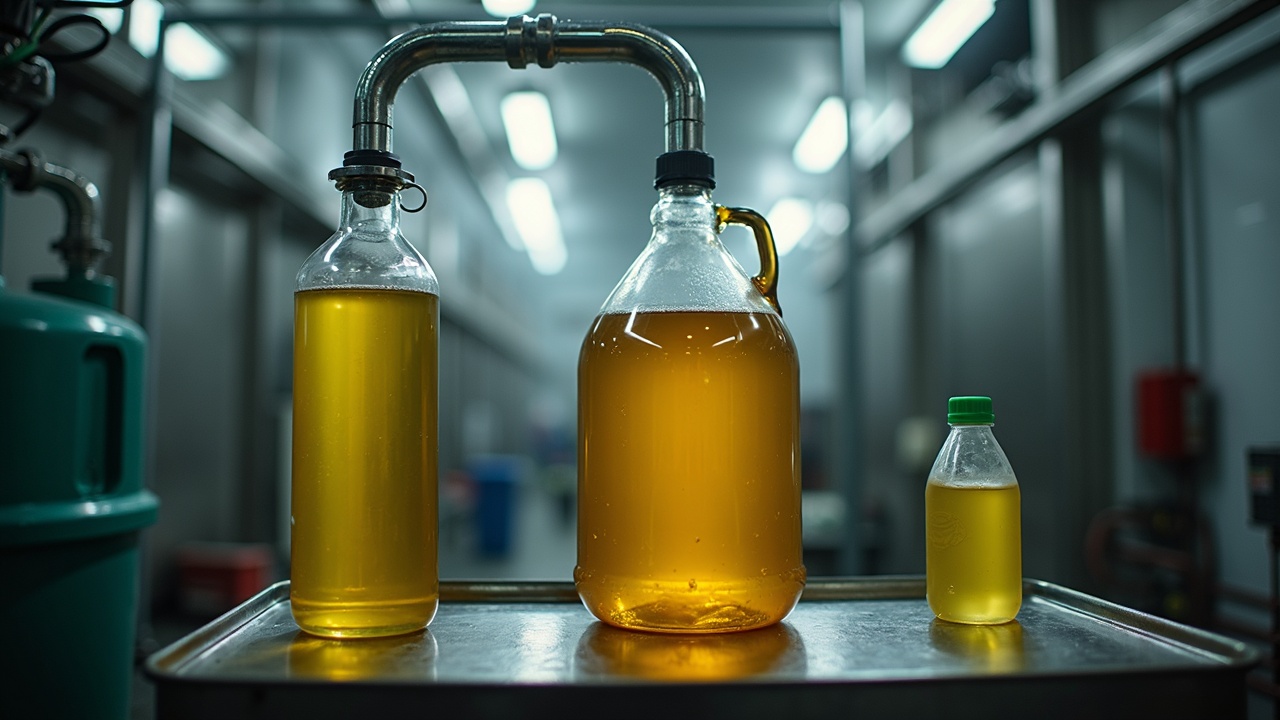
\begin{figure}[!htbp] \centering \includegraphics[width=0.55\textwidth,height=0.28\textheight,keepaspectratio]{images/biodiesel-jar.jpg} \caption*{\small\itshape\color{norfarmsBronzeLight} Finished biodiesel in a glass jar. Good biodiesel is clear golden-amber, with no cloudiness, no suspended particles, and no water layer at the bottom.\\ \tiny\upshape\color{norfarmsBronze} Wikimedia Commons, CC BY-SA.} \end{figure}
Budget Appleseed Tier — $400 To $1,200, 10 To 20 Gallons Per Batch
The Appleseed processor, originally designed by Maria "Girl Mark" Alovert and popularized through her 2004 book Biodiesel Homebrew Guide, is the reference homestead build. The core idea is to use a standard 40-gallon electric water heater as the reaction vessel, its built-in heating element as the heat source, its built-in thermostat as the temperature controller, and a small magnetic-drive pump to provide circulation. The entire system is built from parts available at hardware stores and plumbing supply houses.
| Component | Spec | Cost | Notes |
|---|---|---|---|
| Reaction vessel | 40 gal electric water heater, glass-lined, used | $0–$150 | Free or cheap on Craigslist; glass-lined interior is compatible with KOH |
| Water heater element | Factory 4500W 240V or 1500W 120V | Included | 120V version is slower but runs off any household outlet |
| Thermostat | Factory water heater thermostat | Included | Adjustable to 60–65°C reaction temperature |
| Circulation pump | March AC-3CP-MD magnetic drive | $120–$180 | 7 GPM, 1/50 HP, Viton seals, handles biodiesel and methoxide |
| Pump motor | Integrated with pump | Included | Magnetic drive means no shaft seal to leak |
| Suction line | 1/2" black iron pipe, 4 ft | $15 | NOT copper. Black iron or stainless only |
| Discharge line | 1/2" black iron pipe with ball valves | $25 | For directing flow between reaction and draw-off modes |
| Methanol mixing tank | 5 gal HDPE jerry can with outlet fitting | $15 | Dedicated to methanol/methoxide only, clearly labeled |
| Methanol pump | Small gear pump or gravity feed | $40 | Viton seals only |
| Drain valve | 1" ball valve, brass-free | $25 | Stainless ball valve at the water heater drain |
| Settling / wash tank | 55 gal HDPE conical-bottom drum | $80 | Conical bottom lets glycerin draw off cleanly |
| Safety shutoff | 240V disconnect switch with lockout | $30 | Required for water heater element circuits |
| Titration kit | 1 g/L KOH solution, IPA, phenolphthalein, 10 mL burette | $35 | DIY; parts are all reusable |
| Digital scale | 2 kg capacity, 0.1 g resolution | $25 | For weighing catalyst |
| Thermometer | Digital, probe style, 0–150°C | $25 | For verifying reaction temperature |
| PPE | Face shield, chemical gloves, apron, respirator | $80 | Non-negotiable — see Section 7 |
| Wash sprayer | 1 gal garden sprayer, dedicated | $15 | For misting wash water over the biodiesel surface |
| Filter rig | 40 micron bag filter + stand | $50 | For polishing finished fuel |
| Misc plumbing | Fittings, hose, clamps | $60 | Budget for $50–$100 in fittings |
| Total | $640–$990 | Lower end if the water heater is free |
\begin{figure}[!htbp] \centering \includegraphics[width=0.55\textwidth,height=0.28\textheight,keepaspectratio]{images/biodiesel-reactor.jpg} \caption*{\small\itshape\color{norfarmsBronzeLight} A homestead-scale biodiesel reactor. The tank, heating element, circulation pump, and instrumentation can be adapted from off-the-shelf parts; the Appleseed-style build uses a repurposed electric water heater as the reaction vessel.\\ \tiny\upshape\color{norfarmsBronze} Wikimedia Commons, CC BY-SA.} \end{figure}
Homestead Scale Tier — $2,500 To $8,000, 50 To 100 Gallons Per Batch
| Component | Spec | Cost | Notes |
|---|---|---|---|
| Reaction vessel | 55–100 gal stainless steel jacketed tank | $800–$2,000 | Food-grade used dairy or brewery tanks common on resale |
| Steam or electric heat | Either a 3000W immersion heater or a steam jacket | $300–$600 | Steam is cleaner; electric is simpler |
| Circulation pump | 1/2 HP 316 stainless centrifugal | $250–$400 | Capable of running biodiesel continuously for 60+ minute reaction |
| Temperature controller | PID with thermocouple | $80–$150 | Maintains ±1°C reaction temperature |
| Methanol premix tank | 30 gal stainless closed tank with stirrer | $200–$400 | Enclosed to contain methanol vapor |
| Methanol storage | 55 gal steel drum with bund | $100–$150 | Store outdoors under cover, away from ignition sources |
| Caustic handling station | Scale + enclosed mixing container | $100 | For safely weighing and mixing KOH into methanol |
| Settling tank | 100 gal stainless conical-bottom | $400–$700 | Used dairy tank or fabricated |
| Wash station | 2× 100 gal HDPE conical-bottom drums | $300 | For mist-wash or bubble-wash procedure |
| Dry wash column | Optional — 10 gal Magnesol or Amberlite BD10DRY column | $400 | Alternative to water wash |
| Dryer / polishing column | Heated tank with vacuum or airflow drying | $200 | Final water removal |
| Methanol recovery still | Small copper-free reflux column, 2" stainless | $400–$800 | For reclaiming methanol from wash water |
| Instrumentation | Thermometers, pH meter, flow meters, timer | $200 | Process monitoring |
| Fuel storage | 250 gal stainless or HDPE with bund | $400–$800 | Ethanol-compatible, ventilated |
| Safety equipment | CO₂ detector, methanol vapor detector, ABC extinguisher, full PPE | $300 | Non-negotiable at this scale |
| Total | $4,430–$7,300 | Full build excluding workspace and plumbing |
\begin{figure}[!htbp] \centering \includegraphics[width=0.55\textwidth,height=0.28\textheight,keepaspectratio]{images/biodiesel-pump.jpg} \caption*{\small\itshape\color{norfarmsBronzeLight} \textbf{Retail biodiesel pump.} Commercial biodiesel distribution already exists in the US at thousands of stations. A homestead producer reproduces the same fuel chemistry at farm scale --- the molecules are identical, only the production volume differs.\\ \tiny\upshape\color{norfarmsBronze} Wikimedia Commons, public domain.} \end{figure}
Materials Compatibility — The Zero-Exception Rules
This is one of the three most common sources of equipment failure in homestead biodiesel operations (the other two being inadequate feedstock dewatering and skipping titration). Get these rules right from the start and plumb the whole system to them.
| Material | Compatible? | Use For | Do Not Use For |
|---|---|---|---|
| Stainless steel 304/316 | Yes | Everything | — |
| Black iron pipe | Yes | Fuel lines, reaction vessel plumbing | — |
| Glass-lined steel | Yes | Reaction vessel (water heater interior) | — |
| HDPE (food grade) | Yes | Storage tanks, wash tanks, settling tanks | Reaction vessel (HDPE softens at 55°C+ reaction temperature) |
| PTFE (Teflon) | Yes | Gaskets, tubing, seals | — |
| FKM / Viton | Yes | Pump seals, O-rings, fuel pump diaphragms | — |
| Aluminum | Limited | Short-term contact only | Long-term storage — biodiesel slowly attacks aluminum |
| Silicone | Limited | Cool-side tubing only | Hot biodiesel or methanol vapor |
| Copper | No | — | Everything — copper catalyzes fuel oxidation and dissolves into fuel |
| Brass | No | — | Everything — brass contains copper and has the same failure mode |
| Bronze / gunmetal | No | — | Everything — same copper failure mode |
| Galvanized steel | No | — | Anything — zinc coating dissolves in methanol and biodiesel |
| Nitrile rubber (NBR) | No | — | Fuel lines, pump diaphragms, seals — swells and cracks |
| Natural rubber | No | — | Anything — dissolves in methanol |
| Zinc | No | — | Anything — dissolves in methanol |
Warning — Copper And Brass Are The Single Most Common Failure Mode.
Older homestead biodiesel guides are inconsistent on copper and brass compatibility. The 2024 corrosion research is clear: copper catalyzes the oxidation of biodiesel into organic acids, those acids attack the copper, copper ions contaminate the fuel, and the plumbing fails from the inside. This failure is slow (3--12 months) and produces fuel that looks fine in the jar but causes injector problems downstream. \textbf{Use black iron, stainless, or PTFE for every wetted part. No copper. No brass. No bronze. Not even a single fitting.}
Warning — Nitrile Rubber Swells In Biodiesel.
Standard rubber fuel line from an auto parts store is nitrile rubber (NBR). It swells and cracks when exposed to biodiesel. The failure mode is: fuel line leaks, fire hazard, and eventual rupture. Use Viton (FKM) fuel line rated for biodiesel service. Viton line is $2--$5 per foot, available from McMaster-Carr, Gates Specialty Hose, and most fuel system supply vendors.
6. Feedstock Preparation
\begin{sectionopener} \textbf{What This Section Covers:} The six-step procedure that converts a drum of dirty used fryer oil into clean, dry, titrated feedstock ready for reaction: collect, settle, filter, dewater, titrate, test-batch. \end{sectionopener}
Sloppy feedstock preparation is the second most common reason for failed biodiesel batches (after skipping titration). The goal at this stage is to remove water, remove solid contamination, measure FFA accurately, and run a small test batch to verify everything will work before committing the full batch. Each step is non-negotiable.
Step 1 — Collection And Transport
Collect used oil from the source in food-grade HDPE drums (15–55 gallon) with tight-sealing lids. Never use galvanized containers, never use uncovered containers, never use containers that previously held other chemicals.
- Label each drum with the collection date and source
- Keep lids sealed except during pouring
- Transport in a vehicle bed or trailer, not inside a passenger cabin (used oil smells strongly and the smell is hard to remove)
- Keep drums out of direct sunlight during transport and storage — UV accelerates FFA rise
- Target drum utilization within 30 days of collection; oil held longer climbs in FFA and may require acid pretreatment
Step 2 — Settling
Transfer the collected oil to a conical-bottom or sloped-bottom settling tank. Let it rest undisturbed for 24–48 hours. During settling, water and food particles fall to the bottom of the tank and a clear oil layer forms on top. The bottom fraction — usually 2–8% of the total volume — contains water, breading crumbs, fat particles, and whatever else was in the fryer. Draw off and discard the bottom layer before proceeding. The upper fraction is usable oil ready for filtering.
Settling can be accelerated by heating the oil to 95–100°F; warm oil is less viscous and water drops settle faster. Do not heat to methanol reaction temperature at this stage — water will boil and create a mess.
Step 3 — Filtering
Pass the settled oil through a progressive filter train:
- First stage: 100 micron stainless mesh strainer or 100 micron bag filter — removes chunks, breading, fat particles
- Second stage: 40 micron polypropylene bag filter — removes fine solids
Fresh filter bags cost $3–$8 each at most farm and pump supply houses. Plan on one set of bags per 50 gallons of feedstock. Do not skip this step — fine solids in the reaction vessel nucleate soap formation and reduce conversion.
Step 4 — Dewatering
Heat the filtered oil to 100°C (212°F) with continuous agitation for 15–30 minutes. Water evaporates and is vented off the top of the tank. This is the single most important step for preventing soap formation in the reaction. Any residual water in the oil will react with the KOH catalyst to form soap and degrade the batch.
Indicator that water has been driven off: the oil stops bubbling (water vapor stops forming) and the surface becomes calm. If bubbling continues after 30 minutes, continue heating until it stops.
After dewatering, cool the oil to the target reaction temperature (55–60°C) before adding methoxide. Hot oil dumped directly into the reaction methoxide mixture will cause methanol to flash off.
Step 5 — Titration
After the oil is dewatered and cooled, draw a 1 mL sample and run the titration procedure described in Section 4. Record the result. Calculate the total catalyst dose:
Total catalyst (g) = (3.5 + titration_mL) × oil_volume_liters
A reading above 5 indicates oil that should be handled with the two-stage acid-plus-base process. A reading between 2 and 5 indicates oil that can go through single-stage processing but with slightly reduced yield. A reading below 2 indicates good feedstock — typical for virgin oil, rare for used cooking oil.
\begin{tipbox} \textbf{Titrate Every Batch, Even Batches From The Same Source.} The FFA level in used cooking oil varies from one collection to the next even at the same restaurant. A fryer that was cleaned last week will produce oil with different FFA than the same fryer two weeks from now. Operators who titrate every single batch produce consistent fuel. Operators who memorize a catalyst dose from one good batch and reuse it for subsequent batches produce inconsistent fuel and eventually produce soap. \end{tipbox}
Step 6 — Test Batch
Before running a full batch, run a 1 liter test batch in a clear glass jar. Follow the full process: heat to 55°C, add methoxide (1 liter × (3.5 + titration_mL) ÷ 100 grams of KOH dissolved in 200 mL of methanol), stir continuously for 60 minutes, let settle overnight. The next morning, the test jar should show two clear layers: biodiesel on top (golden), glycerin on bottom (dark brown). If the test jar shows a uniform emulsion instead of two clean layers, the batch will not work and the full batch should not be started. Adjust parameters (recheck FFA, recheck water content, verify catalyst weight and methanol volume) and run another test jar before committing.
The test batch takes 90 minutes of active work plus an overnight settle. The full batch it prevents from failing is worth many hours of labor plus the cost of a drum of oil. Always test batch first.
7. The Reaction — Running A Batch Start To Finish
\begin{sectionopener} \textbf{What This Section Covers:} The step-by-step procedure for running a biodiesel reaction from the first methanol measurement to the final settled batch with clean phase separation. \end{sectionopener}
A successful biodiesel reaction is four hours of active work followed by 8–24 hours of settling. The four hours include heating, methoxide preparation, reaction time, and initial glycerin draw-off. The settling time is passive — the reaction vessel sits quietly while density-driven phase separation completes.
Step 1 — Calculate The Recipe
For a batch of N liters of dewatered, titrated, filtered oil:
Methanol volume
= 0.20 × N liters (20% of oil volume)
KOH catalyst
= (3.5 + titration_mL) × N grams
Worked example: 40 liters of used cooking oil with a titration reading of 4.0 mL.
- Methanol: 0.20 × 40 = 8.0 liters
- Catalyst: (3.5 + 4.0) × 40 = 7.5 × 40 = 300 grams of KOH
Step 2 — Premix The Methoxide
In a sealed mixing container (never open to air), dissolve the calculated mass of KOH flakes in the calculated volume of methanol. The KOH dissolves exothermically — the mixture will warm noticeably. Stir or shake until the KOH is fully dissolved. Do not add water. Do not leave the container open. Methoxide generates methanol vapor and the reaction of KOH with water is violent.
Time required: 20–30 minutes. Methoxide is fully prepared when there are no KOH flakes visible at the bottom of the container and the solution is clear (may be slightly yellow).
Warning — Methoxide Is The Most Dangerous Chemical In The Whole Process.
Sodium methoxide and potassium methoxide are strongly caustic and also soluble in organic solvents, which means they can penetrate skin much faster than KOH or NaOH alone. Skin contact causes severe chemical burns that often do not become painful until several minutes after contact, by which time the damage is deep. \textbf{Full-face shield, chemical gloves rated for methanol, long-sleeved shirt, and apron are non-negotiable during methoxide preparation.} If methoxide contacts skin, flush immediately with copious water for 15+ minutes and seek medical attention.
Step 3 — Heat The Oil
Heat the prepared (filtered, dewatered, titrated) oil in the reaction vessel to 55°C (131°F). The water heater thermostat in a budget Appleseed processor is set to this temperature and will cycle the heating element on and off to maintain it. In a homestead-scale system with a PID controller, set the controller to 55°C and wait for the oil to reach temperature before adding methoxide.
Why 55°C and not higher: methanol boils at 64.7°C. Running the reaction above 60°C causes methanol to evaporate out of the mixture faster than it can react, reducing yield. Running below 50°C slows the reaction and reduces conversion. The 55°C sweet spot balances reaction rate against methanol volatility.
Step 4 — Add Methoxide And Start Circulation
With the oil at 55°C and the circulation pump running, slowly pour the methoxide into the reaction vessel through an inlet port. Do not dump it all at once — the methoxide is lighter than oil and will float on top if added fast. Pour over 2–5 minutes with the circulation pump running continuously.
Once all the methoxide is added, continue circulation at full flow rate for 60 minutes. The reaction is proceeding during this entire hour. The pump's job is to ensure the methoxide is fully mixed with the oil and to refresh the interface between phases so fresh methoxide constantly contacts unreacted triglyceride.
Visual observation: the oil-methoxide mixture initially looks cloudy due to the density difference. Within 10–15 minutes the mixture becomes more uniform and amber-colored. Within 30 minutes the mixture is uniformly dark amber with no visible phase separation. By 60 minutes the reaction is 95%+ complete.
Step 5 — Stop Circulation And Settle
At the end of 60 minutes, stop the circulation pump. Do not drain. Do not disturb. Let the reaction vessel sit quietly for 8–24 hours. During settling, the density difference between biodiesel (0.88 g/mL) and glycerol (1.26 g/mL) drives phase separation. The biodiesel forms a clear golden-amber top layer; the glycerol forms a dark brown, viscous bottom layer containing most of the residual methanol, the excess catalyst, the glycerin, and any soap that formed from FFA residuals.
A good settling result: top layer is golden and clear, bottom layer is dark brown, sharp interface between them, no thick white emulsion layer. Interface should be 15–25% of the way up from the bottom (glycerol is roughly 20% of the total volume).
A bad settling result: thick white or creamy emulsion in the middle, no clear interface, uniform color throughout. This indicates high soap content and incomplete reaction — the batch will not separate cleanly and the biodiesel cannot be washed normally. Causes: water in feedstock, insufficient catalyst, FFA higher than assumed, temperature too low during reaction. Emulsified batches can sometimes be rescued by heating to 60°C and adding more methoxide, but usually it is faster to chalk up the lesson and start fresh.
Step 6 — Draw Off The Glycerin
Open the bottom valve of the reaction vessel and drain the bottom (glycerol) layer into a separate container — preferably a clear HDPE drum so you can see what is coming out. The glycerol layer drains slowly because it is viscous. Stop draining the instant the color lightens — the interface between glycerol and biodiesel is visible as a change from dark brown to clear amber, and you want to catch the transition precisely.
Any glycerol left in the reaction vessel will contaminate the subsequent wash step. Err on the side of draining slightly into the biodiesel layer rather than leaving glycerol behind.
The drained glycerol goes to the byproducts process (Section 10). The remaining biodiesel in the reaction vessel is now ready for washing.
8. Washing And Drying — The Quality Stage
\begin{sectionopener} \textbf{What This Section Covers:} Why washing is non-negotiable, the water-wash and dry-wash procedures, the 3/27 test and soap test for quality verification, and the final drying step to bring water content below the ASTM D6751 specification. \end{sectionopener}
Unwashed biodiesel contains residual methanol, residual catalyst, residual glycerin, dissolved soap, and trace water. All of these must be removed to produce fuel-grade product. ASTM D6751 specifies maximum limits for free glycerin (0.020%), bound glycerin (0.240%), water (0.050%), and several other contaminants, all of which are controlled by the wash stage. Skipping or shortcutting the wash produces fuel that looks golden in the jar but damages injectors, clogs filters, and fails engine service faster than petroleum diesel.
Two wash approaches are used at homestead scale: water wash (the classic method, uses water to remove contaminants) and dry wash (uses absorbent media like Magnesol or Amberlite BD10DRY instead of water). Water wash is the cheaper, older approach; dry wash is faster and generates no wastewater but costs more per gallon. Both produce fuel that meets ASTM specifications.
Water Washing — The Classic Method
Water washing exploits the fact that methanol, catalyst, glycerin, and soap are all water-soluble while biodiesel is not. Wash water added to the crude biodiesel dissolves the contaminants and, because water is denser than biodiesel, settles to the bottom of the wash tank carrying the contaminants with it. Multiple wash cycles progressively remove more contaminants until the fuel is clean.
Wash procedure:
- Transfer the crude biodiesel from the reaction vessel to a wash tank (typically a 55 gal HDPE conical-bottom drum)
- First wash (gentle): add clean water equal to 10% of the biodiesel volume. Gently swirl or bubble air through the water layer — do not agitate violently because violent mixing creates a persistent emulsion. Let settle for 30 minutes. Drain water from the bottom.
- Second wash (moderate): add water equal to 25% of the biodiesel volume. Bubble air through gently for 5–10 minutes. Let settle for 30 minutes. Drain water.
- Third wash (thorough): add water equal to 50% of the biodiesel volume. Bubble air through for 10 minutes. Let settle for 30 minutes. Drain water.
- Fourth wash (polish): add water equal to 50% of the biodiesel volume. Bubble air through for 5 minutes. Let settle for 30 minutes. Drain water.
The wash water progressively becomes less cloudy as contaminants are removed. The first wash water is typically milky white (high soap, high glycerin). The fourth wash water should be nearly clear, with only a slight haze. If the fourth wash water is still milky, run a fifth and sixth wash until clean.
Mist-washing is an alternative technique for the first wash, where instead of dumping water into the tank and agitating, wash water is sprayed as a fine mist over the top of the biodiesel and allowed to settle through the fuel layer by gravity. Mist-washing prevents emulsion formation during the first wash (which is the wash most likely to emulsify). After the first mist wash, subsequent washes can use the bubble-wash method described above.
Dry Washing — The Magnesol / Amberlite Alternative
Dry washing uses an absorbent medium — most commonly magnesium silicate (Magnesol) or ion exchange resin (Amberlite BD10DRY, Purolite PD-206) — to absorb the contaminants from the crude biodiesel without using water. The fuel passes through a column packed with the absorbent medium, which captures soap, residual catalyst, glycerin, and methanol.
Advantages: no wastewater, no emulsion risk, faster turnaround (hours instead of overnight).
Disadvantages: cost (Magnesol is approximately $2–$3 per pound in 2026, requires roughly 1 lb of medium per 25 gallons of fuel), disposal of spent medium (treat as oily waste), and the medium must be regenerated or replaced periodically.
Procedure: circulate the crude biodiesel through a heated column (40–50°C) packed with 1 lb of Magnesol per 25 gal of biodiesel for 20–30 minutes, then drain and filter the polished fuel through a 5 micron filter.
Most homestead operators start with water washing because the materials cost is near zero and the process is more tolerant of errors. Operators who scale up to higher throughput often switch to dry washing because the process is faster and does not require wastewater management.
The 3/27 Wash Test — The Most Sensitive Quality Check
After washing, test the fuel quality using the 3/27 methanol wash test. This is the most sensitive homestead test for incomplete reaction (unconverted triglycerides or mono/di-glycerides).
Procedure:
- Add 3 mL of the washed biodiesel to a small glass vial
- Add 27 mL of methanol
- Cap the vial and shake vigorously for 10 seconds
- Let the vial stand for 5 minutes and observe
A passing result: the biodiesel completely dissolves in the methanol to form a clear, single-phase golden-amber solution with no cloudiness, no precipitate, and no visible second layer.
A failing result: the solution is cloudy, or a second (oily) layer separates out on top of the methanol layer. Either indicates residual mono-glycerides, di-glycerides, or unreacted triglycerides — meaning the reaction did not complete. Failing fuel should be re-reacted with additional methoxide rather than used as fuel.
The Soap Test
Residual soap in finished biodiesel causes injector problems and accelerates filter plugging. The soap content can be measured with a simple titration using bromophenol blue indicator and hydrochloric acid (HCl) standardized solution. The test measures dissolved soap in ppm.
Procedure:
- Dissolve 10 grams of biodiesel in 100 mL of isopropanol
- Add 5 drops of bromophenol blue indicator (the solution turns blue)
- Titrate with 0.01 N HCl solution until the color changes from blue to yellow
- Calculate: soap (ppm) = mL_HCl_used × 320 (for KOH soap)
Target: soap content below 66 ppm for KOH-based biodiesel (below 41 ppm for NaOH-based). Higher soap content indicates insufficient washing and should be addressed with additional wash cycles.
Drying — Removing Residual Water
After washing, the biodiesel contains 1–5% dissolved water. ASTM D6751 requires below 500 ppm (0.05%). Remove the residual water by one of three methods:
- Heat drying: heat the washed biodiesel to 100°C with gentle agitation for 20–30 minutes. Water evaporates off the top of the fuel.
- Vacuum drying: apply mild vacuum (10–20 inches Hg) to the fuel tank at 50°C for 30 minutes. Water boils off at lower temperature under vacuum.
- Air drying / polish filtration: circulate the fuel through a heated filter cart with a hydrophilic element that preferentially absorbs water.
Any of the three methods produces fuel with water content below 500 ppm when operated correctly. Heat drying is the simplest and requires no additional equipment beyond the reaction vessel and its heating element.
Visual indicator of dry fuel: dry biodiesel is brilliantly clear and sparkling under direct light. Wet biodiesel is slightly cloudy or hazy. The difference is subtle but visible in a transparent container with a strong backlight.
After drying, pass the fuel through a final 5 micron polishing filter before transferring to the finished fuel storage tank.
9. Denaturing And Storage
\begin{sectionopener} \textbf{What This Section Covers:} Why biodiesel does not require denaturing (unlike ethanol), storage container selection, temperature and humidity management, shelf life, and the critical fuel filter strategy for vehicles switching from petroleum diesel to biodiesel. \end{sectionopener}
Biodiesel does not require denaturing. Unlike ethanol — which must be denatured with gasoline or a chemical denaturant to avoid beverage alcohol taxation — biodiesel has no alternative use as a drinkable product and is not regulated by the TTB. Finished, washed, dried biodiesel can go directly from the production tank to the fuel storage tank with no additional processing.
Storage Container Selection
Biodiesel storage follows the same materials compatibility rules as the production process. Approved:
- Stainless steel 304/316 tanks
- Black iron tanks (standard fuel oil tanks are almost always black iron, and they work fine for biodiesel)
- HDPE (high-density polyethylene) food-grade tanks rated for fuel service
- Glass (for small sample quantities)
Not approved:
- Galvanized tanks (zinc dissolves in biodiesel)
- Aluminum for long-term storage (slow attack on aluminum walls)
- Copper or brass anywhere in the system
- Plastic tanks not rated for fuel (HDPE is fine; LDPE softens; ABS deforms)
A standard homestead setup uses a 55 gallon steel drum for short-term storage (up to 3 months) or a 275 gallon IBC tote with the steel cage and an HDPE liner for medium-term storage (up to 12 months).
Temperature Management
Biodiesel's cold-flow properties depend on the feedstock fatty acid profile. Waste cooking oil biodiesel (typically from soybean and canola blends) has a cloud point of -5°C to +5°C (23°F to 41°F). Below the cloud point, the fuel begins to form wax crystals that clog fuel filters and fuel lines. Below the pour point (typically 5–10°C below the cloud point) the fuel stops flowing entirely.
Cold-weather storage strategies:
- Insulated tank: wrap the storage tank with pipe insulation or build a simple insulated box around it. For Hill Country winters, basic insulation keeps the tank above freezing most nights.
- Heated tank: add a thermostatic tank heater (sold for waste oil heaters, $100–$200) to maintain the tank above 10°C during cold spells. 50W is sufficient for a 55 gal drum in a garage; 200W for a 275 gal tote in an outbuilding.
- Blending: blend with petroleum diesel (B50 or B20) for winter operation. Petroleum diesel's cloud point is much lower than biodiesel's, and blending pushes the cloud point of the mixture down proportionally.
- Winterization: remove the high-melting saturated fatty acid esters from the fuel by chilling it to just above the cloud point and filtering off the first solids that form. This is the same technique used by commercial biodiesel plants to produce low-cloud winter grade fuel.
Hygroscopicity
Biodiesel absorbs water from humid air directly through the fuel surface. A half-empty tank in a humid climate can pick up 0.1–0.3% water by volume per month from the headspace above the fuel. This is lower than ethanol's water absorption rate but still significant for long-term storage.
Mitigation:
- Keep storage tanks as full as possible — less headspace means less water absorption
- Top up partial tanks with additional fuel or displace the headspace with dry nitrogen for long-term storage
- Use sealed tanks with minimal air exchange
- Test water content before using fuel that has been stored more than 6 months
Shelf Life
Biodiesel shelf life is 6–12 months for fuel produced from oxidatively stable feedstocks (canola, sunflower) stored under good conditions (sealed tank, cool temperature, low humidity). Fuel from less stable feedstocks (soybean, waste cooking oil) is on the shorter end of this range. The degradation product is oxidized glyceride polymers that form a sticky gum in the fuel, eventually clogging injectors.
Shelf life extension:
- Antioxidant additives: TBHQ (tert-butylhydroquinone) or BHT (butylated hydroxytoluene) at 100–200 ppm extends shelf life by 6–12 months. Commercial diesel fuel additives often contain antioxidants already.
- Cool, dry, dark storage: exactly as for all fuels. Direct sunlight and heat accelerate oxidation.
- Nitrogen blanket: displacing the headspace with nitrogen eliminates oxygen exposure.
The Fuel Filter Strategy For New Biodiesel Users — Critical
The single most common complaint from drivers switching from petroleum diesel to biodiesel is "my fuel filter keeps clogging." This is not a biodiesel problem. It is a signal that biodiesel is doing its job as a solvent — loosening years of gum, varnish, and water-bound sludge that accumulated in the fuel tank, fuel lines, and filter housing during the petroleum diesel era. The loosened deposits flow into the filter and plug it. Once the system is clean, the new fuel filter catches only normal debris and the complaint stops.
The recommended switchover procedure for any existing vehicle:
- Install a fresh fuel filter before switching to biodiesel. This gives the new fuel the cleanest possible starting point.
- Carry a spare fuel filter on the first few tanks of biodiesel. Expect the filter to clog within 300–800 miles of switchover for older equipment.
- Change the filter at 500 miles after switching to biodiesel, regardless of whether it appears to need changing.
- Change the filter again at 1,500 miles after switching.
- Return to the normal service interval (usually 15,000–30,000 miles) after the two break-in changes.
Skipping this strategy is the most common reason new biodiesel users have bad first experiences and conclude that "biodiesel doesn't work in my truck." Biodiesel works fine in almost every diesel vehicle; the fuel system needs a chance to clean out first.
\begin{tipbox} \textbf{Keep A Fresh Filter Or Two In The Truck On Your First Biodiesel Tank.} A clogged fuel filter stalls a diesel engine and can leave you stranded. A spare filter and a 15-minute roadside change gets you moving again. By the third or fourth biodiesel tank the system is clean and the problem is gone for good. \end{tipbox}
10. Waste Streams And Byproducts
\begin{sectionopener} \textbf{What This Section Covers:} What to do with the glycerol, how to recover methanol from the wash water, and how to handle the spent filter cake and wash water responsibly. \end{sectionopener}
Every 50 gallons of biodiesel production yields approximately 10 gallons of crude glycerol, 200–500 mL of spent methanol (in the wash water), and some solids (filter cake, sludge from dewatering). All of these are useful or disposable with minimal processing.
Crude Glycerol — The Main Byproduct
Crude glycerol drawn off at the end of the reaction is a thick, dark brown, viscous liquid containing approximately 50% glycerol, 20–30% residual methanol, 10–15% soap (potassium stearate and potassium oleate from FFA that reacted with catalyst), 5–10% water, and trace catalyst.
\begin{figure}[!htbp] \centering \includegraphics[width=0.55\textwidth,height=0.28\textheight,keepaspectratio]{images/glycerin-molecule.png} \caption*{\small\itshape\color{norfarmsBronzeLight} Glycerol (C\textsubscript{3}H\textsubscript{8}O\textsubscript{3}). Three carbons, three hydroxyl groups. Non-toxic, water-soluble, the ``backbone'' of every triglyceride that is removed during transesterification.\\ \tiny\upshape\color{norfarmsBronze} Wikimedia Commons, public domain.} \end{figure}
First step — methanol recovery. Before doing anything else with the crude glycerol, recover the residual methanol. Methanol is the most expensive ingredient in biodiesel production after the oil itself, and 20–30% of the methanol used in the reaction ends up in the glycerol phase. Recovery pays for itself quickly at any scale above a few dozen gallons per year.
Simple recovery procedure:
- Transfer the crude glycerol to a stainless steel pot with a loose lid
- Heat to 70–80°C (160–175°F) for 30–60 minutes
- Capture the methanol vapor in a simple condenser (a copper coil — wait, not copper; a stainless coil — in a cold water bath)
- Collect the condensed methanol in a clean container for reuse in the next batch
The recovered methanol is approximately 95% pure and can be reused directly in the next biodiesel batch with a small correction to the methoxide mix ratio. Commercial biodiesel plants recover 98–99% of their methanol through dedicated distillation columns; homestead-scale recovery is typically 70–85% which is still economically worthwhile.
After methanol recovery — options for the glycerol:
- Soap making. Crude glycerol plus additional KOH or NaOH produces a decent hand soap. Soap makers have adapted recipes specifically for biodiesel glycerol. Cold-process soap made from biodiesel glycerol is a viable cottage product and can be sold at farmers' markets for $4–$8 per bar.
- Composting. Crude glycerol is a carbon source and a microbial energy source. Add to compost piles at 1–3% by volume. Do not exceed this rate — high glycerol concentrations attract insects and can go anaerobic.
- Anaerobic digester feedstock. If you run a small anaerobic digester for methane production from livestock manure or food waste, crude glycerol is an excellent energy supplement. 1 gallon of glycerol in the digester produces roughly 5–10 cubic feet of methane.
- Waste oil heater fuel. Glycerol has a calorific value of approximately 5.5 kcal/g (slightly lower than diesel fuel). It burns in properly adjusted waste oil heaters. Several manufacturers (Lanair, EnergyLogic, Clean Burn) make waste oil heaters rated for glycerol and mixed fuel streams. A homestead that produces biodiesel and burns the glycerol for shop heat closes the energy loop entirely.
- Dust control on gravel roads. Crude glycerol mixed with water (1:3) is a non-toxic, non-corrosive dust suppressant for unpaved roads. This is a real commercial application — municipalities buy biodiesel glycerol for road maintenance in some regions.
Spent Methanol Recovery From Wash Water
Water-washed biodiesel produces 4–8 gallons of wash water per 50 gallons of fuel. The first wash water is cloudy with soap and contains 2–5% dissolved methanol. Methanol can be recovered from wash water using the same simple distillation approach as for the glycerol, though the yield is lower and the effort per gallon of recovered methanol is higher.
Decision rule: at homestead scale, recover methanol from the crude glycerol (worth the effort) and not from the wash water (not worth the effort unless you already have a running still for some other reason). Pour first-wash water into a soap pot or onto the garden after pH adjustment to neutral with vinegar. Subsequent wash water is essentially clean and can be disposed of normally.
Filter Cake And Sludge
The bottom fraction from settling and the spent filter bags from dewatering contain fat particles, food solids, and trace oil. These can be composted directly or added to a waste-oil heater for thermal disposal. They do not require any special handling beyond keeping them out of waterways.
11. Engine And Equipment Compatibility
\begin{sectionopener} \textbf{What This Section Covers:} Which diesel engines run B100 without modification, which tolerate B20 only, the Viton versus nitrile fuel system decision, the minimal conversion procedure for older engines, cold-weather strategies, and how maintenance changes when switching to biodiesel. \end{sectionopener}
\begin{figure}[!htbp] \centering \includegraphics[width=0.55\textwidth,height=0.28\textheight,keepaspectratio]{images/om617-engine.jpg} \caption*{\small\itshape\color{norfarmsBronzeLight} The Mercedes-Benz OM617 inline-5 turbodiesel --- a classic indirect-injection engine that runs B100 biodiesel without modification. The pre-combustion chamber design is tolerant of fuel variations the way modern common-rail systems are not.\\ \tiny\upshape\color{norfarmsBronze} Wikimedia Commons, public domain.} \end{figure}
Unlike gasoline engines converted to ethanol — which need carburetor rejetting, injector sizing changes, and timing adjustments — diesel engines running biodiesel need almost nothing. Biodiesel has properties close enough to petroleum diesel that the engine, fuel system, and ignition timing do not need to change. The only things that matter are fuel system materials (seals, hoses, gaskets), fuel filter strategy during break-in, and cold-weather management.
Engine Categories And Compatibility
Category 1: Indirect-injection (IDI) diesels — B100 safe with seal check. Older diesels with pre-combustion chambers and mechanical injection pumps tolerate biodiesel better than any other engine category. Examples include:
\begin{figure}[!htbp] \centering \includegraphics[width=0.55\textwidth,height=0.28\textheight,keepaspectratio]{images/kubota-tractor.jpg} \caption*{\small\itshape\color{norfarmsBronzeLight} \textbf{Kubota diesel tractor.} Pre-Tier 4 Kubota tractors run B100 biodiesel without modification. The tractor is the single most valuable target for biodiesel on a working homestead --- a 40 HP tractor burning 400 gallons/year saves \$1,600+ annually at retail diesel prices.\\ \tiny\upshape\color{norfarmsBronze} Wikimedia Commons, CC BY-SA.} \end{figure}
- Mercedes-Benz OM601/602/603/616/617 (1970s–early 1990s) — the classic W123, W124, and W126 diesels
- Ford 6.9L and early 7.3L IDI (1983–1994 diesel pickups before the Powerstroke)
- International / Navistar IDI diesels of the same period
- Kubota pre-Tier 4 tractor engines
- Yanmar pre-Tier 4 industrial and marine engines
- Perkins 4.108 and 4.236 marine and industrial engines
- Lister-Petter single and twin-cylinder stationary engines
- Older John Deere and Caterpillar tractor diesels (pre-1995)
These engines are designed to tolerate fuel variability. They were originally designed in an era when diesel fuel quality was less consistent, and they have robust injection pumps, large clearances in the fuel system, and pre-combustion chambers that tolerate imperfect atomization. B100 works in these engines straight out of the homestead processor — subject only to the seal compatibility check (see below).
Category 2: Modern common-rail diesels (1995–2014) — B20 per OEM, B50 in practice. Common-rail diesels with high-pressure electronic injection are more sensitive than IDI engines but still tolerate biodiesel blends well. Examples:
- GM Duramax 6.6L (LB7, LLY, LBZ, LMM, LML — 2001–2014)
- Ford Powerstroke 7.3L (1994–2003), 6.0L (2003–2007), 6.4L (2008–2010), 6.7L (2011–present)
- Dodge / Ram Cummins 5.9L 24-valve (1998.5–2007) and 6.7L (2007.5–present)
- VW / Audi TDI (1996–2014 before emissions cheat scandal)
OEM position: B20 maximum, and only if the fuel meets ASTM D6751. Community practice: B50 or B100 works fine in most of these engines as long as the fuel is high quality and the fuel system has been converted to Viton (discussed below). The warranty implication is that fuel-system damage attributed to biodiesel is not covered by the OEM warranty on B21+ blends; for out-of-warranty vehicles this is irrelevant.
Category 3: Modern Tier 4 Final diesels (2014+) — B5 typical, some B20 rated. Diesels with diesel particulate filters (DPF), diesel exhaust fluid (DEF) systems, and selective catalytic reduction (SCR) are more sensitive because biodiesel has a higher boiling range than petroleum diesel, and the DPF regeneration cycles can produce lubricating oil dilution with biodiesel that does not burn off during regen. OEM positions vary:
- Kubota Tier 4 Final (V3800-CR, V6108-CR): B5 maximum officially
- John Deere Tier 4 Final: B5 default, B20 for some models with specific fuel treatments
- Cummins 6.7L 2014+: B20 approved
- GM Duramax 2017+: B20 approved with BQ-9000 certified fuel
For Tier 4 Final equipment, stay at the OEM-approved blend level. The DPF system is expensive to replace and the warranty coverage is worth protecting.
Category 4: Gasoline engines converted to diesel or vegetable oil via SVO kits. Straight vegetable oil (SVO) conversions are a separate topic not covered here; SVO and biodiesel are different approaches to the same goal. SVO uses un-transesterified oil that requires dual fuel tanks and heat exchange systems; biodiesel uses transesterified fuel that drops straight into the factory fuel system. Biodiesel is the more robust and more widely compatible approach for any homestead operator who does not specifically want SVO.
The Viton Versus Nitrile Question
The single most important fuel-system compatibility question is: are the seals and hoses in your diesel engine made from Viton (FKM) or nitrile (NBR)?
- Viton / FKM — fluoroelastomer, standard in all post-2000 OEM fuel systems, compatible with biodiesel at any blend level.
- Nitrile / NBR — acrylonitrile-butadiene rubber, standard in pre-1995 fuel systems and in most aftermarket fuel lines sold as "generic fuel line" at auto parts stores. Not compatible with biodiesel — swells 10–30% and develops surface cracks within 3–12 months of exposure.
For post-2000 OEM diesels: the factory fuel system is almost certainly Viton. No seal replacement is needed. Use biodiesel directly after changing fuel lines only if they are obviously nitrile rubber.
For pre-1995 diesels: the factory fuel system is probably nitrile. Before running B20 or higher, replace:
- Fuel supply line from tank to injection pump — Viton rubber hose or Teflon-lined braided stainless ($30–$60)
- Fuel return line from injectors back to tank — same material ($20–$40)
- Injection pump seals — most injection pumps can be rebuilt with Viton seal kits ($40–$120 depending on pump model)
- Fuel pump diaphragm (if mechanical lift pump) — Viton diaphragm rebuild kit ($20–$50)
- Fuel filter housing gaskets — Viton gaskets ($5–$15)
- Fuel tank sealant — most older fuel tanks use a sealant at fittings that may degrade; check for leaks after 30 days of biodiesel operation
The total cost of a pre-1995 fuel system conversion is $100–$300 depending on the vehicle and how much work you do yourself. This is a one-time cost.
For 1995–2000 diesels: case-by-case. Most transitioned from nitrile to Viton during this period but specific model-year confirmation is needed. Check the factory service manual or an online community for your specific engine.
The Minimal Conversion Procedure
For a diesel already running petroleum diesel and about to switch to biodiesel, the conversion procedure is:
- Verify seal compatibility (Viton = no action needed, nitrile = replace as above)
- Install a fresh fuel filter before the switchover
- Add biodiesel to a partially-empty tank (don't run the tank dry and then add biodiesel; mixing the fuels gradually is gentler on the system)
- Drive normally for the first 500 miles
- Change the fuel filter at 500 miles and again at 1,500 miles (the break-in clean-out described in Section 9)
- Resume normal service intervals after the second filter change
That is the entire conversion for 95% of diesel vehicles.
Cold Weather Strategies
Biodiesel gels at higher temperatures than petroleum diesel. A B100 fuel made from soybean-dominated waste cooking oil has a cloud point around 0°C and a pour point around -3°C. This is fine for Texas Hill Country winters most years but can be a problem during hard cold snaps, and is a significant problem in northern states or at high elevation.
Strategy 1 — Blend down. Mix biodiesel with petroleum diesel before use. A B50 blend has a cloud point approximately halfway between the biodiesel and petroleum cloud points. A B20 blend is effectively petroleum diesel for cold-flow purposes. Most operators running biodiesel through winter use B50 from December through February and switch back to B100 for the rest of the year.
Strategy 2 — Fuel heater. Install a 12V electric fuel heater between the tank and the injection pump. Commercial units cost $75–$200 and warm the fuel to 60–80°F before it reaches the pump, preventing wax crystal formation. This is the standard approach for northern US operators running biodiesel year-round.
Strategy 3 — Pour point depressant additive. Chemical additives that interfere with wax crystal formation and depress the cloud point 5–15°C. Clariant makes several biodiesel-compatible additives; generic pour point depressants are sold by diesel fuel service vendors. Dose: 500–2000 ppm depending on additive.
Strategy 4 — Winterization. Chill a batch of biodiesel to just above its cloud point (0–2°C) for 24 hours, then filter off the wax crystals that form at the bottom. The winterized fuel has a cloud point roughly 10°C lower than the starting fuel. This is the same process used by commercial biodiesel plants to produce winter-grade fuel. Requires a chill tank and a cloth filter.
Strategy 5 — Feedstock selection. Biodiesel made from canola, sunflower, or high-oleic soybean oil has significantly better cold-flow properties than standard waste cooking oil biodiesel. Operators who produce year-round in cold climates sometimes run different feedstocks seasonally.
Maintenance Schedule Changes
| Maintenance Item | Petroleum Diesel | Biodiesel B100 | Reason |
|---|---|---|---|
| Fuel filter | Every 15,000–30,000 mi | First change at 500 mi, then 1,500 mi, then every 15,000 mi | Biodiesel loosens legacy deposits |
| Fuel line inspection | Annual | First check at 30 days, then annual | Verify Viton seal integrity |
| Engine oil | Factory spec | Reduce interval by ~15% | Biodiesel can dilute engine oil if fuel injection leaks into crankcase |
| Fuel system cleaning | As needed | Not needed | Biodiesel cleans the system continuously |
| Injection pump | 100,000+ mi | Same or longer | Biodiesel is more lubricating than modern low-sulfur petroleum diesel |
| Fuel tank | Inspect every 5 yr | Same | No special changes |
Notable benefit: injection pumps and fuel system components typically last longer on biodiesel than on modern ultra-low-sulfur petroleum diesel. The sulfur removal process that produces ULSD also removed some of the lubricity compounds that protected older fuel systems, and biodiesel restores that lubricity. Commercial fleets running B20 report 5–15% longer service life on fuel system components compared to straight ULSD.
12. Sources
Primary Technical References:
- Tickell, Joshua. From the Fryer to the Fuel Tank: The Complete Guide to Using Vegetable Oil as an Alternative Fuel. Biodiesel America, 4th ed. 2003.
- Van Gerpen, Jon, Shanks, B., Pruszko, R., Clements, D., and Knothe, G. Biodiesel Production Technology. NREL/SR-510-36244, 2004.
- Alovert, Maria "Girl Mark". Biodiesel Homebrew Guide. 2004.
- Knothe, Gerhard, Van Gerpen, Jon, and Krahl, Jürgen (eds.). The Biodiesel Handbook. 2nd ed. AOCS Press, 2010.
Chemistry And Reaction Optimization (2024–2025):
- Various authors. "Transesterification Catalyst Optimization and Recent Advances." Catalysts 14:9 (2024): 581. MDPI.
- Various authors. "Recent Advances in Biodiesel Production." PMC/NCBI 2024. [PMC10881653]
- NREL. 2024 Assessment of BQ-9000 Biodiesel Properties. National Renewable Energy Laboratory, 2024.
Quality Standards:
- ASTM D6751-24. Standard Specification for Biodiesel Fuel Blend Stock (B100) for Middle Distillate Fuels. ASTM International, 2024.
- EN 14214. Liquid petroleum products — Fatty acid methyl esters (FAME) for use in diesel engines and heating applications — Requirements and test methods. European Committee for Standardization, 2019.
- ASTM D2500. Standard Test Method for Cloud Point of Petroleum Products.
Extension And Farm-Scale References:
- Penn State Extension. Biodiesel Safety and Best Management Practices. 2023. agsci.psu.edu/extension
- Iowa State University Extension. Small-Scale Biodiesel Production. 2022.
- Utah State University. Biodiesel From Waste Oil: Farm-Scale Production. 2021.
- ATTRA / NCAT. Biodiesel: DIY Production Basics. 2020.
- Penn State EGEE 439. Transesterification Fundamentals. 2024.
Engine Compatibility:
- Cummins, Inc. Biodiesel Fuel Guidelines. 2024. cummins.com
- Kubota Corporation. Biodiesel Fuel Compatibility Statement. 2023.
- Ford Motor Company. Powerstroke Biodiesel Service Information. 2023.
- SAE International. Ethanol and Biodiesel Fuel Compatibility in Automotive Components. SAE Technical Paper 2008-01-1745.
- DieselNet. Biodiesel Engine Compatibility Summary. dieselnet.com
Safety And Chemistry:
- NIOSH. Pocket Guide to Chemical Hazards: Methyl Alcohol. DHHS Publication 2005-149.
- NIOSH. Pocket Guide to Chemical Hazards: Potassium Hydroxide. DHHS 2005-149.
- OSHA. Biofuels Safety Guidance. Green Jobs Initiative, 2024.
Regulatory:
- U.S. Alternative Fuels Data Center. Biodiesel Laws and Incentives. afdc.energy.gov
- Texas Commission on Environmental Quality (TCEQ). RG-462: Guidance on On-Farm Biodiesel Production.
- IRS Form 8864. Biodiesel and Renewable Diesel Fuels Credit.
- IRS Form 720. Quarterly Federal Excise Tax Return.
Historical:
- Diesel, Rudolf. The Diesel Oil Engine. Transactions of the Institution of Mechanical Engineers, 1912.
- Journey to Forever. Biodiesel Homestead Production Guide. journeytoforever.org
Image Credits: All photographs and diagrams in this document are in the public domain or licensed under Creative Commons, sourced from Wikimedia Commons (commons.wikimedia.org): Rudolf Diesel portrait (PD) · Canola field (PD) · Used cooking oil (CC BY-SA) · Transesterification reaction diagram (PD) · Glycerol molecule (PD) · Waste oil heater (CC BY-SA) · Biodiesel sample jar (CC BY-SA) · Mercedes OM617 engine (CC BY-SA).
Document complete. Cross-referenced: ASTM D6751-24; NREL 2024 BQ-9000 assessment; Tickell Fryer to Fuel Tank 4th ed; Penn State Extension BMP 2023; TCEQ RG-462; IRS Forms 720 and 8864; 2024 peer-reviewed catalyst and corrosion research.