plants
Biogas Production
Produce biogas from waste: digester types for every scale, sizing and design parameters, startup and operation, gas handling, and end uses.
title: "Biogas Production" subtitle: "Anaerobic Digestion from Feedstock to Fuel" author: "Nored Farms" date: "2026"
Content Extraction Summary
**Hook Options:** 1. A single cow produces enough manure to generate 2-3 hours of cooking gas per day — most farms flush that energy into a lagoon and then buy propane. 2. The same bacteria that make swamp gas, landfill explosions, and cow burps are the most efficient biological energy converters on earth — and they work for free if you build them a dark, warm, oxygen-free box. 3. China has over 40 million household biogas digesters. The U.S. has fewer than 300 farm-scale systems. The technology is not new, unproven, or complicated — it is ignored.
**Key Mechanism:** Anaerobic digestion is a four-stage microbial process (hydrolysis, acidogenesis, acetogenesis, methanogenesis) where bacteria break down organic matter in the absence of oxygen, producing a gas mixture of 50-70% methane and 25-45% CO2, plus a nutrient-rich fertilizer (digestate) as a byproduct.
**Misconception to Correct:** Biogas is not a marginal novelty energy source. It is pipeline-grade methane production using biology instead of drilling. The barrier is not technology — it is the assumption that small-scale energy production cannot be economically rational.
**Practical Application:** A family of four with two cows and kitchen scraps can produce enough biogas to replace 100% of their cooking fuel and generate surplus fertilizer worth $400-800/year in avoided input costs.
**Citation-Ready Claims:**
- Anaerobic digestion reduces pathogen load in manure by 90-99% depending on temperature and retention time (Sahlström, 2003, *Bioresource Technology* 87(2): 161-166)
- Biogas from cattle manure yields 150-250 m³ per ton of volatile solids under mesophilic conditions (Weiland, 2010, *Applied Microbiology and Biotechnology* 85(4): 849-860)
- H2S concentrations above 100 ppm cause olfactory fatigue within 2-15 minutes; above 500 ppm can be fatal within 30 minutes (OSHA Fact Sheet, "Hydrogen Sulfide")
- China's rural biogas program peaked at 41.68 million household digesters by 2014 (Chen et al., 2017, *Renewable and Sustainable Energy Reviews* 76: 80-97)
- Co-digestion of food waste with manure increases methane yield by 25-400% depending on substrate ratios (Mata-Alvarez et al., 2014, *Renewable and Sustainable Energy Reviews* 36: 412-427)
1. Introduction — The Oldest Fermentation You Have Never Used
Every swamp on earth is a biogas reactor. Every landfill. Every cow rumen. Every rice paddy. Anaerobic digestion — the microbial breakdown of organic matter without oxygen — has been running continuously on this planet for roughly 3.5 billion years, since before the atmosphere contained free oxygen. The methane in the earth's early atmosphere was biogenic. The organisms responsible, methanogenic archaea, are among the oldest life forms ever identified. They predate photosynthesis.
The first human use of biogas was accidental. Ancient Assyrian texts from the 10th century BC describe using biogas to heat bath water, though the mechanism was not understood. Marco Polo noted that the Chinese used covered sewage tanks to produce gas, though he had no framework to explain what he observed. The first scientific identification of methane as a distinct gas came from Alessandro Volta in 1776, who collected gas bubbles from the sediment of Lake Maggiore in Italy and demonstrated that they were flammable. Humphry Davy identified methane in farmyard manure gas in 1808. The first engineered digester was built in Bombay, India, in 1859 — a leper colony that used a septic tank to produce gas for lighting.
The technology scaled in two directions simultaneously during the 20th century. India and China pursued small household digesters. India's Khadi and Village Industries Commission promoted the floating-drum Gobar Gas plant beginning in the 1960s, ultimately installing millions of units. China's fixed-dome digester program, launched during the Great Leap Forward and expanded massively in the 1970s-2000s, peaked at over 41 million household units by 2014 (Chen et al., 2017). These were simple, low-cost, gravity-fed systems designed for a single family with a few livestock — exactly the scale relevant to a working homestead.
Meanwhile, Europe pursued industrial-scale biogas. Germany alone operates over 9,000 farm-scale biogas plants feeding electricity into the national grid. Denmark generates roughly 20% of its natural gas supply from biogas. Sweden runs a fleet of municipal buses on upgraded biogas. The technology at industrial scale is mature, profitable, and unremarkable — which makes the near-total absence of small-scale biogas systems in the United States all the more striking.
The reason biogas is rare in America has nothing to do with climate, feedstock availability, or technical difficulty. Cheap natural gas made biogas economically uncompetitive at market prices. Cheap propane made cooking gas trivially available in rural areas. And the regulatory framework around manure management, while increasingly strict, has not yet created the economic pressure that drove European adoption. None of those conditions are permanent. Propane prices have doubled in most rural markets since 2019. Fertilizer prices tripled in 2022 and have not returned to baseline. A biogas digester produces both fuel and fertilizer from waste that currently costs money to manage. The economics are changing.
**What biogas actually is.** Raw biogas is a mixture of approximately 50-70% methane (CH₄), 25-45% carbon dioxide (CO₂), 1-5% water vapor, 0.1-3% hydrogen sulfide (H₂S), and trace amounts of nitrogen, hydrogen, and ammonia. The methane is the energy carrier. Methane has an energy content of approximately 35.8 MJ/m³ (about 1,000 BTU/ft³) — slightly less than natural gas at 38.3 MJ/m³ because natural gas also contains ethane and propane. Raw biogas, because it is diluted with CO₂, has an energy content of roughly 20-25 MJ/m³. That is still enough to run a cooking stove, a boiler, a modified gasoline or diesel engine, or an electrical generator.
**What a digester produces besides gas.** The liquid and solid residue remaining after digestion — called digestate — retains all of the nitrogen, phosphorus, and potassium from the original feedstock but in plant-available mineral forms (ammonium nitrogen instead of organic nitrogen). Digestate from a well-run digester is a better fertilizer than raw manure, with less odor, fewer viable weed seeds, and 90-99% fewer pathogens (Sahlström, 2003). On a working farm, the digestate alone can justify the cost of the system.
2. Source Materials — Feedstock Selection and Co-Digestion
The single most important variable in biogas production is feedstock. Not digester design, not temperature control, not gas plumbing — feedstock. The wrong feedstock produces no gas. The right feedstock, properly managed, produces gas reliably for decades with minimal intervention.
What Can Be Digested
Almost any organic material that is biodegradable can be anaerobically digested. The practical question is how much gas it produces per ton and how much trouble it causes in the process.
| Feedstock | Biogas Yield (m³/ton fresh weight) | Methane Content (%) | C:N Ratio | Notes | |---|---|---|---|---| | Cow manure | 25-35 | 55-65 | 20-25:1 | Ideal base substrate. Well-buffered. | | Pig manure | 30-45 | 60-70 | 6-14:1 | High nitrogen. Needs carbon co-substrate. | | Poultry manure | 50-70 | 60-65 | 3-10:1 | Very high nitrogen. Toxic alone above 20% of feed. | | Food waste (mixed) | 80-150 | 55-65 | 15-25:1 | Highest yield common feedstock. Variable composition. | | Grass silage | 160-200 | 52-56 | 20-30:1 | Excellent energy crop. High yield per acre. | | Corn silage | 180-220 | 50-55 | 40-60:1 | Highest yield crop feedstock. Needs nitrogen co-substrate. | | Wheat straw | 20-40 | 50-55 | 80-120:1 | Very high C:N. Must be co-digested. Slow degradation. | | Sugar beet pulp | 60-80 | 52-58 | 35-45:1 | Fast-degrading. Risk of acidification. | | Slaughterhouse waste | 70-120 | 60-70 | 8-15:1 | High yield but regulatory restrictions. Foaming risk. | | Human sewage sludge | 15-25 | 60-65 | 6-10:1 | Low yield. Pathogen concerns. Regulatory barriers. | | Crop residues (mixed) | 30-60 | 50-55 | 50-90:1 | Require pre-treatment (chopping, soaking). | | Fats, oils, grease (FOG) | 500-1,000+ | 65-72 | — | Extremely high yield but inhibitory above 5% of feed volume. |
The C:N Ratio Problem
Methanogenic archaea require carbon for energy and nitrogen for protein synthesis. The optimal carbon-to-nitrogen ratio for anaerobic digestion is 20-30:1. Below 15:1, excess nitrogen converts to ammonia (NH₃), which inhibits methanogenesis at concentrations above 1,500 mg/L total ammoniacal nitrogen and becomes acutely toxic above 3,000 mg/L (Rajagopal et al., 2013, *Bioresource Technology* 140: 431-438). Above 40:1, the process becomes nitrogen-limited and slows to a crawl.
This is why co-digestion is standard practice, not an advanced technique. Cow manure (C:N 20-25:1) is the ideal base because it sits right in the optimal range and provides natural pH buffering from its bicarbonate content. Add food waste for higher gas yield. Add straw or crop residues for carbon when running high-nitrogen substrates like poultry manure.
**Practical co-digestion recipe for a homestead digester:**
- 70-80% cow manure (by weight) — base substrate, buffer, inoculum
- 10-20% food waste (kitchen scraps, spoiled produce) — gas yield booster
- 5-10% crop residues or grass clippings — carbon supplement, structure
This blend hits a C:N ratio of approximately 22-28:1, degrades predictably, and produces 40-60 m³ of biogas per ton of mixed feedstock.
What Not to Feed a Digester
- **Antibiotics and disinfectants.** Tetracycline, tylosin, and copper sulfate in livestock manure inhibit methanogenesis. Allow a 7-day washout period after treating animals before feeding their manure to the digester.
- **Excessive fats and oils.** FOG above 5% of total feedstock volume causes foaming, scum layer formation, and long-chain fatty acid inhibition. Small amounts boost gas yield. Large amounts kill the biology.
- **Lignin-heavy materials.** Wood chips, sawdust, and bark are almost entirely indigestible anaerobically. Lignin resists microbial breakdown under anaerobic conditions. Use these in composting, not digestion.
- **Sand, dirt, and grit.** Inorganic material settles to the bottom and reduces active digester volume. Pre-screen feedstock to remove soil contamination.
- **Citrus peels in bulk.** D-limonene is antimicrobial. Small amounts are fine. Truckloads of orange peels will crash the biology.
3. Equipment — Digester Types for Every Scale
Fixed-Dome Digester (Chinese Model)
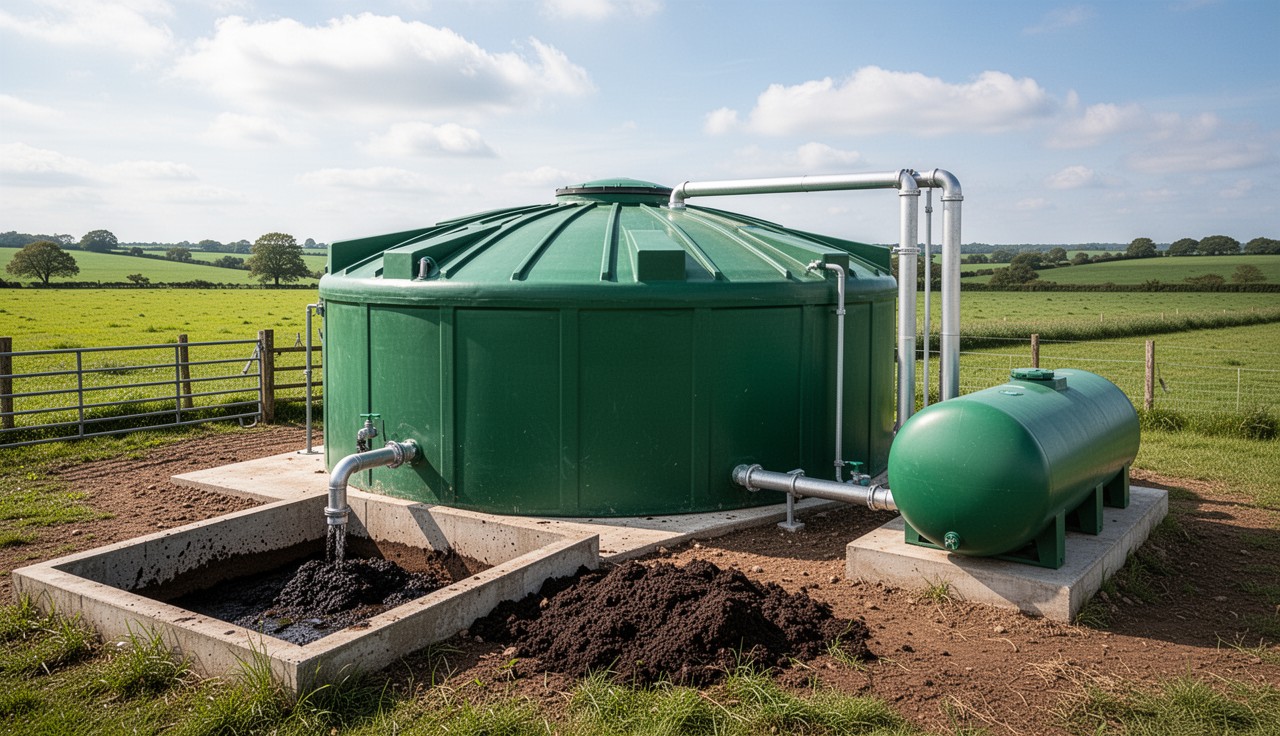
The most widely deployed biogas system in human history. Over 40 million installed in China alone. A fixed-dome digester is a sealed underground masonry or concrete chamber with no moving parts, no metal components, and an expected lifespan of 30-50 years.
**How it works.** Feedstock slurry enters through an inlet pipe. Gas accumulates in the dome above the slurry surface. As gas pressure builds, it pushes slurry up through the outlet into an overflow tank (the compensation chamber). When gas is used, the slurry flows back down. The gas pressure is self-regulating — typically 5-15 cm water column.
**Sizing.** Standard Chinese household digesters are 6-10 m³ total volume for a family of 4-5 with 2-3 cattle. Construction cost in developing countries: $200-600 USD. In the United States, building one from concrete: $1,500-4,000 for the same size.
**Advantages:** No moving parts. No corrosion. Underground construction maintains thermal mass. Extremely long lifespan. Low maintenance — annual desludging only.
**Disadvantages:** Requires skilled masonry. Must be gas-tight — even hairline cracks cause failure. Underground construction means excavation. Not portable. Difficult to repair once sealed.
Floating-Drum Digester (Indian Model)
India's contribution to small-scale biogas. The KVIC (Khadi and Village Industries Commission) Gobar Gas Plant uses an inverted steel drum that floats on the slurry surface inside a cylindrical masonry well. The drum rises as gas accumulates and falls as gas is used, providing both gas storage and constant-pressure delivery.
**Sizing.** Standard KVIC designs range from 1 m³ to 10 m³ digester volume. A 2 m³ unit serves a family of 4 with 2 cattle. Construction cost: $300-800 in developing countries. U.S. equivalent build: $1,000-3,000.
**Advantages:** Constant gas pressure (determined by drum weight). Visual gas level indicator — the drum height tells you how much gas you have. Simpler to build gas-tight than a fixed dome.
**Disadvantages:** The steel drum corrodes. Expected drum lifespan: 5-15 years depending on H₂S concentration and whether the drum is painted. Drum replacement is the primary ongoing cost.
Bag/Tube Digester (Plug-Flow)
The fastest, cheapest biogas system to deploy. A tubular polyethylene bag (typically 4-6 meters long, 1-1.5 meters diameter) laid in a trench. Feedstock enters one end, digestate exits the other. Gas collects in the upper portion of the bag and is piped off through a T-fitting.
**Materials cost:** $50-200 for a household-scale unit. The bag is UV-stabilized polyethylene or PVC, 0.5-1.0 mm thickness. Expected lifespan: 2-5 years before UV degradation requires replacement.
**Advantages:** Cheapest entry point for biogas. Can be installed in a single day. No masonry skills required. Portable — can be moved if needed.
**Disadvantages:** Short lifespan. Vulnerable to puncture (rodents, tools, livestock). Poor thermal insulation — performance drops sharply in winter without insulation. Low gas storage capacity — must be used as produced or stored separately.
IBC Tote System (Small-Scale DIY)
The practical starting point for anyone in the United States who wants to experiment with biogas before committing to permanent infrastructure. Uses standard 275-gallon (1,000-liter) IBC totes, which are available used for $50-150 at agricultural supply stores.
**Basic design:** One IBC tote serves as the digester. The top cap is sealed and fitted with a gas outlet (ball valve + barbed fitting), a pressure relief valve (set to 2-4 psi), and a feeding port (4-inch PVC cleanout fitting). A second IBC tote, partially filled with water, serves as a gas storage vessel using the water displacement method — gas enters the bottom through a submerged pipe, water is displaced out through an overflow, and the gas is stored at whatever pressure the water column provides.
**Capacity:** A single 1,000-liter IBC tote, fed 10-15 kg of cow manure slurry daily (8% total solids), produces approximately 0.3-0.5 m³ of biogas per day — enough for 30-60 minutes of cooking on a single-burner stove. Not enough to run a household. Enough to prove the concept and learn the biology before scaling up.
**Insulation:** Wrap the tote in rigid foam insulation (2 inches minimum) and enclose in a plywood box for cold-climate operation. A thermostatically controlled aquarium heater (300W) inside the tote maintains mesophilic temperature in winter. Power cost: approximately $15-25/month in winter, negligible in summer.
4. Setup — Sizing Calculations and Design Parameters
Digester Sizing
Three numbers determine digester size: daily feedstock volume, hydraulic retention time (HRT), and organic loading rate (OLR).
**Step 1: Determine daily feedstock volume.** A standard dairy cow produces 35-45 kg of manure per day. Mixed with water to 8-10% total solids, this becomes approximately 50-60 liters of slurry per cow per day.
Example: 3 cows + 5 kg kitchen waste/day = 135-180 kg manure + 5 kg food waste = roughly 180-220 liters of slurry/day.
**Step 2: Apply hydraulic retention time.** HRT is the average number of days feedstock remains in the digester. Longer HRT means more complete digestion and more gas per unit of feedstock — but also a larger digester.
| Temperature Regime | Temperature Range | Recommended HRT | Gas Production Rate | |---|---|---|---| | Psychrophilic (unheated) | 10-25°C | 60-90 days | Slow, variable | | Mesophilic (standard) | 30-40°C (optimal 35°C) | 20-30 days | Steady, reliable | | Thermophilic (heated) | 50-60°C (optimal 55°C) | 10-15 days | Fast, higher yield |
Mesophilic digestion at 35°C with a 25-day HRT is the standard for small-scale systems. It is the most stable, most forgiving, and most energy-efficient regime. Thermophilic digestion produces 15-25% more gas and better pathogen kill, but requires precise temperature control (±2°C) and is far less tolerant of operational upset.
**Step 3: Calculate digester volume.** Digester volume = Daily slurry input × HRT × safety factor (1.2-1.5)
Example: 200 liters/day × 25 days × 1.3 = 6,500 liters = 6.5 m³
A 6.5 m³ digester is the correct size for a household with 3 cows at mesophilic temperature. This is well within the range of a standard Chinese fixed-dome or Indian floating-drum design.
**Step 4: Check organic loading rate.** OLR is the mass of volatile solids fed per cubic meter of digester per day. For mesophilic digesters, the safe OLR range is 1-3 kg VS/m³/day. Above 4 kg VS/m³/day, the digester is at risk of acidification from volatile fatty acid accumulation.
For cow manure at 8% total solids and 80% volatile solids: OLR = (200 L/day × 0.08 × 0.80) / 6.5 m³ = 12.8 kg VS / 6.5 m³ = 1.97 kg VS/m³/day
That is within the safe range. The system is properly sized.
Expected Gas Production
A properly designed and operated mesophilic digester processing cow manure should produce 0.25-0.40 m³ of biogas per kg of volatile solids destroyed. For the example system above:
- Daily VS input: 12.8 kg
- VS destruction rate: 40-60% (typical for mesophilic, 25-day HRT)
- Daily gas production: 12.8 × 0.50 × 0.35 = approximately 2.2 m³/day
At 60% methane content, that is 1.3 m³ of methane per day — equivalent to approximately 1.3 liters of diesel fuel or 1.4 liters of gasoline in energy content. Enough for 2-3 hours of cooking on a standard biogas burner or 1-1.5 hours of operation of a 3 kW biogas generator.
5. Process — Startup, Operation, and Gas Handling
Startup and Inoculation
A new digester needs a viable population of methanogenic archaea before it can produce methane. These organisms grow slowly — doubling time of 5-16 days for mesophilic methanogens, compared to hours for most bacteria. A digester started with raw manure alone takes 30-60 days to reach stable gas production. A digester inoculated with active digestate from a working system reaches stable production in 10-20 days.
**Inoculation sources (in order of preference):** 1. Active digestate from a running biogas plant — the best possible inoculum. Even 20% by volume dramatically accelerates startup. 2. Rumen fluid from a slaughterhouse — rich in methanogenic archaea. Mix 50:50 with manure slurry. 3. Septic tank sludge (from an active, functioning system) — contains methanogens adapted to similar substrates. 4. Pond or swamp sediment — wild methanogen populations. Slowest but functional.
**Startup procedure:** 1. Fill digester to 60% volume with inoculum + manure slurry at 6-8% total solids. 2. Seal the digester. Confirm gas-tight with soapy water on all fittings. 3. Wait 5-7 days. Do not feed. The initial gas will be mostly CO₂ and will not burn. 4. Test gas with a match at the burner on day 7. If it burns with a blue flame, methane production has begun. If it does not burn, wait 3-5 more days and test again. 5. Begin feeding at 50% of design loading rate. Increase to full loading over 2-3 weeks. 6. Monitor pH weekly. Stable digesters run at pH 6.8-7.4. If pH drops below 6.5, stop feeding and wait for the methanogens to catch up with the acid-producing bacteria.
**The most common startup failure:** Overfeeding during the first month. The acid-producing bacteria (acidogens) establish faster than the methane-producing archaea (methanogens). If you feed too much too fast, volatile fatty acids accumulate, pH drops, and the methanogens are inhibited. This is called "souring." Recovery from a soured digester takes 4-8 weeks of zero feeding. Patience during startup is the single most valuable operational skill.
Daily Operation
Once stable, a biogas digester is one of the least labor-intensive systems on a homestead.
**Daily tasks (10-15 minutes):** 1. Mix feedstock with water to target consistency (8-10% total solids — should pour like thin pancake batter). 2. Feed slurry through the inlet. Feed at the same time each day. Consistency matters more than precision. 3. Check gas pressure (water column gauge or pressure gauge). Normal operating pressure: 5-20 cm water column (0.07-0.28 psi). 4. Drain condensate from gas line low points (a U-trap in the gas line collects water — drain daily in humid climates).
**Weekly tasks (30 minutes):** 1. Check pH of digestate at the outlet. Target: 6.8-7.4. 2. Check gas composition with a portable gas analyzer or match test (steady blue flame = adequate methane content). 3. Inspect gas line connections with soapy water for leaks.
**Monthly/seasonal tasks:** 1. Check H₂S scrubber media (iron sponge) — replace when spent (turns from brown to black). 2. Inspect pressure relief valve function. 3. In cold climates, verify insulation integrity and heating system operation.
Gas Collection and Storage
Biogas is produced continuously but used intermittently. Storage is necessary.
**Low-pressure gas bags.** The simplest storage method. A heavy-duty PVC or butyl rubber bag (1-10 m³ capacity) connected to the digester gas outlet stores biogas at near-atmospheric pressure. The bag inflates as gas accumulates and deflates as gas is used. Cost: $50-300 depending on size. Lifespan: 3-10 years.
**Water displacement storage.** An inverted container (drum, tank, or IBC tote) sitting in a water bath. Gas enters from below, displaces water, and is stored at a pressure equal to the weight of the container plus the water column height. Provides consistent pressure. Cost: $50-200 DIY. Indefinite lifespan for steel or concrete versions.
**Compressed storage.** Biogas can be compressed to 150-200 bar for vehicle fuel or long-term storage, but this requires an H₂S-free, dried gas (H₂S destroys compressors) and a multi-stage compressor rated for methane service. This is industrial-scale equipment. Not appropriate for homestead-scale unless you are generating surplus gas and have a specific vehicle fuel application.
H₂S Removal — The Iron Sponge Method
Hydrogen sulfide (H₂S) is present in all biogas at concentrations ranging from 100 to 10,000 ppm depending on feedstock. H₂S is toxic, corrosive, and must be removed before the gas is burned in any engine, boiler, or generator. It can be burned directly in a cooking stove at low concentrations (below 200 ppm) with adequate ventilation, but the smell is foul and the sulfur dioxide combustion product is also unpleasant.
**Iron sponge scrubbing** is the standard small-scale removal method. Steel wool or iron-oxide-coated wood chips are packed into a PVC pipe (4-6 inch diameter, 2-4 feet long) through which the biogas flows. The H₂S reacts with the iron oxide to form iron sulfide:
Fe₂O₃ + 3H₂S → Fe₂S₃ + 3H₂O
The iron sponge turns from reddish-brown to black as it is consumed. A 4-inch × 3-foot column packed with grade 0000 steel wool will scrub approximately 50-100 m³ of biogas before needing replacement, depending on inlet H₂S concentration.
**Regeneration.** Spent iron sponge can be partially regenerated by exposing it to air:
2Fe₂S₃ + 3O₂ → 2Fe₂O₃ + 6S
This is an exothermic reaction. Spread the spent media thinly outdoors and allow it to oxidize for 24-48 hours. The regenerated media has approximately 60-70% of its original capacity. It can be regenerated 2-3 times before the accumulated sulfur renders it ineffective.
**Caution:** Never dump a large mass of spent iron sponge into an enclosed space for regeneration. The oxidation reaction generates significant heat and can cause spontaneous ignition of the sulfur and steel wool. Always regenerate in open air, spread thin.
6. Gas Composition and End Use
What Is in the Gas
| Component | Typical Range | Effect | |---|---|---| | Methane (CH₄) | 50-70% | The fuel. Burns clean. | | Carbon dioxide (CO₂) | 25-45% | Inert diluent. Reduces energy density. | | Water vapor (H₂O) | 1-5% | Condensation causes pipeline corrosion. | | Hydrogen sulfide (H₂S) | 100-10,000 ppm | Toxic. Corrosive. Must be scrubbed for engine use. | | Nitrogen (N₂) | 0-3% | Inert. From air ingress. | | Hydrogen (H₂) | 0-1% | Minor fuel contribution. | | Ammonia (NH₃) | 0-1% | Corrosive to copper fittings. | | Siloxanes | Trace | From food waste containing silicone products. Deposits as silica on engine components. |
Cooking
The most direct and efficient use of biogas. A standard biogas cooking burner consumes 0.2-0.4 m³/hour. Biogas burners require larger orifices than natural gas or propane burners because the lower energy density of biogas requires higher flow rates. A propane burner will not run efficiently on biogas without modification — the orifice must be drilled out to 2-3x the propane orifice diameter.
Biogas burner efficiency: 55-65%. A family of 4 needs approximately 1.2-1.5 m³ of biogas per day for cooking — achievable from the manure of 2 cows plus kitchen waste.
Heating
Biogas can be burned in any gas-fired boiler or space heater with appropriate burner modification (larger orifice, adjusted air-fuel mixture). At 60% methane content, biogas has approximately 21.5 MJ/m³. For comparison, propane delivers 91.5 MJ/m³ — roughly 4x the energy density. Biogas heating makes sense where the gas is free (from waste processing) and the demand is moderate (greenhouse heating, water heating for livestock, supplemental space heating).
Engine Fuel
Biogas can run any spark-ignition (gasoline) engine with minimal modification — replace the carburetor with a gas mixer or inject biogas upstream of the throttle body. Compression-ignition (diesel) engines require dual-fuel operation: 70-80% biogas with 20-30% diesel for compression ignition (diesel serves as the pilot fuel).
**Critical requirement for engine use:** H₂S must be below 100 ppm. Above that concentration, H₂S forms sulfuric acid in the crankcase oil, destroying bearings and cylinder walls within 500-1,000 hours of operation. Scrub before using in any engine.
Engine efficiency on biogas: 25-30% electrical conversion for spark-ignition, 30-38% for dual-fuel diesel. A 5 kW generator running on biogas consumes approximately 2.5-3.0 m³/hour.
Electrical Generation — CHP
Combined heat and power is the highest-value use of biogas at farm scale. A CHP unit is an engine-generator set where the waste heat from the engine coolant and exhaust is captured for water or space heating. Total energy recovery: 80-90% (30-38% electrical + 45-55% thermal). This is the configuration that makes farm-scale biogas economically viable in Europe.
A 10 kW CHP unit running 8 hours/day on biogas from 20 cattle produces approximately 80 kWh/day of electricity and 120 kWh/day of thermal energy — enough to power a small farm's electrical loads and heat the digester, a greenhouse, or a livestock building.
Upgrading to Biomethane
Biogas can be upgraded to pipeline-quality biomethane (>95% CH₄) by removing CO₂. Methods include water scrubbing, pressure swing adsorption (PSA), membrane separation, and amine scrubbing. This is industrial-scale technology — the smallest commercially viable upgrading plants process 100-250 m³/hour of raw biogas. Not applicable at homestead scale, but relevant for farm cooperatives or community-scale digesters feeding into natural gas grids.
7. Safety — Methane, H₂S, and Confined Spaces
Biogas safety failures kill people every year. The three hazards are explosion, poisoning, and asphyxiation. Every person who operates a biogas system must understand all three.
Methane Explosion Risk
Methane is explosive in air at concentrations between 5% and 15% (the lower and upper explosive limits, LEL and UEL). Below 5%, there is not enough fuel. Above 15%, there is not enough oxygen. Between those limits, any ignition source — a spark, a flame, a hot surface above 537°C — detonates the mixture.
**Practical consequences:**
- Never use an open flame to check for gas leaks. Use soapy water.
- Never smoke near a digester, gas storage, or gas lines.
- All electrical equipment in a biogas handling area must be rated for Zone 2 (IEC) or Class I Division 2 (NEC) hazardous locations — no arcing contacts, no unsealed switches, no standard light fixtures.
- Gas storage vessels must have pressure relief valves set below the vessel's burst pressure. Over-pressurization is the leading cause of biogas system failures.
- A digester that has been opened for maintenance contains a methane atmosphere. Ventilate with forced air for a minimum of 30 minutes before any person enters. Test atmosphere with a combustible gas detector before entry.
Hydrogen Sulfide — The Invisible Killer
H₂S is the most dangerous component of biogas. It is heavier than air (specific gravity 1.19) and accumulates in low-lying areas, pits, and enclosed spaces. At low concentrations it smells like rotten eggs. At high concentrations it paralyzes the olfactory nerve — you stop smelling it before it kills you.
| H₂S Concentration (ppm) | Effects | |---|---| | 0.5-10 | Detectable odor. No health effects at brief exposure. | | 10-50 | Eye and respiratory irritation. Prolonged exposure causes headache. | | 50-100 | Moderate eye and lung irritation. Olfactory fatigue begins. OSHA ceiling: 50 ppm. | | 100-200 | Olfactory nerve paralysis within 2-15 minutes. You stop smelling it. | | 200-500 | Pulmonary edema, unconsciousness. Potentially fatal with prolonged exposure. | | 500-1,000 | Rapid unconsciousness ("knockdown"). Fatal within 30-60 minutes. | | >1,000 | Immediate collapse. Death within minutes. |
**Non-negotiable safety rules for H₂S:**
- Never enter a digester, manure pit, gas storage area, or any enclosed space associated with biogas without a personal H₂S monitor. These cost $100-200 and clip to your clothing.
- Never work alone around biogas systems. A rescue partner must be present — outside the space, with a plan for calling emergency services.
- If you smell rotten eggs and then the smell disappears, you are not "getting used to it." Your olfactory nerve is shutting down. Leave the area immediately and move upwind.
- Manure pits and slurry channels are the most common sites of fatal H₂S exposure on farms — more common than digester-related incidents.
Oxygen Displacement
Biogas in an enclosed space displaces oxygen. Normal atmospheric oxygen is 20.9%. Below 19.5%, impairment begins. Below 16%, consciousness is lost. Below 10%, death occurs within minutes. A digester headspace, a gas storage room, or a poorly ventilated area where biogas has leaked can become an immediately dangerous to life or health (IDLH) atmosphere without any visible or obvious warning.
**Confined space entry protocol:** 1. Test atmosphere with a 4-gas monitor (O₂, CH₄ LEL, H₂S, CO) before entry. 2. Continuous ventilation with a blower during entry. 3. Continuous atmospheric monitoring during occupancy. 4. Rescue plan and trained standby person at the entry point. 5. Never bypass this protocol. The survivors of biogas fatalities are almost always the people who did not enter the space to attempt a rescue without protection.
8. Digestate Management — Fertilizer, Pathogen Reduction, and Regulations
Fertilizer Value
Digestate retains essentially all of the nutrients from the original feedstock. Anaerobic digestion does not consume nitrogen, phosphorus, or potassium — it converts them from organic to mineral forms. The nitrogen in raw manure is mostly organic nitrogen (bound in proteins and amino acids), which must be mineralized by soil bacteria before plants can use it. Digestate nitrogen is 60-80% ammonium nitrogen (NH₄⁺), which is immediately plant-available.
**Typical digestate nutrient content (from cattle manure digestion):**
- Total nitrogen: 3-5 kg/m³
- Ammonium nitrogen: 2-4 kg/m³ (60-80% of total N)
- Phosphorus (P₂O₅): 0.5-1.5 kg/m³
- Potassium (K₂O): 2-5 kg/m³
- pH: 7.5-8.5
At a production rate of 200 liters/day, a household digester produces approximately 73 m³ of digestate per year — containing roughly 220-365 kg of total nitrogen, 37-110 kg of phosphorus, and 146-365 kg of potassium. At 2024 fertilizer prices, the nutrient value alone is $400-800/year.
Pathogen Reduction
Mesophilic digestion (35°C, 20-30 day HRT) reduces *E. coli* by 90-99%, *Salmonella* by 90-99.9%, and helminth eggs by 80-95% (Sahlström, 2003). Thermophilic digestion (55°C, 15+ day HRT) achieves near-complete elimination of vegetative pathogens and 99.9%+ reduction of helminth eggs — meeting EPA Class A biosolids standards for unrestricted land application.
Mesophilic digestate is generally safe for application to cropland but should not be applied to edible crops consumed raw within 30 days of application. Thermophilic digestate can be applied with fewer restrictions.
Dewatering and Storage
Raw digestate is 92-95% water. For field application, this is fine — apply with a slurry tanker or through irrigation lines. For transport or sale, dewatering is necessary.
**Gravity separation.** Allow digestate to settle in a holding tank for 24-48 hours. The solids settle to approximately 15-20% total solids. Decant the liquid fraction (which contains most of the ammonium nitrogen) and apply it separately as liquid fertilizer.
**Screw press.** A mechanical screw press dewaters digestate to 25-35% total solids. The solid fraction can be composted, used as livestock bedding (if from a thermophilic digester), or stored in windrows. The liquid fraction is the primary fertilizer product.
Regulatory Requirements
In the United States, digestate from animal manure digesters is regulated as manure under state nutrient management plans. No additional permits are typically required for on-farm use. If digestate is sold or distributed off-farm, EPA 40 CFR Part 503 biosolids regulations may apply, depending on the state and the feedstock.
Food waste digestate may trigger additional regulatory requirements. Check state-level solid waste regulations before accepting food waste from off-farm sources.
9. Scaling — From Household to Farm to Grid
Household Scale (1-10 m³ digester)
The starting point. 2-5 livestock plus kitchen waste. Produces enough gas for cooking. Digestate replaces purchased fertilizer for a kitchen garden or small market garden. Total system cost: $500-4,000 depending on design. Payback period: 2-5 years against propane and fertilizer costs.
Farm Scale (50-500 m³ digester)
A dairy with 50-200 cows produces enough manure to justify a continuously stirred tank reactor (CSTR) with a CHP unit. Typical system: 200 m³ digester, 20-50 kW CHP engine-generator, waste heat recovery for digester heating and barn heating. Capital cost: $150,000-500,000. Payback period: 5-10 years with electricity sales, fertilizer savings, and tipping fees for food waste co-digestion.
The critical economic variable at farm scale is tipping fees. Accepting food waste from restaurants, grocery stores, and food processors at $30-60/ton transforms the economics — you are paid to take the feedstock that produces gas and fertilizer. Every profitable farm-scale digester in the United States accepts co-substrates.
Community and Grid Scale (1,000+ m³)
Multiple-farm cooperatives or municipal digesters processing 50-200 tons/day of mixed feedstock. Gas is upgraded to biomethane and injected into the natural gas grid or compressed as vehicle fuel. Capital cost: $2-10 million. Requires professional engineering, full-time operators, and regulatory permitting.
Denmark's model is instructive: over 150 centralized biogas plants process manure from multiple farms plus organic industrial waste. The gas is upgraded and injected into the national gas grid. The digestate is returned to the contributing farms as fertilizer. The system is profitable, reduces agricultural greenhouse gas emissions by 30-50%, and creates rural jobs.
Combined Heat and Power — The Farm-Scale Sweet Spot
CHP is the configuration that makes biogas pencil out at farm scale in the United States. A CHP unit converts 30-38% of biogas energy to electricity and captures 45-55% as usable heat. The remaining 10-15% is stack loss.
A 30 kW CHP unit running 7,500 hours/year (85% availability) produces 225,000 kWh of electricity. At $0.12/kWh (average U.S. commercial rate), that is $27,000/year in electricity value — plus thermal energy for digester heating, barn heating, or process hot water. Against a capital cost of $200,000-400,000 for the complete system (digester + CHP + gas handling), the payback with co-digestion tipping fees is 5-8 years.
10. Sources
1. Chen, L., Zhao, L., Ren, C., & Wang, F. (2017). The progress and prospects of rural biogas production in China. *Renewable and Sustainable Energy Reviews*, 76, 80-97.
2. Mata-Alvarez, J., Dosta, J., Romero-Güiza, M.S., Fonoll, X., Peces, M., & Astals, S. (2014). A critical review on anaerobic co-digestion achievements between 2010 and 2013. *Renewable and Sustainable Energy Reviews*, 36, 412-427.
3. Rajagopal, R., Massé, D.I., & Singh, G. (2013). A critical review on inhibition of anaerobic digestion process by excess ammonia. *Bioresource Technology*, 140, 431-438.
4. Sahlström, L. (2003). A review of survival of pathogenic bacteria in organic waste used in biogas plants. *Bioresource Technology*, 87(2), 161-166.
5. Weiland, P. (2010). Biogas production: current state and perspectives. *Applied Microbiology and Biotechnology*, 85(4), 849-860.
6. OSHA Fact Sheet. Hydrogen Sulfide (H₂S). U.S. Department of Labor, Occupational Safety and Health Administration.
7. American Biogas Council. (2023). Biogas State Profile: United States. https://americanbiogascouncil.org
8. Al Seadi, T., Rutz, D., Prassl, H., Köttner, M., Finsterwalder, T., Volk, S., & Janssen, R. (2008). *Biogas Handbook*. BiG>East Project, University of Southern Denmark.
9. Gerardi, M.H. (2003). *The Microbiology of Anaerobic Digesters*. John Wiley & Sons.
10. Bond, T., & Templeton, M.R. (2011). History and future of domestic biogas plants in the developing world. *Energy for Sustainable Development*, 15(4), 347-354.
`[practical-skills]` `[facility-design]` `[advanced]`