Plants
Black Cohosh (Actaea racemosa, syn. Cimicifuga racemosa)
Grow black cohosh (Actaea racemosa): botany, origin and history, plant morphology, climate and soil requirements, propagation, and harvest.
On this page
Botanical Description
Black cohosh is a tall, shade-obligate perennial in the Ranunculaceae (buttercup) family. Native to eastern North American deciduous forests, it grows in dense understory colonies along hillsides and ravines from southern Ontario to Georgia.
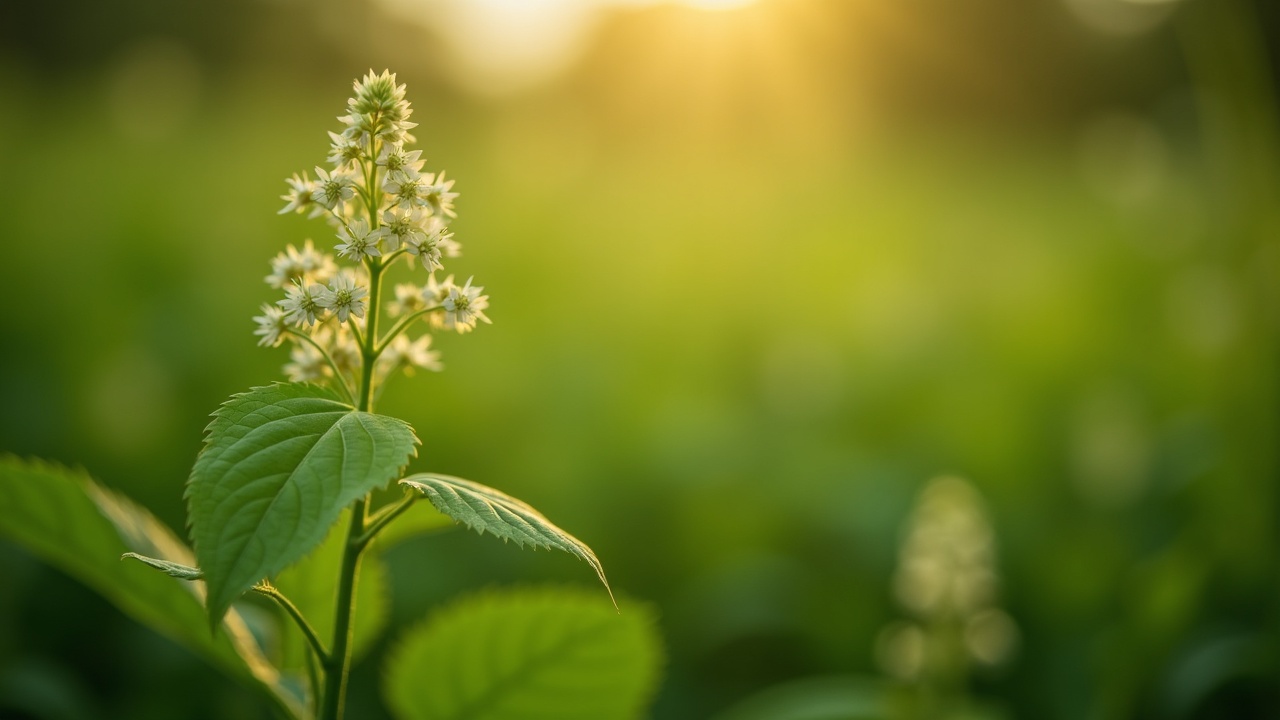
The plant produces dramatic white flower racemes, spires up to 60 cm long, that bloom June through September. The flowers are small, lack petals, and rely on stamens for their brush-like appearance. They smell unpleasant. Pollination is primarily by generalist flies and beetles, not bees.
The medicinal parts are the root and rhizome. These are thick, dark, knotted structures with a bitter taste and faint, acrid odor.
Origin and History
Appalachian indigenous peoples used black cohosh root long before European contact. Cherokee, Iroquois, and Algonquin nations documented uses for rheumatic pain, gynecological complaints, and snakebite, the common name "bugbane" references its use as an insect repellent.
European settlers adopted it by the 1830s. The Eclectic physicians made it a staple for uterine conditions under the name Macrotys. By the 1950s, German phytomedicine companies began standardizing extracts. Remifemin, the most studied commercial preparation, launched in Germany in 1956 and remains the benchmark product.
The misidentification as a phytoestrogen took hold in the 1980s-90s when supplement companies marketed it alongside soy isoflavones. The correction came slowly. Burdette et al. (2003) demonstrated the serotonergic mechanism, but marketing copy still lags behind the science.
Plant Morphology
- Height: 1-2.5 m at maturity
- Leaves: Large, compound, ternately divided. Leaflets sharply toothed, 5-12 cm long.
- Flowers: White, apetalous, in terminal racemes 20-60 cm long. Each flower 6-8 mm across.
- Fruit: Dry follicles, 5-10 mm, containing 8-10 seeds per capsule. Seeds require double dormancy to germinate.
- Root/Rhizome: Dark brown to black. Thick, horizontal rhizome with numerous fibrous roots. Knotted, woody texture. Cross-section shows a distinct ring pattern.
Climate Requirements
| Parameter | Range / Tolerance |
|---|---|
| USDA Hardiness Zones | 3–8 |
| Light | Partial to full shade |
| Soil | Rich, moist, well-drained woodland soil; pH 5.0–6.0 |
| Moisture | Consistently moist; does not tolerate drought |
| Spacing | 18–24 inches |
- USDA Zones: 3-8
- Light: Partial to full shade. Mimics deciduous forest understory. Dappled light through canopy is ideal. Direct sun causes leaf scorch and stunted root development.
- Temperature: Tolerates winter lows to -40C. Requires 90-120 days of cold stratification for seed germination. Summer heat above 32C with direct exposure will stress the plant.
- Moisture: Consistent moisture required. Not drought-tolerant. Prefers 100-125 cm annual rainfall or supplemental irrigation. Does not tolerate standing water.
Soil and Fertility
Black cohosh is a woodland soil specialist. It evolved in deep, humus-rich forest floor conditions.
- pH: 5.0-6.0 (moderately acidic)
- Texture: Loamy, well-drained, high organic matter (5%+ ideal)
- Fertility: Heavy feeder on decomposed leaf litter. In cultivation, top-dress annually with 5-8 cm aged hardwood leaf compost. Avoid synthetic nitrogen, it pushes foliar growth at the expense of root triterpene concentration.
- Mycorrhizal associations: Benefits from ectomycorrhizal fungi native to hardwood forests. Inoculation with forest floor soil from native stands improves establishment rates.
Propagation
From seed (preferred for genetic diversity): Seeds require double dormancy, warm stratification (60-90 days at 20-25C) followed by cold stratification (90-120 days at 1-5C). Sow in fall for natural stratification outdoors. Germination rate: 40-60% under optimal conditions. Expect 12-18 months from sow to first true leaves.
From rhizome division (faster, clonal): Divide mature plants (4+ years) in early spring before growth initiates. Each division needs 2-3 buds and attached root mass. Replant immediately at 5-8 cm depth. Spacing: 45-60 cm between plants, 60-90 cm between rows. Division yields harvestable roots 2-3 years faster than seed but narrows genetic base.
Sourcing ethics: Purchase nursery-propagated stock only. Wild-dug transplants accelerate population decline and carry disease risk. Several Appalachian nurseries now specialize in woodland medicinals. Use them.
Growth Cycle and Harvest
- Year 1-2: Establishment. Small basal leaves only. No harvest.
- Year 3: First flowering possible. Root mass still insufficient.
- Year 4-5: Harvestable root mass achieved. Rhizomes reach 2-4 cm diameter.
- Harvest window: Late September through November, after aerial parts senesce. Triterpene glycoside concentrations peak in fall dormancy.
- Method: Dig entire root mass. Shake off soil. Do not wash immediately, field-dry 2-4 hours first. Harvest selectively: take no more than 30% of a cultivated stand per year to maintain colony vigor.
Post-Harvest Handling
1. Remove aerial stems. Brush off soil. Avoid water until ready for final wash. 2. Wash roots in cold running water. Scrub with stiff brush. Remove all soil and debris. 3. Cut rhizomes into 1-2 cm cross-sections. Split large roots lengthwise. 4. Dry at 35-40C with good airflow. Do not exceed 45C, triterpene glycosides degrade above this threshold. Drying time: 5-10 days depending on humidity. 5. Properly dried root snaps cleanly. If it bends, continue drying. 6. Store in sealed containers away from light and moisture. Shelf life: 2-3 years if stored below 20C and under 30% humidity.
Processing and Preservation
Tincture (standard preparation): 1:5 ratio, dried root to 60% ethanol. Macerate 4-6 weeks with daily agitation. Press and filter. Dose: 1-2 mL, 2-3 times daily.
Decoction (traditional): Simmer 3-5 g dried root in 350 mL water for 20-30 minutes. Strain. This method extracts water-soluble compounds but misses many triterpene glycosides, which are poorly water-soluble.
Standardized extract (commercial benchmark): Isopropanol extraction standardized to 2.5% triterpene glycosides (calculated as 27-deoxyactein). This matches the Remifemin specification used in most clinical trials. Home extraction cannot reliably achieve standardization, for clinical applications, use tested commercial preparations.
Functional Compounds
| Compound | Class | Documented Activity | |---|---|---| | Actein | Triterpene glycoside | 5-HT7 receptor binding; thermoregulatory modulation | | 23-epi-26-deoxyactein | Triterpene glycoside | Serotonergic activity; anti-inflammatory | | Cimicifugoside | Triterpene glycoside | 5-HT1A partial agonism | | Fukinolic acid | Hydroxycinnamic acid | Antioxidant; weak SERM activity (debated) | | Cimicifugic acids A-F | Phenylpropanoid esters | Anti-inflammatory; free radical scavenging | | N-methylserotonin | Indole alkaloid | Direct serotonergic compound (trace amounts) |
The triterpene glycosides are the primary actives. Their serotonergic mechanism explains the clinical effects on vasomotor symptoms without estrogenic risk, no increased breast cancer proliferation, no endometrial stimulation.
Safety and Use Boundaries
Cycling is non-negotiable. 6-8 weeks on, minimum 4 weeks off. Extended continuous use correlates with rare but documented hepatotoxicity cases.
Known risks:
- Rare hepatotoxicity: approximately 50 case reports worldwide as of 2020. Most involved prolonged continuous use or concurrent hepatotoxic medications (Teschke & Schwarzenboeck, 2009).
- GI upset at high doses. Start low.
- Headache reported in clinical trials at rates similar to placebo.
Contraindications:
- Active liver disease or history of hepatotoxicity
- Concurrent use of hepatotoxic drugs (acetaminophen at high doses, statins, certain antifungals)
- Pregnancy and lactation, insufficient safety data
- Hormone-sensitive cancers, while the mechanism is serotonergic, not estrogenic, clinical caution applies until larger studies confirm safety in this population
Adulteration risk: Commercial black cohosh products are frequently adulterated with Asian Actaea species (A. dahurica, A. heracleifolia), which have different chemical profiles and safety data. DNA-verified sourcing matters.
System Integration
Black cohosh fits a specific niche in a diversified woodland medicinal planting:
- Companion planting: Grows well under established hardwood canopy alongside goldenseal, ginseng, wild ginger, and bloodroot. All share similar soil, shade, and moisture requirements.
- Forest farming: Integrate into existing woodlot management. Black cohosh tolerates the same conditions as high-value timber species (oak, hickory, tulip poplar). Revenue diversification while timber matures.
- Conservation cultivation: Every cultivated root reduces wild harvest pressure. Appalachian populations cannot sustain current extraction rates. Growing your own is a conservation act.
- Rotation strategy: In a formulation context, cycle black cohosh with other nervine and adaptogenic herbs. It is not a daily-driver extract. It is an intervention tool for specific symptom windows.
References
1. Burdette, J.E., Liu, J., Chen, S., et al. (2003). Black cohosh acts as a mixed competitive ligand and partial agonist of the serotonin receptor. Journal of Agricultural and Food Chemistry, 51(19), 5661-5670. DOI: 10.1021/jf034264r
2. Leach, M.J., & Moore, V. (2012). Black cohosh (Cimicifuga spp.) for menopausal symptoms. Cochrane Database of Systematic Reviews, (9), CD007244. DOI: 10.1002/14651858.CD007244.pub2
3. Teschke, R., & Schwarzenboeck, A. (2009). Suspected hepatotoxicity by Cimicifugae racemosae rhizoma (black cohosh, root): critical analysis and structured causality assessment. Phytomedicine, 16(1), 72-84. DOI: 10.1016/j.phymed.2008.09.009
4. Chamberlain, J.L., Prisley, S., & McGuffin, M. (2013). Understanding the relationships between American ginseng harvest and hardwood forests inventory and timber harvest to improve co-management of the forests of eastern United States. Journal of Sustainable Forestry, 32(6), 605-624. DOI: 10.1080/10549811.2013.798827
5. Fabricant, D.S., Nikolic, D., Lankin, D.C., et al. (2005). Cimipronidine, a cyclic guanidine alkaloid from Cimicifuga racemosa. Journal of Natural Products, 68(8), 1266-1270. DOI: 10.1021/np050066d
6. Foster, S. (2013). Exploring the peripatetic maze of black cohosh adulteration: a review of the analytical methods and their adequacy for authentication. Phytochemistry Reviews, 12(4), 783-798. DOI: 10.1007/s11101-013-9313-2
Tags: #black-cohosh #actaea-racemosa #triterpene-glycosides #serotonergic #woodland-medicinals #appalachian-native #menopausal-support #forest-farming #conservation-cultivation #cycling-required
Common questions
What is botanical description?
Black cohosh is a tall, shade-obligate perennial in the Ranunculaceae (buttercup) family. Native to eastern North American deciduous forests, it grows in dense understory colonies along hillsides and ravines from southern Ontario to Georgia. The plant produces dramatic white flower racemes, spires up to 60 cm long, that bloom June through September. The flowers are small, lack petals, and rely on stamens for their brush-like appearance. Pollination is primarily by generalist flies and beetles, not bees.
What has black cohosh traditionally been used for?
Appalachian indigenous peoples used black cohosh root long before European contact. Cherokee, Iroquois, and Algonquin nations documented uses for rheumatic pain, gynecological complaints, and snakebite, the common name "bugbane" references its use as an insect repellent. European settlers adopted it by the 1830s. The Eclectic physicians made it a staple for uterine conditions under the name Macrotys . By the 1950s, German phytomedicine companies began standardizing extracts.
What is plant morphology?
Height: 1-2.5 m at maturity. Leaves: Large, compound, ternately divided. Leaflets sharply toothed, 5-12 cm long. Flowers: White, apetalous, in terminal racemes 20-60 cm long. Each flower 6-8 mm across.
What climate does black cohosh tolerate?
Light: Partial to full shade. Mimics deciduous forest understory. Dappled light through canopy is ideal. Direct sun causes leaf scorch and stunted root development. Temperature: Tolerates winter lows to -40C.
What soil does black cohosh need?
Black cohosh is a woodland soil specialist. It evolved in deep, humus-rich forest floor conditions. pH: 5.0-6.0 (moderately acidic). Texture: Loamy, well-drained, high organic matter (5%+ ideal). Fertility: Heavy feeder on decomposed leaf litter.
How do I propagate black cohosh?
From seed (preferred for genetic diversity): Seeds require double dormancy, warm stratification (60-90 days at 20-25C) followed by cold stratification (90-120 days at 1-5C). Sow in fall for natural stratification outdoors. Germination rate: 40-60% under optimal conditions. Expect 12-18 months from sow to first true leaves. From rhizome division (faster, clonal): Divide mature plants (4+ years) in early spring before growth initiates.
When should I harvest black cohosh?
Year 3: First flowering possible. Root mass still insufficient. Year 4-5: Harvestable root mass achieved. Rhizomes reach 2-4 cm diameter. Harvest window: Late September through November, after aerial parts senesce.
What can I make from black cohosh?
Tincture (standard preparation): 1:5 ratio, dried root to 60% ethanol. Macerate 4-6 weeks with daily agitation. Dose: 1-2 mL, 2-3 times daily. Decoction (traditional): Simmer 3-5 g dried root in 350 mL water for 20-30 minutes. This method extracts water-soluble compounds but misses many triterpene glycosides, which are poorly water-soluble.
What is the active compound in black cohosh?
| Compound | Class | Documented Activity | |---|---|---| | Actein | Triterpene glycoside | 5-HT7 receptor binding; thermoregulatory modulation | | 23-epi-26-deoxyactein | Triterpene glycoside | Serotonergic activity; anti-inflammatory | | Cimicifugoside | Triterpene glycoside | 5-HT1A partial agonism | | Fukinolic acid | Hydroxycinnamic acid | Antioxidant; weak SERM activity (debated) | | Cimicifugic acids A-F | Phenylpropanoid esters | Anti-inflammatory; free radical scavenging | | N-methylserotonin | Indole alkaloid | Direct serotonergic compound (trace amounts) |.
Is black cohosh safe?
Cycling is non-negotiable. 6-8 weeks on, minimum 4 weeks off. Extended continuous use correlates with rare but documented hepatotoxicity cases. Rare hepatotoxicity: approximately 50 case reports worldwide as of 2020. Most involved prolonged continuous use or concurrent hepatotoxic medications (Teschke & Schwarzenboeck, 2009).
What is system integration?
Black cohosh fits a specific niche in a diversified woodland medicinal planting:. Companion planting: Grows well under established hardwood canopy alongside goldenseal, ginseng, wild ginger, and bloodroot. All share similar soil, shade, and moisture requirements. Forest farming: Integrate into existing woodlot management. Black cohosh tolerates the same conditions as high-value timber species (oak, hickory, tulip poplar).