plants
Cordwood Masonry Construction
Build with cordwood masonry: choosing and seasoning log ends, mortar formulations, wall construction, and insulation for durable earthy walls.
Content Extraction Summary
Hook Options
- A cordwood wall built with 16-inch log ends, lime-sand-sawdust mortar, and a sawdust-insulated cavity achieves R-25 to R-30 — comparable to a conventional 2x6 framed wall with spray foam — using materials that cost next to nothing if you own timber.
- Cordwood buildings over 1,000 years old still stand in Scandinavia and northern Greece, where the technique evolved independently in any culture with access to short-log timber and lime mortar.
- The thermal trick is not the wood. It is the dead air space between two mortar beads filled with loose insulation — a cavity that conventional log construction lacks entirely.
Key Mechanism
Cordwood masonry works by stacking short log sections (12–24 inches) crosswise in the wall, with mortar applied as two parallel beads along the interior and exterior faces. The cavity between the beads is filled with a loose insulation mix — typically sawdust, cellulose, or sheep's wool. Heat transfers slowly through end-grain wood (which has roughly twice the R-value per inch of side-grain), and the insulated cavity breaks the thermal bridge that would otherwise conduct energy straight through the mortar. The result is a mass wall with high thermal lag, moderate R-value, and exceptional moisture buffering.
Misconception to Correct
Most people assume cordwood walls are just decorative — a rustic aesthetic with poor thermal performance compared to framed walls. In reality, properly built cordwood walls with an insulated cavity outperform most standard frame construction in total thermal performance because they combine moderate R-value with high thermal mass. The mass effect — absorbing heat during the day and releasing it at night — reduces peak heating and cooling loads in ways that R-value alone does not capture. Rob Roy's monitoring of cordwood homes in northern New York showed heating costs 40–60% below comparable frame houses in the same climate.
Practical Application
If you have access to standing deadwood, storm-felled timber, or thinning operations, a cordwood building costs $10–$30 per square foot of wall — roughly one-tenth the cost of conventional stick-frame construction. The technique requires no specialized tools, no heavy equipment, and no electrical power. A 200-square-foot outbuilding can be built by two people in 3–4 weekends using wood that would otherwise be burned or left to rot.
Citation-Ready Claims
- [End-grain R-value ~1.25 per inch for softwoods vs ~0.71 for side-grain] → [End-grain traps air in cell lumens] → [USDA Forest Products Laboratory Wood Handbook, Chapter 4]
- [Lime-sand-sawdust mortar used in Scandinavian cordwood buildings dating to 1000+ years] → [Archaeological record] → [Rob Roy, *Cordwood Building: The State of the Art*, 2003]
- [Cordwood walls with insulated cavity achieve R-1.4 to R-1.6 per inch of wall thickness] → [Tested in cold-climate builds] → [Richard Flatau, *Cordwood Construction Best Practices*, 2012]
A Complete Guide to Building with Log Ends
*Pure Euphoria Botanicals · Nored Farms · Austin, Texas*
1. Introduction and History
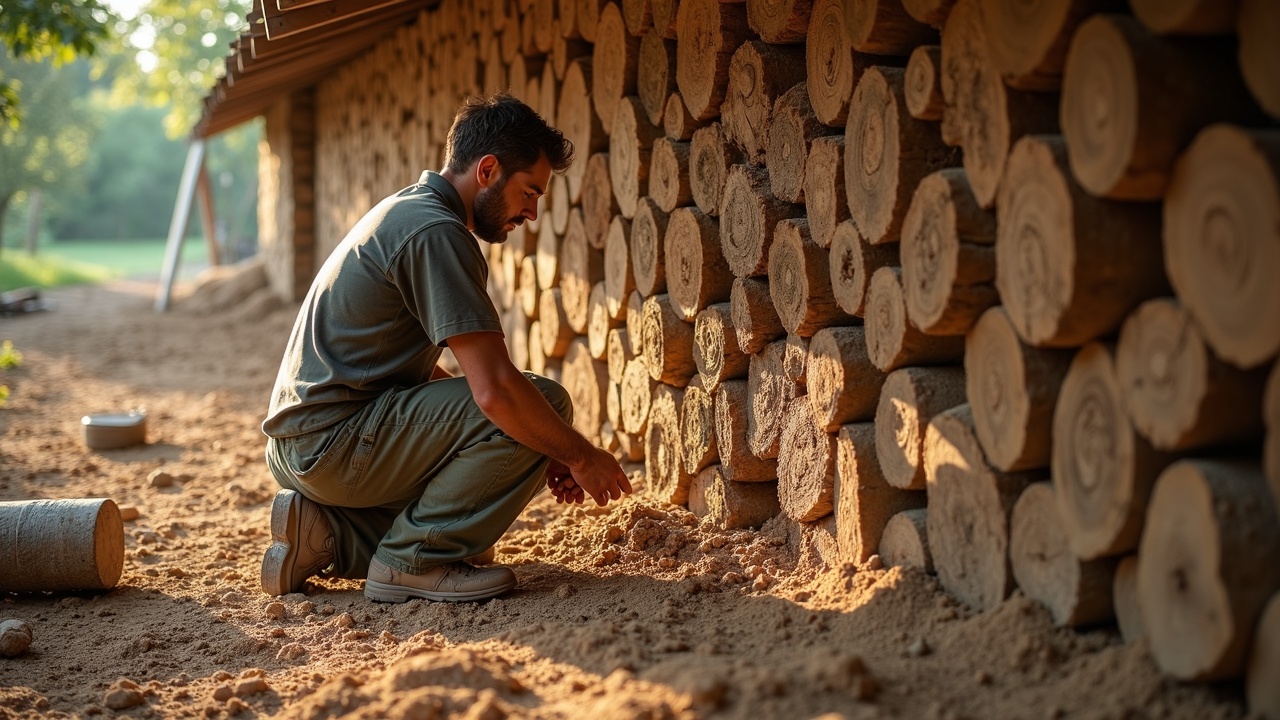
A cordwood wall is a thermal battery disguised as a rustic wall. Short log sections — typically 12 to 24 inches long — are stacked crosswise in mortar the way a cord of firewood is stacked, but with each log end exposed on both the interior and exterior face of the wall. The mortar locks the logs in place. The insulation cavity between the two mortar beads provides the thermal break. The mass of the wall absorbs and releases heat slowly, flattening temperature swings in ways that lightweight framed walls cannot.
The technique is genuinely ancient. Archaeological evidence from northern Scandinavia and the Greek region of Thessaly documents cordwood-style construction dating to at least 1,000 years ago (Roy 2003). In North America, cordwood structures built by Scandinavian and Eastern European immigrants in Wisconsin and Minnesota in the 1880s–1900s still stand and remain occupied. The technique never scaled commercially because it is labor-intensive and does not lend itself to factory production — but those same qualities make it ideal for owner-builders using locally sourced materials.
**Why it works thermally.** Wood conducts heat faster across the grain than along it. End-grain — the cross-section you see when you cut a log — traps air in the cellular structure (lumens) of the wood, producing an R-value of approximately 1.0–1.25 per inch for softwoods, compared to 0.71 per inch for side-grain (USDA Forest Products Laboratory, Wood Handbook Chapter 4). A 16-inch softwood log end provides roughly R-16 to R-20 through the wood alone. Add the insulated cavity between the mortar beads, and the composite wall reaches R-25 to R-30.
**Why it works economically.** The primary materials are short logs, sand, lime, and sawdust. If you have timber access, the wood is free. Lime and sand are cheap in bulk. Sawdust is typically free from sawmills. A 200-square-foot cordwood structure can be built for $2,000–$6,000 in materials depending on foundation type and roofing — roughly $10–$30 per square foot of wall area.
2. Wood Selection
Species selection is the single most important decision in cordwood building. The wrong species will shrink, crack, and pull away from the mortar within two years, creating gaps that destroy both thermal performance and structural integrity.
Species Ranking
| Species | Shrinkage (tangential %) | Density (lb/ft³) | R-value/inch | Suitability | |---|---|---|---|---| | Northern white cedar | 4.9 | 22 | ~1.25 | Excellent — gold standard | | Eastern red cedar | 4.7 | 33 | ~1.15 | Excellent — naturally rot-resistant | | White pine | 6.1 | 25 | ~1.20 | Good — widely available | | Spruce (white/Engelmann) | 6.5 | 27 | ~1.15 | Good — straight grain | | Poplar/aspen | 7.1 | 27 | ~1.10 | Acceptable — seasons fast, but softer | | Douglas fir | 7.8 | 34 | ~1.00 | Marginal — higher shrinkage | | Oak (red/white) | 8.5–10.5 | 44–47 | ~0.71 | Avoid — extreme shrinkage, high density | | Elm | 9.5 | 35 | ~0.80 | Avoid — interlocked grain, hard to split | | Hard maple | 9.9 | 44 | ~0.73 | Avoid — shrinks and checks badly |
**Why cedar dominates.** Northern white cedar (Thuja occidentalis) has the lowest volumetric shrinkage of any commonly available North American softwood at 7.2% green to oven-dry — tangential shrinkage of only 4.9%. It is lightweight, naturally rot-resistant due to thujaplicin content, and has excellent R-value per inch. If you have access to cedar, use it. If not, white pine and spruce are the next best options.
**Why hardwoods fail.** Oak, elm, and hard maple shrink 8–10% tangentially. In a cordwood wall, that shrinkage pulls the log end away from the mortar, creating annular gaps around every log. Those gaps are air leaks. Air leaks destroy R-value faster than any other single factor. A wall full of shrinkage gaps around hardwood log ends performs worse than an uninsulated frame wall because of the convective loops that form in the gaps.
Seasoning Requirements
**Minimum seasoning time: 1 full year. Preferred: 2 years.** Green wood in a cordwood wall is the most common cause of wall failure.
- **Cut to length first.** Log ends season faster when cut to their final wall thickness (12–24 inches) because moisture escapes through the end grain. A full-length log dries slowly from the ends inward.
- **Split large rounds.** Anything over 6 inches in diameter should be split. Rounds check (crack radially) as they dry. Splits do not.
- **Stack off the ground.** Sticker-stack like lumber — spacers between layers for airflow. Cover the top, leave the sides open.
- **Target moisture content: 12–15%.** Use a pin-type moisture meter. Insert pins into the end grain at least 1 inch deep. Surface readings are unreliable.
Bark Removal
Remove all bark before building. Bark traps moisture against the wood, harbors insects, and provides a surface for mortar to bond to that will eventually delaminate. Bark shrinks at a different rate than wood, pulling away and creating channels for water infiltration.
**Method:** A drawknife in spring when the sap is flowing strips bark easily. Seasoned logs require a drawknife and more effort. Do not leave bark "for aesthetics" — it will cause problems within 3–5 years.
End-Sealing
Controversial in the cordwood community, but the physics are clear. Sealing the end grain of log ends with linseed oil or a commercial end-sealer before installation slows moisture exchange between the wood and mortar during curing. This reduces the chance of the mortar cracking as it dries against a log end that is actively absorbing moisture from the wet mortar.
**Apply one coat of boiled linseed oil to both end-grain faces before laying.** Allow 24 hours to absorb. This does not prevent long-term moisture buffering — it only slows the initial moisture exchange during the critical first weeks of mortar curing.
3. Mortar Formulations
Cordwood mortar is not standard masonry mortar. It must flex slightly with the seasonal expansion and contraction of wood, remain vapor-permeable to allow moisture to move through the wall, and resist freeze-thaw cycling. Portland-only mortars are too rigid and too vapor-impermeable for cordwood work.
Traditional Lime-Sand-Sawdust Mortar
The oldest and most forgiving formulation. Used in most historic cordwood buildings.
| Component | Proportion | Purpose | |---|---|---| | Hydrated lime (Type S) | 3 parts | Binder, flexibility, vapor permeability | | Sharp sand (mason's sand) | 3 parts | Aggregate, strength | | Soaked sawdust | 2 parts | Reduces weight, adds insulation, improves workability | | Water | As needed | Consistency of thick oatmeal |
**Preparation:** Soak sawdust in water for 24 hours, then squeeze out excess. Dry sawdust steals water from the mortar and weakens it. Lime-sand-sawdust mortar sets slowly (weeks, not days), gains strength gradually, and remains slightly flexible — ideal for walls that contain wood.
Enhanced Portland-Lime-Sand-Sawdust Mortar
Adds Portland cement for faster initial set and higher compressive strength. Rob Roy's recommended formulation for structural cordwood walls.
| Component | Proportion | Purpose | |---|---|---| | Portland cement (Type I) | 1 part | Early strength, faster set | | Hydrated lime (Type S) | 1 part | Flexibility, vapor permeability | | Sharp sand | 3 parts | Aggregate | | Soaked sawdust | 2 parts | Insulation, workability | | Water | As needed | Thick oatmeal consistency |
**Key ratio:** Never exceed 1:1 Portland to lime. More Portland makes the mortar too rigid, and rigid mortar cracks when wood moves seasonally. The lime component is non-negotiable — it provides the elasticity that keeps the mortar bonded to log ends through seasonal cycling.
Insulation Cavity Fill
The cavity between the two mortar beads is the thermal heart of the wall. It must be filled with a loose, dry insulation that resists settling, moisture absorption, and vermin.
| Fill Material | R-value/inch | Pros | Cons | |---|---|---|---| | Dry sawdust | ~2.5 | Free, readily available | Settles over time, flammable if not treated | | Sawdust + hydrated lime (10:1) | ~2.5 | Lime deters insects and mold | Slightly reduces R-value | | Loose cellulose insulation | ~3.5 | Best R-value, treated for fire/insects | Costs money | | Sheep's wool | ~3.5 | Moisture-buffering, naturally fire-resistant | Expensive, must be moth-treated | | Vermiculite | ~2.5 | Fireproof, does not settle | Heavy, poor moisture performance |
**Best practice:** Sawdust mixed with hydrated lime at a 10:1 ratio by volume. The lime absorbs moisture, deters insects, and slightly retards combustion. This is the traditional fill and still the most cost-effective. Fill the cavity loosely — do not pack it. Packing increases density and reduces R-value.
4. Wall Systems — The Double-Bead Thermal Trick
This is the detail that separates a well-built cordwood wall from a mediocre one. It is also the detail most frequently omitted by beginners.
The Double Mortar Bead
Mortar is applied as two separate beads — one along the interior face of the wall and one along the exterior face. Each bead is typically 3–4 inches wide for a 16-inch wall. The space between the beads (8–10 inches in a 16-inch wall) is left open and filled with insulation.
**Why this matters:** Mortar has an R-value of approximately 0.20 per inch — roughly 6 times worse than wood end-grain. A solid mortar joint running the full depth of the wall would create a thermal bridge — a highway for heat to conduct straight through the wall. The double-bead system breaks that bridge. Heat must pass through the exterior mortar bead, then through the insulation cavity (with its R-20 to R-35 depending on fill and width), then through the interior mortar bead. The cavity is the wall's primary insulation layer.
Log-End Length and R-Value
| Log-End Length | Wood R-value | Cavity Width (approx.) | Cavity R-value | Total Wall R-value (approx.) | |---|---|---|---|---| | 12 inches | R-12 to R-15 | 4–6 inches | R-10 to R-21 | R-16 to R-22 | | 16 inches | R-16 to R-20 | 8–10 inches | R-20 to R-35 | R-25 to R-30 | | 24 inches | R-24 to R-30 | 16–18 inches | R-40 to R-63 | R-38 to R-45 |
**16 inches is the most common log-end length.** It balances thermal performance (R-25 to R-30) with wall weight and material use. 24-inch walls are overkill for most climates and create extremely deep window wells. 12-inch walls are marginal in cold climates (USDA zones 4 and colder).
Pointing and Tooling
After each course is laid and the mortar begins to firm (typically 1–4 hours depending on temperature and humidity), the mortar joints must be tooled. Use a flat pointing trowel or a bent spoon to compress and smooth the mortar surface where it meets the log end. This step is critical:
- **Compresses the mortar** against the log end, improving the bond.
- **Creates a smooth surface** that sheds water on the exterior face.
- **Seals micro-cracks** that form as the mortar begins to set.
Tool the exterior joints to a slightly concave profile that directs water away from the wood-mortar interface. Interior joints can be flat or slightly concave — appearance is the main concern indoors.
5. Foundation and Framing
Cordwood walls are heavy. A 16-inch cordwood wall weighs 80–120 pounds per cubic foot depending on species and mortar density. Foundation and framing decisions must account for this load.
Post-and-Beam Frame with Cordwood Infill (Recommended)
The safest and most common approach for owner-builders. A structural frame of timber posts and beams carries the roof load. The cordwood wall is non-structural infill — it provides thermal envelope and weather protection but does not bear the roof.
**Advantages:**
- Roof goes up first, allowing cordwood work to proceed under cover (critical for mortar curing).
- Frame handles lateral loads (wind, seismic) that cordwood walls resist poorly.
- If wood shrinks or mortar cracks, the wall is not structurally compromised.
- Allows wider window and door openings without structural lintels in the cordwood.
**Frame sizing:** Minimum 6x6 posts for small structures. 8x8 for anything over 400 square feet. Posts spaced 8–12 feet on center with beams at top plate height. Frame can be traditional timber frame with mortise-and-tenon joinery or modern post-and-beam with steel connectors.
Load-Bearing Cordwood Walls
Possible for small structures (under 400 square feet) with careful engineering. The cordwood wall itself carries the roof load. Requires:
- **Continuous bond beam** at the top of the wall — either a reinforced concrete bond beam or a doubled-up timber plate bolted through the top course.
- **Limited window/door openings** — no more than 40% of any wall face.
- **Proper lintels** over every opening — reinforced concrete, steel angle, or heavy timber.
- **Thicker walls** — 16 inches minimum for load-bearing. 24 inches preferred.
- **Corner bonding** — alternating log courses at corners like brick, or reinforcing with vertical rebar through the mortar joints.
**Recommendation:** Use post-and-beam for anything you plan to live in. Use load-bearing only for small outbuildings, garden sheds, and saunas where the consequences of settlement are minor.
Foundation Requirements
- **Minimum 12 inches above grade.** Cordwood walls must not contact soil or standing water. Moisture wicking up from the ground will rot the lower log ends within 5–10 years.
- **Foundation width must match or exceed wall thickness.** A 16-inch wall needs a 16-inch foundation — wider is fine, narrower is not.
- **Options:** Poured concrete stem wall (most durable), concrete block (adequate), rubble trench with grade beam (best drainage, lower cost), treated timber sill on concrete piers (simplest for small structures).
- **Capillary break:** Apply a bituminous damp-proof course (tar paper or liquid-applied membrane) on top of the foundation before laying the first course. This prevents ground moisture from wicking into the mortar and wood.
6. Construction Technique
Laying Courses
1. **Spread mortar on the foundation or previous course.** Apply two parallel beads, each 3–4 inches wide, one along the interior face and one along the exterior face. Leave the center open for insulation. 2. **Press log ends into the mortar.** Push each log end firmly into both mortar beads until mortar squeezes up around the sides. The log should be embedded approximately 1 inch into the mortar on each face. 3. **Fill gaps between logs with mortar.** Use smaller log ends, bottle ends, or mortar alone to fill the triangular gaps between round logs. These gaps are the main source of air leakage if left unfilled. 4. **Fill the insulation cavity.** After completing 2–3 courses (before the mortar sets hard), pour or stuff the insulation fill into the cavity between the mortar beads. Do not compress — loose fill performs best. 5. **Point and tool the joints.** After the mortar firms to thumbprint hardness (resists moderate thumb pressure without deforming), tool the joints smooth. 6. **Repeat.** Build 2–3 courses per day maximum. More than that risks slumping — the weight of upper courses pushes out the still-soft mortar in lower courses.
Embedding Bottles and Glass
A signature cordwood technique. Glass bottles laid sideways in the wall with their bases facing one direction and their openings facing the other create translucent light ports when the sun hits them. Colored bottles produce colored light.
- **Wine bottles** (750ml) fit standard 12–16 inch walls. Tape two bottles base-to-base with clear silicone and packing tape for a sealed light port.
- **Medicine bottles, jars, and glass blocks** all work.
- **Structural note:** Bottles have no structural value and reduce the wall's compressive strength at that point. Limit bottles to 5–10% of total wall area. Do not cluster them near corners or lintels.
- **Insect note:** Seal all bottle openings with mortar or silicone. Open bottle necks facing the interior become insect highways.
Electrical Routing
Plan electrical before building. Routing wire through a finished cordwood wall is extremely difficult.
- **Run conduit vertically through the mortar joints** during construction. EMT (electrical metallic tubing) or PVC conduit mortared into the vertical joints between log ends provides a chase for wires.
- **Outlet and switch boxes** should be set into the mortar at the planned height during construction, with conduit run to them before the surrounding courses are laid.
- **Do not drill through log ends for wiring.** Drilling weakens the log and creates a moisture pathway.
- **Alternative:** Run all electrical on the surface using exposed conduit or wiremold raceways. This is easier, allows future modification, and is standard practice in many cordwood homes.
Window and Door Integration
- **Window and door frames must be set in place before the cordwood wall reaches their height.** The cordwood is laid up to and around the frame.
- **Use a buck (rough frame) of 2x lumber matching the wall thickness.** The buck sits on the foundation or lower wall courses, and cordwood is laid against it.
- **Anchor the buck to the cordwood with galvanized spikes or threaded rod** driven through the buck sides into the mortar at 16-inch intervals vertically.
- **Leave a 1/4-inch gap between the buck and the window/door frame,** filled with backer rod and caulk. This accommodates seasonal wood movement.
- **Drip cap over every opening.** A metal drip cap (Z-flashing) over the lintel directs water away from the top of the frame. Without it, water runs down the face of the wall and pools on the lintel, eventually rotting the header.
7. Thermal Performance
Why Cordwood Outperforms Its R-Value
R-value measures resistance to conductive heat transfer only. It does not account for thermal mass — the ability of a heavy wall to absorb and store heat.
A cordwood wall has significant thermal mass: 80–120 lb/ft³. A 2x6 framed wall with fiberglass batts has an effective mass of roughly 5–8 lb/ft³. In climates with significant diurnal temperature swings (hot days, cool nights), thermal mass moderates interior temperature by absorbing excess daytime heat and releasing it at night. The net effect is that a cordwood wall with an R-25 rating performs comparably to a lightweight framed wall rated R-35 to R-40 in terms of actual energy use (Roy 2003).
R-Value Breakdown by Component
| Component | Thickness | R-value | |---|---|---| | Interior air film | — | R-0.68 | | Interior mortar bead | 3 inches | R-0.60 | | Wood end-grain (softwood) | 16 inches | R-16 to R-20 | | Insulation cavity (sawdust-lime) | 10 inches | R-25 | | Exterior mortar bead | 3 inches | R-0.60 | | Exterior air film | — | R-0.17 |
**Composite R-value through a log end:** ~R-17 to R-21 (wood dominates) **Composite R-value through a mortar joint:** ~R-27 (cavity dominates) **Effective whole-wall R-value:** R-25 to R-30 (weighted average based on ~60% wood, ~40% mortar by wall area)
The mortar joints actually have a *higher* R-value than the wood in a properly built double-bead wall because the cavity is wider at the mortar joints (no wood occupying the center). This is the opposite of conventional construction, where the joints (studs, headers) are the weakest thermal link.
8. Finishing
Interior Surfaces
- **Log ends:** Apply boiled linseed oil with a rag or brush. One coat, allowed to soak in fully (24–48 hours), then a second coat. Linseed oil darkens the wood slightly, brings out the grain pattern, and provides moderate moisture protection. Reapply every 5–10 years or when the wood looks dry and pale.
- **Mortar joints:** Leave natural, or apply a breathable masonry sealer if you want a cleaner look. Do not use polyurethane or film-forming sealers — they trap moisture and cause mortar spalling.
- **Optional interior plaster:** A lime wash (slaked lime and water) can be brushed over the mortar joints for a brighter, more uniform look without sealing moisture in.
Exterior Surfaces
- **Log ends:** Boiled linseed oil is the standard treatment. Some builders prefer tung oil or exterior-grade Danish oil for better UV resistance. Reapply every 3–5 years on the exterior — UV and rain degrade the oil faster than indoor conditions.
- **Mortar joints:** Monitor for cracks. Hairline cracks are normal and do not significantly affect performance. Cracks wider than 1/16 inch should be repaired with fresh mortar or a flexible masonry caulk.
- **Overhangs:** The single most effective protection for cordwood walls is a generous roof overhang — 18 inches minimum, 24 inches preferred. Overhangs keep rain from driving directly into the mortar joints and log-end faces. In climates with heavy rain, 36-inch overhangs are not excessive.
Chinking
Chinking refers to filling gaps and cracks in the wall, particularly at the wood-mortar interface where seasonal movement has opened small separations. Use a flexible, vapor-permeable chinking compound — not standard caulk, which is too rigid and not vapor-permeable.
- **Traditional chinking:** Lime mortar pressed into gaps with a pointing knife.
- **Modern chinking:** Elastomeric log-home chinking products (Perma-Chink, Sashco) that remain flexible through wide temperature ranges.
- **When to chink:** After the first full heating season. Wood and mortar undergo their most significant movement in the first year. Chinking before the wall has cycled through a full year of seasons means you will be chinking again.
9. Common Mistakes
**Green wood.** The number one cause of cordwood wall failure. Green (unseasoned) wood shrinks as it dries in the wall, pulling away from the mortar and creating gaps around every log end. Those gaps are air leaks. Air leaks destroy thermal performance, allow moisture infiltration, and eventually rot the wood from the inside. Minimum 1 year seasoning. 2 years is safer. Test with a moisture meter — 15% or below.
**Wrong species.** Hardwoods (oak, elm, maple) shrink 8–10% tangentially. Softwoods (cedar, pine, spruce) shrink 5–7%. That 3–5% difference is the difference between a tight wall and a wall full of gaps. Use softwoods. If you must use a hardwood, use it only for accent pieces (small rounds, decorative inserts) — never as the primary log stock.
**Insufficient seasoning space.** You need roughly 2–3 times more log ends than you think. A 200-square-foot wall area (8x25 feet) requires approximately 1,500–2,500 log ends depending on diameter. Start cutting and stacking 2 years before you plan to build. Underestimating the quantity of seasoned wood needed is a common reason projects stall.
**Mortar too wet.** Wet mortar slumps out of the joints, fails to bond properly to log ends, and takes forever to cure. The correct consistency is thick oatmeal — a handful held sideways should hold its shape for 3–4 seconds before slumping. If it flows off the trowel, it is too wet.
**No insulation cavity.** Running a single solid bead of mortar through the full thickness of the wall eliminates the thermal break that makes cordwood walls work. A solid mortar joint has an R-value of roughly R-3 for a 16-inch wall — worse than a single pane of glass. The double-bead-with-cavity system is not optional. It is the core thermal principle of cordwood construction.
**Insufficient overhang.** Rain is the primary enemy of cordwood walls. Driving rain saturates the mortar joints, soaks into end grain, and initiates freeze-thaw spalling. A 12-inch overhang is the absolute minimum. 24 inches is standard. On the weather side of the building (prevailing wind direction), consider 36 inches.
**Building in hot weather without shade.** Mortar that dries too fast in direct sun does not cure — it dehydrates. Dehydrated mortar is weak, crumbly, and poorly bonded. Build under the roof (post-and-beam approach) or shade the wall with tarps during hot weather. Mist freshly laid mortar lightly if conditions are hot and dry.
**Ignoring the capillary break.** Omitting the damp-proof membrane between the foundation and the first course allows ground moisture to wick up into the mortar and bottom log ends continuously. The bottom course will rot within 5–10 years.
10. Sources
- Roy, Rob. *Cordwood Building: The State of the Art.* New Society Publishers, 2003. The definitive modern reference — covers history, design, construction technique, and thermal performance based on decades of building and monitoring cordwood structures in northern New York.
- Flatau, Richard. *Cordwood Construction Best Practices.* Self-published, 2012. Detailed construction manual with emphasis on Wisconsin climate performance, mortar formulations, and wood selection from a builder with 30+ years of cordwood experience.
- USDA Forest Products Laboratory. *Wood Handbook: Wood as an Engineering Material.* General Technical Report FPL-GTR-282. Madison, WI, 2021. Standard reference for wood species properties including shrinkage, density, thermal conductivity, and moisture relationships. Chapter 4 covers thermal properties. Free download from fpl.fs.usda.gov.
- Henstridge, Jack. *Building the Cordwood Home.* Self-published, 1978. One of the earliest modern how-to guides. Dated in some respects but useful for understanding the simplicity of the original technique before modern insulation-cavity improvements.
- Lansdown, F.M. and Flatau, R. "Thermal Performance of Cordwood Masonry Walls." Energy and Buildings, vol. 19, 1993. One of the few peer-reviewed studies measuring in-situ cordwood wall performance. Confirmed R-1.4 to R-1.6 per inch of wall thickness for double-bead walls with insulated cavities.
`[practical-skills]` `[facility-design]` `[advanced]`