guides
Cordyceps (Cordyceps militaris): The “Caterpillar Fungus” That Athletes Use for Oxygen and You Can Grow in Jars
Complete cordyceps cultivation guide covering Cordyceps militaris indoor grain substrate growing, cordycepin and adenosine chemistry.
Biological Context: Wild vs. Cultivated
The cordyceps story begins with one of nature’s most dramatic parasitic relationships. Wild Cordyceps sinensis (now Ophiocordyceps sinensis) is an entomopathogenic fungus that infects ghost moth caterpillars in the Tibetan Plateau, gradually consuming the larva from within and eventually sprouting a slender, finger-like fruiting body from the mummified caterpillar’s head. This “caterpillar fungus” has been used in Tibetan and Chinese medicine for at least 500 years and currently commands prices of $20,000–$50,000+ per kilogram due to extreme scarcity and insatiable demand.
The species we cultivate—Cordyceps militaris—is a different but related species that produces many of the same bioactive compounds (notably cordycepin) and can be grown on grain substrates without any insect host. C. militaris actually produces higher concentrations of cordycepin than wild C. sinensis, making it the superior choice for functional use.
The 1993 Chinese Olympic Scandal
Cordyceps gained worldwide attention in 1993 when Chinese female distance runners shattered multiple world records at the Chinese National Games by unprecedented margins. When accused of using performance-enhancing drugs, their coach Ma Junren attributed their performance to a training regimen that included cordyceps and turtle blood soup. All athletes passed drug tests. While the claim was viewed skeptically (many athletes from Ma’s program later tested positive for EPO), it triggered enormous global interest in cordyceps for athletic performance.
Indoor Cultivation
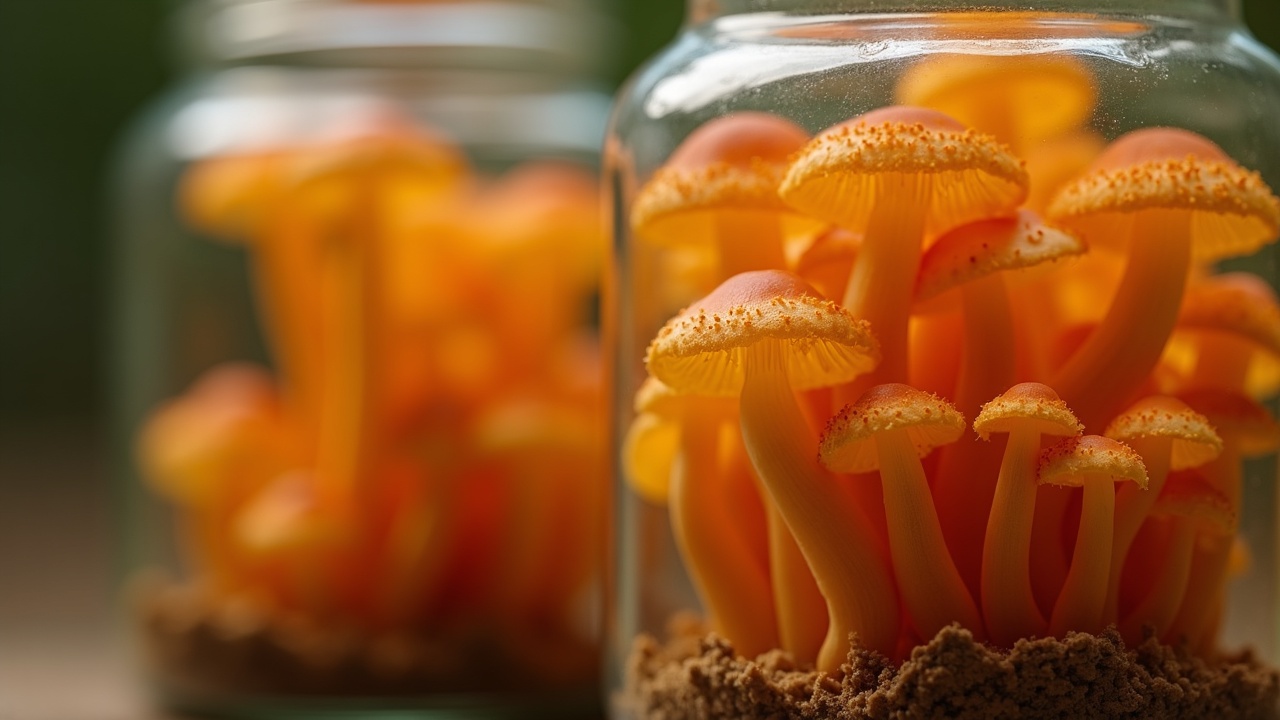
Cordyceps militaris is one of the few medicinal mushrooms that fruits readily on simple grain substrates in controlled indoor conditions, making it accessible to home cultivators.
| Parameter | Details |
|---|---|
| Substrate | Brown rice, millet, or wheat berries supplemented with silkworm pupae powder or nutritional yeast |
| Container | Wide-mouth glass jars or polypropylene bags with filter patches |
| Sterilization | Pressure cook substrate at 15 PSI for 90 minutes; strict sterile technique required |
| Temperature (colonization) | 68–72°F in darkness; 3–4 weeks |
| Temperature (fruiting) | 60–65°F with 12-hour light cycle; 4–8 weeks |
| Light | Essential for fruiting; indirect natural light or LED grow lights (12/12 cycle) |
| Humidity | 90–95% during fruiting |
The fruiting bodies are striking: bright orange to orange-red clubs, 2–5 inches tall, growing upward from the colonized substrate. Light direction determines growth orientation—clubs grow toward the light source. A single jar can produce multiple flushes over 2–3 months before the substrate is exhausted.
Phytochemistry
| Compound | Notes |
|---|---|
| Cordycepin (3'-deoxyadenosine) | Nucleoside analog; the primary bioactive; anti-inflammatory, anti-tumor, and anti-viral properties in research models; 2–8mg/g in C. militaris fruiting bodies |
| Adenosine | Purine nucleoside; vasodilator; involved in cellular energy (ATP) metabolism |
| Beta-glucans | Immunomodulatory polysaccharides; 10–30% of dry weight |
| Ergosterol | Vitamin D2 precursor; converts to vitamin D when UV-exposed |
| Mannitol (cordycepic acid) | Sugar alcohol; may support kidney function and reduce oxidative stress |
Cordycepin is structurally almost identical to adenosine (a building block of ATP, the body’s energy currency) but lacks a hydroxyl group at the 3' position. This subtle structural difference allows it to interfere with various cellular processes including RNA synthesis, inflammation cascades, and tumor cell proliferation. It is currently under investigation as a pharmaceutical lead compound for cancer and inflammatory diseases.
Clinical Research
- Exercise performance: A 2016 systematic review concluded that cordyceps supplementation may improve VO2 max and time to exhaustion in older adults, but effects in young trained athletes are inconsistent. A well-designed 2020 trial using C. militaris extract showed improved oxygen utilization during high-intensity cycling in recreational athletes.
- Respiratory function: Clinical studies in COPD and asthma patients show improvements in oxygen saturation and reduced dyspnea, consistent with the traditional Tibetan use for altitude sickness and breathing difficulties.
- Fatigue: Multiple trials demonstrate reduced perceived fatigue and improved energy levels in moderately fatigued adults over 4–12 week supplementation periods.
- Kidney function: Chinese clinical studies (variable quality) report improvements in kidney function markers in patients with chronic kidney disease, a use rooted in traditional Chinese medicine kidney-tonifying theory.
Precautions
- Blood sugar: May lower blood glucose; monitor if diabetic.
- Blood thinning: Cordycepin may inhibit platelet aggregation; caution with anticoagulants.
- Immunosuppressive drugs: Immune-modulating properties may interact with immunosuppressants.
- Autoimmune conditions: Standard caution for immune-modulating supplements.
- Wild vs. cultivated: Wild C. sinensis products are frequently adulterated or counterfeit due to extreme prices. Cultivated C. militaris is more reliable, better characterized, and more affordable.
Extraction & Preparation
Cordyceps, like reishi, contains both water-soluble polysaccharides (beta-glucans, cordycepin-related compounds) and alcohol-soluble bioactives (adenosine, cordycepin). A complete extraction requires both water and ethanol fractions. Cordycepin (3’-deoxyadenosine) — the key compound distinguishing cordyceps from most other adaptogens — is water-soluble but is best stabilized in the presence of deoxycoformycin, which is also present in the mushroom and preserved in full-spectrum extracts.
Simple Home Methods
Use only Cordyceps militaris dried fruiting bodies — not mycelium powder, which is mostly grain starch. The hot water extraction is straightforward. The dual-extraction two-step covers both the polysaccharide and cordycepin fractions. Growing your own fruiting bodies on brown rice is genuinely accessible and produces verified material.
Hot water decoction: Simmer 10–15 grams of dried C. militaris fruiting bodies in 4 cups of water in a covered pot for 1.5–2 hours at a low simmer. The water turns amber. Strain through cheesecloth, squeezing the spent material. Drink 1–2 cups daily, or reduce the decoction and add to soups or coffee. Keeps in the fridge 5–7 days.
Home dual extraction: After the water decoction above, pack the spent fruiting body material into a mason jar and cover completely with 80-proof vodka or Everclear diluted to 60%. Seal and macerate 3 weeks. Strain and press. Combine equal parts refrigerated water decoction and alcohol extract for dosing — 2–3 tablespoons of the combined preparation daily.
Vinegar extraction: Pack a mason jar with dried fruiting bodies, cover with apple cider vinegar, seal, and macerate 4–6 weeks. Strain and press. An alcohol-free option that captures a portion of the polysaccharide content. Dose: 1–2 tablespoons in water daily.
Fermentation: Add dried C. militaris to an active honey wine (mead) fermentation — combine with 2 pounds of honey, 1 gallon of water, wine yeast, and an airlock. Ferment 3–4 weeks. The fermentation extracts both water-soluble compounds over time and the developing alcohol extends the extraction range. Rack and bottle when clear. This is a useful long-term preparation for the adaptogenic applications.
Hot Water Extraction
Simmer dried Cordyceps militaris fruiting bodies in water for 1–2 hours at a low boil (1:10 ratio, reduce by half). This extracts the polysaccharide fraction including beta-glucans and the water-soluble cordycepin. C. militaris fruiting bodies are the appropriate substrate — they contain measurable cordycepin at 0.1–0.5% dry weight. Mycelium-on-grain products (most commercial “cordyceps”) contain primarily grain starch and minimal cordycepin.
Dual Extraction Protocol
For a complete preparation: (1) Simmer dried fruiting bodies in water for 1.5 hours; strain and reserve liquid. (2) Re-extract spent material in 60–70% ethanol for 3–4 weeks. (3) Combine both fractions. The hot water fraction carries the polysaccharide content; the ethanol fraction carries adenosine and additional sterol/terpenoid compounds. This dual extraction is what quality commercial cordyceps products specify — look for fruiting body dual extract with stated cordycepin percentage (≥0.1%).
Verification of Quality
The cordyceps supplement market has a significant quality problem: most products are mycelium grown on grain with no cordycepin content. Require a COA (certificate of analysis) showing cordycepin content from fruiting body material. Alternatively, grow your own C. militaris fruiting bodies — indoor cultivation on a brown rice substrate produces harvestable fruiting bodies with verified cordycepin content, making it one of the few supplements where home production rivals commercial quality.
Product Use
Cordyceps is an adaptogen used for aerobic capacity, oxygen utilization, fatigue recovery, and kidney/adrenal support in traditional Chinese medicine. Cordycepin inhibits cellular ATP synthesis in a dose-dependent manner (which paradoxically improves mitochondrial efficiency at low doses), while the beta-glucan fraction modulates immune response. The traditional use for high-altitude fatigue and respiratory endurance has been partially validated in clinical studies showing improved VO2 max in elderly patients. Dose: 1–3 grams daily of dual-extracted fruiting body material.
References
- Hirsch et al., Journal of Dietary Supplements (2017) — cordyceps and exercise performance systematic review
- Dudgeon et al., Journal of Strength and Conditioning Research (2020) — C. militaris cycling performance
- Tuli et al., 3 Biotech (2014) — cordycepin pharmacology review
- Zhu et al., Journal of Alternative and Complementary Medicine (1998) — clinical applications review
- Shrestha et al., Mycology — C. militaris cultivation techniques