Extraction
Microwave-Assisted Extraction: Rapid Botanical Processing with Electromagnetic Energy
How microwave-assisted extraction heats solvents from within for rapid botanical compound extraction.
On this page
How Microwave Energy Drives Extraction
Microwave-assisted extraction (MAE) uses electromagnetic radiation at frequencies between 300 MHz and 300 GHz, the same spectrum used in kitchen microwave ovens (typically 2.45 GHz). Unlike conventional heating, which transfers energy from the outside of a vessel inward through conduction and convection, microwaves penetrate directly into the material and cause polar molecules (especially water) to rotate rapidly in response to the oscillating electromagnetic field. This molecular friction generates heat from within the material itself.
In the context of botanical extraction, this internal heating has a profound effect. Plant cells contain water within their vacuoles and cytoplasm. When microwaves heat this intracellular water, it expands rapidly and builds internal pressure within the cell. If the pressure exceeds the structural strength of the cell wall, the cell ruptures from the inside out, releasing its contents into the surrounding solvent. This mechanism, cell disruption through internal steam generation, is what makes MAE fundamentally different from and often faster than conventional extraction.
Inside-Out vs. Outside-In
In conventional extraction, solvent must penetrate cell walls from outside, dissolve compounds, and then diffuse back out, a slow process governed by diffusion kinetics. In MAE, the cell wall is ruptured from within, and compounds are driven out by internal pressure. This inversion of the extraction mechanism is why MAE can achieve in 5 minutes what conventional methods accomplish in 5 hours.
Equipment and Operation
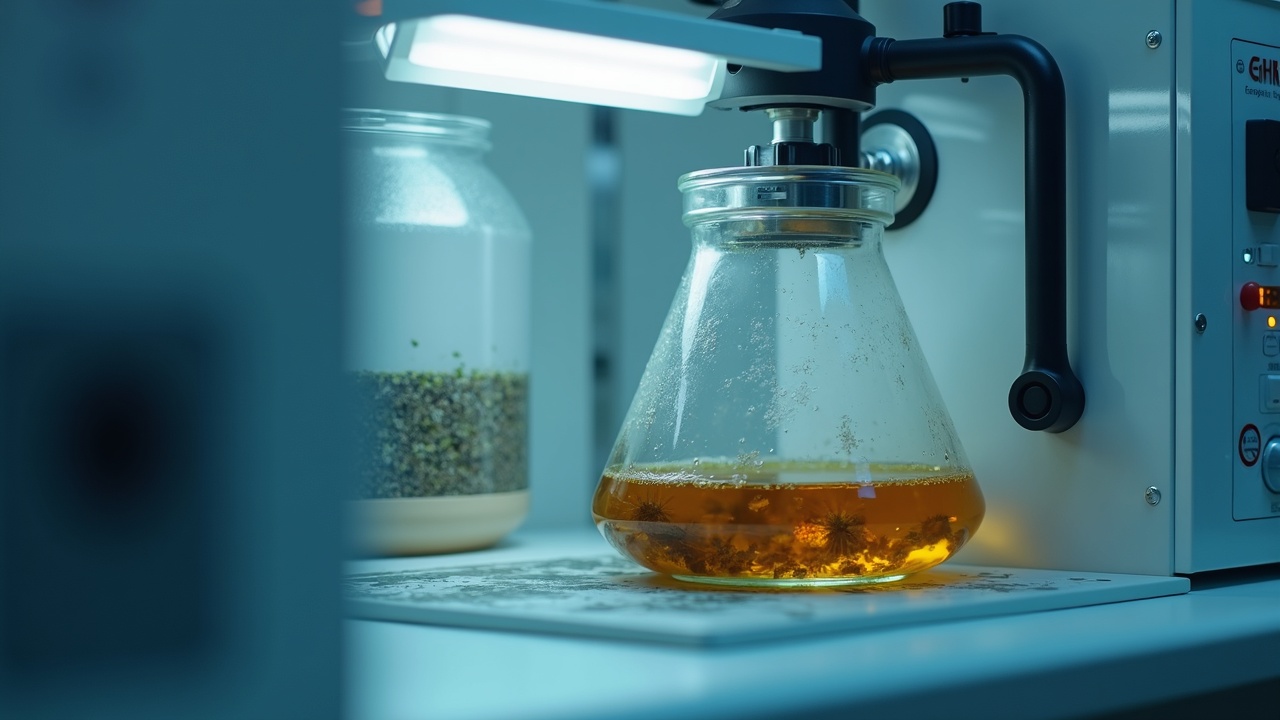
MAE equipment ranges from modified household microwave ovens used in research labs to sophisticated closed-vessel systems for commercial production:
Open-Vessel (Atmospheric) Systems
Similar in concept to a household microwave with a modified extraction vessel. The plant material and solvent are heated in an open or vented container at atmospheric pressure. Simple and inexpensive, but limited to temperatures at or below the solvent's boiling point. Useful for screening studies and small-batch production.
Closed-Vessel (Pressurized) Systems
Sealed extraction vessels that allow temperatures to exceed the solvent's normal boiling point. Higher temperatures dramatically increase solvent power and extraction speed. Closed-vessel systems include temperature and pressure sensors, stirring mechanisms, and automated control software. These are the standard for reproducible, production-quality MAE.
Solvent-Free Microwave Extraction (SFME)
A specialized variant where fresh (high-moisture) plant material is irradiated without added solvent. The plant's own water is heated, generating steam that carries volatile compounds (essential oils) out of the matrix. The steam is condensed externally, producing essential oils and hydrosols with no organic solvent involved. SFME is an elegant green chemistry technique particularly suited to aromatic herbs.
| Parameter | Typical Range |
|---|---|
| Frequency | 2.45 GHz (standard industrial/domestic frequency) |
| Power | 100–1,500 W (laboratory); up to 6,000 W (industrial) |
| Temperature | 50–200°C depending on solvent and vessel type |
| Extraction Time | 1–30 minutes (vs. hours for conventional methods) |
| Solvent | Water, ethanol, water-ethanol mixtures, or none (SFME) |
| Equipment Cost | $2,000–15,000 (lab); $20,000–150,000 (production) |
Rapid Extraction Times
The speed advantage of MAE over conventional extraction is well-documented in the research literature:
- Essential oils from lavender: Conventional steam distillation requires 60–90 minutes. SFME produces equivalent yields in 15–20 minutes.
- Polyphenols from grape pomace: Conventional ethanol maceration takes 12–24 hours. MAE achieves similar yields in 5–10 minutes.
- Alkaloids from bark: Conventional reflux extraction requires 4–6 hours. MAE with ethanol completes in 10–15 minutes.
- Curcuminoids from turmeric: Conventional extraction takes 6–8 hours. MAE completes in 3–8 minutes with equivalent or superior yields.
- Flavonoids from citrus peel: Conventional water extraction takes 2–4 hours. MAE achieves maximum yield in 5–15 minutes.
These time savings translate directly into economic advantages: lower energy consumption per batch, higher equipment utilization, reduced labor costs, and faster time-to-market for new products.
Which Plants and Compounds
MAE is most effective for plants and compounds where cell disruption and rapid heating produce meaningful improvements:
Aromatic and Essential Oil Plants
Rosemary, thyme, oregano, basil, mint, and lavender respond exceptionally well to SFME. The technique produces essential oils with terpene profiles very close to fresh plant material because the short extraction time minimizes thermal degradation of volatile compounds.
Phenolic-Rich Botanicals
Green tea, olive leaves, grape seeds, pomegranate rind, and rosemary are rich in polyphenols that MAE extracts efficiently. Studies consistently show phenolic yields equal to or exceeding conventional methods, achieved in dramatically less time.
Medicinal Roots and Barks
Dense plant materials that resist rapid conventional extraction benefit significantly from MAE's internal heating mechanism. Ginseng, astragalus, turmeric, and various medicinal barks yield their active compounds more readily under microwave irradiation.
Seeds and Hard Plant Tissues
Flaxseed, chia seed, and other oilseeds release their bioactive compounds more readily under MAE due to internal moisture expansion disrupting the seed coat. This is particularly useful for extracting lignans, omega fatty acids, and seed-specific polyphenols.
Product Characteristics
- Preserved volatiles: Short extraction times mean volatile terpenes, essential oil components, and aromatic compounds are better retained compared to prolonged conventional heating methods.
- Equivalent potency: At optimized parameters, MAE extracts match or exceed the bioactive compound concentration of conventional extracts, despite the dramatically shorter processing time.
- Color preservation: The rapid processing reduces thermal degradation of pigments, producing more visually appealing extracts with natural coloration intact.
- Reduced chlorophyll: When combined with ethanol, short MAE times limit chlorophyll co-extraction, reducing the need for post-processing purification steps.
- Higher antioxidant activity: Studies on multiple plant materials show MAE extracts retain higher antioxidant capacity than conventionally extracted counterparts, likely due to better preservation of heat-sensitive phenolic compounds.
Advantages and Limitations
Key Advantages
- Exceptional speed: 10–100x faster than conventional maceration and significantly faster than Soxhlet or reflux extraction.
- Energy efficiency: Despite high power input, the dramatically shorter processing time results in lower total energy consumption per extraction cycle.
- Reduced solvent: Higher efficiency means less solvent is needed for equivalent yields, reducing material costs and waste.
- Solvent-free option: SFME eliminates the need for any organic solvent for essential oil production, a genuine green chemistry advancement.
- Reproducibility: Computer-controlled systems with precise power, temperature, and time settings produce highly consistent results batch after batch.
- Compact footprint: MAE equipment is relatively small compared to conventional extraction setups of equivalent throughput.
Key Limitations
- Thermal degradation risk: Improperly controlled MAE can rapidly overheat and degrade heat-sensitive compounds. Careful temperature monitoring and pulsed irradiation protocols are essential.
- Non-polar solvent incompatibility: Microwaves heat polar molecules. Non-polar solvents like hexane are transparent to microwaves and do not heat. MAE works best with water, ethanol, and polar mixtures.
- Scale-up challenges: Microwave penetration depth is limited (typically 2–4 cm in water at 2.45 GHz). Large-volume extraction requires careful vessel design to ensure uniform heating. Hot spots can form in large batches.
- Safety considerations: High-power microwave equipment requires proper shielding to prevent radiation leakage. Closed-vessel systems operate under pressure and require appropriate safety controls.
- Material limitations: Dry plant materials with very low moisture content may not respond well to MAE because the cell-rupture mechanism depends on internal water. Pre-moistening can address this but adds a processing step.
The Future of MAE in Botanicals
Microwave-assisted extraction is still in its growth phase as a commercial botanical processing technology. Most current adoption is in the food, fragrance, and pharmaceutical industries. As dedicated botanical-grade equipment becomes more widely available and operating protocols for specific herbs are published, MAE is expected to become a standard tool for producers seeking to balance extraction quality with production speed and environmental sustainability.
Research on extraction microwave
Peer reviewed studies about extraction microwave, listed so you can read the original rather than take our word for it. They are background on the subject, not a source for any one sentence above.
- Analytical-scale microwave-assisted extraction (2000). doi:10.1016/s0021-9673(00)00921-3
- Recent extraction techniques for natural products: microwave‐assisted extraction and pressurised solvent extraction (2002). doi:10.1002/pca.631
- Microwave extraction (1986). doi:10.1016/s0021-9673(01)94714-4
- Microwave-Assisted Extraction of Flavonoids: A Review (2011). doi:10.1007/s11947-011-0573-z
- Microwave-assisted extractions of active ingredients from plants (2011). doi:10.1016/j.chroma.2011.07.040
Common questions
What is how microwave energy drives extraction?
Microwave-assisted extraction (MAE) uses electromagnetic radiation at frequencies between 300 MHz and 300 GHz, the same spectrum used in kitchen microwave ovens (typically 2.45 GHz). Unlike conventional heating, which transfers energy from the outside of a vessel inward through conduction and convection, microwaves penetrate directly into the material and cause polar molecules (especially water) to rotate rapidly in response to the oscillating electromagnetic field. This molecular friction generates heat from within the material itself.
What equipment does extraction microwave need?
MAE equipment ranges from modified household microwave ovens used in research labs to sophisticated closed-vessel systems for commercial production:. Open-Vessel (Atmospheric) Systems. Similar in concept to a household microwave with a modified extraction vessel. The plant material and solvent are heated in an open or vented container at atmospheric pressure. Simple and inexpensive, but limited to temperatures at or below the solvent's boiling point.
What are rapid extraction times?
The speed advantage of MAE over conventional extraction is well-documented in the research literature:. Essential oils from lavender: Conventional steam distillation requires 60–90 minutes. SFME produces equivalent yields in 15–20 minutes. Polyphenols from grape pomace: Conventional ethanol maceration takes 12–24 hours. MAE achieves similar yields in 5–10 minutes.
What is happening chemically in extraction microwave?
MAE is most effective for plants and compounds where cell disruption and rapid heating produce meaningful improvements:. Aromatic and Essential Oil Plants. Rosemary, thyme, oregano, basil, mint, and lavender respond exceptionally well to SFME. The technique produces essential oils with terpene profiles very close to fresh plant material because the short extraction time minimizes thermal degradation of volatile compounds. Phenolic-Rich Botanicals.
What are product characteristics?
Preserved volatiles: Short extraction times mean volatile terpenes, essential oil components, and aromatic compounds are better retained compared to prolonged conventional heating methods. Equivalent potency: At optimized parameters, MAE extracts match or exceed the bioactive compound concentration of conventional extracts, despite the dramatically shorter processing time. Color preservation: The rapid processing reduces thermal degradation of pigments, producing more visually appealing extracts with natural coloration intact.