plants
Farm and Property Security
Secure a rural property: perimeter design, intrusion detection, surveillance, lighting, and layered measures that deter and slow intruders.
Content Extraction Summary
Layered rural property security using the deter-detect-delay-respond framework. Covers perimeter design, electronic detection and surveillance, communication networks, physical hardening, livestock protection, equipment security, fire prevention, and legal considerations. Addresses both human trespass/theft and predator threats. Emphasizes that no single measure works alone — effective security is redundant, overlapping, and adapted to the specific property.
1. Introduction
Most rural property owners assume isolation is protection. It is not. Isolation is opportunity.
The Bureau of Justice Statistics reports that rural property crime rates rival suburban areas, but clearance rates are far lower. Rural law enforcement response times average 30 minutes or more in many counties — some exceed an hour. A 2019 USDA survey found that 38% of farms experienced some form of theft or trespass in the prior year. Equipment theft alone costs U.S. agriculture over $1 billion annually according to the National Equipment Register.
The problem is not that rural people lack awareness. The problem is that most security thinking is reactive and single-layered: a lock on the gate, a dog in the yard, a shotgun by the door. Each of those has value. None of them alone constitutes security.
Effective property security operates in four layers:
- **Deter** — Make the property look harder to hit than the next one.
- **Detect** — Know something is wrong before it reaches you.
- **Delay** — Slow an intruder's progress so you have time to respond.
- **Respond** — Have a plan, communication, and the means to act.
Every recommendation in this article maps to one or more of those layers. The goal is not to build a fortress. The goal is to build enough overlapping systems that a threat is caught early, slowed down, and met with a prepared response.
This applies equally to two-legged threats (trespassers, thieves, trespassing hunters) and four-legged threats (coyotes, feral hogs, mountain lions, stray dogs). The same layered thinking applies to both.
2. Perimeter
Fencing for Security, Not Just Livestock
Livestock fencing and security fencing serve different purposes. A five-strand barbed wire fence keeps cattle in but does nothing to slow a determined human. A woven wire fence with a strand of barbed wire on top presents a meaningful obstacle.
**Fence types ranked by security value:**
| Fence Type | Livestock Value | Security Value | Cost per Linear Foot | |---|---|---|---| | 5-strand barbed wire | High (cattle) | Low | $1.50–$3.00 | | Woven wire (no-climb) | High (goats, sheep) | Moderate | $3.00–$6.00 | | Woven wire + barbed top | High | Good | $4.00–$7.00 | | Chain link 6 ft | Low | High | $8.00–$15.00 | | Pipe/panel fencing | High (corrals) | High | $12.00–$25.00 | | Cattle panels + T-posts | Moderate | Moderate | $4.00–$8.00 |
For security-critical boundaries — the road frontage, property lines adjacent to public land, areas near equipment storage — woven wire with a barbed top strand or pipe fencing is the minimum. Interior cross-fencing can remain standard agricultural grade.
Gate Design and Access Control
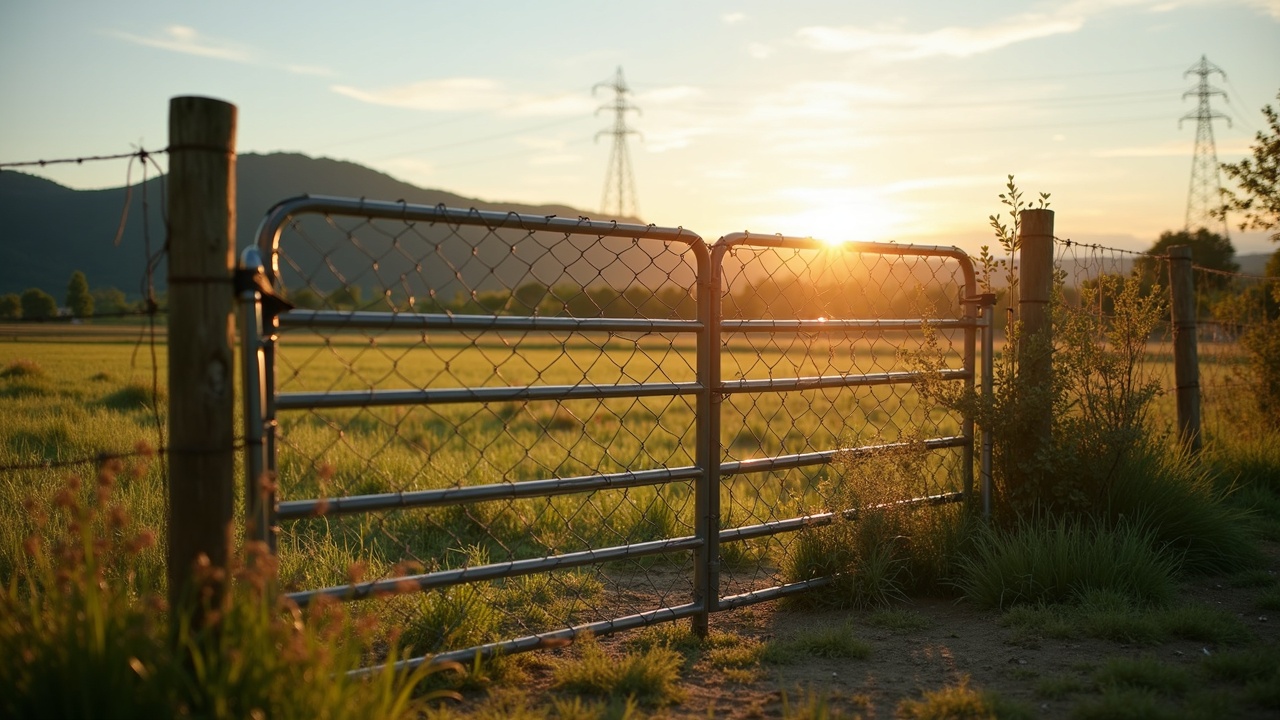
Gates are the weakest point in any perimeter. A $10,000 fence with a $40 chain and padlock is security theater.
Effective gate strategy:
- **Primary entrance:** Metal gate, commercial-grade padlock (Abus, American Lock), or combination lock. If budget allows, a gate opener with keypad or remote control.
- **Secondary entrances:** Keep these to a minimum. Every additional gate is another vulnerability. If a gate exists only for occasional equipment access, consider a removable bollard or panel section instead.
- **Hinges:** Weld hinge pins or use non-removable hinge pins. Thieves regularly lift gates off exposed hinges.
- **Width:** Make vehicle gates exactly the width needed. An oversized opening invites drive-through access from adjacent fields.
- **Locking:** Shrouded shackle padlocks resist bolt cutters far better than standard padlocks. A Master Lock 6271 or Abus 20/70 costs $20–$40 and is worth ten times that.
Natural Barriers
The cheapest and most durable perimeter features grow themselves.
- **Osage orange (Bois d'Arc) hedgerows:** Historically used as living fences before barbed wire existed. Dense, thorny, and virtually impenetrable when mature. Plant 12–18 inches apart and maintain at 6–8 feet tall. Takes 3–5 years to become effective.
- **Multiflora rose:** Extremely effective barrier but invasive in many states — check local regulations before planting.
- **Berms and drainage:** A 3-foot earth berm along a property boundary blocks casual vehicle access and creates a natural sight line. Combine with a drainage ditch on the outer side for enhanced effect.
- **Treelines:** Dense cedar or pine rows block line-of-sight from the road, removing the ability to scout the property by driving past.
The trade-off with visual screening: it hides your property from thieves but also hides their activity from the road. Place visual screening where you want to block scouting, and maintain clear sight lines where you want neighbors and passersby to see unusual activity.
Signage
Signs are pure deterrence. Their legal value varies by state, but their psychological value is consistent.
- **"No Trespassing" signs:** Required in many states to prosecute trespassers. Texas Penal Code 30.05 requires that notice be given by signage, fencing, or verbal communication. Most states require signs at reasonable intervals — every 200–1,000 feet depending on jurisdiction.
- **"Property Under Surveillance" signs:** Effective deterrent regardless of whether cameras are actually present. Some jurisdictions treat these signs as evidence of security awareness, which can affect liability outcomes.
- **Purple paint:** Texas, Arkansas, Missouri, Illinois, Kansas, and several other states recognize purple paint marks on trees or posts as legal equivalent to "No Trespassing" signs. Marks must be vertical lines at least 8 inches long, at 3–5 foot height, and visible from adjacent marks.
- **Avoid:** Signs that advertise specific security brands (tells a thief exactly what to defeat), aggressive or threatening language (creates liability), or anything that implies you are eager for confrontation.
3. Detection
Detection is about early warning. The goal is to know something is on your property before it reaches anything valuable.
Motion-Activated Lighting
Light is one of the cheapest and most effective deterrents against both human intruders and predators. Coyotes and most nocturnal predators avoid well-lit areas.
**Solar LED placement strategy:**
- Mount lights at 8–12 feet. Too low and they are easy to disable. Too high and they illuminate too broadly, losing the startle effect.
- Place at every entrance point: gates, driveways, barn doors, equipment sheds.
- Angle lights outward from buildings, not toward them. You want to see who is approaching, not blind yourself.
- Use warm-white (3000K) for areas near livestock housing — the sudden blast of cool-white can stress animals.
- Budget solar LED floods (Litom, Aootek) run $15–$30 each. Place them densely rather than buying expensive units sparsely.
- Overlap coverage zones. A single failed unit should not create a dark gap.
Trail Cameras
Trail cameras are the most cost-effective detection tool available for rural properties. A $60 camera running on batteries for 6–12 months provides surveillance that would cost thousands in a traditional camera system.
**Three types:**
| Type | Pros | Cons | Best Use | |---|---|---|---| | SD card | Cheap, no service fees, works anywhere | Must physically retrieve card to view images | Remote gates, back fences, wildlife monitoring | | WiFi | View images on phone within range | Limited range (100–300 ft), needs power nearby | Near house, barns, areas with WiFi | | Cellular | Sends images to phone immediately, works anywhere with cell signal | Monthly service fee ($5–$15/mo), needs signal | Primary entrances, high-value areas, remote sections |
**Placement principles:**
- Face cameras north or south to avoid sun glare triggering false captures.
- Mount at 3–4 feet for vehicle license plates and human identification. Chest height captures faces; lower captures plates.
- Use security boxes (Camlockbox, Master Lock) to prevent theft of the cameras themselves.
- Place at choke points: gates, gaps in fence lines, creek crossings, road pull-offs adjacent to property.
- Set to photo + short video. A single photo may miss critical detail. A 10-second video captures direction of travel, vehicle details, and companion count.
Recommended models: Stealth Cam Fusion (cellular, good value), Reconyx HyperFire 2 (premium reliability), Campark T200 (budget SD card).
Driveway Sensors
A driveway sensor alerts you that someone has entered the property before they reach the house. This is the single most important detection upgrade for most rural properties.
**Dakota Alert MURS:** The standard for rural driveway alerts. Uses MURS radio frequency (no license required), transmits up to 1 mile line-of-sight. The DCPA-4000 probe sensor detects vehicles and large animals, reducing false alerts from deer. Base unit sits in the house and chimes or announces the zone. Supports up to four zones. Cost: $150–$250 per zone.
**Guardline:** Wireless, battery-powered motion sensor with a plug-in receiver. Simpler and cheaper than Dakota Alert. Range up to 500 feet. Good for driveways and immediate property perimeter. Cost: $60–$120 for a two-sensor kit.
**Driveway hose sensors:** The simplest option. A rubber hose across the driveway triggers a chime inside when a vehicle drives over it. Cheap, reliable, no batteries. Limited to vehicle detection.
For properties with multiple access points, Dakota Alert is the best option because each zone can be identified separately — you know which entrance was triggered.
Perimeter Alarm Systems
For high-value areas (equipment yards, chemical storage, greenhouses), dedicated perimeter alarms add another layer.
- **Beam break sensors:** An infrared beam between two posts triggers an alarm when broken. Commercial-grade units (Optex, Takex) work reliably up to 200 meters. Cost: $150–$400 per pair.
- **Buried cable sensors:** Detect vibration from footsteps or vehicles. Expensive to install but invisible and difficult to defeat. Primarily used for high-security applications.
- **Magnetic gate contacts:** Simple reed switches on gates that trigger an alert when opened. Cost: $10–$30 per gate, plus a receiver or alarm panel.
4. Surveillance
Surveillance differs from detection. Detection tells you something is there. Surveillance tells you what it is, what it is doing, and provides evidence.
Camera Systems
**PoE (Power over Ethernet) vs. WiFi:**
PoE cameras run a single Ethernet cable that carries both data and power. They are more reliable, produce higher resolution, and do not compete with household WiFi bandwidth. Every serious security installer recommends PoE over WiFi for fixed installations.
WiFi cameras (Ring, Wyze, Blink) are convenient for rental properties and temporary setups. They are not adequate for primary property surveillance. They fail in bad weather, drop connection under network load, and depend on cloud services that can change terms or pricing at any time.
**Resolution requirements:**
- 1080p minimum for general area surveillance.
- 4K (8MP) for entrances, gates, and equipment yards where license plate and facial identification matter.
- Higher resolution requires more storage. Budget accordingly.
**NVR (Network Video Recorder) vs. Cloud:**
An NVR stores footage locally on a hard drive you own. No monthly fees, no dependency on internet connectivity, no corporate access to your footage. A Reolink or Hikvision NVR with 4–8 camera channels and a 2TB hard drive costs $200–$400 and stores 2–4 weeks of continuous recording.
Cloud storage (Ring, Arlo, Nest) costs $10–$30/month indefinitely. Over five years, that exceeds the cost of a complete NVR system multiple times over. Cloud also requires internet — when your internet goes down, your security goes with it.
Placement Strategy
- **Overlapping fields of view.** No single camera should be the only coverage for a critical area.
- **Cover approaches, not just destinations.** A camera on the barn door shows who entered. A camera on the driveway shows how they arrived and what they drove.
- **Elevation matters.** Mount cameras at 10–14 feet to prevent tampering while maintaining useful image detail.
- **Include at least one wide-angle overview camera** per major zone (house area, barn area, equipment area) for context.
Night Vision and IR Illumination
Most property crimes occur between midnight and 5 AM.
- **IR illumination:** Built into most security cameras. Effective to 80–150 feet depending on the model. Produces black-and-white night images. Sufficient for most applications.
- **Dedicated IR illuminators:** Add supplemental IR light for cameras covering large areas. An 850nm illuminator is invisible to the human eye. A 940nm illuminator is invisible to cameras as well — use 850nm unless concealment is more important than image quality.
- **Color night vision:** Some newer cameras (Reolink CX series, Hikvision ColorVu) produce full-color images at night using large sensors and supplemental white light. Valuable for vehicle color identification.
Remote Monitoring
Access your camera system remotely via smartphone apps. Reolink, Hikvision (Hik-Connect), and Dahua all offer free apps for their NVR systems. This requires either:
- Port forwarding on your router (functional but creates a security vulnerability).
- A VPN connection to your home network (more secure, slightly more complex to set up).
- P2P cloud relay (most consumer systems use this — moderate security, easiest setup).
5. Communication
Security is a community function. An isolated property defended in isolation is at a disadvantage.
Neighbor Networks
The single most effective security measure on a rural road is knowing your neighbors and having their phone numbers.
- Exchange contact information with every neighbor within visual or audible range of your property.
- Agree on what constitutes a reason to call: unfamiliar vehicles parked near property lines, unusual activity at night, open gates that should be closed.
- Many rural areas use group text threads or WhatsApp groups for neighborhood communication.
Radio Communication
Cell service is unreliable on many rural properties. Radio provides backup communication that does not depend on towers or internet.
**GMRS (General Mobile Radio Service):**
- Requires an FCC license ($35, no exam, covers the whole family for 10 years).
- Range: 2–25 miles depending on terrain and equipment.
- Handheld units start at $30 (Baofeng, Retevis). Mobile units with external antennas reach further.
- Many rural areas have GMRS repeaters that extend range dramatically.
**Ham radio:**
- Requires a Technician-class license (35-question exam, free to moderate cost depending on testing session).
- Much greater range and capability than GMRS.
- 2-meter and 70-centimeter bands cover local communication. HF bands reach nationwide.
- Overkill for most property security needs, but valuable in disaster scenarios.
**FRS (Family Radio Service):**
- No license required.
- Limited to 2 watts, short range (0.5–2 miles typical).
- Adequate for on-property communication between family members during chores or patrols.
Signal Dead Zone Solutions
- **Cell boosters:** WeBoost and SureCall make boosters that amplify weak cell signals. A WeBoost Home MultiRoom ($300–$500) with an external antenna can turn one bar into usable service. Requires at least a faint signal to amplify — cannot create signal where none exists.
- **Mesh networks:** GoTenna Mesh or Meshtastic (open-source, LoRa-based) create device-to-device text messaging networks that work without cell towers, WiFi, or internet. Range: 1–5 miles per hop, extendable with relay nodes. Useful for property-wide communication and mutual aid networks.
- **Satellite communicators:** Garmin inReach or ZOLEO provide two-way text messaging via satellite anywhere on Earth. Cost: $300–$400 for the device, $15–$50/month for service. Worth the cost for properties truly beyond cell coverage.
6. Physical Hardening
Fences and cameras detect and deter. Physical hardening delays.
Door and Window Reinforcement
Most residential burglaries involve kicking in a door. The standard residential door frame splits with 80–100 pounds of force. The fix costs under $50.
- **Door Armor or StrikeMaster II:** Reinforcement kits that replace the short screws in your strike plate with 3.5-inch screws that anchor into the wall stud, and add a steel plate spanning the full length of the strike area. A reinforced door resists 800+ pounds of force.
- **Deadbolts:** Grade 1 deadbolts (Schlage B60N, Medeco Maxum) resist picking, bumping, and drilling. A Grade 3 deadbolt from a hardware store is marginally better than no deadbolt.
- **Hinge reinforcement:** Add hinge bolts or security hinges with non-removable pins to exterior doors.
- **Sliding doors:** A steel bar or Charlie bar in the track prevents forced opening. A secondary lock at the top of the door prevents lifting.
- **Windows:** Security film (3M Safety & Security) holds broken glass in place, converting a smash-and-enter into a slow, loud process. Cost: $5–$10 per square foot installed. Burglar bars on ground-floor windows of unoccupied buildings (shops, storage buildings) are effective if fire safety egress is maintained.
Outbuilding Security
Barns, shops, and equipment sheds are often more targeted than houses because they contain high-value portable items (tools, fuel, equipment parts) and are further from observation.
- **Commercial-grade hasp and padlock** on every outbuilding door. Use a hasp with concealed mounting bolts — a hasp mounted with exposed carriage bolts can be removed with a socket set.
- **Roll-up doors:** Lock with a slide bolt and padlock at the bottom rail, plus a padlock on the chain hoist or motor disconnect.
- **Shop security:** Weld a locking bar to metal shop doors. A 2-inch square tube across double doors with a shrouded padlock is cheap and very effective.
- **Motion lights on all outbuildings.** A thief who can work in darkness works quickly. One who works under a floodlight works nervously or not at all.
Safe Rooms
A safe room is not a bunker. It is a reinforced interior room (closet, bathroom, interior bedroom) where occupants can shelter while waiting for law enforcement or while assessing the situation.
Minimum features:
- Solid-core door with Grade 1 deadbolt and door reinforcement kit.
- Cell phone and charger kept inside.
- Flashlight.
- First aid kit.
- A means of defense appropriate to training level and local law.
Cost to convert an existing interior room: $100–$300.
Lock Selection
- **Residential:** Schlage B60N or Kwikset SmartKey deadbolts for keyed entry. Both are Grade 1 rated.
- **Outbuildings:** American Lock 1100 series (solid steel body, 6-pin tumbler, boron shackle). Resists cutting, prying, and picking.
- **Gates:** Abus Diskus or American Lock 2000 series shrouded padlock. The shrouded design prevents bolt cutter access to the shackle.
- **Key management:** Minimize the number of different keys. Re-key locks to a common key using the same manufacturer. Keep a spare set in a secure off-property location (trusted neighbor, bank safe deposit box).
7. Livestock Protection
Four-legged threats are often more persistent and costly than two-legged ones. The USDA estimates annual livestock losses to predators at over $250 million.
Livestock Guardian Dogs
LGDs are the most effective predator deterrent available. A bonded, working LGD reduces predation losses by 80–100% in most operations (Gehring et al., 2010, Wildlife Society Bulletin).
**Breeds:**
| Breed | Size | Temperament | Climate | Best For | |---|---|---|---|---| | Great Pyrenees | 85–130 lbs | Calm, independent | Cold/moderate | Sheep, goats, poultry | | Anatolian Shepherd | 90–150 lbs | Assertive, territorial | Hot/dry | Cattle, large predators | | Kangal | 100–150 lbs | Dominant, powerful | Hot/dry | Large predator pressure | | Akbash | 80–140 lbs | Alert, less aggressive | Moderate | Mixed operations | | Maremma | 70–100 lbs | Gentle, steady | Moderate | Smaller operations, poultry |
**Integration rules:**
- Puppies must be raised with livestock from 8 weeks. A dog raised in the house and then put with sheep is a pet, not a guardian.
- Two dogs minimum for serious predator pressure. One dog sleeps while the other guards. A single dog working alone burns out or gets flanked by pack predators.
- Do not train guardian dogs as you would a pet. LGDs are independent decision-makers. Obedience training undermines the instincts that make them effective.
- Expect 18–24 months before a young LGD is fully reliable. Supervise closely during the adolescent period (6–18 months) when poor decisions happen.
Guard Llamas and Donkeys
- **Guard llamas:** One gelded male llama per flock of 200–300 sheep or goats. Effective against single coyotes and stray dogs. Ineffective against packs, mountain lions, or bears.
- **Guard donkeys:** Standard or mammoth jennies (females) or geldings. More aggressive than llamas. Effective against coyotes and dogs. Will stomp and bite. Do not use intact jacks (males) — they may attack livestock.
- Both are low-maintenance compared to LGDs. Neither requires training — their protective behavior is instinctual.
Predator Deterrents
- **Foxlights:** Solar-powered units that flash random patterns of colored light, simulating human activity. Effective for 3–6 months before predators habituate. Rotate placement regularly.
- **Electric fence:** A single strand of electric wire at coyote nose height (8–12 inches) along the bottom of perimeter fencing significantly reduces coyote intrusion. Cost: $1–$2 per foot.
- **Radio/noise deterrents:** A radio playing talk radio (not music) in a barn at night deters opportunistic predators. Effectiveness fades with habituation — rotate on/off schedules.
Night Housing
The simplest and most reliable protection for small livestock and poultry is locking them in a secure structure at night.
- Poultry must be locked in a coop with hardware cloth (not chicken wire — raccoons and foxes tear through chicken wire easily). Use 1/2-inch hardware cloth on all openings.
- Sheep and goats in predator-heavy areas benefit from night penning in a lit, enclosed area near the house.
- Automatic coop doors (ChickenGuard, Omlet) close at dusk and open at dawn, eliminating the risk of forgetting.
8. Equipment Security
Farm equipment is a high-value target. Older tractors are started with a universal key or no key at all. Trailers are driven away in seconds.
GPS Tracking
- **Hardwired trackers:** LandAirSea Overdrive, Spytec GL300 — small, battery-powered units that report location via cellular. Costs $20–$50 for the unit, $15–$25/month for service. Hide inside equipment frames, under seats, or in battery compartments.
- **OBD trackers:** For trucks and vehicles with OBD-II ports. Plug-in installation, real-time tracking.
- **AirTags/SmartTags:** Apple AirTags and Samsung SmartTags are cheap ($25–$30), require no subscription, and provide location updates via the massive Apple/Samsung device networks. Limited to urban and suburban density — less reliable in truly remote areas. Place inside trailers, toolboxes, equipment compartments.
- **Multiple trackers per high-value item.** A thief who finds one tracker may not look for a second one hidden elsewhere on the same machine.
Disable Switches
Make equipment unusable without specific knowledge.
- **Battery disconnect switch:** A $10–$20 rotary disconnect on the battery cable. Turn it off when equipment is stored. The machine will not start.
- **Hidden fuel shutoff valve:** Install an inline fuel shutoff in an inconspicuous location. The machine cranks but will not run.
- **Hidden kill switch:** Wire a toggle switch into the ignition circuit, starter solenoid, or fuel pump circuit. Mount it where only you know to look.
- These are not high-security measures. They stop opportunistic theft and joyrides. A professional thief with a trailer will simply load the machine and defeat the disable switch later.
Secure Storage
- Equipment not in use should be stored behind a locked gate or in a locked building.
- Park large equipment where it cannot be easily accessed with a trailer — back it against a wall, park another machine blocking egress, or chain it to a fixed anchor.
- Implement tools run $5,000–$50,000 — treat them accordingly. A shipping container ($2,000–$5,000 delivered) makes an excellent secure implement shed.
Documentation
- Photograph every piece of equipment. Include serial number plates, unique marks, and modifications.
- Record serial numbers in a spreadsheet stored both locally and in cloud backup.
- Engrave or stamp your driver's license number or OAN (Owner Applied Number) on equipment. This aids recovery and proves ownership.
- Report serial numbers to your insurance company and local sheriff's office.
9. Fire Prevention
Fire is the most destructive threat to a rural property. Urban properties have fire hydrants and a fire station minutes away. Rural properties may wait 20–45 minutes for a volunteer fire department.
Defensible Space
The concept of defensible space comes from wildland fire management. It means creating zones around structures where fuel (vegetation, debris, stored materials) is managed to reduce fire intensity.
- **Zone 1 (0–30 feet from structures):** No combustible storage. Mow grass short. Remove dead vegetation. Space trees so canopies do not overlap. No firewood stacks against buildings.
- **Zone 2 (30–100 feet):** Reduce brush density. Prune trees to 6–10 feet above ground to prevent ground fire from climbing into canopy. Space trees 10+ feet apart.
- **Zone 3 (100–200 feet):** Thin trees and brush to reduce fuel continuity. This zone slows an approaching fire and reduces ember production.
Fire Breaks
A maintained fire break is a strip of bare or very low vegetation that interrupts fire spread.
- Minimum width: 30 feet for grass fires, 200+ feet for timber.
- Mow or disk fire breaks around all structures, hay storage, and fuel storage.
- Maintain fire breaks annually. A fire break that grows up is not a fire break.
- County road right-of-ways and maintained driveways serve as natural fire breaks.
Water Access
- **Ponds and tanks:** Maintain at least one water source within pumping distance of every major structure. A dry-hydrant fitting on a stock pond ($200–$500 installed) allows a fire truck to draft water directly.
- **Dedicated fire suppression tanks:** A 2,500-gallon poly tank with a gas-powered pump and fire hose provides independent fire suppression capability. Cost: $1,500–$3,000 complete.
- **Well capacity:** Know your well's recovery rate. A typical residential well produces 5–10 GPM — not enough for sustained fire suppression. Supplemental storage is essential.
Structure Protection
- **Metal roofing:** A metal roof does not ignite from embers. An asphalt shingle roof is the single greatest structural vulnerability in a wildfire. Replacing a roof is expensive. Prioritize it for structures in high-fire-risk areas.
- **Ember guards:** Fine mesh (1/8-inch) over attic vents, soffit vents, and dryer vents prevents ember intrusion. Most structure fires in wildland events start from embers entering through vents, not from direct flame contact (NIST, 2018).
- **Sprinkler systems:** Exterior sprinkler heads on rooflines and eaves, fed by a dedicated pump and water tank, can protect structures during a passing fire. Commercial systems exist (Frontline Wildfire Defense), or build with standard irrigation components.
- **Gutter guards:** Dry leaves in gutters are ignition points. Keep gutters clean or install guards.
Fire Extinguisher Placement
- One ABC-rated extinguisher in every structure, mounted near exits.
- One in every vehicle and piece of mobile equipment.
- A 20-lb extinguisher minimum in shops and barns. A 5-lb kitchen extinguisher is inadequate for an outbuilding fire.
- Inspect annually. Replace or recharge as indicated on the gauge.
10. Legal Considerations
Security measures exist within a legal framework. Understanding that framework prevents liability and ensures your actions are defensible.
Castle Doctrine and Stand Your Ground
Castle doctrine provides legal protection for using force against intruders inside your dwelling. The specifics vary significantly by state.
- **Strong castle doctrine states** (Texas, Florida, Georgia, among others): Presumption that an intruder in your dwelling intends harm. No duty to retreat inside the home. Some extend this to occupied vehicles and businesses.
- **Duty to retreat states** (approximately 14 states, including New York, New Jersey, Massachusetts): Require you to attempt to retreat before using force, even in some home intrusion scenarios.
- **Critical distinction:** Castle doctrine applies to dwellings. It rarely applies to barns, equipment sheds, or open land. Shooting at a person stealing from your barn is legally different from shooting at a person breaking into your bedroom. Know the distinction in your state.
Trespass Law
- Most states classify trespass by degree. Simple trespass (entering posted land) is typically a misdemeanor. Trespass with intent to commit a crime escalates to a felony in many jurisdictions.
- **Posted notice requirements** vary. Some states require signs, some accept fencing, some accept verbal notice. Purple paint statutes exist in 20+ states as of 2024.
- Document trespassing incidents: photographs, dates, descriptions. This creates a record that supports prosecution and restraining orders for repeat offenders.
Liability
- Property owners can face liability for injuries to trespassers in some states, particularly if the trespasser is a minor or if the property contains "attractive nuisances" (pools, abandoned structures, old equipment).
- Booby traps are illegal everywhere. Spring guns, tripwire-activated devices, electrified door handles — all create criminal liability regardless of the intent.
- Dogs that bite trespassers create liability exposure. Livestock guardian dogs have a stronger legal position than pet dogs because they are working agricultural animals, but liability still exists. Consult your state's dog bite statutes and your insurance agent.
Signage Requirements
- Signs must be maintained. A weathered, unreadable sign may not satisfy legal notice requirements.
- Post at all entry points and at intervals along the boundary specified by your state's statute.
- "Beware of Dog" signs: There is a legal split on whether these help or hurt. In some jurisdictions, they prove you knew the dog was dangerous (increasing liability). In others, they serve as adequate warning (reducing liability). Get a straight answer from a local attorney.
Documentation Habits
- Photograph and date-stamp evidence of trespass, damage, and theft immediately.
- File police reports even when you know nothing will come of it. The report creates a paper trail that supports insurance claims and establishes pattern of criminal activity in the area.
- Keep a property security log: incidents, maintenance performed, equipment serial numbers, camera footage saved. This is evidence. Treat it accordingly.
- Store backup copies of documentation off-property — cloud storage, safe deposit box, or trusted family member.
11. Sources
1. Bureau of Justice Statistics. (2019). Criminal Victimization in Rural Areas. U.S. Department of Justice. 2. National Equipment Register. (2020). Annual Report on Equipment Theft. NER/NICB. 3. USDA National Agricultural Statistics Service. (2020). Cattle and Calves Death Loss in the United States Due to Predator and Nonpredator Causes, 2015. 4. Gehring, T. M., VerCauteren, K. C., & Landry, J. M. (2010). Livestock Protection Dogs in the 21st Century. Journal of Wildlife Management, 74(6), 1339–1356. 5. National Institute of Standards and Technology. (2018). Hazard Mitigation Methodology and Case Studies — Reducing Risk from Wildland-Urban Interface Fires. NIST Technical Note 2205. 6. Texas Penal Code, Section 30.05 — Criminal Trespass. 7. International Association of Fire Chiefs. (2020). Ready, Set, Go! Program — Wildfire Preparedness Guide. 8. USDA APHIS Wildlife Services. (2021). Wildlife Damage Management Technical Series — Coyotes.
`[practical-skills]` `[facility-design]` `[beginner]`