plants
Food Forest Design: Permaculture Layers, Species Selection & Implementation
Complete guide to food forest design covering the seven-layer model, plant guild assembly, species selection by climate zone, succession management.
Introduction
A productive piece of land does not need to be managed like a farm to feed people. It needs to be designed like a forest. The temperate deciduous forest is the most productive biological system on earth per acre of surface area and it manages itself without tillage, without irrigation schedules, and without fertilizer inputs. No one plants cover crops between the trees. No one schedules the compost drops. The system handles fertility, moisture retention, pest suppression, succession, and regeneration without any external inputs because it was assembled over centuries into a configuration where every organism serves multiple functions and the system as a whole is more stable than any of its parts.
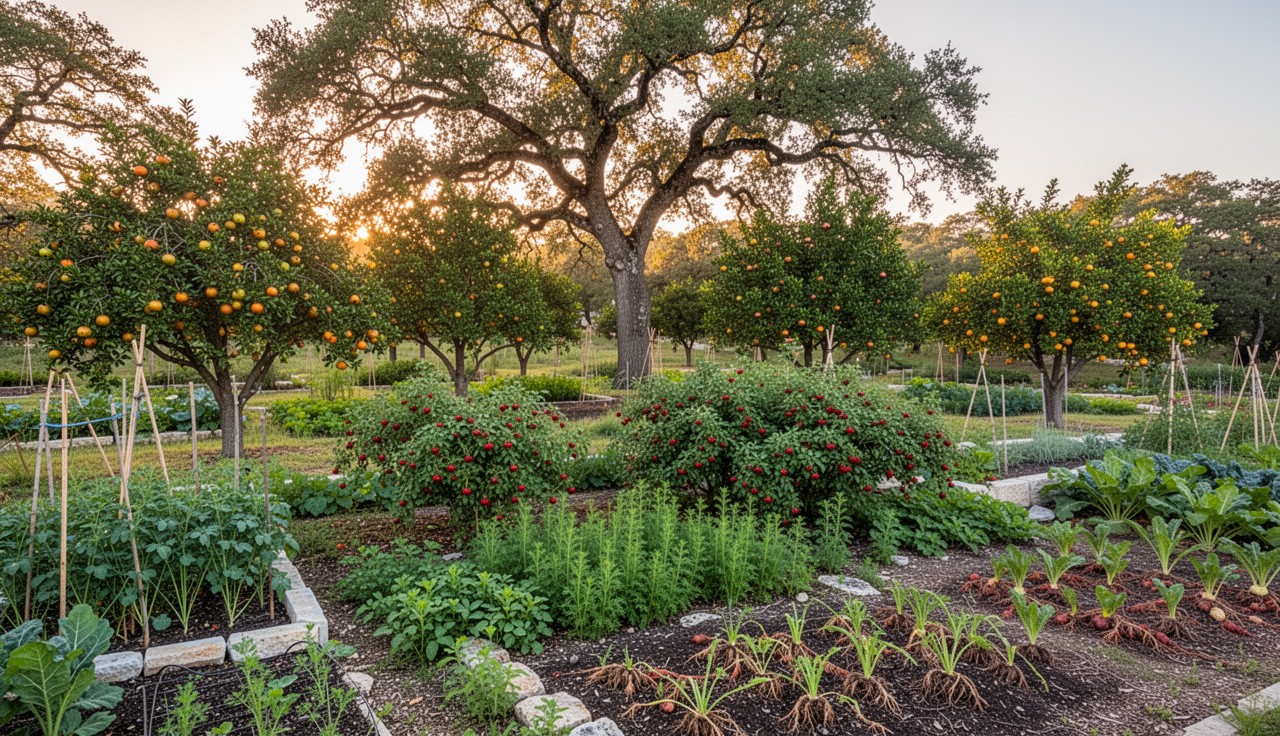
Food forest design and permaculture apply that forest logic to land that grows human food. The goal is to assemble a productive landscape that mimics the structure, diversity, and self-regulating function of a natural woodland system while substituting productive food and medicine plants for the native species that would otherwise occupy each ecological niche. The result, when done well, is a system that becomes progressively easier to manage and more productive over time — the opposite of every annual-cropping system.
Part I: Reading the Site
Observation Before Action
The first principle of permaculture design is to observe before acting. A year of watching a piece of land through all four seasons tells you more about what will grow there and how to manage water than any soil test or design consultation. Where does water flow after heavy rain? Where does it pond? Which areas stay green longest into a drought? Where does frost settle on cold mornings? Where does the existing vegetation show the highest vigor? These patterns reflect the hydrology, soil variation, frost drainage, and solar exposure of the site in ways that no survey can fully capture.
In Texas Hill Country, this observation period reveals patterns that shape every productive food forest design. Cedar-dominated slopes indicate poor thin soils with good drainage but high evapotranspiration from the cedar. Low areas between hills often collect runoff and have deeper, more developed soils. South-facing rocky outcrops stay warmer through winter and warm faster in spring. North-facing slopes in canyons stay moist well into summer dry periods. These are not inconveniences to work around. They are productive niches to work with.
Site Assessment Checklist
- Water: Where does rain arrive, flow, pond, and exit the site? Where are natural collection points, seasonal seeps, or drainage concentrations?
- Sun: Which areas receive full sun year-round, which are shaded at different times, and which areas have frost protection from topography or existing vegetation?
- Soil: What is the depth of topsoil? Is there a clay hardpan, caliche layer, or bedrock close to the surface? What is the native pH?
- Wind: What are the prevailing wind directions and speeds across seasons? Are there areas sheltered from desiccating summer winds?
- Existing vegetation: What is already growing voluntarily? Indicator plants reveal soil conditions, drainage, and disturbance history better than any test.
- Access: Where do people and animals move on the site? High-traffic paths shape where high-maintenance plants should and should not be placed.
- Existing assets: Trees, rock outcrops, structures, water features, and existing productive plants are all design elements to work with rather than obstacles to clear.
Indicator Plants and What They Reveal
Existing plant communities are the most reliable indicators of site conditions available to any grower. Plants cannot lie about where they thrive.
| Indicator Plant | What It Indicates | Implication for Design |
|---|---|---|
| Dense Eastern red cedar | Thin rocky alkaline soil; low organic matter; previously grazed or disturbed | Site needs soil building before intensive food production; cedar clearing releases nutrients and opens light |
| Native persimmon | Deep soil with some moisture retention; previously wooded | Natural fruit tree site; persimmon root depth indicates accessible subsoil moisture |
| Texas live oak | Well-drained loam to clay-loam; stable; historically wooded | Excellent food forest candidate; oak associates well with many productive species and mycorrhizal networks |
| Dewberries and wild blackberries | Disturbed ground transitioning to woodland; adequate moisture | Site is already in succession toward woody perennials; accelerate with food forest planting |
| Nettles and elderberry | High nitrogen; deep moist soil; organic matter accumulating | Excellent planting site; high natural fertility; prioritize for highest-demand productive plantings |
| Prickly pear and sotol | Very thin dry soil; caliche or bedrock close to surface; alkaline | Native perennial and medicinal zone; do not attempt intensive food production without significant soil building |
| Dense Johnsongrass or Bermuda | Disturbed fertile soil with adequate moisture; previously cultivated | High potential after management; sheet mulch aggressively to transition to perennials |
Part II: The Seven-Layer Model
The most useful structural model for food forest design is the seven-layer system, derived from observing the vertical stratification of temperate and subtropical woodland ecosystems. Every productive forest occupies multiple vertical niches simultaneously from the canopy to the soil surface, with each layer creating conditions that support the layers below it.
Layer 1: Canopy
The canopy layer consists of the tallest trees in the system. In a mature food forest these are large nut and fruit trees. Canopy trees cast shade that cools the system below in summer, intercept rainfall that would otherwise compact bare soil, and drop leaves that feed soil biology and build organic matter over decades.
- Native Texas candidates: Texas live oak, bur oak, Texas pecan, Mexican plum, cedar elm, persimmon
- Productive food forest candidates: Pecan (Zones 6–9), chestnut (Zones 4–8), black walnut (Zones 4–8), mulberry (Zones 4–9), pawpaw (Zones 4–8)
- Spacing: 30–40 feet between canopy trees; plan for the mature spread, not the sapling size at planting
- Succession timing: Canopy trees take 10–20 years to reach full size; plant them first and build all other layers around them
Layer 2: Sub-Canopy
Sub-canopy trees grow beneath the canopy layer and fill the space between large trees during the decades it takes canopy trees to reach full size. Many sub-canopy species are among the most immediately productive fruit trees available, and they thrive in the partial shade that the mature canopy will eventually provide. This layer is often the most productive part of a young food forest because sub-canopy trees reach fruiting size in three to six years while canopy trees are still establishing.
- Fruit trees: Apple, pear, plum, cherry, peach, apricot, and fig for Zones 5–9
- Zone 8–9 specific: Fig, pomegranate, jujube, and loquat are excellent productive sub-canopy species highly suited to Hill Country conditions and drought tolerance
- Spacing: 15–25 feet between sub-canopy trees
Layer 3: Shrub
The shrub layer occupies the space below sub-canopy trees and along the system edges. It is the most functionally diverse layer in terms of ecological roles: nitrogen-fixing shrubs feed the system, berry-producing shrubs feed people and wildlife, aromatic and medicinal shrubs provide harvest value and pest deterrence, and densely growing shrubs create habitat and edge complexity that supports predatory insects and birds.
- Nitrogen-fixing shrubs: Siberian pea shrub (Caragana), indigo bush, leadplant, desert willow
- Berry and fruit shrubs: Elderberry, currants, gooseberries, hardy pomegranate, beautyberry, agarita
- Medicinal and aromatic: Rosemary hedge form, lavender, turk’s cap, Texas sage (Leucophyllum)
- Wildlife and edge: Hawthorn, native wild plum, native sumac, desert willow
Layer 4: Herbaceous
The herbaceous layer grows beneath the shrubs and between woody plants. It includes the majority of culinary herbs, medicinal plants, and perennial vegetables. Many herbaceous layer plants are dynamic accumulators that mine nutrients from deep soil and make them available at the surface through leaf drop.
- Culinary herbs: Oregano, thyme, sage, chives, lemon balm, sorrel, Mexican tarragon
- Medicinal plants: Comfrey, echinacea, valerian, skullcap, holy basil, passionflower, ashwagandha, lemon verbena
- Dynamic accumulators: Comfrey (mines potassium, calcium, and phosphorus from deep in the soil), yarrow, dandelion, borage
- Nitrogen fixers: White clover, red clover, groundnut (Apios americanus; native edible tuber), self-heal
Layer 5: Ground Cover
Ground cover plants are low-growing spreading species that protect the soil surface from desiccation, compaction, and weed invasion. In a food forest the goal is to have no bare soil anywhere in the system at any time of year.
- Edible ground covers: Strawberry, creeping thyme, wood sorrel, violets, nasturtium
- Functional ground covers: White clover for nitrogen and pollinator forage, creeping rosemary, ajuga
- Native ground covers for Texas: Prairie verbena, antelope horn milkweed for monarch habitat, native stonecrop, buffalo grass in open areas
Layer 6: Vine
Vines use the vertical structure of trees and shrubs as support, filling otherwise unused canopy space with productive growth.
- Food vines: Grape for Zones 4+, kiwi for Zones 4–9, passion fruit for Zone 7+, maypop native passion vine for Zone 6+
- Functional vines: Coral honeysuckle (native Texas; attracts hummingbirds and pollinators), Carolina jessamine (native; early pollinator forage)
- Management: Train vines deliberately onto specific support structures; unchecked vines can overwhelm young trees and require annual pruning to remain productive
Layer 7: Root
The root layer encompasses plants grown specifically for underground harvests: tubers, rhizomes, and roots. The ideal root layer plants are perennials that can be harvested by selective digging without disturbing the surrounding soil structure.
- Root layer crops: Jerusalem artichoke for Zones 3–9 (produces abundantly; requires containment), groundnut (Apios americanus; nitrogen-fixing and native), oca for Zones 7–10
- Zone 8–9 additions: Ginger, turmeric, wild garlic, society garlic (edible and ornamental)
- Management note: Jerusalem artichoke spreads aggressively by tuber; plant in a defined area bounded by mowing paths or harvest the entire crop each fall to prevent takeover
Seven-Layer Reference Table
| Layer | Height | Key Functions | Example Species (Texas / Zone 8–9) |
|---|---|---|---|
| 1. Canopy | 30–60+ ft | Shade; leaf mulch; microclimate moderation; nut and fruit production | Pecan, Texas live oak, bur oak, mulberry, Mexican plum |
| 2. Sub-canopy | 10–25 ft | Primary fruit production; intermediate shade; wildlife habitat | Fig, jujube, pomegranate, loquat, plum, pear, apple |
| 3. Shrub | 3–10 ft | Nitrogen fixation; berry production; medicinal harvest; edge habitat | Elderberry, agarita, rosemary hedge, beautyberry, Texas sage |
| 4. Herbaceous | 1–4 ft | Culinary herbs; medicinals; dynamic accumulators; nitrogen fixation | Comfrey, holy basil, echinacea, passionflower, skullcap, lemon balm |
| 5. Ground cover | Under 1 ft | Soil protection; living mulch; pollinator forage | White clover, creeping thyme, strawberry, prairie verbena |
| 6. Vine | Climbs structure | Vertical fruit production; canopy diversity; wildlife habitat | Maypop, mustang grape, coral honeysuckle |
| 7. Root | Underground | Underground harvest; soil aeration; mycorrhizal activity | Jerusalem artichoke, turmeric, ginger, groundnut |
Part III: Plant Guilds
What a Guild Is and Why It Matters
A plant guild is a group of species assembled around a central productive plant in a way that each member supports the others’ function. The classic food forest guild is built around a fruit or nut tree as the central species with the surrounding plants selected for specific functional roles: nitrogen fixation to feed the tree, dynamic accumulation to mine deep minerals and deposit them at the surface, pest deterrence through aromatic compounds, pollinator attraction to ensure fruit set, ground cover to retain moisture and suppress weed competition, and wildlife habitat to support the predatory insects and birds that manage pest populations.
The Apple Tree Guild: A Template
The apple guild is the most documented example of food forest guild design and serves as a template applicable to most temperate fruit trees.
- Central tree: Apple in any variety suited to the climate and zone
- Nitrogen fixer: Siberian pea shrub or white clover planted within the root zone; clover mown and left as mulch
- Dynamic accumulators: Comfrey planted at the drip line; chop-and-drop leaves up to six times per season as a potassium and calcium mulch
- Pest deterrents: Chives and garlic chives planted at the base; aromatic umbel flowers deter aphids and attract hoverflies that eat aphids
- Pollinator attractors: Borage, phacelia, and sweet cicely planted within the guild to draw and hold pollinators during the bloom period
- Ground cover: White clover and creeping thyme filling all bare soil under the drip line
- Mulch ring: Deep wood chip mulch from drip line inward to trunk base protects soil, feeds biology, and retains moisture through summer dry periods
The Texas Pecan Guild
Pecan is the signature food forest tree for central and south Texas, deeply adapted to the climate and soils of the region.
- Central tree: Two pecan trees of complementary pollination types; Type I includes Pawnee and Cheyenne; Type II includes Desirable and Kiowa; both types needed for reliable nut set
- Zinc accumulators: Comfrey and borage both accumulate zinc in their tissue; chop-and-drop at the drip line provides zinc directly to the root zone
- Nitrogen fixers: White clover as living mulch under the canopy; desert willow or Caragana as shrub-layer nitrogen fixers
- Ground cover: Native grasses and wildflowers maintained as a diverse meadow below the canopy rather than mowed turf or bare ground
- Water harvesting: A swale or berm earthwork uphill of each pecan tree intercepts hillside runoff and directs it slowly to the root zone
Medicinal Plant Guilds for the Hill Country
For growers whose primary goal is medicinal plant production rather than tree fruit, the guild concept applies equally well.
- Guild 1 — Nervine: Passionflower trained on a trellis with echinacea, skullcap, and holy basil as understory companions and white clover as living mulch
- Guild 2 — Adaptogen: Ashwagandha with comfrey as dynamic accumulator and white clover for nitrogen; borage for pollinator attraction during ashwagandha flowering
- Guild 3 — Aquatic: Blue lotus in an aquatic container integrated into a pond-edge guild with watercress, native sedges, and water mint
Pest Deterrence and Pollinator Support
Aromatic herbs including lavender, rosemary, and anise hyssop distributed throughout any medicinal guild deter most foliage-feeding insects. Borage, phacelia, and native bee balm adjacent to all medicinal plantings increase fruit and seed set on all surrounding species.
Part IV: Succession Management
Working with Natural Succession
Ecological succession is the process by which a plant community changes over time from pioneer species toward a stable climax community. In most of North America the climax community is woodland or forest. Food forest design inverts conventional land management by choosing which stage of succession to occupy at each point in the landscape, assembling the productive species that fill that niche, and then managing the system to maintain it at the chosen stage rather than fighting the natural process.
Establishment Phase: Years 1 to 5
The most labor-intensive period. Primary tasks are creating soil where needed, suppressing competitive vegetation, establishing pioneer and nitrogen-fixing species, and planting the permanent species at their eventual mature spacing.
- Sheet mulch all areas to be planted with overlapping cardboard and 4–6 inches of wood chips; this smothers existing vegetation and begins the soil-building process simultaneously
- Plant fast-growing nitrogen-fixing species immediately: black locust, Siberian pea shrub, and white clover establish within the first season and begin feeding the system
- Plant canopy trees first and at their final mature spacing; protect with tree tubes if deer pressure is present
- Plant sub-canopy trees in years 1–2 simultaneously with or just after canopy trees
- Establish shrub layer plants in years 2–3 as canopy trees are getting established
- Seed and transplant herbaceous layer species in years 2–5 as system shade patterns develop
- Establish ground covers throughout the entire process; fill all bare soil at every stage
Development Phase: Years 5 to 15
As canopy and sub-canopy trees develop, the light environment in the food forest changes continuously. The primary management task during this phase is selective thinning and coppicing. Pioneer nitrogen-fixing trees planted to build soil are gradually removed as their shade begins to suppress the permanent fruit and nut trees.
- Coppicing: Cutting woody plants to the base to stimulate vigorous regrowth; appropriate for nitrogen fixers, willow, elder, and many multi-stem shrubs
- Pollarding: Cutting branches back to a main trunk framework each season; appropriate for mulberry and other large-leafed species grown for biomass
- Selective thinning: Remove pioneer species as permanent species grow into their allocated space; always prioritize removing any plant directly competing for light with a long-term productive tree
Mature Phase: Year 15 and Beyond
A mature food forest requires dramatically less management than any vegetable garden or annual-cropping system. The system maintains its own fertility through leaf fall and decomposition. The plant diversity creates a complex food web that manages pest populations. The deep root systems of established trees access subsoil moisture and nutrients that annual crops cannot reach. Primary management tasks are harvesting, occasional pruning for light penetration, coppicing of nitrogen fixers on a rotation, and adding new species to fill any gaps.
Part V: Species by Zone
Zones 3 to 5: Cold Northern Climates
- Canopy: American chestnut hybrids, shellbark hickory, black walnut, bur oak, butternut
- Sub-canopy: Apple, pear, plum, serviceberry, hawthorn, pawpaw
- Shrubs: Currants, gooseberries, elderberry, hazelnut, Siberian pea shrub
- Herbaceous: Comfrey, yarrow, valerian, echinacea, rhubarb, sorrel, wild ginger
- Ground cover: White clover, wild strawberry, creeping thyme, mint
Zones 6 to 7: Temperate Four-Season
The most productive zone range for traditional food forest species. A full range of temperate fruits and nuts perform reliably and the growing season is long enough to allow most medicinal and aromatic herbs to establish and produce significant harvests.
- Canopy: Pecan, black walnut, American persimmon, mulberry, chestnut, bur oak
- Sub-canopy: Fig in sheltered positions, pawpaw, persimmon, jujube, pear, apple, plum, apricot
- Shrubs: Elderberry, hazelnut, native plum, currants, beautyberry, passionflower vine
- Herbaceous: Full range of culinary and medicinal herbs; echinacea, comfrey, holy basil, skullcap, lemon balm, ashwagandha
Zones 8 to 10: Texas Hill Country and Semi-Arid
The Hill Country poses specific challenges and specific opportunities. Shallow limestone soils, summer heat, and periodic severe drought favor natives and drought-adapted species over the temperate fruit varieties that dominate Zone 6 and 7 food forest literature. The productive strategy is to lead with deep-rooted native species already adapted to site conditions and build the food forest outward from native anchors.
Cedar Clearing: The Highest-Leverage Action
A properly cleared and chipped cedar monoculture site releases enormous amounts of light and nutrients simultaneously. The chips from cleared cedar laid as deep mulch jump-start soil biology immediately, and the remaining root systems decay to create channels for water infiltration.
- Canopy: Texas live oak, bur oak, Texas pecan, cedar elm, Mexican plum, Texas persimmon
- Sub-canopy: Texas persimmon, fig, jujube, pomegranate, loquat, Satsuma mandarin in sheltered positions
- Shrubs: Agarita, turk’s cap, elderberry, native wild plum, beautyberry, rosemary hedge, desert willow
- Herbaceous: Holy basil, passionflower, skullcap, damiana, echinacea, comfrey, lemongrass in sheltered beds, ginger and turmeric in partial shade
- Ground cover: Prairie verbena, buffalo grass in open areas, white clover in moister zones, native stonecrop on rocky outcrops
- Vines: Maypop (native passion vine with edible fruit), mustang grape (native), coral honeysuckle
Part VI: Water Harvesting in the Food Forest
Earthworks
Water is the limiting resource in food forest establishment in semi-arid climates. Earthworks that slow, spread, and sink rainfall dramatically increase the effective precipitation available to the system and can eliminate or greatly reduce the need for supplemental irrigation once the system establishes.
A swale is a level on-contour ditch that intercepts hillside runoff and allows it to infiltrate slowly rather than running off the property. The excavated soil is mounded on the downhill side as a berm and planted with productive deep-rooted species. The combination of swale and berm creates a water-harvesting and planting system in a single earthwork.
- Swale sizing: Approximately 1 cubic foot of swale volume per 100 square feet of catchment area per inch of expected rainfall
- Overflow spillway: Every swale needs a stabilized low point that directs overflow into a vegetated area; never allow overflow to undercut a berm or terrace
- Berm planting: Plant swale berms immediately after construction with deep-rooted perennials to stabilize before the first rain event
Wood Chip Mulch as the Foundation of Water Retention
Deep wood chip mulch is the single highest-impact establishment input in any food forest, particularly in hot semi-arid climates. A 4–6 inch layer of wood chips over all bare soil surfaces reduces evaporation from the soil surface by 60–80 percent, moderates soil temperature by 10–20 degrees Fahrenheit compared to bare ground, suppresses annual weed competition, and feeds soil biology as it decomposes. On a ranch with regular cedar clearing operations, the chips from that clearing distributed across food forest planting areas provide the mulch layer that builds all the conditions for everything else to establish successfully.
Part VII: Integration with Working Ranch Land
Food Forest as a Land Use Layer
On a working ranch, food forest design is not a replacement for existing land use but an addition to it. The food forest occupies land that is not currently producing high value: rocky hillsides, creek margins, windbreak corridors, and areas where conventional grazing or hay production would require inputs exceeding returns. Converting these areas to productive multi-layer perennial systems increases total land productivity without competing with existing agricultural uses on more productive ground.
The integration points are multiple and reinforcing:
- Livestock integration: Pigs, chickens, and ducks can be rotated through established food forest sections to harvest fallen fruit, control pest insects, and add fertility through manure; keep all livestock out during the establishment phase
- Timber and fuel production: Black locust, cedar, and other coppiced species provide ongoing firewood and timber without requiring clear-cutting operations
- Medicinal production: The herbaceous and shrub layers are ideal production environments for medicinal species including passionflower, skullcap, holy basil, and native medicinals that have shade and moisture requirements met by the canopy overhead
- Carbon sequestration: A mature food forest sequesters carbon in both woody biomass and deep soil organic matter at rates significantly higher than any annual-cropping alternative on the same land
References
- Jose S. 2009. Agroforestry for ecosystem services and environmental benefits. Agroforestry Systems. 76(1):1–10. doi:10.1007/s10457-009-9229-7
- Nair PKR, Kumar BM, Nair VD. 2009. Agroforestry as a strategy for carbon sequestration. Journal of Plant Nutrition and Soil Science. 172(1):10–23. doi:10.1002/jpln.200800030
- Wolz KJ, Lovell ST, et al. 2018. Frontiers in alley cropping: transformative solutions for temperate agriculture. Global Change Biology. 24(3):883–894. doi:10.1111/gcb.13986
- Jacke D, Toensmeier E. 2005. Edible Forest Gardens, Vol I: Vision and Theory. Chelsea Green Publishing.
- Peoples MB, Herridge DF, Ladha JK. 1995. Biological nitrogen fixation: an efficient source of nitrogen for sustainable agricultural production? Plant and Soil. 174(1–2):3–28. doi:10.1007/BF00032239
- Chalker-Scott L. 2007. Wood chip mulch: landscape boon or bane? HortTechnology. 17(4):473–480. doi:10.21273/HORTTECH.17.4.473
- Lowenfels J, Lewis W. 2006. Teaming with Microbes: The Organic Gardener’s Guide to the Soil Food Web. Timber Press.
- Lancaster B. 2013. Rainwater Harvesting for Drylands and Beyond, Volumes 1–2. Rainsource Press.
- Mollison B. 1988. Permaculture: A Designers’ Manual. Tagari Publications.
- USDA NRCS. 2012. Agroforestry Notes: Alley Cropping and Food Forest Practices. AF Note-39.