Preserving
Fruit Wine and Mead Production
Make fruit wine and mead at home: yeast science, equipment, the fruit-wine and mead processes, and managing water chemistry and nutrients.
On this page
Fermentation is older than farming. Residue analysis from pottery in Jiahu, China, dated to 7000 BCE, confirmed a mixed fermented beverage of rice, honey, and hawthorn fruit (McGovern et al., 2004, PNAS 101(51)). That is roughly 4,000 years before the earliest evidence of cultivated grape wine. Every culture with access to sugar and ambient yeast figured this out independently. The Mayans fermented balche from bark and honey. Norse cultures made mead central to religious ceremony. Sub-Saharan African cultures fermented palm sap, honey, and dozens of wild fruits.
The biology is simple. Saccharomyces cerevisiae, brewer's yeast, consumes simple sugars and excretes ethanol and carbon dioxide. It does this not because it benefits from alcohol production, but because ethanol is toxic to competing microorganisms. The yeast poisons its environment to eliminate competition. Every bottle of wine is the end result of microbial chemical warfare.
Understanding that single principle reframes the entire craft. Your job as the winemaker is to create conditions where S. cerevisiae wins decisively and quickly, before spoilage organisms can establish. Everything that follows, sanitation, nutrient management, temperature control, sulfite additions, serves that one goal.
1. Yeast Science
Strain Selection
Not all S. cerevisiae behaves the same. Wine yeast strains have been selected over centuries for specific traits:
- Lalvin EC-1118 (Prise de Mousse), The workhorse. Tolerates up to 18% ABV, ferments cleanly across a wide temperature range (10–30°C / 50–86°F), restarts stuck fermentations reliably. Neutral flavor contribution. If you are making your first batch of anything, use this strain.
- Lalvin 71B-1122, Metabolizes 20–40% of malic acid during fermentation, softening high-acid fruits like blackberry, cherry, and plum. Best for fruit wines where you want the fruit character forward. Alcohol tolerance approximately 14%.
- Lalvin K1-V1116, Cold-tolerant strain that ferments well at 10–15°C (50–59°F). Clean profile, good for delicate fruits and meads where you want honey character preserved. Tolerance around 18%.
- Lalvin D-47, Enhances mouthfeel and body. Sensitive to temperatures above 20°C (68°F), produces excessive fusel alcohols when warm. Excellent for meads fermented in cool conditions. Tolerance around 14%.
Alcohol tolerance determines how much sugar the yeast can convert before the ethanol it produces kills it. A strain rated at 14% will stop fermenting and leave residual sweetness if the must contains enough sugar for 16%. This is a tool, not a limitation. It is how you produce off-dry and sweet wines without backsweetening.
Nutrient Requirements
Yeast cells are not just sugar-to-alcohol converters. They are living organisms that need nitrogen, vitamins, minerals, and sterols to build cell membranes, synthesize enzymes, and reproduce. The single most common cause of fermentation problems in fruit wine and mead is nitrogen deficiency.
Yeast-Assimilable Nitrogen (YAN) is the total nitrogen available to yeast in a form they can actually use. It includes:
- Ammonium ions (NH4+), from diammonium phosphate (DAP)
- Free amino nitrogen (FAN), from organic sources like Fermaid-O (autolyzed yeast)
Grape must typically contains 150–300 mg/L YAN naturally. Honey contains almost none, often under 50 mg/L. Most fruit musts fall somewhere between. This is why grape wine ferments relatively easily and mead has a reputation for being slow and temperamental. The honey is not the problem. The missing nitrogen is.
Minimum YAN targets by starting gravity:
| Original Gravity | Approximate Potential ABV | Target YAN (mg/L) |
|---|---|---|
| 1.050–1.070 | 6.5–9% | 150 |
| 1.070–1.090 | 9–12% | 200 |
| 1.090–1.110 | 12–14.5% | 250 |
| 1.110–1.130 | 14.5–17% | 300+ |
Temperature Effects
Temperature controls the rate of fermentation and the types of flavor compounds produced.
- Below 13°C (55°F). Fermentation is very slow or stalls. Some cold-tolerant strains (K1-V1116) still work at 10°C.
- 13–18°C (55–64°F), Slow, clean fermentation. Preserves delicate fruit and honey aromatics. Produces more esters (fruity/floral notes). Preferred for white wines, meads, and delicate fruit wines.
- 18–24°C (64–75°F), Moderate fermentation rate. Good balance of speed and flavor. Most fruit wines ferment well in this range.
- Above 24°C (75°F), Fast fermentation, increased fusel alcohol production (hot, solvent-like flavors), increased risk of volatile acidity. Avoid for most styles.
- Above 30°C (86°F), Risk of yeast death and stuck fermentation. Never ferment at these temperatures.
The single best improvement most home winemakers can make is controlling fermentation temperature. A closet, basement, or swamp cooler (fermenter in a water bath with a wet towel and fan) drops temperatures 5–10°F reliably.
2. Equipment
None of this requires expensive gear. The essentials:
Fermentation Vessels
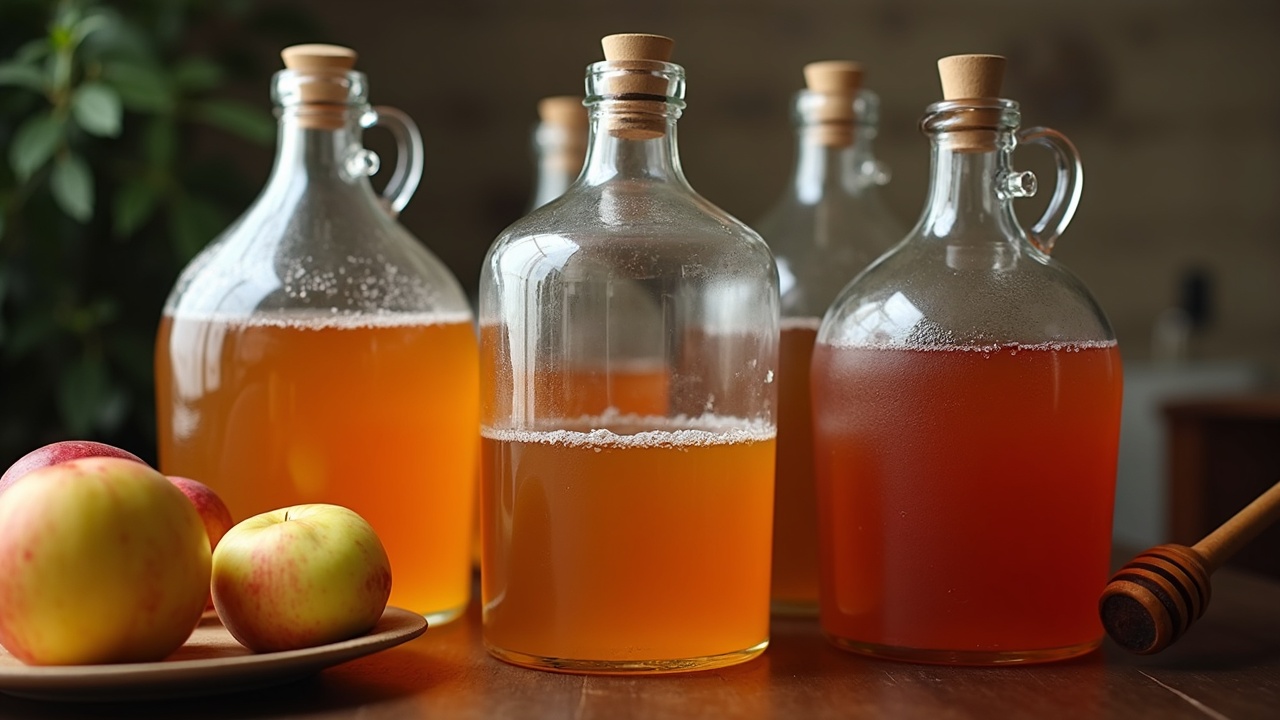
- Glass carboys (1-gallon and 5-gallon). Nonreactive, easy to sanitize, allow visual monitoring. The 1-gallon size is ideal for learning, mistakes cost $5 in ingredients instead of $25.
- Food-grade plastic buckets (2-gallon or 6.5-gallon), Used for primary fermentation when the must contains fruit pulp. Wide mouth allows easy addition and removal of fruit.
- Airlocks and drilled stoppers. One-way valves that allow CO2 to escape while preventing oxygen and wild organisms from entering. Three-piece airlocks are easier to clean than S-type.
Measurement
- Hydrometer and test jar, Measures specific gravity (sugar content) of the must. Essential for calculating potential alcohol, tracking fermentation progress, and confirming completion. A $7 tool that prevents 90% of guesswork.
- pH meter or pH strips, Measures acidity. Accurate pH strips (narrow range, 2.8–4.4) work. A digital pH meter ($15–40) is more precise.
- Thermometer, Stick-on fermometer strips on the carboy or a floating dairy thermometer.
Processing
- Racking cane and siphon tubing, Transfers wine off sediment (lees) without disturbing it. Auto-siphons ($12) eliminate the need to start siphons by mouth.
- Nylon straining bags. Hold fruit pulp during primary fermentation. Allows extraction while making removal clean.
- Bottle filler, bottles, corks, and corker, A spring-tip bottle filler ($5), recycled wine bottles (free), #9 corks, and a double-lever corker ($20–40) handle bottling.
Sanitation
- Star San or iodophor. No-rinse acid sanitizers. Star San is the standard: 1 oz per 5 gallons of water, 30-second contact time, no rinse needed. Every surface that contacts the must after boiling or pasteurization must be sanitized. This is not optional. Sanitation failures cause more ruined batches than any other single variable.
Budget vs. Proper:
- Budget setup (1-gallon): 1-gallon glass jug, airlock, stopper, hydrometer, Star San, auto-siphon, tubing. Total: $25–35.
- Proper setup (5-gallon): 6.5-gallon bucket, 5-gallon carboy, airlock, stopper, hydrometer, pH meter, auto-siphon, tubing, bottle filler, corker. Total: $80–120.
3. Fruit Wine Process
Fruit Selection and Preparation
Almost any fruit with appreciable sugar and flavor can be fermented. The variables that matter:
- Sugar content, Measured as Brix (degrees Brix = grams of sugar per 100 grams of solution) or by hydrometer (specific gravity). Most fruits range from 8–18 Brix naturally. Wine requires a starting Brix of 20–26 (SG 1.080–1.110) for 10–14% ABV.
- Acid content, Expressed as titratable acidity (TA) in g/L or as pH. Target pH for fruit wines: 3.2–3.6. Target TA: 5.5–7.5 g/L (as tartaric equivalent). Low-acid fruits (pear, banana, melon) need acid additions. High-acid fruits (currant, cranberry, gooseberry) need dilution or blending.
- Tannin, Provides structure and mouthfeel. Most fruits are low in tannin compared to grape. Black tea, oak chips, or grape tannin powder can supplement. Use 1/4 tsp grape tannin per gallon as a starting point.
- Pectin, Fruits high in pectin (apple, plum, berry) will produce haze if pectin is not broken down. Pectic enzyme (pectinase) added before fermentation solves this. Dose: 1/2 tsp per gallon, added to crushed fruit 12–24 hours before pitching yeast.
Fruit quantities per gallon of finished wine:
| Fruit | Pounds per Gallon | Notes |
|---|---|---|
| Blackberry | 3–4 | High acid, high color |
| Blueberry | 3–4 | Moderate acid, needs tannin |
| Strawberry | 3.5–4 | Delicate flavor, ferment cool |
| Peach | 3–4 | Low acid, add acid blend |
| Apple (cider) | 8–10 (whole fruit) | Press juice, or use 1 gal fresh cider |
| Cherry (sour) | 3–4 | Very high acid, may dilute |
| Plum | 3.5–4 | Good body, high pectin |
| Elderberry | 2–3 | Intense color and tannin, often blended |
| Watermelon | 8–10 | Very low sugar and acid, supplement both |
Sugar Adjustment
Measure the specific gravity of your must with a hydrometer after dissolving all ingredients.
- Target SG for dry wine: 1.080–1.095 (10.5–12.5% potential ABV)
- Target SG for off-dry to sweet wine: 1.095–1.120 (12.5–16% potential ABV, expecting residual sugar or backsweetening)
To raise SG, add white granulated sugar, honey, or fruit juice concentrate. Approximate addition: 1 oz (28 g) of sugar per gallon raises SG by roughly 0.002.
Acid Adjustment
Measure pH. If above 3.8, add acid blend (tartaric/malic/citric mix) in 1/4 tsp increments per gallon, mixing and re-measuring until pH reaches 3.3–3.6. If below 3.0, dilute with water or add calcium carbonate (1/4 tsp per gallon) to raise pH. Never add so much acid that the wine becomes unpleasant. Taste it. The number matters less than the balance.
Primary Fermentation (Days 1–7)
- Sanitize everything. Bucket, lid, airlock, spoon, hydrometer, test jar.
- Crush or chop fruit. Place in nylon straining bag inside the primary bucket.
- Add water to reach target volume. Add pectic enzyme. Add sulfite (1/4 tsp potassium metabisulfite per 5 gallons, skip if using wild/unpasteurized juice and you want a wild ferment character). Wait 12–24 hours.
- Dissolve sugar to target SG. Add acid blend if needed. Add tannin if needed.
- Rehydrate yeast per manufacturer instructions (typically 104°F / 40°C water, let stand 15 minutes, then temper to within 10°F of must temperature before pitching).
- Pitch yeast. Add first nutrient addition (see Section 5 for SNA schedule). Seal bucket with airlock.
- Punch down the fruit cap 2–3 times daily for 5–7 days. This prevents mold on exposed fruit surfaces and extracts color and flavor.
- Monitor SG daily. When SG drops to 1.030–1.020 (about 1/3 sugar break), proceed to secondary.
Secondary Fermentation (Weeks 2–8)
- Remove fruit bag. Squeeze gently. Do not wring, which extracts harsh tannins.
- Rack (siphon) wine off gross lees into a sanitized carboy. Fill to within 1–2 inches of the stopper to minimize headspace and oxygen exposure.
- Attach airlock. Fermentation will slow visibly. CO2 bubbles will decrease from several per second to one every few seconds, then one every few minutes.
- Rack again at 2–3 weeks into secondary, once a visible layer of fine lees has settled. Top up headspace with a similar wine, juice, or boiled-and-cooled water.
- Confirm fermentation complete. Two identical SG readings 48 hours apart, at or below 0.998 for a dry wine. If SG is stable above 1.000 and you want a dry wine, the fermentation may be stuck (see Troubleshooting).
4. Mead Process
Honey Selection
Honey variety affects flavor more than any other variable in mead. Raw, unfiltered, unheated honey produces the best results.
- Wildflower, Complex, variable, good all-purpose. Most commonly available raw.
- Orange blossom, Floral, citrusy, excellent for traditional show mead.
- Clover, Mild, clean, inexpensive. Good for beginners and melomels.
- Buckwheat, Dark, molasses-like, intense. Best blended or in braggots.
- Meadowfoam, Vanilla and marshmallow notes. Premium, expensive, exceptional for traditional mead.
Honey-to-water ratios by target strength:
| Style | Honey per Gallon | Approx. OG | Approx. ABV |
|---|---|---|---|
| Hydromel (session) | 1.5–2 lbs | 1.040–1.055 | 5–7% |
| Standard | 2.5–3 lbs | 1.080–1.100 | 10–13% |
| Sack (strong/sweet) | 3.5–4.5 lbs | 1.120–1.150 | 14–18% |
Must Preparation
- Heat water to 100–110°F (38–43°C). Do not boil honey, boiling drives off delicate volatile aromatics and is unnecessary for sanitation. If concerned about wild yeast, use potassium metabisulfite.
- Dissolve honey thoroughly. This is the must.
- Measure OG with hydrometer. Adjust honey if needed.
- Cool to yeast pitching temperature (65–75°F / 18–24°C for most strains).
- Rehydrate yeast using Go-Ferm Protect Evolution (rehydration nutrient) at 1.25 g per gram of yeast in 104°F water. This increases yeast viability by 50–80% and is especially critical for high-gravity meads.
Staggered Nutrient Addition (SNA) Protocol
This is the single most important technique in meadmaking. Honey is almost devoid of nitrogen. Without added nutrients, yeast stress, produce sulfur compounds, stall, and die. The SNA protocol provides nutrients in stages that match yeast growth phases.
Standard SNA schedule (per gallon, for OG ~1.100):
- Total YAN target: 250 mg/L
- Nutrient sources: Fermaid-O (organic nitrogen from autolyzed yeast) + DAP (diammonium phosphate, inorganic nitrogen)
- Preferred ratio: 75% Fermaid-O, 25% DAP. Organic nitrogen produces cleaner fermentations with fewer off-flavors.
Dosing schedule:
| Addition | Timing | Fermaid-O | DAP |
|---|---|---|---|
| 1 | 24 hours after pitch | 1.0 g/gal | 0.35 g/gal |
| 2 | 48 hours after pitch | 1.0 g/gal | 0.35 g/gal |
| 3 | 72 hours after pitch | 1.0 g/gal | 0.35 g/gal |
| 4 | 1/3 sugar break (SG ~1.065 for 1.100 OG) | 1.0 g/gal | 0 (no DAP after 1/3 break) |
Critical rule: Do not add DAP after the 1/3 sugar break (approximately 9% Brix drop). Late inorganic nitrogen additions produce ethyl carbamate, a suspected carcinogen, during aging. Use only organic nitrogen (Fermaid-O) for the final addition. This is well-documented in enological literature (Butzke, 1998, J Food Sci 63(3)).
Degassing: Stir or swirl the mead vigorously at each nutrient addition to release dissolved CO2. Excess CO2 in solution inhibits yeast metabolism and is a common cause of slow fermentations. Degassing also suspends settled yeast cells back into the must.
Mead Styles
- Traditional (show mead), Honey and water only. The most technically demanding, nothing masks flaws. Honey quality is paramount.
- Melomel, Mead with fruit. Add fruit in secondary for brighter flavor, or in primary for deeper integration. Same fruit quantities as fruit wine per gallon of total must.
- Metheglin, Mead with herbs and/or spices. Add botanicals in secondary, primary fermentation can strip delicate aromatics. Start with less than you think. Cinnamon, vanilla, clove, ginger, black pepper, lavender, and chamomile are common.
- Cyser, Mead made with apple juice instead of water. Use fresh-pressed, unpasteurized cider for best results. OG will be higher than water-based meads at the same honey quantity.
- Braggot, Mead with malt. Essentially a beer-mead hybrid. Requires boiling the malt portion.
- Bochet, Mead made with caramelized honey. The honey is cooked in a large pot until it darkens to amber or brown, producing toffee, caramel, and marshmallow flavors. Extremely hot and dangerous to boil. Use a pot at least 4x the volume of honey to prevent boilover.
5. Water Chemistry and Nutrients
Water
Chlorine and chloramine in municipal water kill yeast and produce chlorophenol off-flavors (band-aid, plastic). Remove chlorine by boiling or standing 24 hours. Chloramine requires treatment with potassium metabisulfite (1/4 Campden tablet per gallon) or an activated carbon filter.
Spring water or reverse-osmosis water are reliable alternatives. Distilled water works but lacks minerals that support yeast health. Add 1/4 tsp gypsum (CaSO4) per gallon to provide calcium and sulfate.
Nutrient Products
- DAP (diammonium phosphate), Pure inorganic nitrogen source. Cheap, effective, but produces harsher fermentations when used alone. Use as supplement, not sole nitrogen source. Dose: 0.5–1.0 g/gal total across additions.
- Fermaid-O, 100% organic nitrogen from autolyzed yeast. Provides amino acids, sterols, unsaturated fatty acids, and micronutrients. Produces the cleanest fermentations. Dose: 2.0–4.5 g/gal total across additions, depending on starting gravity.
- Fermaid-K, Blend of DAP, autolyzed yeast, and vitamins (including thiamine). Good all-purpose nutrient. Less refined than Fermaid-O but adequate for most fruit wines and standard-gravity meads. Dose: 1.0–2.0 g/gal total.
- Go-Ferm / Go-Ferm Protect Evolution, Rehydration nutrient for yeast. Mixed into the rehydration water before adding dry yeast. Not a fermentation nutrient, it specifically supports cell membrane integrity during the osmotic shock of rehydration. Dose: 1.25 g per gram of yeast.
Sulfites
Potassium metabisulfite (K-meta) serves two functions: antimicrobial (kills wild yeast and bacteria before inoculation) and antioxidant (prevents browning and oxidation during aging and bottling).
- Pre-fermentation dose: 1/4 tsp per 5 gallons (approximately 50 ppm SO2). Wait 12–24 hours before pitching yeast, the sulfite dissipates.
- Post-fermentation dose (at each racking): 1/4 tsp per 5 gallons. Maintains 25–50 ppm free SO2 to protect against oxidation and microbial spoilage.
- At bottling: 1/4 tsp per 5 gallons. Target 25–35 ppm free SO2.
Free SO2 is more effective at lower pH. A wine at pH 3.2 needs less sulfite than a mead at pH 3.8 to achieve the same antimicrobial effect. This is why maintaining proper pH matters for stability, not just flavor.
6. Troubleshooting
Stuck Fermentation
Fermentation stops before reaching target FG. Causes, in order of likelihood:
- Nitrogen deficiency. The most common cause. Add 1.0 g/gal Fermaid-O, degas thoroughly, and stir yeast back into suspension. Wait 24 hours.
- Temperature too low, Move fermenter to warmer location (65–72°F / 18–22°C). Wrap in a towel or blanket. Do not heat rapidly.
- Temperature too high. Yeast may have died. Cool the must, then pitch a fresh, rehydrated starter of EC-1118 (the most robust restart strain).
- Alcohol toxicity, Exceeded the strain's tolerance. If this was unintentional, pitch EC-1118 with Go-Ferm. If you want sweetness, this is your outcome, stabilize and bottle.
- CO2 toxicity. Dissolved CO2 is narcotic to yeast at high concentrations. Degas vigorously by stirring with a sanitized spoon or using a wine whip drill attachment.
Off-Flavors
| Off-Flavor | Smells/Tastes Like | Cause | Fix |
|---|---|---|---|
| Hydrogen sulfide (H2S) | Rotten eggs | Nitrogen deficiency, stressed yeast | Add Fermaid-O, degas, splash-rack. Copper sulfate (0.5 ppm) as last resort. |
| Fusel alcohols | Hot, solvent, rubbing alcohol | Fermentation too warm, or massive yeast pitch | Time, fusels integrate with 6–12 months aging. Prevent by fermenting cooler. |
| Acetic acid | Vinegar | Acetobacter infection (oxygen exposure) | If mild, blend. If strong, make vinegar intentionally. Prevention: minimize headspace, keep airlocks full. |
| Ethyl acetate | Nail polish remover | Wild yeast, acetobacter | Not fixable at detectable levels. Prevention: sanitation, sulfites. |
| Phenolic | Band-aid, plastic, medicinal | Chlorine in water, wild yeast contamination | Not fixable. Prevention: dechlorinate water, sanitize properly. |
| Mousy | Wet cardboard, cereal, mouse cage | Brettanomyces or lactic acid bacteria | Not fixable. Prevention: sulfites, sanitation. |
Haze
- Pectin haze, Fruit wine looks permanently cloudy despite weeks of clearing. Add pectic enzyme (double dose at room temperature; enzyme works slower outside primary fermentation). Wait 1–2 weeks.
- Protein haze, Caused by fruit and honey proteins. Fine with bentonite clay (1–2 tsp per gallon, hydrated in warm water 24 hours before use).
- Starch haze, Rare in wine, possible if unripe fruit was used. Add amylase enzyme.
- Chill haze. Appears when wine is cold, disappears when warm. Cold-stabilize: chill to 28–32°F (-2–0°C) for 1–2 weeks, rack off precipitate.
7. Aging, Fining, and Bottling
Aging
Most fruit wines and meads improve dramatically with aging. Minimum timelines:
- Hydromel / light fruit wine, Drinkable at 4–6 weeks. Best at 3–6 months.
- Standard mead / full-bodied fruit wine, Drinkable at 3 months. Best at 6–12 months.
- Sack mead / high-ABV fruit wine, Drinkable at 6 months. Best at 12–24 months.
- Bochet / aged traditional mead, Best at 18–36 months. Exceptional meads improve for years.
Aging happens in the carboy. Keep airlocks filled (use vodka instead of water to prevent mold). Store in a cool, dark location. Rack every 2–3 months or when a visible lees layer forms.
Oak
Oak chips, cubes, or spirals add vanilla, toast, and tannic structure. Start conservatively, 0.5 oz per gallon for 2–4 weeks, tasting weekly. Remove when you like the flavor. Medium toast French oak complements mead. American oak is bolder and works with berry wines. Sanitize oak by soaking in a small amount of the wine for 24 hours before adding.
Fining Agents
If time alone does not clear the wine:
- Bentonite, Removes positively charged proteins. Most effective general fining agent. 1–2 tsp per gallon.
- Sparkolloid, Positively charged; removes negatively charged haze particles. Good for stubborn haze after bentonite. Follow manufacturer directions. Requires heating.
- Gelatin + Kieselsol (two-part fining), Highly effective but strips some color and body. Use only when other methods fail.
Stabilization Before Bottling
If bottling with residual sugar (off-dry or sweet wines), you must prevent refermentation in the bottle:
- Potassium sorbate. Prevents yeast from reproducing (does not kill existing yeast). Dose: 1/2 tsp per gallon. Must be used with potassium metabisulfite. Sorbate alone can be metabolized by lactic acid bacteria into a geranium-like off-flavor.
- Potassium metabisulfite. Add 1/4 tsp per 5 gallons at bottling.
- Alternative: Sterile filtration, Filters at 0.45 micron remove all yeast. Requires a pressure-driven filter setup ($40–100). Produces a brilliantly clear, shelf-stable product without chemical additions.
Dry wines (FG below 0.998) with no residual sugar can be bottled with sulfite only. There is no sugar for yeast to referment.
Bottling
- Sanitize bottles, filler, tubing, and corks.
- Rack wine into a bottling bucket (a bucket with a spigot at the bottom). This allows a final sulfite addition and gentle mixing before filling.
- Fill bottles to within 1/2 inch of the bottom of where the cork will sit. Overfilling makes corking difficult; underfilling leaves excess oxygen.
- Cork immediately. Use #9 straight corks for long-term aging (12+ months). Synthetic corks or screw caps work for wines consumed within 6 months.
- Store bottles upright for 3 days to allow corks to re-expand and seal, then store on their sides to keep corks moist.
8. Backsweetening
If your wine fermented fully dry and you prefer sweetness:
- Stabilize first with potassium sorbate + potassium metabisulfite. Wait 24 hours.
- Add sweetener. Options: honey (best for mead, maintains character), sugar syrup (2:1 sugar:water, for neutral sweetening), frozen juice concentrate (adds flavor and sweetness).
- Add in small increments, tasting after each. It is very easy to overshoot. Start with 1 oz honey per gallon and increase.
- Record the amount added for future batch consistency.
9. Legal Considerations
Federal Homebrew Exemption (United States)
The federal government legalized homebrewing in 1978 under Public Law 95-458, amending the Internal Revenue Code. The allowance:
- Single adult household: 100 gallons per calendar year, tax-free.
- Household with two or more adults: 200 gallons per calendar year, tax-free.
- Wine and mead are included in this exemption alongside beer.
- Distillation is not included. Distilling alcohol without a federal Distilled Spirits Permit (DSP) is a federal felony under 26 U.S.C. 5601, regardless of state law. This applies even to "water distillation" setups used to concentrate alcohol.
State Variation
Federal law sets the floor, but states can be more restrictive:
- Mississippi and some other states have historically had additional restrictions or did not explicitly legalize homebrewing until recent years. Check current state statute before producing.
- Some states prohibit removal of homebrew from the premises for any purpose, including homebrew competitions or sharing.
- Selling any homemade wine, mead, or beer requires federal and state licensing. The homebrew exemption is for personal and household use only.
International
Laws vary dramatically. Canada, UK, Australia, and New Zealand generally allow home winemaking for personal use without licensing. Many European countries have specific volume limits. Some countries prohibit home alcohol production entirely. Verify local law before beginning.
10. Sources
- McGovern, P.E. (2009). Uncorking the Past: The Quest for Wine, Beer, and Other Alcoholic Beverages. University of California Press.
- McGovern, P.E., et al. (2004). "Fermented beverages of pre- and proto-historic China." PNAS 101(51): 17593–17598.
- Bely, M., Sablayrolles, J.M., & Barre, P. (1990). "Automatic detection of assimilable nitrogen deficiencies during alcoholic fermentation in oenological conditions." Journal of Fermentation and Bioengineering 70(4): 246–252.
- Torija, M.J., et al. (2003). "Effects of fermentation temperature on the strain population of Saccharomyces cerevisiae." International Journal of Food Microbiology 80(1): 47–53.
- Ugliano, M., et al. (2007). "Effect of nitrogen supplementation and Saccharomyces species on hydrogen sulfide and other volatile sulfur compounds in Shiraz fermentation and wine." Australian Journal of Grape and Wine Research 13(2): 68–76.
- Butzke, C.E. (1998). "Survey of yeast assimilable nitrogen status in musts from California, Oregon, and Washington." American Journal of Enology and Viticulture 49(2): 220–224.
- Schramm, K. (2003). The Compleat Meadmaker. Brewers Publications.
- Keller, J. (2015). "Staggered nutrient additions for mead and cider fermentations." Lallemand Oenology Technical Notes.
- Piatz, S. (2014). The Complete Guide to Making Mead. Voyageur Press.
- Public Law 95-458 (1978). Amendment to Internal Revenue Code, 26 U.S.C. 5053(e), Federal Homebrew Exemption.
Tags: [practical-skills] [formulation] [advanced]
Common questions
What is yeast science?
cerevisiae behaves the same. Wine yeast strains have been selected over centuries for specific traits:. Lalvin EC-1118 (Prise de Mousse) , The workhorse. Tolerates up to 18% ABV, ferments cleanly across a wide temperature range (10–30°C / 50–86°F), restarts stuck fermentations reliably. Neutral flavor contribution.
What is fruit wine process?
Fruit Selection and Preparation. Almost any fruit with appreciable sugar and flavor can be fermented. The variables that matter:. Sugar content , Measured as Brix (degrees Brix = grams of sugar per 100 grams of solution) or by hydrometer (specific gravity). Most fruits range from 8–18 Brix naturally.
What is mead process?
Honey variety affects flavor more than any other variable in mead. Raw, unfiltered, unheated honey produces the best results. Wildflower , Complex, variable, good all-purpose. Most commonly available raw. Orange blossom , Floral, citrusy, excellent for traditional show mead.
How much water does fruit wine mead need?
Chlorine and chloramine in municipal water kill yeast and produce chlorophenol off-flavors (band-aid, plastic). Remove chlorine by boiling or standing 24 hours. Chloramine requires treatment with potassium metabisulfite (1/4 Campden tablet per gallon) or an activated carbon filter. Spring water or reverse-osmosis water are reliable alternatives. Distilled water works but lacks minerals that support yeast health.
What are legal considerations?
Federal Homebrew Exemption (United States). The federal government legalized homebrewing in 1978 under Public Law 95-458, amending the Internal Revenue Code. Single adult household: 100 gallons per calendar year, tax-free. Household with two or more adults: 200 gallons per calendar year, tax-free. Wine and mead are included in this exemption alongside beer.