plants
LED Lighting Systems for Growing
Build LED grow lighting: light science, spectrum, LED types, fixture selection, and DIY builds for healthy indoor plant growth.
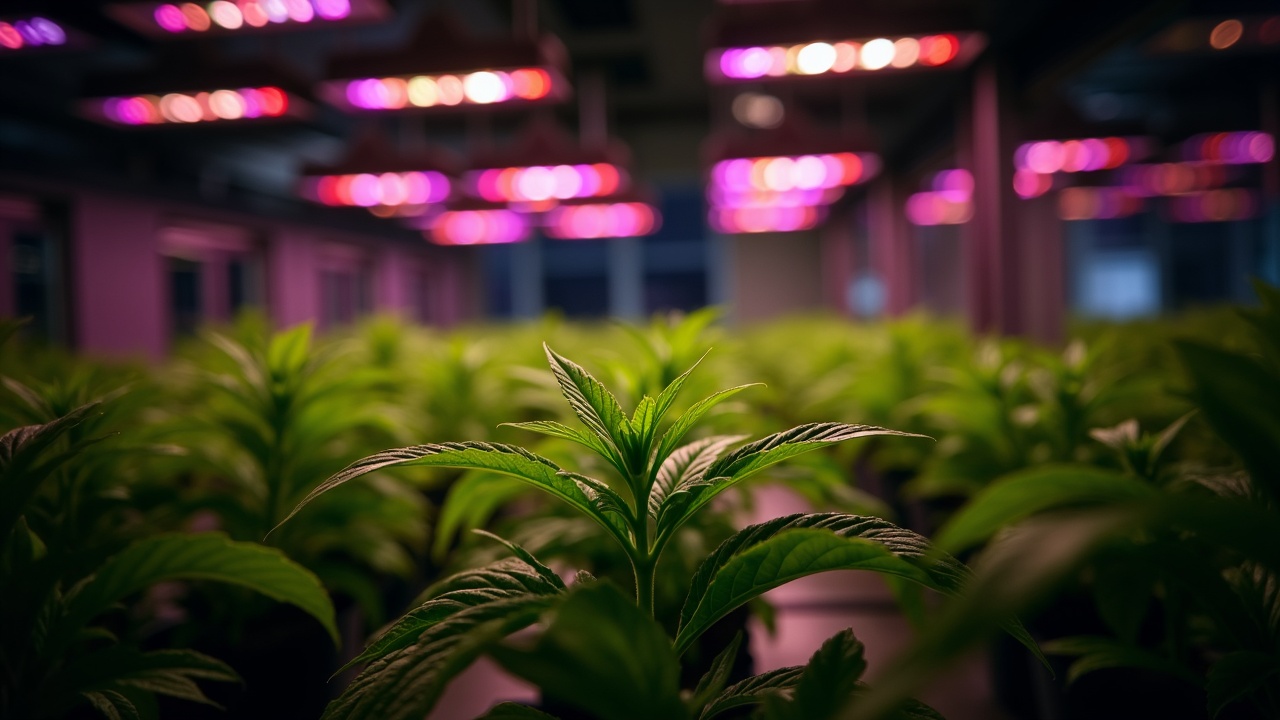
Content Extraction Summary
Expert-level guide to LED grow lighting covering light science (PAR, PPF, PPFD, DLI), spectrum selection by growth phase, LED chip and fixture types with efficacy ratings, honest spec sheet reading, DIY quantum board builds with Meanwell drivers, PPFD targets by crop with DLI calculations, energy comparisons across lighting technologies, common mistakes, and supplemental greenhouse strategies. Designed so a grower can select, build, or evaluate any LED system from spec sheet to harvest.
1. Introduction
Most LED grow lights sold online lie about their output. A panel marketed as "1000W" often draws 150W from the wall and produces the PPFD of a decent desk lamp. The gap between marketing watts and actual photon delivery is where growers lose money and crops lose yield.
LED technology has eliminated every legitimate reason to run HPS or metal halide for indoor growing. Modern white LED diodes (Samsung LM301H, Osram GW CSSRM3.PM) exceed 3.0 umol/J efficacy — meaning each watt of electricity produces more usable plant light than any discharge lamp ever built. HPS tops out around 1.7 umol/J. The physics settled this debate years ago.
But efficiency means nothing if you buy the wrong fixture, hang it at the wrong height, or run the wrong spectrum for your crop phase. This guide covers the full chain: light science, spectrum mechanics, fixture evaluation, DIY builds, and crop-specific light planning.
The single most important concept in this entire document: **Daily Light Integral (DLI)**. Not wattage. Not lumens. Not "full spectrum" marketing. DLI — the total number of photosynthetically active photons delivered to your canopy per square meter per day. Every decision flows from that number.
2. Light Science
Why Lumens Are Meaningless for Plants
Lumens measure brightness as perceived by the human eye, weighted heavily toward green-yellow light (555nm). Human eyes evolved to see in daylight. Plants evolved to eat light. These are different problems.
A lamp can produce enormous lumen output while delivering almost no photons in the wavelengths plants actually use for photosynthesis. Fluorescent tubes are a classic example — high lumens, mediocre plant growth. Lumen ratings on grow lights are a distraction at best, a deception at worst.
PAR — Photosynthetically Active Radiation
PAR defines the wavelength range plants use: **400-700nm**. This is not a measurement — it is a defined range. Any photon between 400 and 700 nanometers counts as PAR. Recent research extends this to 400-750nm (ePAR) to include far-red contributions, but 400-700nm remains the standard for specifications and comparisons.
PPF — Photosynthetic Photon Flux
PPF measures **total PAR photons emitted by a light source per second**, expressed in micromoles per second (umol/s). This is the fixture's total output regardless of where those photons land.
PPF is the honest number. If a manufacturer does not publish PPF measured by an independent integrating sphere test, the fixture is not worth evaluating.
PPFD — Photosynthetic Photon Flux Density
PPFD measures **PAR photons hitting a specific point per second per square meter**, expressed in umol/m²/s. This is what your plants actually receive.
PPFD varies across the canopy. Center readings are always higher than edges. A single center PPFD number is misleading. Honest manufacturers publish PPFD maps — grid measurements at a specified hanging height over a defined area.
Key relationship:
**PPF** = total photons leaving the fixture
**PPFD** = photons arriving at a specific point on the canopy
The difference = photons lost to walls, floor, reflectors, and inverse square law
DLI — Daily Light Integral
DLI is the metric that actually predicts yield. It measures **total accumulated PAR photons per square meter per day**, expressed in mol/m²/day.
**DLI Calculation:**
``` DLI (mol/m²/day) = PPFD (umol/m²/s) x photoperiod (hours) x 3600 / 1,000,000 ```
Example: 400 PPFD for 16 hours:
``` DLI = 400 x 16 x 3600 / 1,000,000 = 23.04 mol/m²/day ```
Example: 600 PPFD for 12 hours:
``` DLI = 600 x 12 x 3600 / 1,000,000 = 25.92 mol/m²/day ```
This means a lower PPFD with a longer photoperiod can deliver more total light than a higher PPFD with a shorter day. DLI is how you compare apples to apples across different lighting strategies.
Inverse Square Law
Light intensity decreases with the square of the distance. Double the distance from fixture to canopy, PPFD drops to one-quarter. This is why hanging height matters enormously and why uniform canopy height improves light utilization.
3. Spectrum
Blue (400-500nm)
Blue light drives vegetative growth, stomatal regulation, and compact morphology. Plants grown without adequate blue stretch toward the light source, producing weak, elongated stems. Blue photons are absorbed primarily by chlorophyll a (peak ~430nm) and cryptochrome photoreceptors.
Practical range: 440-460nm for primary blue. Excess blue beyond 20-25% of total PPF reduces overall photosynthetic efficiency without proportional benefit.
Red (600-700nm)
Red light is the most photosynthetically efficient wavelength range. Chlorophyll a and b both absorb strongly here, with peaks around 660nm. Red drives photosynthesis rate per photon more than any other color.
The McCree curve — measured action spectrum of photosynthesis across plant species — shows red photons (600-700nm) are 20-30% more efficient at driving carbon fixation than blue photons, per photon delivered (McCree, 1972, *Agricultural Meteorology* 9:191-216).
Far-Red (700-750nm)
Far-red sits outside traditional PAR but contributes meaningfully through the **Emerson enhancement effect**. When far-red photons are delivered simultaneously with red, the combined photosynthetic rate exceeds the sum of each wavelength alone.
This happens because photosystem I (PSI) absorbs far-red efficiently while photosystem II (PSII) does not. Delivering both wavelengths simultaneously keeps both photosystems operating at maximum throughput. Zhen and Bugbee (2020, *Frontiers in Plant Science*) demonstrated that far-red photons delivered with shorter wavelengths are equally efficient as traditional PAR photons for driving photosynthesis.
Far-red also influences phytochrome-mediated shade avoidance. A low red:far-red ratio signals shade, promoting stem elongation and early flowering. This is useful for triggering flowering transitions but counterproductive during vegetative growth.
Green (500-600nm)
Green light penetrates deeper into the canopy than red or blue. While leaves reflect significant green light at the surface, transmitted green photons reach lower leaves that would otherwise be shaded.
In dense canopies — lettuce heads, bushy herbs, dense pepper plants — green light contribution to total canopy photosynthesis is significant. Smith et al. (2017, *American Journal of Botany* 104:1348-1359) showed green light drives photosynthesis in inner canopy layers where red and blue are depleted.
Full-spectrum white LEDs inherently contain green. This is one reason broad-spectrum whites often outperform red-blue "blurple" panels in practice despite lower theoretical per-photon efficiency.
Full Spectrum vs. Targeted Spectrum
**Full spectrum (broad white + supplemental red):** Simpler fixture design, better visual assessment of plant health (you can actually see the leaves), good canopy penetration from green component. Modern best practice for most growers.
**Targeted spectrum (red + blue only):** Higher theoretical efficiency per photon, but creates purple light that makes diagnosing nutrient deficiency, pest damage, or disease nearly impossible by eye. Limited canopy penetration. Largely obsolete for serious growing.
**Recommended approach:** 3000K-3500K warm white LEDs (Samsung LM301B/H) as the base, with supplemental 660nm deep red and optional 730nm far-red bars for flowering enhancement. This delivers broad PAR coverage, usable green for canopy penetration, and targeted red for photosynthetic efficiency.
4. LED Types
SMD (Surface-Mount Diode)
The dominant technology for modern grow lights. Individual diodes soldered to a circuit board. Current top-tier chips:
| Chip | Manufacturer | Efficacy (umol/J) | Notes | |------|-------------|-------------------|-------| | LM301H | Samsung | 3.10 | Current gold standard, binned for consistency | | LM301B | Samsung | 2.92 | Previous standard, still excellent, lower cost | | LM301H EVO | Samsung | 3.14 | Newest revision, marginal improvement | | GW CSSRM3.PM | Osram | 3.03 | Alternative to Samsung, good thermal performance | | GW PSLR31.PM | Osram | 2.80 | Budget tier, still competitive |
Efficacy numbers are at specified drive currents (typically 65mA). Overdriving reduces efficacy. A fixture using LM301H chips driven at 150% rated current does not achieve 3.1 umol/J.
COB (Chip-on-Board)
Multiple LED dies bonded directly to a substrate, producing intense point-source light. Citizen CLU048 and Cree CXB3590 were popular. COBs produce high PPFD from a small area but create hotspots and require significant heatsinking.
COBs have largely been replaced by SMD quantum boards for most applications. They still have a role in high-bay supplemental lighting and spot applications but are poor choices for uniform canopy coverage.
Quantum Board vs. Bar Style
**Quantum boards:** Large flat PCBs densely populated with SMD LEDs. Even light distribution. Original design popularized by Horticulture Lighting Group (HLG). Good for small to medium grow areas (2x2 to 4x4 feet).
**Bar style (spider/multi-bar):** Multiple LED bars spaced across a frame. Better light spread over large areas. Superior thermal performance because heat is distributed across more surface area. Bars can be individually adjusted for height and spacing. Preferred for larger canopies (4x4 feet and above) and commercial applications.
Bar-style fixtures dominate commercial indoor farming because they spread heat load, allow closer placement to canopy (reducing distance loss), and produce more uniform PPFD maps than boards.
Driver Matching
LEDs are current-driven devices. The driver converts AC mains power to the constant current the LEDs require. Mismatched drivers cause flickering, premature LED failure, or inefficiency.
**Meanwell HLG series** is the industry standard for DIY and many commercial fixtures:
- HLG-120H: 120W, suits small builds
- HLG-240H: 240W, standard single-board build
- HLG-480H: 480W, large bar builds
- HLG-600H: 600W, commercial bar arrays
The suffix letter matters:
- **-A**: Adjustable via internal potentiometer (current and voltage)
- **-B**: Dimmable via external 0-10V signal or potentiometer
- **-AB**: Both adjustable and dimmable
For grow lights, **-B** versions are preferred. External dimming allows adjusting output without opening the driver enclosure, and enables automated dimming via controller.
**Voltage matching:** Total forward voltage of your LED string must fall within the driver's output voltage range. Series strings add voltages; parallel strings add currents. Calculate before purchasing.
5. Fixture Selection
Reading Spec Sheets Honestly
Three wattage numbers appear on grow light spec sheets. Two of them are designed to mislead you.
| Spec | What It Actually Means | What to Trust | |------|----------------------|---------------| | LED wattage | Maximum rated power of all LED chips combined if driven at absolute max | Ignore completely | | "Equivalent" wattage | Marketing fiction claiming LED equals some HPS wattage | Ignore completely | | Wall wattage (input power) | Actual watts drawn from your outlet, measured at the plug | Use for electricity cost | | PPF (umol/s) | Total photosynthetically active photons emitted per second | Use for light output | | Efficacy (umol/J) | PPF divided by wall wattage — photons per watt | Use for efficiency comparison |
**The only number that matters for comparing light output between fixtures is PPF.** The only number that matters for efficiency is umol/J.
A fixture advertising "1000W" that draws 200W from the wall and produces 500 umol/s has an efficacy of 2.5 umol/J. A fixture advertising "240W" that draws 240W and produces 720 umol/s has an efficacy of 3.0 umol/J. The "240W" fixture produces 44% more usable light.
Coverage Area Calculations
Coverage depends on target PPFD and fixture PPF. A rough planning formula:
``` Coverage area (m²) = PPF (umol/s) / target PPFD (umol/m²/s) x utilization factor ```
Utilization factor accounts for wall reflectivity, fixture optics, and mounting geometry. Use 0.7-0.85 for reflective grow tents, 0.5-0.6 for open rooms with white walls.
**Example:** A 600 umol/s fixture targeting 500 PPFD in a reflective tent:
``` Coverage = 600 / 500 x 0.8 = 0.96 m² (roughly 3.2 x 3.2 feet) ```
Hanging Height
Closer = higher center PPFD but worse uniformity. Further = lower PPFD but more even spread. Optimal hanging height depends on fixture design.
**Bar-style fixtures:** 8-12 inches above canopy for flowering, 18-24 inches for seedlings/clones. Close mounting is possible because heat and light are spread across bars.
**Quantum boards:** 12-18 inches for flowering, 24-30 inches for seedlings. Point-source concentration requires more distance for uniformity.
**Always follow the manufacturer's PPFD map** and note the hanging height at which it was measured. A PPFD map measured at 24 inches is useless if you plan to hang at 12 inches.
PPFD Maps
A legitimate PPFD map shows a grid of measurements (minimum 9 points for a small fixture, 25+ for larger units) at a specified hanging height over a defined footprint. Look for:
- Measurement height clearly stated
- Grid density (more points = more honest)
- Edge measurements included (not just center peak)
- Average PPFD calculated across the grid, not just peak center value
- Independent lab testing (not manufacturer self-reported)
Uniformity ratio = minimum PPFD / maximum PPFD across the grid. Above 0.7 is good. Below 0.5 means the edges of your canopy are getting half the light of the center.
6. DIY Builds
Why Build
Commercial fixtures include margins for marketing, distribution, warranty reserves, and profit. A DIY build using identical components costs 40-60% less for the same light output. A Samsung LM301H quantum board from a supplier like Kingbrite or Meijiu paired with a Meanwell driver delivers identical photons to a name-brand fixture at a fraction of the price.
The trade-off: no warranty, no UL/ETL listing, and you are responsible for electrical safety.
Sourcing Components
**LED boards/strips:**
- Kingbrite (Alibaba) — Samsung LM301H quantum boards, proven supplier, ships worldwide
- Meijiu (Alibaba) — Similar product line, competitive pricing
- PCB strips from Bridgelux, Seoul Semiconductor for bar builds
**Drivers:**
- Meanwell HLG series — buy from authorized distributors (Mouser, Digikey, Arrow) for genuine units
- Avoid unbranded Amazon drivers — counterfeit Meanwell units are common and fail dangerously
**Heatsinks:**
- Extruded aluminum heatsink profiles from heatsink suppliers or Amazon
- Minimum 1mm aluminum mounting plate for quantum boards
- Bar builds: aluminum angle or channel extrusions
Wiring
Standard DIY quantum board wiring:
1. **AC input** to driver: Use 18AWG or heavier, grounded 3-wire cord. Connect hot, neutral, and ground to driver terminals per driver datasheet. 2. **DC output** to LED board: Driver V+ and V- to board positive and negative pads. Use 18AWG minimum, keep runs under 6 feet to minimize voltage drop. 3. **Dimming** (HLG-B drivers): Connect a 100K ohm potentiometer between the DIM+ and DIM- terminals. Turning the pot adjusts output from 0-100%. 4. **Grounding:** Bond driver case and heatsink/frame to earth ground. Non-negotiable for safety.
**Series vs. parallel board connections:**
- **Series:** Voltages add, current stays same. Two boards rated at 48V in series need a driver outputting ~96V at board current. Simpler wiring, fewer failure modes.
- **Parallel:** Currents add, voltage stays same. Requires matched boards to prevent current hogging. Generally avoid for DIY builds unless using driver with independent channels.
Heatsink Design and Thermal Management
LEDs convert roughly 50% of input power to heat. A 240W board produces ~120W of heat that must be dissipated or the LEDs degrade, shift spectrum, and lose efficacy.
**Thermal rules:**
- Junction temperature must stay below 85C for rated lifespan (LM301H rated for 36,000 hours at Tj 85C)
- Ambient temperature + thermal resistance x power dissipation = junction temperature
- More heatsink surface area = lower thermal resistance = longer LED life
**Passive cooling** (no fans) is preferred for grow environments. Fans introduce failure points and move humid air across electronics. Passive designs require:
- Minimum 0.5 square feet of heatsink area per 100W of heat
- Adequate airflow around the heatsink (not enclosed in a tight housing)
- Thermal paste or thermal pads between board and heatsink — air gaps kill thermal transfer
**Mounting:** Bolt quantum boards directly to flat heatsink surfaces using thermal paste at the interface. Do not rely on adhesive tape for boards exceeding 100W — bolts ensure consistent pressure and thermal contact.
7. Light Planning
PPFD Targets by Crop
| Crop | Target PPFD (umol/m²/s) | Photoperiod (hr) | Target DLI (mol/m²/day) | |------|------------------------|-------------------|------------------------| | Lettuce, baby greens | 180-250 | 16-18 | 12-17 | | Spinach | 200-300 | 14-16 | 12-17 | | Basil | 250-350 | 16-18 | 15-22 | | Cilantro, parsley | 200-300 | 14-16 | 12-17 | | Mint | 200-300 | 14-16 | 12-17 | | Microgreens | 100-200 | 12-16 | 6-12 | | Strawberries | 300-450 | 14-16 | 17-25 | | Tomatoes (fruiting) | 400-600 | 14-16 | 22-35 | | Peppers (fruiting) | 400-600 | 14-16 | 22-35 | | Cucumbers | 300-500 | 16-18 | 20-30 | | Cannabis (vegetative) | 400-600 | 18 | 30-40 | | Cannabis (flowering) | 600-900 | 12 | 30-40 | | Orchids (Phalaenopsis) | 100-200 | 12-14 | 5-10 | | Succulents | 300-500 | 12-14 | 15-25 | | Seedlings / clones | 100-200 | 16-18 | 6-12 | | Medicinal herbs (general) | 250-400 | 14-16 | 14-22 |
These ranges represent established targets from controlled environment agriculture research. High-light crops (tomatoes, peppers) benefit from higher PPFD but show diminishing returns above 600 umol/m²/s due to light saturation of photosystem II — additional photons create heat stress without proportional carbon fixation.
DLI Calculation Worksheet
**Step 1:** Determine your crop's target DLI from the table above.
**Step 2:** Choose your photoperiod (hours of light per day).
**Step 3:** Calculate required PPFD:
``` Required PPFD = Target DLI x 1,000,000 / (photoperiod hours x 3600) ```
**Example — Basil at 18 mol/m²/day DLI, 16-hour photoperiod:**
``` PPFD = 18 x 1,000,000 / (16 x 3600) PPFD = 18,000,000 / 57,600 PPFD = 312.5 umol/m²/s ```
**Step 4:** Calculate fixture PPF needed for your grow area:
``` Required PPF = Required PPFD x grow area (m²) / utilization factor ```
**Example — 312.5 PPFD over a 1.2m x 1.2m (1.44 m²) tent with 0.8 utilization:**
``` PPF = 312.5 x 1.44 / 0.8 PPF = 562.5 umol/s ```
**Step 5:** Select a fixture or plan a DIY build that produces at least 562.5 umol/s PPF.
Photoperiod Scheduling
Most vegetable crops perform best under long-day conditions (14-18 hours). Short-day plants (some flowering species) require uninterrupted dark periods to trigger flowering.
**Critical rule for photoperiod-sensitive crops:** The dark period must be truly dark. Light leaks during the dark period — even brief ones from opening a grow tent — can disrupt flowering in short-day plants. Timer reliability is not optional. Use heavy-duty mechanical or digital timers rated for the fixture's amperage. Cheap timers fail, and timer failure during flowering costs weeks of growth.
**Dawn/dusk ramping:** Some controllers ramp LED intensity up and down over 15-30 minutes to simulate sunrise and sunset. This reduces plant stress from sudden light-on transitions but is not strictly necessary for most crops. It does reduce inrush current on the electrical circuit.
8. Energy Efficiency
Technology Comparison
| Technology | Typical Efficacy (umol/J) | Watts for 500 PPFD over 1m² | Heat Output | Lifespan (hours) | |-----------|--------------------------|-------------------------------|-------------|-------------------| | Single-ended HPS (1000W) | 1.0-1.3 | ~450W | Very high | 10,000-24,000 | | Double-ended HPS | 1.5-1.7 | ~330W | High | 10,000-20,000 | | Ceramic Metal Halide (315W) | 1.4-1.6 | ~350W | High | 20,000 | | T5 fluorescent | 0.8-1.2 | ~500W | Moderate | 20,000 | | Mid-tier LED (2020-era) | 2.0-2.5 | ~220W | Low-moderate | 50,000+ | | Top-tier LED (Samsung LM301H) | 2.8-3.1 | ~175W | Low | 50,000+ |
Heat Load Reduction
Switching from 1000W HPS to equivalent LED output reduces heat generation by 50-60%. In a grow room running 10 fixtures, this translates directly to:
- Lower HVAC tonnage required (roughly 1 ton of cooling per 3,500 BTU/hr; each 1000W HPS produces ~2,700 BTU/hr of waste heat)
- Reduced electricity for cooling — HVAC energy savings often equal or exceed the lighting energy savings
- Lower dehumidification load since less heat means less transpiration-driven humidity
- Ability to place fixtures closer to canopy without burning plants, improving light utilization
Cost Analysis Example
**10-fixture room, 12 hours/day, $0.12/kWh:**
| | HPS (1000W each) | LED equivalent (400W each) | |---|---|---| | Daily lighting cost | $14.40 | $5.76 | | Monthly lighting cost | $432 | $173 | | Estimated monthly HVAC for cooling | $200+ | $60-80 | | Total monthly operating | $632+ | $233-253 | | Annual savings with LED | — | ~$4,500-4,800 |
LED fixtures cost more upfront. A quality 400W LED bar fixture runs $400-800 retail, $150-300 DIY. At $4,500+/year in energy savings for a 10-light room, the payback period on LED conversion is typically 6-18 months depending on purchase approach.
9. Common Mistakes
Lights Too Close — Light Burn
Symptoms: Bleaching of upper leaves (turning white or pale yellow from the top down), leaf edges curling upward, dry crispy patches on leaves nearest the fixture.
This is **not** nutrient burn. Light burn whitens leaves from excess photon flux overwhelming the chloroplasts. The plant cannot process more photons than its photosystems can handle. Excess energy becomes heat and reactive oxygen species that damage cells.
Fix: Raise lights or dim output. Reduce PPFD to within your crop's target range. Light burn at 1200+ PPFD is common with high-output bar fixtures mounted too close.
Lights Too Far — Stretching
Symptoms: Elongated internodes (long gaps between leaf nodes), thin weak stems, plants leaning toward the light source, slow growth.
The plant is investing energy into stem elongation to reach the light source rather than leaf and root development. This is a shade avoidance response mediated by phytochrome signaling — low PPFD triggers the plant to "reach" for more light.
Fix: Lower lights or increase output. Verify PPFD at canopy level with a meter.
Wrong Spectrum for Growth Phase
Running heavy blue during flowering wastes photons on vegetative signaling when the plant needs red for photosynthetic efficiency and far-red for the Emerson effect. Running heavy red during vegetative growth produces stretched, floppy plants that lack structural strength.
Fix: Use a full-spectrum white base (3000-3500K) and adjust supplemental red bars for flowering phases. Or use a fixture with spectrum control channels.
Insufficient Edge Coverage
A single centered fixture produces a hotspot in the middle and falloff at the edges. Plants at the edges receive 40-60% less light than center plants. This creates uneven growth, uneven ripening, and wasted canopy space.
Fix: Use multiple fixtures or bar-style arrays that spread photons across the full canopy. Overlap PPFD patterns between adjacent fixtures. Reflective walls help but do not solve large coverage gaps.
Timer Failures
Cheap timers stick in the on position, delivering 24-hour light to photoperiod-sensitive crops. This is catastrophic for flowering: a single night of interrupted darkness can revert a plant from flowering back to vegetative growth, costing 2-4 weeks.
Fix: Use industrial-grade digital timers with battery backup. Test timers monthly by verifying on/off times. Consider smart controllers with remote monitoring and alarm notifications.
No PPFD Measurement
Running a grow light without measuring PPFD at canopy level is guessing. Light meters designed for PAR measurement (Apogee MQ-500, or the more affordable Photone smartphone app for rough readings) eliminate guesswork.
Fix: Measure PPFD at canopy level at multiple points. Compare to crop targets. Adjust height and dimming until actual PPFD matches planned PPFD. Re-measure as plants grow taller and close the gap to the fixture.
10. Supplemental Lighting
Greenhouse Supplemental LED
Greenhouses receive free sunlight but lose it to cloud cover, short winter days, and structural shading. Supplemental LED lighting fills the gap between available sunlight DLI and crop target DLI.
**Calculating supplemental need:**
``` Supplemental DLI = Target DLI - Available solar DLI ```
Winter in northern latitudes (40N+) delivers 5-15 mol/m²/day depending on cloud cover. A tomato crop needing 25 mol/m²/day in January at 42N latitude requires 10-20 mol/m²/day of supplemental light.
``` Supplemental PPFD = Supplemental DLI x 1,000,000 / (supplemental hours x 3600) ```
If providing 12 mol/m²/day supplemental over 14 hours:
``` PPFD = 12 x 1,000,000 / (14 x 3600) = 238 umol/m²/s ```
This is a moderate supplemental load — achievable with mid-power LED bars mounted above the trellis.
Extending Photoperiod
Some crops benefit from extended day length without high PPFD. Ornamental long-day plants (petunias, calibrachoa) can be kept in vegetative growth or triggered to flower by extending photoperiod to 16+ hours using low-intensity LED lighting (30-50 PPFD) during the extension hours. This is called **photoperiodic lighting** — the goal is signaling, not photosynthesis.
Red + far-red LEDs at low intensity are most effective for photoperiodic extension because phytochrome response (which controls flowering signals) is triggered by even low levels of red/far-red light.
This is dramatically cheaper than running high-output grow lights for the extension hours. A few watts of targeted red/far-red LEDs accomplish what hundreds of watts of full-spectrum light would do, purely for daylength signaling.
Seasonal Light Compensation
Track your location's outdoor DLI through the year using solar radiation databases (NASA POWER, or local agricultural extension data). Plot monthly average DLI against your crop targets. The gap between available solar DLI and target DLI across the year defines your supplemental lighting system size.
Design the system to cover the worst-case month (typically December-January in the Northern Hemisphere). During high-light months, dim or switch off supplemental LEDs to save energy. Many commercial greenhouse controllers automate this based on real-time PAR sensor readings — supplemental LEDs only fire when solar DLI is tracking below target for the day.
11. Sources
1. McCree, K.J. (1972). The action spectrum, absorptance and quantum yield of photosynthesis in crop plants. *Agricultural Meteorology*, 9, 191-216.
2. Zhen, S. and Bugbee, B. (2020). Substituting far-red for traditionally defined photosynthetic photons results in equal canopy quantum yield for CO2 fixation and increased photon capture during long-term studies. *Frontiers in Plant Science*, 11, 581156.
3. Smith, H.L., McAusland, L., and Murchie, E.H. (2017). Don't ignore the green light: exploring diverse roles in plant processes. *American Journal of Botany*, 104(8), 1348-1359.
4. Kusuma, P., Pattison, P.M., and Bugbee, B. (2020). From physics to fixtures to food: current and potential LED efficacy. *Horticulture Research*, 7, 56.
5. Both, A.J., Benjamin, L., Franklin, J., Holroyd, G., Incoll, L.D., Lefsrud, M.G., and Pitkin, G. (2015). Guidelines for measuring and reporting environmental parameters for experiments in greenhouses. *Plant Methods*, 11, 43.
6. Hernandez, R. and Kubota, C. (2016). Physiological responses of cucumber seedlings under different blue and red photon flux ratios using LEDs. *Environmental and Experimental Botany*, 121, 66-74.
7. Runkle, E.S. and Heins, R.D. (2001). Specific functions of red, far red, and blue light in flowering and stem extension of long-day plants. *Journal of the American Society for Horticultural Science*, 126(3), 275-282.
8. Samsung Electronics (2023). LM301H Data Sheet, Rev. 5. LED Component Division.
9. Mean Well Enterprises (2023). HLG Series Constant Current/Constant Voltage LED Driver Specification.
10. Pattison, P.M., Tsao, J.Y., Brainard, G.C., and Bugbee, B. (2018). LEDs for photons, physiology and food. *Nature*, 563, 493-500.
`[practical-skills]` `[growing]` `[facility-design]` `[advanced]`