Preserving
Meat Curing, Smoking, and Preservation
Cure and smoke your own meat: salt-curing science, dry curing, wet curing and brining, cold and hot smoking, and smokehouse design.
On this page
Tags: [practical-skills] [formulation] [advanced]
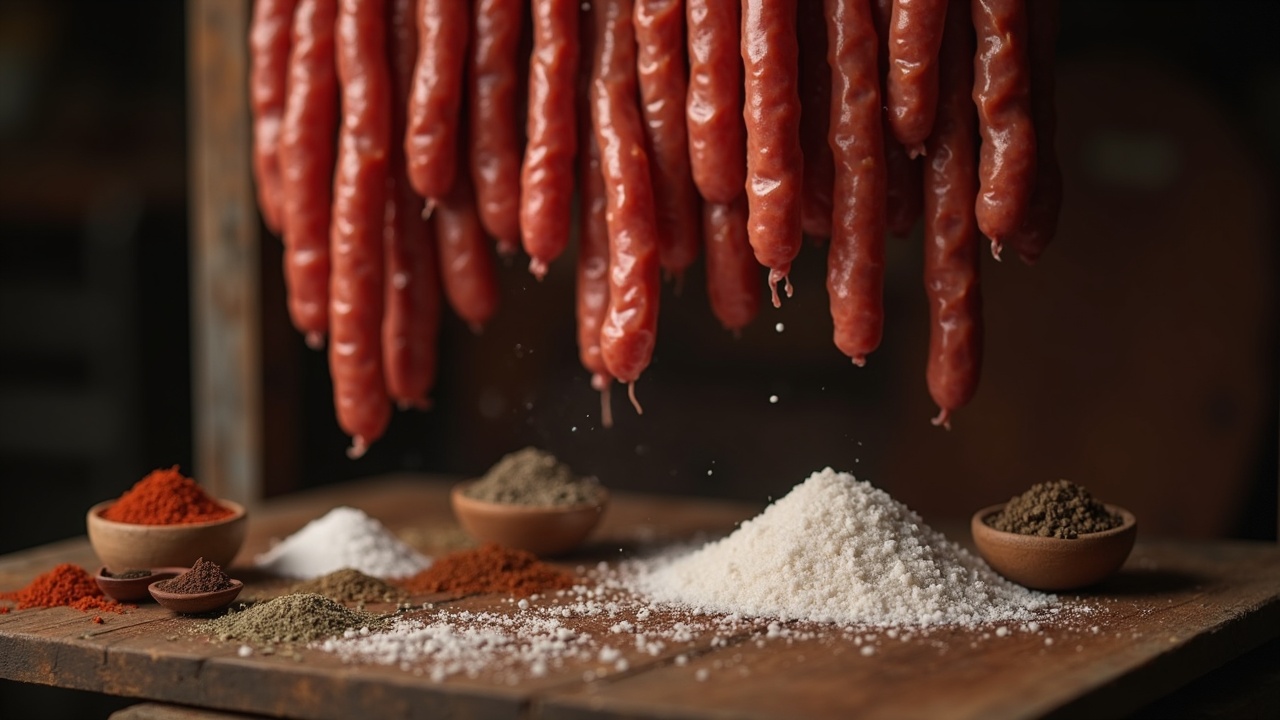
Salt preserves meat by making water unavailable to bacteria. That single sentence contains the entire science of curing. Everything else is technique and refinement. Water activity, not moisture content, determines whether Clostridium botulinum can wake up and produce the deadliest biological toxin on earth. Humans figured this out before they had a word for bacteria. The Gauls were exporting salt-cured hams to Rome before Caesar crossed the Rubicon. Chinese records describe cured pork from 1500 BCE. What has changed in 3,500 years is not the core chemistry. It is the precision with which we can now control it.
1. Introduction and History
Meat curing is among the oldest technologies. Desiccation by wind and sun was the first method, strips of meat hung in dry air, still practiced in South Africa as biltong and in the Andes as charqui (the origin of "jerky"). Salt curing followed wherever solar evaporation ponds or salt deposits existed. The Sumerians recorded salting fish around 3000 BCE. Egyptian tombs contained salted meats as provisions for the afterlife.
The Roman Empire industrialized curing. Garum, fermented fish sauce, was Rome's ketchup. Salted pork legs traveled trade routes across Europe. The Latin word "salarium", root of "salary", reflects the economic weight of salt in preservation.
Smoking likely began accidentally. Meat hung above cooking fires lasted longer. Phenolic compounds deposited by smoke are genuinely antimicrobial (Milly et al., 2005). Formaldehyde in smoke cross-links surface proteins, creating a physical barrier. The combination of salt curing and smoking produced products stable enough to cross oceans. Salt pork and salt beef were the caloric backbone of every navy from the 1400s through the 1800s.
Nitrate entered the story through contaminated salt. Mined salt containing sodium nitrate (saltpeter) produced distinctly pink, better-flavored cured meats. Butchers sought out these salt sources without understanding why they worked. The mechanism was not identified until the early 1900s: bacteria in the meat reduce nitrate (NO3⁻) to nitrite (NO2⁻), which reacts with myoglobin to form nitrosomyoglobin, the characteristic pink of cured meat, and simultaneously inhibits C. botulinum spore germination (Haldane, 1901).
The USDA formalized nitrite limits in the 1920s after a series of botulism outbreaks from improperly cured sausages. The 156 ppm ingoing nitrite limit for comminuted products and 200 ppm for immersion-cured products remain the standard (9 CFR 424.21).
2. Salt Curing Science
Osmotic Dehydration
Sodium chloride preserves meat through two mechanisms: direct antimicrobial activity and water activity reduction.
When salt contacts meat, it dissolves in surface moisture and creates a hypertonic solution. Water migrates from inside muscle cells across their semi-permeable membranes toward the higher salt concentration outside, standard osmosis. This dehydrates both the meat cells and any bacterial cells present. Bacteria in a hypertonic environment lose turgor pressure, their enzymes denature, and metabolic processes halt.
Water activity (a_w) is the ratio of vapor pressure in the food to vapor pressure of pure water. Pure water = 1.0. Fresh meat = 0.99. The critical thresholds:
| Water Activity (a_w) | Effect |
|---|---|
| 0.97 | Most Gram-negative spoilage bacteria inhibited |
| 0.95 | Salmonella inhibited, minimum for growth |
| 0.94 | Most general bacteria inhibited |
| 0.91 | Salmonella growth ceases |
| 0.86 | Staphylococcus aureus growth ceases |
| 0.85 | Most pathogenic bacteria eliminated |
| 0.80 | Most spoilage yeasts inhibited |
| 0.75 | Most halophilic bacteria inhibited |
| 0.65 | Most spoilage molds inhibited |
| 0.60 | No microbial growth, absolute preservation |
(Source: ICMSF, 1996, Microorganisms in Foods 5)
A hard-cured country ham at a_w 0.89 sits below the growth threshold for every pathogenic bacterium except a few halophilic strains that are not human pathogens. That is why an 18-month aged country ham hanging in a barn at ambient temperature is safe. The physics make it so.
Nitrates vs. Nitrites: Prague Powder #1 vs. #2
This distinction matters because confusing them can be dangerous.
Prague Powder #1 (pink curing salt #1, Insta Cure #1):
- 6.25% sodium nitrite + 93.75% sodium chloride
- Dyed pink to prevent confusion with table salt
- Used for products that will be cooked, smoked, or canned, bacon, ham, sausages, jerky, corned beef
- Acts immediately. Nitrite is the active form
- Standard dose: 1 teaspoon per 5 lbs of meat (156 ppm nitrite)
- Not appropriate for long-cured products (nitrite depletes over time)
Prague Powder #2 (pink curing salt #2, Insta Cure #2):
- 6.25% sodium nitrite + 1% sodium nitrate + 92.75% sodium chloride
- Used for dry-cured products that are not cooked and cure for weeks to months, salami, bresaola, prosciutto, country ham, soppressata
- The nitrate acts as a slow-release reservoir: bacteria reduce NO3⁻ to NO2⁻ gradually over the curing period, maintaining botulism protection for months
- Standard dose: 1 teaspoon per 5 lbs of meat
- Inappropriate for quick-cured products (nitrate needs time to convert)
The mistake that kills people: using neither. Curing whole muscles without nitrite is manageable because oxygen exposure and salt penetration are adequate. Curing ground meat in casings without nitrite creates anaerobic conditions ideal for C. botulinum. Every documented botulism case from cured sausage in the modern era involved products made without nitrite (Tompkin, 2005).
3. Dry Curing
Dry curing applies salt and cure directly to the meat surface. No liquid brine. The salt draws moisture out, concentrating flavor while reducing water activity. Time does the rest.
Bacon (Dry-Cured)
The simplest entry point. Results in 7 days.
Cure formula per 5 lbs (2.27 kg) pork belly:
- 55g (3.5 Tbsp) kosher salt, 2.5% by weight
- 25g (2 Tbsp) brown sugar or maple sugar
- 5.7g (1 tsp) Prague Powder #1
- 5g (1 tsp) coarse black pepper
- Optional: 3g smoked paprika, 2g garlic powder
Process:
- Trim belly to uniform thickness. Remove skin if desired (leave on for better smoke adhesion).
- Mix cure ingredients. Rub evenly on all surfaces, more on thick areas, less on thin edges.
- Place in a zip-lock bag or vacuum bag. Refrigerate at 36-40°F.
- Flip daily for 7 days. The belly will firm significantly and release liquid. This is the water leaving. Do not discard it; it is part of the equalization process.
- After 7 days, rinse thoroughly under cold water. Pat dry.
- Place uncovered on a rack in the refrigerator for 12-24 hours. This forms the pellicle, a tacky protein surface that smoke adheres to. Skip this step and smoke slides off.
- Cold smoke at 70-80°F for 4-6 hours, or hot smoke at 200°F to internal temperature of 150°F.
- Chill, slice against the grain to desired thickness, and cook.
Pancetta
Italian dry-cured pork belly. No smoke. Rolled and hung.
Cure formula per 5 lbs pork belly:
- 55g kosher salt (2.5% by weight)
- 5.7g Prague Powder #2 (1 tsp)
- 15g coarse black pepper
- 5g juniper berries, crushed
- 3g dried thyme
- 3g fennel seed
- 4 bay leaves, crushed
- 3g garlic, minced
- 2g red pepper flakes
Process:
- Rub cure mixture over entire belly. Vacuum seal or wrap tightly. Refrigerate 10-14 days, flipping every 2-3 days.
- Rinse. Pat dry. Coat the meat side generously with cracked black pepper.
- Roll tightly into a cylinder, meat side in. Tie firmly with butcher's twine at 1-inch intervals.
- Hang in a curing space at 55-60°F, 65-75% humidity.
- Cure for 2-3 months or until 30% weight loss is achieved. Weigh at the start and check weekly.
- White mold on the casing is normal and desirable (Penicillium nalgiovense). Green or black mold should be wiped with a vinegar-dampened cloth. If it persists, discard.
Bresaola
Dry-cured beef eye of round. Lean, dense, sliced paper-thin.
Cure formula per 3 lbs (1.36 kg) eye of round:
- 40g kosher salt (3% by weight)
- 4.3g Prague Powder #2
- 10g coarse black pepper
- 5g juniper berries, crushed
- 3g dried rosemary
- 2g ground cinnamon
- 3g garlic, minced
- 15g brown sugar
Process:
- Trim all external fat and silverskin. Fat on beef goes rancid during long curing, unlike pork fat.
- Rub cure over entire surface. Vacuum seal. Refrigerate 14-21 days, flipping every 2-3 days.
- Rinse. Pat dry. Stuff into a beef bung cap or large collagen casing. Tie tightly.
- Hang at 55-60°F, 65-75% humidity for 2-4 months.
- Target: 35-40% weight loss. At this point, a_w is below 0.90.
- Slice paper-thin. Serve with olive oil, lemon, arugula, and Parmigiano.
Country Ham
The American tradition. Whole hind legs, salted and aged 6-18 months.
Cure formula per pound of ham:
- 1 oz (28g) salt
- 0.5 oz (14g) brown sugar
- 0.1 oz (2.8g) Prague Powder #2
Process:
- Rub cure into all surfaces of the fresh ham, packing extra around the hock joint and aitch bone. These areas are deepest and most prone to spoilage.
- Place on a rack in a cold room (36-40°F) for 2 days per pound of ham weight. A 15-lb ham cures for 30 days.
- Wash off excess cure. Coat exposed surfaces with a mixture of black pepper and red pepper to deter insects.
- Hang in a ventilated, unheated space. Temperature should cycle naturally, cold in winter (cure penetration), warming in spring (flavor development), warm in summer (aging).
- Total aging: 6 months minimum, 12-18 months for premium results.
- Weight loss target: 18-25%. The ham is shelf-stable at room temperature.
- Before eating, soak 24-48 hours in cold water (changing water twice) to draw out excess salt. Simmer or bake to 160°F internal.
4. Wet Curing and Brining
Wet curing dissolves the cure in water. The meat sits submerged. Two approaches: immersion brining and equilibrium brining.
Immersion Brining
The traditional method. A strong brine (typically 50-80 degrees SAL, or 12-20% salt by weight) acts quickly but produces uneven results. The outer layers are saltier than the center. Suitable for large-scale operations and products where uniformity matters less.
Corned beef brine (per gallon of water):
- 380g (1.5 cups) kosher salt
- 45g (3 Tbsp) Prague Powder #1
- 50g (¼ cup) brown sugar
- 2 Tbsp pickling spice (mustard seed, coriander, bay leaves, black peppercorn, allspice, cloves, dill seed, red pepper)
- 5 cloves garlic, crushed
Process:
- Dissolve salt, cure, and sugar in 1 quart boiling water. Add remaining water as cold. Cool to below 40°F before adding meat.
- Submerge a 4-5 lb beef brisket flat in the brine. Weight it down to stay submerged.
- Refrigerate 5-7 days, flipping halfway.
- Remove, rinse well, and simmer in fresh water with pickling spice for 3-4 hours or until fork-tender.
Equilibrium Brining
The modern, superior method for home use. The brine is calculated to contain the exact amount of salt and cure needed for the meat weight. The meat cannot become over-salted, it reaches equilibrium with the brine and stops absorbing. Takes longer but produces perfectly seasoned results every time.
Equilibrium brine formula:
- Weigh the meat.
- Weigh the water (enough to cover the meat).
- Add the meat weight and water weight together = total weight.
- Calculate salt at 2-3% of total weight.
- Calculate Prague Powder #1 at 0.25% of total weight.
- Calculate sugar at 1% of total weight (optional).
Example, 5 lb (2270g) brisket, 3000g water:
- Total weight: 5270g
- Salt: 132g (2.5%)
- Prague Powder #1: 13.2g (0.25%)
- Sugar: 52.7g (1%)
Process:
- Dissolve cure in water. Submerge meat. Refrigerate.
- Cure for 7-10 days. There is no risk of over-curing.
- Rinse and cook as desired.
Pastrami
Pastrami is corned beef's more interesting cousin. Brine-cured brisket, rubbed with spice, and hot-smoked.
- Equilibrium brine a whole packer brisket for 10-14 days.
- Remove from brine. Rinse. Pat dry.
- Coat with a rub: 2 parts coarse black pepper, 1 part coarse ground coriander, garlic powder, onion powder, smoked paprika, mustard powder.
- Refrigerate uncovered 12-24 hours to set the pellicle.
- Hot smoke at 225-250°F using oak or hickory until internal temperature reaches 203°F (this takes 10-14 hours for a full packer).
- Rest in butcher paper for 1 hour. Slice thin against the grain.
5. Smoking
Smoke serves three functions: antimicrobial surface treatment, antioxidant protection for fat, and flavor. Wood combustion produces over 200 identified compounds. The ones that matter for preservation: phenols, organic acids, and carbonyls including formaldehyde.
Cold Smoke vs. Hot Smoke
| Parameter | Cold Smoke | Hot Smoke |
|---|---|---|
| Temperature | 68-86°F (20-30°C) | 126-275°F (52-135°C) |
| Duration | 12-72 hours (intermittent) | 1-12 hours |
| Cooking effect | None, meat stays raw | Partial to full cooking |
| Use case | Bacon, lox, country ham, salami | Sausage, ribs, brisket, jerky |
| Safety requirement | Meat must be cured first | Curing optional (but recommended for sausage) |
| Season | Cool weather or temp-controlled environment | Year-round |
Cold smoking without curing is dangerous. The temperature range of 68-86°F is optimal for bacterial growth. Only the prior application of salt and nitrite makes cold smoking safe. Never cold smoke uncured meat.
Wood Selection
Different woods produce different phenolic profiles. This chart covers the major species available in North America.
| Wood | Flavor Profile | Intensity | Best Pairings |
|---|---|---|---|
| Hickory | Strong, bacon-like, slightly sweet | Heavy | Pork, beef, game |
| Mesquite | Intense, earthy, aggressive | Very heavy | Beef, venison (short exposure only, bitter if overused) |
| Oak (red or white) | Medium, clean, slightly sweet | Medium-heavy | Beef, pork, sausage, the universal wood |
| Apple | Sweet, mild, fruity | Light-medium | Pork, poultry, fish |
| Cherry | Sweet, mild, slightly tart | Light-medium | Pork, poultry, game birds |
| Pecan | Rich, nutty, slightly sweet | Medium | Pork, poultry, beef |
| Maple | Mild, sweet, delicate | Light | Poultry, pork, fish, bacon |
| Alder | Light, delicate, slightly sweet | Light | Fish (traditional for Pacific NW salmon), poultry |
| Peach/Pear | Sweet, mild, floral | Light | Poultry, pork |
| Walnut | Heavy, bitter if used alone | Heavy | Blend with fruitwood. Never use pure |
Never use: pine, spruce, cedar (except planking), fir, cypress, or any resinous softwood. The terpene compounds produce acrid, unpleasant smoke and can deposit harmful creosote. Treated lumber, plywood, and painted wood will deposit toxins. Use only natural, untreated hardwoods.
6. Smokehouse Design
A smokehouse is a chamber that holds smoke at a controlled temperature around food. Complexity ranges from a cardboard box to a masonry building. The principles are identical: smoke inlet, food hanging area, ventilation control, and temperature management.
DIY Cold Smoker from Old Refrigerator
The most cost-effective dedicated cold smoker.
Materials:
- Discarded refrigerator (remove compressor, motor, all refrigerant lines, handle refrigerant per EPA regulations or use a unit already stripped)
- 6-inch diameter flexible aluminum dryer duct, 8-12 feet long
- Smoke generator: electric hot plate + cast iron skillet with wood chips, or a commercial cold smoke generator (A-MAZE-N tube smoker or similar)
- 2 grill grates or dowel rods for hanging hooks
- Drill with hole saw for vent holes
- High-temp silicone sealant
Build:
- Remove all plastic interior shelving, liners, and electrical components. Leave the metal shell and door seal gasket.
- Drill a 6-inch hole in the bottom side wall for smoke inlet.
- Drill two 2-inch vent holes near the top rear for exhaust. Adjustable dampers made from tin can lids and screws allow airflow control.
- Install grill grates at mid-height and upper third, or drill through the sides and insert dowel rods at 6-inch intervals for S-hooks.
- Connect the aluminum duct from the smoke generator (placed 6-12 feet away on the ground) to the inlet hole. The duct length cools the smoke before it enters the chamber. Longer duct = cooler smoke.
- Place the smoke generator (hot plate + skillet of chips, or tube smoker) inside a metal container or separate small enclosure at the far end of the duct.
- Monitor chamber temperature with a probe thermometer through a small drilled hole. Target: 68-86°F for cold smoking.
The insulation of the refrigerator body stabilizes temperature. The door gasket provides a reasonable seal. Total cost: under $50 if the refrigerator is salvaged.
Drum Smoker (Hot Smoke)
The ugly drum smoker (UDS) is the best-performing hot smoker per dollar spent.
Materials:
- 55-gallon steel drum, unlined food-grade (never use drums that held chemicals, paint, or petroleum)
- Charcoal grate from a standard kettle grill
- 22.5-inch cooking grate
- 4 bolts (3/8 inch) for grate supports
- 3-4 air intake holes (¾ inch) drilled 2 inches from the bottom with threaded pipe nipples and caps for control
- One 2-inch exhaust hole in the lid
- High-temp paint for exterior
Build:
- If the drum has a removable lid, perfect. If not, cut the top with an angle grinder, leaving a 1-inch lip, and fashion a handle.
- Drill four holes at 24 inches from the bottom and insert bolts as grate supports.
- Drill 3-4 intake holes at the bottom rim. Thread ¾-inch pipe nipples through, secure with nuts, cap with pipe caps for adjustment.
- Place charcoal grate in the bottom. Light a full chimney of charcoal, dump in, add wood chunks on top.
- Set cooking grate on bolt supports. Place meat. Cover.
- Control temperature with intake caps. Closed = less air = lower temp. Three caps barely cracked holds 225°F. Wide open runs 325°F+.
Permanent Masonry Smokehouse
For the long-term builder. A 4x4x7 foot cinder block or brick structure with a firebox offset.
Key design elements:
- Foundation: 4-inch concrete pad or footer below frost line with cinder block walls
- Interior dimensions: minimum 4 feet x 4 feet floor, 7 feet interior height
- Walls: 8-inch cinder block or double-wall brick. Fire-rated. Interior should be unfinished, no paint, stain, or sealant
- Door: solid wood or insulated metal, tight-fitting, with adjustable upper and lower vents
- Firebox: separate enclosure 6-10 feet from the smokehouse, connected by an underground flue (clay tile or concrete pipe). This distance cools smoke for cold smoking. A damper in the flue controls airflow
- Hanging system: steel pipes or hardwood dowels spaced 12 inches apart, running side-to-side, supporting S-hooks
- Ventilation: adjustable chimney cap or damper on top. Smoke must flow upward past the meat and exit. Stagnant smoke produces bitter creosote deposits
- Temperature control: for hot smoking, install a gas burner or electric element inside the chamber in addition to the offset firebox
This structure handles cold smoking, hot smoking, and can serve as a curing chamber if fitted with humidity and temperature controls. A masonry smokehouse properly built will outlast the person who builds it.
7. Sausage Making
Sausage is the art of turning trim into something better than the whole-muscle cuts it came from. Grinding, seasoning, and stuffing are the basics. Fermentation takes it to another level.
Grinding
Meat temperature is everything. Grind meat at 32-34°F. Partially frozen is ideal. Warm meat smears instead of cutting cleanly, fat coats the lean, protein extraction fails, and the sausage becomes greasy and crumbly.
- Coarse grind: 3/8-inch plate. Country sausage, chili meat, bratwurst.
- Medium grind: ¼-inch plate. Italian sausage, standard breakfast sausage.
- Fine grind: 1/8-inch plate. Hot dogs, bologna, emulsified sausages. Often double-ground.
Fat ratio: 25-30% fat is the standard for most sausages. Lean sausage (below 20% fat) is dry and crumbly. Fat carries flavor, provides moisture during cooking, and creates the characteristic mouthfeel. Pork back fat is the standard fat for sausage making. It is firm, clean-flavored, and renders predictably.
Seasoning
Salt at 1.5-2% of total batch weight is the baseline. Below 1.5%, flavor falls flat and protein extraction is insufficient for a good bind. Above 2.5%, the product is aggressively salty.
Basic Italian sausage (per 5 lbs):
- 40g kosher salt (1.8%)
- 10g coarse black pepper
- 10g fennel seed, toasted and crushed
- 5g red pepper flakes
- 5g garlic powder or 10g fresh garlic, minced
- 5g sugar
- 60ml (¼ cup) ice water
Mixing: After grinding, add seasoning and mix by hand or in a stand mixer with paddle attachment until the mixture becomes sticky and cohesive. This is called the primary bind. Myosin protein extracts from the muscle fibers and forms a matrix that holds the sausage together during cooking. Under-mixed sausage crumbles. Over-mixed sausage is dense and rubbery. Aim for a tacky, paste-like consistency on the surface of the meat, 2-4 minutes of mixing.
Stuffing
Natural casings (hog, sheep, beef) require soaking in warm water for 30 minutes, then flushing with running water through the opening. Hog casings (32-35mm) are standard for Italian, bratwurst, and Polish sausage. Sheep casings (20-24mm) produce breakfast links and snack sticks. Beef rounds (40-45mm) handle summer sausage and bologna. Beef bungs (100mm+) are for large-format salami and mortadella.
Stuffing process:
- Load the casing onto the stuffing tube. Leave 6 inches of empty casing hanging off the end. Do not tie it yet.
- Feed the meat mixture into the stuffer. Push through at steady pressure.
- As meat fills the casing, guide it off the tube with one hand. Keep even, firm pressure, not so tight that the casing bursts, not so loose that air pockets form.
- When the desired length is stuffed, slide off excess casing. Tie both ends.
- Twist or tie into individual links at desired intervals. Alternate twist direction on each link to prevent untwisting.
- Prick any visible air bubbles with a sausage pricker or sterilized pin. Air pockets harbor bacteria and cause spoilage in cured products.
Fermented Sausage
Fermented sausages, salami, soppressata, summer sausage, use bacterial cultures to produce lactic acid inside the casing, dropping pH below 5.0. This combines with salt, nitrite, and reduced water activity to create a shelf-stable product without cooking.
Dry-Cured Salami (Genoa-style)
Formula per 10 lbs (4.5 kg), 75% lean pork, 25% pork back fat:
- 135g kosher salt (3%)
- 14g Prague Powder #2 (use #2, not #1. This is a long-cure product)
- 14g dextrose (fermentation fuel for starter culture)
- 10g coarse black pepper
- 5g garlic powder
- 3g ground white pepper
- Starter culture: Bactoferm F-RM-52 or T-SPX, per manufacturer's dose
- Distilled water per culture instructions (typically 50ml to rehydrate)
Process:
- Grind lean through 3/8-inch plate, fat through ¼-inch plate. Both at 32°F.
- Combine meat and fat. Add cure, salt, dextrose, and spices. Mix until sticky bind forms.
- Dissolve starter culture in distilled water per package directions. Add to meat and mix 60 seconds.
- Stuff firmly into beef bung caps or 60mm collagen casings. Tie tightly. Prick casing to remove air.
- Fermentation: Hang at 75-80°F, 85-90% humidity for 48-72 hours. The starter culture consumes dextrose and produces lactic acid, dropping pH from 5.8 to below 5.0. Check pH with meter or pH strips, target 4.8-5.0.
- Drying/aging: Move to 55-60°F, 70-75% humidity. Hang for 6-12 weeks. Target 35-40% weight loss.
- White Penicillium mold on the casing is desirable, it regulates moisture loss and protects against undesirable molds. Inoculate casings with Bactoferm 600 mold culture at hanging if your curing environment does not harbor it naturally.
Summer Sausage (Semi-Dry)
Faster and more forgiving than dry-cured salami. Fermented and then cooked.
Formula per 10 lbs, 80% lean beef, 20% pork back fat:
- 135g kosher salt (3%)
- 14g Prague Powder #1 (use #1. This product is cooked)
- 30g dextrose
- 10g mustard seed, ground
- 10g black pepper
- 5g garlic powder
- 3g coriander
- Starter culture: Bactoferm T-SPX
- Encapsulated citric acid: 40g (optional, accelerates tang without fermentation)
Process:
- Grind through 3/16-inch plate.
- Mix all ingredients. Stuff into 3-inch fibrous casings.
- Ferment at 85-90°F for 12-18 hours (or until pH drops below 5.0).
- Hot smoke at 130°F for 1 hour (no smoke, just heat to set casing), then increase to 160°F with heavy smoke for 2-3 hours, then raise to 175°F until internal temperature reaches 155°F.
- Shower or ice-bath to cool internal temp below 100°F within 1 hour to prevent wrinkling.
8. Safety
Meat curing errors kill people. Not often, but when they do, the mechanism is almost always C. botulinum toxin in anaerobically cured sausage or improperly canned products. Respect the microbiology.
Botulism Prevention
C. botulinum is an anaerobic, spore-forming bacterium. Its spores are ubiquitous in soil and on meat surfaces. The spores are heat-resistant. They survive boiling. When conditions are right (anaerobic environment, a_w above 0.94, pH above 4.6, temperature between 38-118°F), spores germinate, the bacteria multiply, and they produce botulinum toxin.
The three defenses:
- Nitrite, 156 ppm ingoing nitrite inhibits spore germination. This is the primary defense in all comminuted (ground) cured products.
- Salt/water activity. A_w below 0.94 prevents C. botulinum growth. Dry-cured whole muscles achieve this through dehydration.
- pH. Below 4.6 prevents growth. Fermented sausages achieve this through lactic acid production.
For safety, use at least two of these barriers simultaneously. Cured sausage relies on all three.
Nitrite Dosing Table
| Product Type | Prague Powder #1 | Ingoing Nitrite (ppm) | Regulation |
|---|---|---|---|
| Comminuted products (sausage, hot dogs) | 1 tsp / 5 lbs meat | 156 ppm max | 9 CFR 424.21 |
| Immersion-cured (corned beef, ham) | Per brine calculation | 200 ppm max | 9 CFR 424.21 |
| Dry-cured (country ham) | Per rub calculation | 625 ppm max (ingoing) | 9 CFR 424.21 |
| Bacon (pumped or massaged) | Per formula | 120 ppm max (ingoing) | 9 CFR 424.21 |
Maximum residual nitrite in finished product: 200 ppm. Most properly cured products contain 10-50 ppm residual at consumption, well below the regulatory ceiling and far below any dose associated with health concerns.
Internal Temperature Targets
These are USDA minimum internal temperatures for food safety in cooked/smoked products.
| Product | Minimum Internal Temperature |
|---|---|
| Whole-muscle pork (ham, loin) | 145°F (63°C) + 3 min rest |
| Ground pork / pork sausage | 160°F (71°C) |
| Ground beef / beef sausage | 160°F (71°C) |
| Poultry (all forms) | 165°F (74°C) |
| Smoked sausage (semi-dry, cooked) | 155°F (68°C) for lethality |
| Jerky (USDA recommendation) | 160°F before or during drying |
Exception: Dry-cured, fermented products (salami, bresaola, prosciutto) are never cooked. Their safety relies on the combined hurdle effect of salt, nitrite, pH, and water activity, not heat.
Water Activity Safety Thresholds
| a_w Level | Safety Status |
|---|---|
| Above 0.95 | Perishable. Requires refrigeration |
| 0.91-0.95 | Semi-perishable, extended shelf life with refrigeration |
| 0.85-0.91 | Shelf-stable against most pathogens, ambient storage possible for properly cured products |
| Below 0.85 | Shelf-stable, no pathogenic bacterial growth |
| Below 0.60 | Indefinite storage, no microbial growth of any kind |
9. Storage and Shelf Life
Fresh sausage (uncured): 1-2 days refrigerated, 2-3 months frozen. Treat like raw ground meat.
Cured, cooked sausage (smoked kielbasa, hot dogs): 2 weeks refrigerated unopened, 1 week opened. 2-3 months frozen.
Cured, uncooked whole muscle (bacon, corned beef): 7-10 days refrigerated. 2-3 months frozen. Vacuum-sealed extends refrigerated life to 3-4 weeks.
Dry-cured whole muscle (prosciutto, bresaola, country ham): Shelf-stable at ambient temperature if a_w is below 0.90. Once cut, wrap tightly and refrigerate. The exposed surface has higher a_w. Whole uncut pieces store 12+ months at 55-65°F.
Dry-cured fermented sausage (salami, soppressata): Shelf-stable whole at 55-65°F for 6-12 months. Once cut, refrigerate and consume within 3-4 weeks. The casing is a protective barrier, once breached, surface conditions change.
Summer sausage (semi-dry fermented, cooked): 3 months refrigerated unopened. 3 weeks once opened. Can be frozen but texture suffers.
Jerky: 1-2 months at room temperature in airtight containers. 6+ months vacuum-sealed. Indefinite if a_w is verified below 0.60 by a meter, but few home producers measure this precisely.
Vacuum sealing extends the shelf life of every product listed above. It also creates anaerobic conditions, which is exactly why nitrite use in vacuum-packed cured products is non-negotiable. Vacuum seal + no nitrite = C. botulinum habitat.
Freezing stops all microbial and enzymatic activity. It does not improve flavor. Fat oxidation still occurs slowly in frozen storage. 3-6 months is the practical limit for smoked products before flavor degrades. Vacuum-sealed frozen products hold quality longer than paper-wrapped.
10. Sources
- ICMSF (International Commission on Microbiological Specifications for Foods). Microorganisms in Foods 5: Characteristics of Microbial Pathogens. Springer, 1996.
- Tompkin, R.B. "Nitrite." In Antimicrobials in Food, 3rd ed., edited by P.M. Davidson, J.N. Sofos, and A.L. Branen, 169-236. CRC Press, 2005.
- Sebranek, J.G. and Bacus, J.N. "Cured Meat Products Without Direct Addition of Nitrate or Nitrite: What Are the Issues?" Meat Science 77, no. 1 (2007): 136-147.
- Milly, P.J., Toledo, R.T., and Ramakrishnan, S. "Determination of Minimum Inhibitory Concentrations of Liquid Smoke Fractions." Journal of Food Science 70, no. 4 (2005): M12-M17.
- Haldane, J. "The Red Colour of Salted Meat." Journal of Hygiene 1, no. 1 (1901): 115-122.
- Marianski, S. and Marianski, A. The Art of Making Fermented Sausages. Bookmagic, 2009.
- Ruhlman, M. and Polcyn, B. Charcuterie: The Craft of Salting, Smoking, and Curing. W.W. Norton, 2005.
- USDA FSIS. "Food Standards and Labeling Policy Book." Code of Federal Regulations, Title 9, Part 424.21.
- McGovern, P.E. et al. "Fermented Beverages of Pre- and Proto-Historic China." Proceedings of the National Academy of Sciences 101, no. 51 (2004): 17593-17598.
- Incze, K. "Dry Fermented Sausages." Meat Science 49, Supplement 1 (1998): S169-S177.
- Toldrá, F. Handbook of Fermented Meat and Poultry. Blackwell, 2007.
- Feiner, G. Meat Products Handbook: Practical Science and Technology. Woodhead Publishing, 2006.
Common questions
Where did meat curing smoking come from?
Meat curing is among the oldest technologies. Desiccation by wind and sun was the first method, strips of meat hung in dry air, still practiced in South Africa as biltong and in the Andes as charqui (the origin of "jerky"). Salt curing followed wherever solar evaporation ponds or salt deposits existed. The Sumerians recorded salting fish around 3000 BCE. Egyptian tombs contained salted meats as provisions for the afterlife.
What is salt curing science?
Sodium chloride preserves meat through two mechanisms: direct antimicrobial activity and water activity reduction. When salt contacts meat, it dissolves in surface moisture and creates a hypertonic solution. Water migrates from inside muscle cells across their semi-permeable membranes toward the higher salt concentration outside, standard osmosis. This dehydrates both the meat cells and any bacterial cells present. Bacteria in a hypertonic environment lose turgor pressure, their enzymes denature, and metabolic processes halt.
What is dry curing?
Dry curing applies salt and cure directly to the meat surface. The salt draws moisture out, concentrating flavor while reducing water activity. The simplest entry point. Cure formula per 5 lbs (2.27 kg) pork belly: . 55g (3.5 Tbsp) kosher salt, 2.5% by weight.
What is smokehouse design?
A smokehouse is a chamber that holds smoke at a controlled temperature around food. Complexity ranges from a cardboard box to a masonry building. The principles are identical: smoke inlet, food hanging area, ventilation control, and temperature management. DIY Cold Smoker from Old Refrigerator. The most cost-effective dedicated cold smoker.
What is sausage making?
Sausage is the art of turning trim into something better than the whole-muscle cuts it came from. Grinding, seasoning, and stuffing are the basics. Fermentation takes it to another level. Meat temperature is everything. Partially frozen is ideal.
Is meat curing smoking safe?
Meat curing errors kill people. Not often, but when they do, the mechanism is almost always C. botulinum toxin in anaerobically cured sausage or improperly canned products. Respect the microbiology. botulinum is an anaerobic, spore-forming bacterium.
How is the result of meat curing smoking stored?
Fresh sausage (uncured): 1-2 days refrigerated, 2-3 months frozen. Treat like raw ground meat. Cured, cooked sausage (smoked kielbasa, hot dogs): 2 weeks refrigerated unopened, 1 week opened. Cured, uncooked whole muscle (bacon, corned beef): 7-10 days refrigerated. Vacuum-sealed extends refrigerated life to 3-4 weeks.