guides
Pomegranate: Advanced Cultivation, Processing, and Use Guide
Advanced guide to pomegranate cultivation covering precise growing parameters, propagation from cuttings, harvest optimization, post-harvest processing.
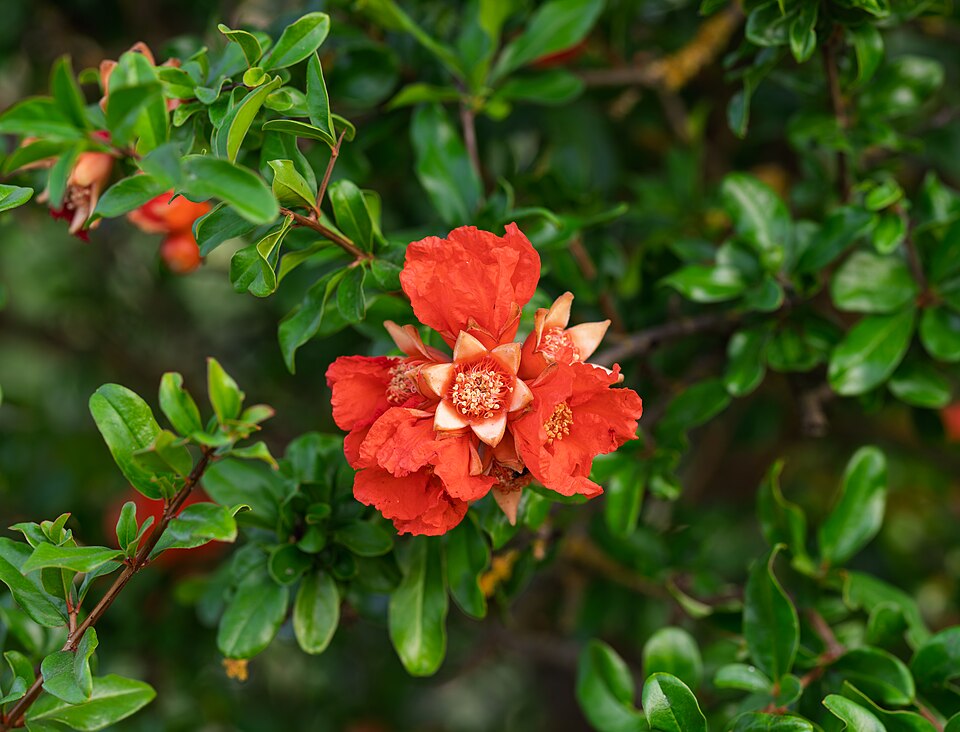
Botanical Description and Contemporary Relevance
Punica granatum is a long-lived deciduous to semi-evergreen fruiting shrub or small tree, typically reaching 10–20 feet (3–6 m) in height, with multiple trunks, angular branching, and glossy, narrow leaves measuring 2–8 cm in length. The plant produces striking red to orange flowers with a thick, waxy calyx, which later hardens into the leathery rind that characterizes the mature fruit.
In modern contexts, pomegranate is cultivated for fresh consumption, juice production, nutraceutical extracts, cosmetic ingredients, fermentation substrates, and ornamental landscaping. Its value lies primarily in its dense polyphenolic profile, particularly ellagitannins (punicalagins), anthocyanins, and flavonols, which are widely studied for their interaction with oxidative stress pathways, endothelial signaling, lipid metabolism, and gut-microbiota-mediated metabolite production.
Metabolite Pathways
According to peer-reviewed literature, pomegranate polyphenols are not absorbed intact in large quantities; instead, they are metabolized by intestinal microbiota into urolithins—compounds that interact with mitochondrial signaling, inflammatory cascades, and cellular stress responses. These interactions are discussed in the context of general wellness, aging biology, and metabolic resilience without making disease claims.
Origin, Domestication, and Historical Use
Pomegranate originated in a broad region stretching from modern-day Iran through northern India and Central Asia, where it has been cultivated continuously for over 4,000 years. Archaeological evidence places pomegranate remains in Bronze Age settlements, while written references appear in Persian, Ayurvedic, Greek, Roman, and later Islamic medical texts.
Historically, the fruit, peel, flowers, and bark were all utilized. The arils were consumed fresh or fermented, the juice reduced into syrups, the peel dried for tannin extraction, and the flowers used in dyeing and topical preparations. In many cultures, pomegranate symbolized fertility, longevity, and abundance due to its prolific seed structure.
Traditional systems often emphasized preparation methods that concentrated polyphenols, such as decoctions of the peel or slow reduction of juice. Modern analytical chemistry has since confirmed that these methods significantly increase extractable tannin concentration relative to raw aril consumption.
Seeds, Fruit Structure, and Reproductive Biology
The fruit is a specialized berry known as a balausta, typically weighing 200–800 g depending on cultivar. Each fruit contains 200–1,400 arils, each consisting of a translucent outer sarcotesta and a lignified inner seed.
Seeds develop over a 5–7 month maturation period following pollination. On the plant, immature fruits are green and firm; ripening is marked by color saturation, rind hardening, and an audible metallic sound when tapped, indicating internal pressure and sugar accumulation.
Seed Processing for Storage
Seeds intended for propagation are extracted from fully mature fruit, washed to remove residual sugars, and dried at ambient temperatures (20–25°C / 68–77°F) with good airflow for 3–7 days before storage. Viability is highest when seeds are stored at 4–8°C (39–46°F) with <40% relative humidity.
Environmental Requirements and Climate Adaptation
Pomegranate thrives in USDA zones 7–11, with optimal fruit quality achieved in regions with hot, dry summers and cool but not severe winters. Mature plants tolerate temperatures down to approximately -10°C (14°F), though fruiting wood is damaged below -6°C (21°F).
| Parameter | Optimal Range |
|---|---|
| Growth Temperature | 25–38°C (77–100°F) |
| Sunlight | Full sun, minimum 8–10 hours daily |
| Humidity | Low to moderate (30–60% preferred) |
| Annual Rainfall / Irrigation | 500–800 mm; excess humidity increases fungal pressure |
| Cold Hardiness (Dormant) | Down to -10°C (14°F) |
| Fruiting Wood Damage | Below -6°C (21°F) |
While drought tolerant once established, controlled water stress during late fruit development is often used in commercial systems to enhance sugar concentration and polyphenol density, provided tree health is maintained.
Soil, Nutrition, and Root Zone Management
Pomegranate prefers well-drained loam or sandy loam soils with a pH range of 5.5–7.2. Heavy clay soils are acceptable only when amended for drainage, as prolonged root saturation reduces oxygen availability and predisposes plants to root pathogens.
Annual Nutrient Requirements (Per Mature Tree)
| Nutrient | Rate | Notes |
|---|---|---|
| Nitrogen (N) | 50–150 g actual N | Excess reduces fruiting |
| Phosphorus (P₂O₅) | 20–40 g | Where deficient |
| Potassium (K₂O) | 60–120 g | Critical for fruit size and rind integrity |
Micronutrients such as iron, zinc, and boron are frequently limiting in alkaline soils. Foliar correction is commonly used due to reduced soil availability at higher pH.
Propagation: Seeds, Cuttings, and Clonal Uniformity
Although pomegranate can be grown from seed, this method produces genetic variability and is generally reserved for breeding or rootstock development. Fruiting orchards overwhelmingly rely on hardwood cuttings.
Cutting Specifications
| Parameter | Specification |
|---|---|
| Length | 20–30 cm (8–12 in) |
| Diameter | 8–12 mm |
| Wood Type | Dormant one-year-old hardwood |
| Rooting Temperature | 22–26°C (72–79°F) |
| Humidity | 70–85% |
| IBA Treatment (Optional) | 1,000–3,000 ppm for commercial standardization |
Adventitious roots form readily without hormone application, though IBA is commonly used to standardize rooting in commercial settings.
Growth Habit, Training, and Structures
Pomegranate naturally forms a multi-stem shrub, but can be trained as a single-trunk tree depending on management goals. Multi-stem systems are often favored for resilience, as damaged trunks can be replaced without replanting.
Structural support is generally unnecessary, though espalier systems are sometimes used in high-density plantings or protected cultivation to improve airflow and light penetration.
Harvest Timing and Quality Optimization
Fruit does not ripen after harvest. Optimal harvest occurs when:
- Soluble solids reach 14–17 °Brix
- Acidity declines to cultivar-specific thresholds
- Rind color is fully developed and resistant to fingernail pressure
Harvest is performed manually using pruning shears to prevent rind tearing. Fruits are highly resistant to decay when intact and can be stored at 4–7°C (39–45°F) with 90–95% relative humidity for up to 3–4 months.
Post-Harvest Handling, Processing, and Storage
| Method | Conditions | Notes |
|---|---|---|
| Fresh Arils | 0–4°C, up to 10 days | Separated mechanically or manually |
| Juicing | Cold pressing | Minimizes oxidation; enzymatic clarification optional |
| Drying (Peel/Arils) | ≤45°C (113°F) | Preserves polyphenols |
| Freezing (Whole Arils) | -18°C (0°F) | Minimal compound degradation |
| Fermentation | Saccharomyces species | Wine or vinegar substrates |
Extraction, Compounds, and Home-Scale Preparations
Primary extracted compounds include punicalagins (α and β), ellagic acid, anthocyanins, and gallic acid derivatives, concentrated primarily in the peel and mesocarp rather than the arils.
Home and Small-Farm Scale Methods
- Aqueous decoction: peel simmered at 80–90°C — favors tannins and acids
- Ethanol maceration: 40–70% ethanol, 4–8 weeks — broader polyphenol spectrum
- Oil infusion: low-heat, long-duration using dried peel — captures lipid-soluble components
Finished extracts are stored in airtight, light-protected containers at <20°C (68°F) to limit oxidative degradation.
Culinary, Raw Use, and Integration into Foods
Arils are consumed raw, juiced, blended, fermented, or cooked. Heat reduces vitamin C but concentrates sugars and tannins. Pomegranate integrates well into syrups, reductions, vinaigrettes, fermented beverages, and lipid-based infusions.
Whole-fruit consumption is limited by seed lignification, which varies significantly by cultivar.
Key Scientific and Scholarly Sources
This article is informed by data and conclusions drawn from, but not limited to:
- Seeram et al., Journal of Agricultural and Food Chemistry
- Lansky & Newman, Journal of Ethnopharmacology
- Tomas-Barberán et al., Molecular Nutrition & Food Research
- Gil et al., Journal of Nutritional Biochemistry
- Viuda-Martos et al., Food Research International
- Fischer et al., Nature Metabolism
- Teixeira da Silva et al., Scientia Horticulturae
- Holland et al., Plant Foods for Human Nutrition
- Faria et al., Journal of Medicinal Food
- USDA Agricultural Research Service crop profiles