plants
Practical Electronics
Learn practical electronics: the core components, the tools you actually need, soldering fundamentals, and building clean power supplies.
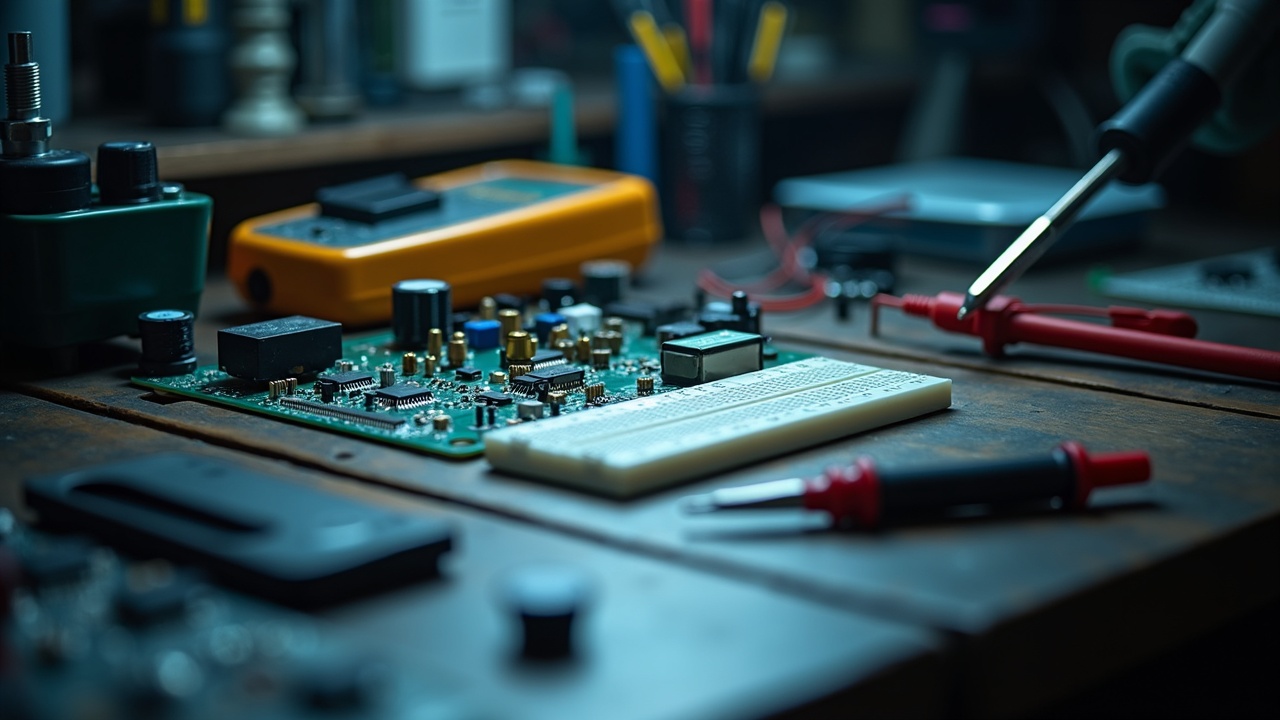
title: "Practical Electronics for Self-Reliance" subtitle: "Components, Circuits, and Repairs — A Working Manual for Builders" author: "Nored Farms" date: "2026"
Content Extraction Summary
Hook Options
1. The single most common cause of failure in consumer electronics is a $0.12 electrolytic capacitor bulging on a circuit board — a two-minute fix with a $30 soldering iron that the manufacturer wants you to pay $200 to replace. 2. A $20 multimeter tells you more about what is wrong with any electrical device than a $2,000 diagnostic scan tool, because 90% of electrical failures are either open circuits, short circuits, or wrong voltages — three things a meter reads directly. 3. An ESP32 microcontroller costs $4, connects to WiFi, reads sensors, and controls relays. The commercial "smart controller" doing the same job costs $150 and stops working when the company shuts down their cloud server.
Key Mechanism
Electronics repair and fabrication reduces to three skills: reading voltage with a meter, soldering components to a board, and tracing a schematic to find where current is supposed to flow versus where it actually flows. Every dead power supply, failed sensor, and broken controller is a puzzle with the same three categories of answer — something is open that should be closed, something is shorted that should be open, or a component is passing the wrong value. The tools and techniques in this document make those three diagnoses routine rather than mysterious.
Misconception to Correct
Most people treat electronics as a specialized discipline requiring an engineering degree. The actual skill floor is lower than basic plumbing. A plumber needs to understand pressure, flow rates, pipe sizing, fitting types, solder joints, and code compliance. An electronics troubleshooter needs to understand voltage, current, resistance, and how to read a schematic — then apply a $20 meter and a $30 soldering iron. The math rarely goes beyond Ohm's Law (V = IR). The tools are cheaper than a pipe wrench set. The barrier is not complexity — it is unfamiliarity.
Practical Application
A homesteader, small farmer, or off-grid operator who can diagnose and repair electronics saves thousands per year in replacement costs, eliminates dependency on service technicians with six-week lead times, and gains the ability to build custom automation — pump controllers, temperature alarms, battery monitors, solar charge indicators — from commodity components costing under $20 each.
Citation-Ready Claims
- Electrolytic capacitor failure is the leading cause of power supply and motherboard failure in consumer electronics — (Imam et al., 2007, *Microelectronics Reliability*, 47(8), 1262–1266)
- ESP32 module power consumption: 80 mA active WiFi, 10 uA deep sleep — (Espressif Systems, 2023, ESP32 Datasheet v4.4)
- Lead-free solder (Sn96.5/Ag3.0/Cu0.5) melting point 217–221°C vs. leaded (Sn63/Pb37) at 183°C — (IPC J-STD-006C, 2019)
- Cold solder joints account for 40–60% of field failures in hand-assembled electronics — (IPC-A-610H, 2020, Acceptability of Electronic Assemblies)
- Arduino platform: 50+ million boards sold, 3 million monthly active users in IDE — (Arduino, 2023 Annual Report)
- NTC thermistor accuracy of +/-0.2°C achievable with Steinhart-Hart linearization — (Steinhart & Hart, 1968, *Deep-Sea Research*, 15, 497–503)
- Buck converter efficiency 90–97% vs. linear regulator efficiency of 40–60% at typical step-down ratios — (Erickson & Maksimovic, 2020, *Fundamentals of Power Electronics*, 3rd ed., Springer)
1. Introduction — The Most Overlooked Self-Reliance Skill
A broken well pump controller at 10 PM on a Friday does not care that the nearest electronics repair shop opens Monday. Neither does a failed charge controller on an off-grid solar system, a dead stock tank heater in February, or a greenhouse ventilation fan that stopped responding to its thermostat. These are not hypothetical scenarios. They are Tuesday on a working homestead.
The standard response is to order a replacement, wait for shipping, and pay retail for a device that failed because one component worth less than a dollar drifted out of specification. The alternative is to own a multimeter, a soldering iron, and enough understanding of basic circuits to find the failed component, remove it, and install a new one. This is not engineering. It is directed troubleshooting with simple tools — closer to changing a car battery than designing an engine.
**Why electronics skills compound.** Every repair teaches pattern recognition that applies to the next failure. Capacitors fail the same way in a TV, a well pump controller, and a solar inverter. Voltage regulators overheat for the same reasons in every device that uses them. Relay contacts pit and corrode identically whether they are switching a coop door motor or a grain auger. Once you understand the failure modes of twenty common components, you can diagnose failures in devices you have never seen before, because they all use the same twenty components.
**Why DIY electronics are now practical.** Microcontrollers that cost $4 (ESP32) or $6 (Arduino Nano) can read sensors, control relays, connect to WiFi, and run automation logic. The commercial equivalent — a "smart" controller with a proprietary app — costs $100 to $300, requires cloud connectivity, and becomes e-waste when the manufacturer discontinues it. A relay module costs $2. A temperature sensor costs $1. A waterproof enclosure costs $5. The total for a custom pump controller with temperature monitoring and WiFi alerts is under $20 in parts and an afternoon of work.
This document covers the components, tools, techniques, and projects that make electronics a practical self-reliance skill. No engineering background required. Ohm's Law and a steady hand cover 90% of it.
2. Components — The Twenty Parts That Build Everything
Every circuit board, from a $5 phone charger to a $5,000 inverter, is assembled from the same small set of components. Learn what each one does, how it fails, and how to test it, and you can read any board like a sentence built from a known alphabet.
Resistors
Resistors limit current and divide voltage. They are the most numerous component on any circuit board and the least likely to fail.
**Color code.** Four-band resistors read left to right: first digit, second digit, multiplier, tolerance. The standard mnemonic (Black-Brown-Red-Orange-Yellow-Green-Blue-Violet-Gray-White = 0-1-2-3-4-5-6-7-8-9) is worth memorizing. A resistor with Brown-Black-Orange-Gold reads as 1-0-x1000 = 10,000 ohms (10K), 5% tolerance. Five-band resistors add a third significant digit.
**Practical note.** If you never memorize the color code, a multimeter in resistance mode reads the value directly. Set meter to ohms, touch probes to each lead, read the display. The color code matters most when you are buying replacements and need to pull the right value from a bin.
**Common values.** 220 ohm (LED current limiting), 1K (signal pull-down), 4.7K (I2C pull-up), 10K (voltage dividers, pull-ups), 100K (high-impedance inputs). These five values handle most hobby and repair work.
Capacitors
Capacitors store and release charge. They smooth power supply ripple, filter signals, and time circuits. They are also the single most failure-prone component in consumer electronics.
**Electrolytic capacitors** are polarized cylinders with a marked negative stripe. They contain liquid or solid electrolyte that degrades with heat and age. When they fail, they bulge at the top vent, leak brown electrolyte, or simply lose capacitance. Every swollen cap you find on a dead circuit board is a diagnosis — replace it and test.
**Ceramic capacitors** are small, flat, unpolarized discs or chips. They rarely fail but can crack from thermal shock or mechanical stress. Common values: 100 nF (0.1 uF) for power supply bypass, 22 pF for crystal oscillator loading.
**Film capacitors** are rectangular, unpolarized, and nearly indestructible. They appear in AC line filtering and audio circuits. If one fails, suspect lightning or severe overvoltage.
**Ratings matter.** Every capacitor has a capacitance value (measured in farads, usually microfarads uF or nanofarads nF) and a voltage rating. The voltage rating must exceed the maximum voltage the capacitor will see in circuit. A 16V-rated capacitor on a 12V rail has a 33% margin — acceptable but not generous. A 25V-rated cap in the same position lasts longer because electrolyte degradation accelerates as operating voltage approaches rated voltage.
Diodes
Diodes pass current in one direction and block it in the other. The stripe on the body marks the cathode (negative) side — current flows toward the stripe.
**Rectifier diodes** (1N4001 through 1N4007) convert AC to DC and protect against reverse polarity. The 1N4007, rated for 1000V and 1A, is the universal replacement for the entire series. Keep twenty in your parts bin.
**Schottky diodes** have lower forward voltage drop (0.2–0.3V vs. 0.6–0.7V for silicon) and faster switching. They appear in power supplies and solar charge circuits where every tenth of a volt matters.
**Zener diodes** regulate voltage by conducting in reverse at a specific breakdown voltage. A 5.1V zener clamps a signal to 5.1V — anything above that gets shunted to ground.
LEDs
LEDs are diodes that emit light. They require a current-limiting resistor in series. Without one, they draw excessive current and burn out in seconds.
**Resistor calculation.** R = (Vsupply - Vled) / Iled. A red LED (Vled = 2.0V) on a 5V supply at 20 mA: R = (5 - 2) / 0.020 = 150 ohms. Use the next standard value up: 220 ohms. This is the most common beginner calculation in electronics, and it works every time.
Transistors
Transistors are electrically controlled switches. A small signal on one pin controls a larger current through the other two.
**NPN transistors** (2N2222, 2N3904) switch loads connected between the collector and positive supply. Apply voltage to the base through a resistor, current flows from collector to emitter. These are the workhorses of small signal switching.
**PNP transistors** (2N2907, 2N3906) are the complement — they switch loads connected between the emitter and positive supply. Less common in hobby work but essential for certain circuit topologies.
**MOSFETs** (IRF520, IRLZ44N) switch higher currents with almost zero input current. A logic-level MOSFET like the IRLZ44N can switch 40A from a 3.3V microcontroller pin. This is how you control motors, heaters, and high-power LEDs from an Arduino or ESP32.
Voltage Regulators
Linear regulators (LM7805, LM7812, LM317) drop input voltage to a fixed output by converting the excess to heat. The LM7805 takes 7–35V in and outputs a steady 5V. Simple, reliable, and inefficient — a 12V-to-5V conversion wastes 58% of the input power as heat.
The LM317 is adjustable. Two resistors set the output voltage: Vout = 1.25 x (1 + R2/R1). It replaces the entire LM78xx series with one part and two resistors.
Relays
Relays are electrically controlled mechanical switches. A coil creates a magnetic field that pulls a contact arm, closing (or opening) a circuit. They isolate low-voltage control signals from high-voltage or high-current loads.
A 5V relay module from any electronics supplier includes the relay, a flyback diode (protects against voltage spikes when the coil de-energizes), an indicator LED, and a transistor driver. Connect three wires to a microcontroller: 5V, ground, signal. The relay switches up to 10A at 250V AC. Total cost: $1.50.
3. Tools — What You Actually Need
The Multimeter
This is the single most important tool. A $20 auto-ranging digital multimeter from any hardware store does 95% of what a $400 bench meter does for repair and hobby work. Do not buy a manual-ranging meter — the extra seconds spent selecting ranges add up to hours over a year of use.
**DC Voltage.** Set the meter to V with a straight line (DC). Touch red probe to the point you are measuring, black probe to ground. This tells you whether power is reaching a component and at what level. If a 5V rail reads 3.2V, something downstream is pulling it down — either a short or a failed component drawing excessive current.
**AC Voltage.** Set the meter to V with a wavy line (AC). Use this for mains voltage testing and transformer outputs. Never probe mains voltage without understanding the shock hazard — 120V AC across your chest can kill.
**Resistance.** Set the meter to the omega symbol. Touch probes across a component that is disconnected from power (never measure resistance in a live circuit). An open fuse reads OL (over limit). A good fuse reads near zero. A resistor should read within tolerance of its marked value. A short circuit reads near zero where it should not.
**Continuity.** The beep mode. Meter beeps when resistance between the probes is near zero. Use this to trace wires, verify connections, check fuses, and find shorts. This mode alone diagnoses half of all electrical problems: "Is this wire actually connected where it should be?"
**Diode test.** Meter displays forward voltage drop of a diode. A good silicon diode reads 0.5–0.7V in one direction and OL in the other. A shorted diode reads near zero both ways. An open diode reads OL both ways. This test also works on transistor junctions — an NPN transistor is two diodes sharing a common anode at the base.
**Current.** Break the circuit and insert the meter in series. Most meters handle up to 10A on the dedicated high-current terminal and 200 mA on the standard terminal. Exceeding these limits blows the meter's internal fuse — a $3 replacement but annoying when you are mid-diagnosis.
Soldering Iron
A temperature-controlled station ($30–60 range) outperforms a fixed-temperature iron at any price. Look for: adjustable temperature (200–450°C), interchangeable tips, and a stand with a sponge or brass wool cleaner.
**Tip selection.** A chisel tip (2.4 mm) handles 80% of through-hole work. A conical tip (0.5 mm) handles fine-pitch SMD work. Start with the chisel.
Wire Strippers
Self-adjusting strippers ($15) save time and prevent nicked conductors. Manual notch strippers work but require matching the wire gauge to the correct notch — wrong notch either fails to cut the insulation or severs strands.
Breadboard
A solderless breadboard ($5) lets you prototype circuits without permanent connections. Components and wires push into spring-loaded holes. The top and bottom rails run horizontally for power and ground. The center columns run vertically in groups of five, connected internally. The center gap separates the two halves and accommodates DIP integrated circuits.
Oscilloscope
Not required for repair work or basic projects, but transformative for understanding what circuits actually do. A USB oscilloscope ($50–100) connects to a laptop and displays voltage over time — you see the 60 Hz sine wave from an outlet, the 50 kHz switching of a power supply, the PWM signal from a motor controller. The DSO138 kit ($25 assembled) is a minimal but functional analog scope for learning.
4. Soldering — The One Physical Skill That Matters
Bad solder joints cause more electronics failures than bad components. The IPC estimates that cold or fractured solder joints account for 40–60% of field failures in hand-assembled electronics (IPC-A-610H, 2020). Learning to solder well is the highest-leverage skill in this entire document.
Tip Maintenance
A clean, tinned tip transfers heat efficiently. A dirty, oxidized tip does not.
1. **Before every session:** Heat the iron, wipe on damp sponge or brass wool, apply a thin coat of fresh solder to the tip. The tip should look shiny silver. 2. **During soldering:** Wipe and re-tin every few joints. If the tip turns dark and solder balls up on it instead of wetting it, wipe, apply flux-core solder, wipe again. 3. **After every session:** Tin the tip with a generous coat of solder before turning off. This prevents oxidation during storage. An un-tinned tip stored hot oxidizes in minutes and may not recover.
Through-Hole Soldering Technique
1. Insert the component lead through the PCB hole. Bend the lead slightly on the back side to hold the component in place. 2. Hold the soldering iron tip so it touches both the component lead and the copper pad simultaneously. Both must reach soldering temperature. 3. Wait one to two seconds for heat transfer. Then feed solder wire to the junction of tip, lead, and pad. The solder should flow onto both surfaces and wick into the through-hole. 4. Remove the solder wire. Hold the iron for one more second. Remove the iron. 5. The finished joint should be a shiny, concave cone around the lead. It should not be a ball. It should not be dull and grainy.
**Thermal mass matters.** A thin resistor lead heats in one second. A large ground plane pad may need three to five seconds. If solder balls up and refuses to flow, the pad is not hot enough — hold the iron longer, use a larger tip, or increase temperature by 20°C.
Cold Joint Identification
A cold joint has a dull, grainy, or cracked appearance instead of a shiny, smooth surface. It results from insufficient heat, movement during cooling, or contaminated surfaces. Cold joints create intermittent connections — the circuit works when cold and fails when warm, or vice versa. Reflow by reheating the joint and applying a small amount of fresh flux-core solder.
SMD Soldering
Surface-mount components have no leads that pass through holes. They sit on the surface and solder to flat pads.
**Drag soldering for IC packages:** Apply flux to the pads. Tack one corner pin. Align the IC. Then drag a small bead of solder across the row of pins with a fine chisel tip. Flux prevents bridges. If bridges occur, add flux and drag again — the surface tension of molten solder pulls it to the pads.
**Passive components (0805 and larger):** Tin one pad. Place the component with tweezers while reheating that pad. Solder the other end. Go back and reflow the first joint.
Desoldering
**Solder wick (braid):** Copper braid laid over a joint and heated with the iron absorbs molten solder by capillary action. Best for flat joints and SMD pads.
**Solder sucker (desoldering pump):** Spring-loaded plunger that creates a vacuum when triggered. Heat the joint, trigger the sucker, it pulls molten solder away. Best for through-hole component removal.
**Hot air station:** Blows controlled hot air to reflow or remove SMD components. Required for BGA and QFN packages. A dedicated station costs $50–100. Not necessary for through-hole repair work.
5. Circuit Reading — Schematics Are Wiring Diagrams, Not Math
A schematic is a map. It shows which components connect to which, and in what configuration. It does not show physical layout — a schematic drawn on paper bears no visual resemblance to the physical circuit board. This disconnection is the main reason beginners struggle with schematics. Once you accept that a schematic is topological (connections) rather than physical (locations), it becomes readable.
Essential Symbols
| Component | Symbol Description | |---|---| | Resistor | Zigzag line (US) or rectangle (international) | | Capacitor | Two parallel lines (non-polarized) or one flat, one curved (polarized) | | Diode | Triangle pointing to a bar (current flows in the direction the triangle points) | | LED | Diode symbol with two small arrows pointing outward | | NPN Transistor | Circle with three leads: base, collector (arrow out), emitter | | MOSFET | Three leads: gate, drain, source (arrow on source indicates N or P channel) | | Ground | Three horizontal lines of decreasing width, or a downward-pointing triangle | | Battery/Power | Long and short parallel lines (long = positive) or labeled V+ and GND | | Switch | Gap in a line with a movable contact | | Relay | Coil symbol (inductor) next to a switch symbol |
Reading a Schematic
1. **Find power and ground.** Every schematic has a voltage source and a ground reference. Trace from positive supply to ground — that is the direction of conventional current flow. 2. **Identify functional blocks.** Most circuits decompose into power supply, input, processing, and output sections. A power supply section has a transformer, rectifier diodes, filter caps, and a regulator. An output section has transistors or relays driving a load. 3. **Trace signal paths.** Follow the signal from input to output. At each component, ask: what does this component do to the signal? A capacitor blocks DC and passes AC. A resistor drops voltage and limits current. A transistor amplifies or switches.
Common Circuit Blocks
**Voltage divider.** Two resistors in series between supply and ground. The junction between them outputs a fraction of the supply voltage: Vout = Vin x R2 / (R1 + R2). Used everywhere for sensor readings, bias voltages, and feedback networks.
**RC filter.** A resistor and capacitor in series or parallel. Low-pass filter (resistor first, capacitor to ground) passes slow signals and blocks fast noise. Time constant = R x C. A 10K resistor and 100 uF cap give a time constant of 1 second — signals faster than about 0.16 Hz are attenuated.
**H-bridge.** Four transistors arranged in an H pattern around a motor. By activating different diagonal pairs, current flows through the motor in either direction, allowing forward and reverse operation. The L298N and L293D are common integrated H-bridge drivers.
**Pull-up and pull-down resistors.** A resistor connecting an input pin to either supply voltage (pull-up) or ground (pull-down) ensures the pin is at a defined logic level when nothing else is driving it. Without a pull-up or pull-down, an unconnected digital input floats between high and low, causing erratic behavior. Standard value: 10K.
6. Power Supplies — Clean Power Is Not Optional
Every circuit needs power at a specific voltage with limited noise and ripple. Get this wrong and everything downstream misbehaves — sensors read garbage, microcontrollers reset randomly, motors stall, and relays chatter.
Linear Regulators
The LM7805 takes input from 7V to 35V and outputs 5.0V at up to 1.5A. It is a three-pin device: input, ground, output. Add a 0.33 uF cap on the input and a 0.1 uF cap on the output, and you have a regulated 5V supply. Total cost: $0.50.
The problem is efficiency. A linear regulator converts excess voltage to heat. Running a 7805 from a 12V source at 1A: the regulator drops 7V and dissipates 7W. That requires a heatsink. Running it from 24V at 1A: 19W dissipated, impractical without forced air cooling.
**When to use linear regulators:** Low current draws (under 200 mA), small voltage drops (input within 3V of output), and applications where switching noise is unacceptable (sensitive analog circuits, audio).
The **LM317** adjustable regulator uses two external resistors to set output voltage from 1.25V to 37V. Formula: Vout = 1.25 x (1 + R2/R1). With R1 = 240 ohm (standard recommendation) and R2 = 720 ohm, output = 1.25 x (1 + 3) = 5.0V. Change R2 to 1.5K for 9.06V. Change R2 to 2K for 11.71V.
Switching Regulators (Buck/Boost Converters)
Switching regulators chop the input voltage at high frequency (50 kHz to 2 MHz), store energy in an inductor, and reconstruct the output at the desired voltage. Efficiency runs 90–97% compared to 40–60% for linear regulators at the same step-down ratio (Erickson & Maksimovic, 2020).
**Buck converters** step voltage down. A $2 MP1584-based module takes 4.5–28V in and outputs 0.8–20V adjustable at up to 3A. Turn the tiny potentiometer with a screwdriver, measure the output with a multimeter, and you have an adjustable power supply.
**Boost converters** step voltage up. An MT3608-based module takes 2–24V in and outputs up to 28V. Use these to run 12V devices from a 5V USB power bank or step up solar panel voltage to charge a higher-voltage battery.
**Buck-boost converters** handle inputs above or below the output voltage. They regulate a steady output even as a battery discharges from above to below the target voltage.
Ripple and Noise
Switching regulators produce electrical noise at their switching frequency. This noise appears as ripple on the output voltage — a 5V output might actually be 5V with 50 mV of high-frequency AC superimposed. For digital circuits and relays, this is irrelevant. For analog sensors and audio circuits, it causes measurement errors and audible buzz.
**Mitigation:** Add a 100 uF electrolytic capacitor and a 0.1 uF ceramic capacitor in parallel on the output. The electrolytic handles low-frequency ripple. The ceramic handles high-frequency noise. This combination costs $0.15 and solves most ripple problems.
USB Power Delivery
USB ports provide 5V at defined current limits: USB 2.0 at 500 mA, USB 3.0 at 900 mA, USB-C at up to 3A (5V) or up to 100W with Power Delivery negotiation. A USB-C phone charger rated 5V/3A is a 15W regulated power supply for $10. An ESP32 or Arduino runs comfortably on USB power.
7. Sensors and Control — Reading the Physical World
The value of electronics for self-reliance multiplies when circuits can sense physical conditions and respond to them. A thermistor reading water temperature and a relay controlling a heater replaces a $200 aquatic thermostat with $5 in parts. The pattern repeats across dozens of applications.
Thermistors (NTC)
Negative temperature coefficient resistors decrease in resistance as temperature increases. A standard 10K NTC reads 10,000 ohms at 25°C, roughly 3,600 ohms at 50°C, and about 27,000 ohms at 0°C. Wire a 10K NTC in a voltage divider with a 10K fixed resistor, feed the midpoint to an Arduino analog input, and calculate temperature using the Steinhart-Hart equation. Accuracy of +/-0.2°C is achievable with calibration (Steinhart & Hart, 1968).
**DS18B20.** If you want temperature sensing without math, this digital sensor outputs calibrated temperature readings over a one-wire bus. Accuracy +/-0.5°C. Waterproof probe versions exist for immersion in liquids. Connect three wires (power, data, ground) and one 4.7K pull-up resistor. Multiple sensors share the same data wire — each has a unique address. Read temperature with a single library call in Arduino code.
Photoresistors (LDRs)
Light-dependent resistors decrease in resistance with increasing light. A standard LDR reads 1M ohm in darkness and 1K ohm in bright sunlight. Voltage divider with a 10K resistor gives a signal that varies with ambient light. Use cases: automatic lighting control, dawn/dusk detection for coop door openers, solar tracker positioning.
Hall Effect Sensors
Hall sensors detect magnetic fields. They come in two types: latching (toggles output each time a magnet passes) and linear (output voltage proportional to field strength). Use a latching Hall sensor with a magnet on a rotating shaft to count RPM. Use a linear Hall sensor to measure current through a conductor by detecting the magnetic field the current creates.
Relay Control Circuits
A microcontroller pin typically sources 10–40 mA at 3.3V or 5V. A relay coil needs 70–150 mA. The solution is a transistor switch.
**Basic relay driver circuit:** 1. Microcontroller output pin connects through a 1K resistor to the base of a 2N2222 NPN transistor. 2. Transistor collector connects to one side of the relay coil. Other side connects to 5V (or 12V for a 12V relay). 3. A 1N4007 diode bridges across the coil (cathode to positive) — the flyback diode that absorbs the voltage spike when the coil de-energizes. 4. Transistor emitter connects to ground. 5. When the microcontroller pin goes HIGH, current flows through the base resistor, the transistor saturates, current flows through the coil, the relay closes.
Pre-built relay modules include all of this on a small PCB for $1.50 each. They accept a logic-level signal and handle the switching internally.
Transistor Switching for High-Current Loads
For DC loads that exceed relay ratings or need PWM speed control (LED strips, DC motors, heaters), a logic-level MOSFET replaces the relay.
**IRLZ44N:** N-channel MOSFET, fully on at 5V gate drive, handles 47A. Wire the load between the drain and positive supply, source to ground, gate to the microcontroller pin through a 100 ohm resistor. Add a 10K resistor from gate to source to ensure the FET turns off when the microcontroller pin is floating (during boot-up, for example).
8. Microcontrollers — $4 Automation
Arduino
The Arduino Uno ($15) and Arduino Nano ($6) are the entry point. They run at 16 MHz, have 14 digital I/O pins (6 with PWM), 6 analog inputs, and are programmed via USB in a simplified C++ environment. The Arduino IDE handles compilation, library management, and upload.
**What Arduino handles well:** Reading sensors, controlling relays, driving displays, timing events, responding to button presses. A pump controller, temperature alarm, or lighting timer is a weekend project with an Arduino, a relay module, and a sensor.
**Limitations:** No WiFi or Bluetooth without add-on modules. Limited memory (32 KB flash, 2 KB RAM). Single-threaded — one long operation blocks everything else.
ESP32
The ESP32 ($4 for a development board) includes WiFi, Bluetooth, dual-core 240 MHz processor, 520 KB RAM, 34 GPIO pins, 18 analog inputs, built-in Hall sensor, built-in temperature sensor, and touch-sensitive inputs. It programs in the same Arduino IDE using the same syntax.
**What ESP32 adds:** Remote monitoring via WiFi (send sensor data to a phone or web dashboard), OTA (over-the-air) firmware updates, MQTT communication for multi-device systems, BLE for battery-powered sensors, deep sleep mode at 10 uA for solar-powered applications (Espressif Systems, 2023).
Basic Automation Programming
The core pattern for any microcontroller automation:
``` Setup: configure pins as input or output, initialize sensors, connect WiFi Loop (runs continuously): 1. Read sensor values 2. Compare to thresholds 3. Activate or deactivate outputs 4. Log or transmit data 5. Wait a defined interval ```
**Example — pump controller pseudocode:**
``` Define: PUMP_PIN = relay output Define: LEVEL_PIN = float switch input Define: TEMP_PIN = thermistor analog input
Setup: PUMP_PIN as output, OFF LEVEL_PIN as input with pull-up
Loop: Read water level (HIGH = tank full, LOW = tank low) Read water temperature
If level is LOW and temperature > 2°C: Turn PUMP_PIN ON If level is HIGH or temperature <= 2°C: Turn PUMP_PIN OFF
Send temperature and pump status to web dashboard Wait 10 seconds ```
The freeze protection threshold (2°C) prevents the pump from running when pipes might be frozen. The web dashboard lets you monitor status from your phone. Total hardware: ESP32 ($4), relay module ($1.50), float switch ($5), NTC thermistor ($0.50), waterproof enclosure ($5). Under $20 for a pump controller that commercial equivalents sell for $150–300.
9. Repair — Finding What Failed
Most electronics repair follows a predictable diagnostic sequence. The failures are not random — components fail in specific, identifiable patterns.
Visual Inspection
Look before you measure. Burned components are often visually obvious — darkened, cracked, blistered, or physically damaged. Electrolytic capacitors bulge at the top when their electrolyte vaporizes. Resistors change color when they overheat. Solder joints crack. Board traces burn through. Connectors corrode.
**The smell test.** Overheated electronics smell like burned plastic, hot metal, or acrid chemical fumes. The smell often lingers on the failed component and can guide your eyes to the right area of the board.
Voltage Tracing
With power applied (carefully — mains voltage boards demand respect), measure voltages at key points compared to ground. Start at the power input and trace downstream.
1. Is the correct voltage reaching the board? (Check at the power connector.) 2. Is the fuse intact? (Measure voltage on both sides of the fuse.) 3. Is the voltage regulator outputting correctly? (5V regulator should output 4.9–5.1V.) 4. Are the supply rails correct at the load? (Measure at the power pins of ICs and modules.)
When voltage is wrong at a specific point, the failure is between that point and the last point where voltage was correct. This narrows the search to a small section of the circuit.
Capacitor Replacement — The Most Common Fix
Electrolytic capacitor failure is the leading cause of power supply and consumer electronics failure (Imam et al., 2007). Capacitors degrade from heat exposure, ripple current stress, and age. A motherboard with five bulging caps in the power section is a $2 repair — five caps at $0.40 each — that restores a board the manufacturer would call unrepairable.
**Replacement procedure:** 1. Note the capacitance (printed on the side, in uF) and voltage rating. 2. Note the polarity — the stripe marks the negative lead. The longer lead on a new cap is positive. 3. Desolder the failed cap using solder wick or a desoldering pump. 4. Install the replacement, matching polarity. Push leads through, flip the board, solder both pads. 5. Trim leads flush with a wire cutter.
**Choosing replacements.** Match or exceed the original capacitance and voltage rating. A failed 1000 uF 16V cap can be replaced with 1000 uF 25V — higher voltage rating is always acceptable. Higher capacitance is usually acceptable in power supply filtering but can cause issues in timing circuits. When in doubt, match the original value exactly.
Fuse Replacement
A blown fuse is a symptom, not a root cause. Replacing a fuse without finding why it blew results in the new fuse blowing, or worse, the failure that blew the fuse occurring somewhere else with no protection.
**Diagnostic sequence:** 1. Measure the resistance of the load side of the fuse with power disconnected. Near zero = short circuit downstream. Do not replace the fuse until you find and fix the short. 2. If resistance is reasonable, the fuse may have blown from a transient surge. Replace with the same rating and monitor. 3. Never increase fuse rating. The fuse protects the wiring and board traces. A 3A fuse on a circuit with 22-gauge traces will blow before the traces burn. A 10A fuse in the same position lets the traces carry destructive current.
Connector Repair
Corroded, bent, or broken connectors cause intermittent failures that drive people to replace entire devices. Cleaning contacts with isopropyl alcohol and a cotton swab restores many connections. Bent pins in barrel connectors can be straightened with needle-nose pliers. Broken solder joints at board-mounted connectors — especially barrel jacks and USB ports that take mechanical stress — are resolved by reflowing or re-soldering the joint.
10. Practical Projects
These projects use the components, tools, and techniques covered in this document. Each one solves a real problem on a homestead or in a workshop.
Battery Monitor
**Problem:** Lead-acid batteries in solar systems, tractors, and UTVs die from chronic undercharging because nobody checks voltage until the battery fails to start the vehicle.
**Solution:** An ESP32 reads battery voltage through a voltage divider (two resistors to scale 12V down to the ESP32's 3.3V input range), displays it on a small OLED screen, and sends an alert via WiFi when voltage drops below 12.0V (50% state of charge for a 12V lead-acid battery).
**Parts:** ESP32 ($4), 0.96" OLED display ($3), 100K + 27K resistors for voltage divider ($0.10), waterproof enclosure ($5). Total: under $15.
**Key detail:** The voltage divider ratio must be precise. 100K and 27K gives a division ratio of 27 / (100 + 27) = 0.2126. A 14.4V fully charged battery reads 14.4 x 0.2126 = 3.06V at the ESP32 input — safely under the 3.3V maximum. Calibrate in software by measuring actual battery voltage with a multimeter and adjusting the code multiplier to match.
Solar Charge Indicator
**Problem:** Knowing whether a solar panel is actually charging a battery requires measuring both voltage and current — information not available on most basic charge controllers.
**Solution:** A panel-mounted display showing panel voltage, battery voltage, and charge current. An INA219 current sensor module ($2) measures current bidirectionally with 12-bit resolution. An ESP32 reads the INA219 via I2C and displays on an OLED.
**Parts:** ESP32 ($4), INA219 module ($2), OLED display ($3), voltage divider resistors ($0.10), enclosure ($5). Total: under $15.
Automatic Pump Controller
**Problem:** Stock tank water levels, cistern refilling, and irrigation pump cycles are managed by running out to flip a switch, or by float valves that fail mechanically.
**Solution:** A float switch triggers an ESP32 to activate a relay controlling the pump. The ESP32 adds freeze protection (shuts pump off below a set temperature), run-time limiting (shuts pump off after a maximum run time to prevent dry running), and WiFi alerts when the tank is full, pump has run, or temperature is critical.
**Parts:** ESP32 ($4), relay module ($1.50), float switch ($5), DS18B20 temperature probe ($2), waterproof enclosure ($5). Total: under $20.
**Safety features in code:**
- Maximum pump run time: 30 minutes. If the tank has not filled in 30 minutes, something is wrong — shut off and alert.
- Minimum off time between cycles: 5 minutes. Prevents rapid cycling that kills pump motors.
- Freeze lockout: No pumping below 2°C.
- Manual override: Physical switch bypasses the controller for emergency operation.
Temperature Alarm
**Problem:** Greenhouse freezes, livestock water heater failures, fermentation temperature excursions, and freezer failures all happen while nobody is watching.
**Solution:** An ESP32 with one or more DS18B20 temperature probes monitors continuously and sends a push notification to your phone when temperature leaves the acceptable range. A local buzzer provides audible alarm even without WiFi.
**Parts:** ESP32 ($4), DS18B20 probes ($2 each), piezo buzzer ($0.50), enclosure ($5). Total: under $15 for single-zone, add $2 per additional zone.
Chicken Coop Door Opener
**Problem:** Predator losses from doors left open at dusk. Labor costs of walking out to the coop twice daily.
**Solution:** A photoresistor detects dawn and dusk. An ESP32 controls a small gear motor (or linear actuator) through a relay or H-bridge motor driver. The door opens at dawn, closes at dusk, with adjustable light thresholds to account for seasonal changes.
**Parts:** ESP32 ($4), LDR with 10K voltage divider ($0.50), L298N motor driver ($2.50), 12V gear motor or linear actuator ($15–25), limit switches top and bottom ($1 each), 12V power supply ($5), enclosure ($5). Total: $35–45.
**Critical details:**
- Two limit switches (fully open, fully closed) prevent the motor from stalling and burning out at end of travel.
- A timer override prevents the door from opening or closing more than once per hour, so a passing car headlight does not trigger a false dawn.
- Light threshold requires a rolling average over 5–10 minutes, not instantaneous readings, to avoid responding to lightning or flashlights.
- Manual override switch for emergency operation.
11. Sources
- Arduino. (2023). *2023 Annual Report*. Arduino SA.
- Chyka, P. A., et al. (2005). Position paper: Single-dose activated charcoal. *Clinical Toxicology*, 43(2), 61–87.
- Erickson, R. W., & Maksimovic, D. (2020). *Fundamentals of Power Electronics* (3rd ed.). Springer.
- Espressif Systems. (2023). *ESP32 Series Datasheet* (v4.4).
- Horowitz, P., & Hill, W. (2015). *The Art of Electronics* (3rd ed.). Cambridge University Press.
- Imam, A., et al. (2007). Evaluation of electrolytic capacitor degradation using modeling. *Microelectronics Reliability*, 47(8), 1262–1266.
- IPC. (2019). *J-STD-006C: Requirements for Electronic Grade Solder Alloys*.
- IPC. (2020). *IPC-A-610H: Acceptability of Electronic Assemblies*.
- Mims, F. M. (2003). *Getting Started in Electronics*. Master Publishing.
- Scherz, P., & Monk, S. (2016). *Practical Electronics for Inventors* (4th ed.). McGraw-Hill.
- Steinhart, J. S., & Hart, S. R. (1968). Calibration curves for thermistors. *Deep-Sea Research*, 15, 497–503.
`[practical-skills]` `[beginner]`