plants
Soap Making from Rendered Fat and Lye
Make soap from rendered fat and lye: source materials, equipment, the saponification chemistry, and the step-by-step cold-process method.
Content Extraction Summary
Hook Options
- Every bar of soap marketed as "lye-free" was made with lye. Saponification requires sodium hydroxide — without it, you have a detergent bar or a melt-and-pour base that someone else already reacted with lye. The marketing is a lie about chemistry.
- A single beef kidney suet rendered into tallow produces 8–12 pounds of hard, white soap that lathers better, lasts longer, and costs less per bar than anything on a store shelf — from an organ fat most butchers throw away or sell for $1–$2 per pound.
- Pioneer families on the American frontier made soap once or twice a year from two ingredients they produced on the homestead: rendered animal fat and wood ash lye. No supply chain. No factory. The chemistry has not changed since the Babylonians documented it in 2800 BC.
Key Mechanism
Saponification is the chemical reaction between a triglyceride (fat or oil) and a strong alkali (sodium hydroxide for bar soap, potassium hydroxide for liquid soap). The alkali breaks the ester bonds in the fat molecule, producing glycerol and fatty acid salts — soap. The reaction is exothermic and irreversible. Once saponification is complete, no lye remains in the finished bar.
Misconception to Correct
The widespread belief that handmade soap is harsh because it contains lye. Properly formulated cold-process soap contains zero free lye after curing. Commercial "soap" bars are often syndet (synthetic detergent) bars stripped of their glycerin byproduct and loaded with surfactants. Handmade soap retains its glycerin, which is why it feels better on skin than most commercial bars.
Practical Application
Render beef tallow or lard from butcher scraps at $1–$2/lb, mix with a precisely calculated sodium hydroxide solution, pour into molds, cure for 4–6 weeks, and produce bars that cost $0.50–$1.00 each. Superfat at 5–8% for a mild, moisturizing bar. One afternoon of work produces 3–6 months of household soap.
Citation-Ready Claims
- [Saponification documented in Babylon ~2800 BC] → [Earliest known soap recipe inscribed on clay tablets] → [Levey, M. "Chemistry and Chemical Technology in Ancient Mesopotamia," 1959]
- [Tallow soap produces harder, longer-lasting bars than most vegetable oil soaps] → [Higher stearic and palmitic acid content increases bar hardness] → [Cavitch, Susan Miller. "The Soapmaker's Companion," 1997]
- [Cold process soap requires 4–6 weeks cure time for full saponification and moisture loss] → [pH drops from ~10 to 8–9 during cure as crystal structure stabilizes] → [Dunn, Kevin. "Scientific Soapmaking," 2010]
Introduction and History
Soap is one of the oldest manufactured chemical products in human history, and one of the simplest. The reaction requires exactly two categories of ingredient: a fat and an alkali. Mix them in the right ratio, wait, and you get soap. The Babylonians recorded the process on clay tablets around 2800 BC — animal fat boiled with wood ash. The Egyptians used it. The Romans used it. The Gauls used it. Every civilization that raised livestock and burned wood independently discovered that combining the two residues produced something that cleaned.
The chemistry was not understood until the early 1800s when Michel Eugène Chevreul identified the specific fatty acids in animal fats and demonstrated that saponification was a defined chemical reaction, not an alchemical transformation. But the practical knowledge preceded the science by four millennia. Homesteaders on the American frontier made soap the same way the Babylonians did — render the fat, leach the ash, combine, stir, wait. The only meaningful improvement since 2800 BC is that we now buy sodium hydroxide in standardized purity instead of leaching it from hardwood ash, which makes the process predictable instead of experimental.
**Why this matters now.** Commercial soap manufacturing was industrialized in the mid-1800s. Procter & Gamble introduced Ivory soap in 1879. By 1950, most American households bought soap instead of making it. By 2000, most "soap" bars on store shelves were not soap at all — they were syndet bars (synthetic detergent) made from petroleum-derived surfactants, stripped of glycerin (which is sold separately to the cosmetics industry), and marketed as "moisturizing" by adding back a fraction of what was removed. The entire consumer soap market is built on taking a simple, effective product, removing its best component, selling that component separately, and then charging more for an inferior replacement.
Making soap from rendered fat is not a nostalgia project. It is a better product at a lower cost with less waste, produced from materials that are otherwise discarded.
Source Materials
Fats and Oils
Every fat and oil produces soap with different characteristics. The fatty acid profile determines hardness, lather, moisturizing quality, and longevity of the finished bar.
| Fat/Oil | SAP Value (NaOH mg/g) | Bar Hardness | Lather Quality | Cost (2026) | Notes | |---|---|---|---|---|---| | Beef tallow | 140–143 | Very hard | Creamy, stable | $1–$3/lb rendered | Best all-around bar soap fat. Hard, long-lasting, mild. | | Lard (pork) | 138–141 | Hard | Creamy, less lather | $1–$2/lb rendered | Slightly softer than tallow. Excellent conditioning. | | Coconut oil | 190–200 | Hard | High, fluffy | $3–$5/lb | Adds lather and cleansing. Drying above 30% of recipe. | | Olive oil (pomace) | 134–138 | Soft | Low, slippery | $4–$8/lb | Gentle, moisturizing. Castile soap. Slow to trace. | | Palm oil | 141–145 | Hard | Moderate | $2–$4/lb | Hardness similar to tallow. Sustainability concerns. | | Lard + coconut (70/30) | Blended | Hard | Creamy + fluffy | $1.50–$3/lb avg | Classic homestead blend. Hard bar, good lather, cheap. | | Tallow + olive (80/20) | Blended | Hard | Creamy, mild | $1.50–$3/lb avg | Pioneer-style. Very hard, very mild, low lather. |
**Rendering fat.** Raw suet (beef kidney fat) or leaf lard (pork kidney fat) produces the cleanest, whitest tallow or lard. Back fat and trim fat work but produce a darker, stronger-smelling product. Cut raw fat into 1" cubes or grind it. Render slowly at 225–250°F in a heavy pot or slow cooker until all solid fat has melted and the cracklings float. Strain through cheesecloth into a clean container. Let it solidify. If the color or smell is not clean, re-render: melt the solidified fat with an equal volume of water, stir, refrigerate, and lift the clean fat disc off the water. Repeat until white and neutral-smelling. Two re-renders are typical for trim fat. Suet usually needs only one.
Lye (Sodium Hydroxide)
Sodium hydroxide (NaOH) is the alkali that makes bar soap. Potassium hydroxide (KOH) makes liquid soap. They are not interchangeable — different SAP values, different end products.
**Commercial NaOH.** Buy food-grade or technical-grade sodium hydroxide at 97–99% purity. Available from soapmaking suppliers, chemical suppliers, and hardware stores (sold as drain cleaner — verify 100% sodium hydroxide with no additives). Cost: $3–$8 per pound. One pound of NaOH makes approximately 3–4 pounds of finished soap depending on the recipe.
**Wood ash lye (historical method).** Hardwood ash leached with rainwater produces potassium hydroxide solution, not sodium hydroxide. This makes a soft soap, not hard bar soap. To convert wood ash lye to bar soap, the solution must be boiled with salt (NaCl) to precipitate sodium hydroxide — a process called "salting out." This works but is unreliable without testing the concentration. For predictable results, buy commercial NaOH.
Water
Use distilled water. Tap water minerals can interfere with saponification and cause cloudiness or rancidity. Cost: $1 per gallon at any grocery store. You need roughly 38% of the oil weight in water for most recipes (water as percentage of oil weight).
Equipment Needed
Budget Tier ($30–$80)
- **Scale** — Digital kitchen scale accurate to 0.1 oz or 1 gram. Soap recipes are by weight, never volume. ($15–$25)
- **Thermometer** — Infrared or instant-read. Needs to read 80–200°F. ($10–$15)
- **Mixing container** — Heavy-duty plastic (HDPE #2 or #5) or stainless steel. No aluminum — NaOH reacts with aluminum violently, producing hydrogen gas. No glass — thermal shock from the lye reaction can crack it.
- **Stick blender (immersion blender)** — This is what makes cold process practical. Without it, you are stirring by hand for 30–60 minutes. With it, trace takes 2–5 minutes. ($15–$25)
- **Molds** — Silicone loaf molds, lined wooden boxes, or PVC pipe sections. Anything that releases the hardened soap.
- **Lye-safe utensils** — Stainless steel or silicone spatulas and spoons. No aluminum, no wood (absorbs lye), no tin.
Proper Tier ($100–$300)
Everything above, plus:
- **Dedicated soap pot** — Large stainless steel stockpot for hot process.
- **Slow cooker** — For hot process saponification. Thrift store find works fine.
- **Log molds with dividers** — Professional silicone column molds or wooden log molds with HDPE liners for consistent bar sizing.
- **pH strips or phenolphthalein** — For verifying saponification is complete (optional but useful for troubleshooting). Finished soap should be pH 8–10.
- **Wire soap cutter or mitre box** — For clean, even bars.
Chemistry — Saponification Explained
The reaction is simple. A triglyceride molecule (fat) has three fatty acid chains attached to a glycerol backbone. Sodium hydroxide breaks the ester bonds connecting the fatty acids to the glycerol. Each fatty acid combines with a sodium ion to form a fatty acid salt — soap. The glycerol is released as a free molecule — glycerin.
**The reaction:**
Fat (triglyceride) + 3 NaOH → 3 Soap (sodium fatty acid salt) + Glycerol
For beef tallow (primarily composed of stearic, oleic, and palmitic acids):
Tristearin + 3 NaOH → 3 Sodium stearate + Glycerol C₅₇H₁₁₀O₆ + 3 NaOH → 3 C₁₇H₃₅COONa + C₃H₈O₃
**SAP value.** Every fat has a specific saponification value — the number of milligrams of NaOH required to fully saponify one gram of that fat. Tallow requires approximately 140 mg NaOH per gram of fat. Coconut oil requires approximately 190 mg per gram. You cannot guess these numbers. Use a lye calculator or published SAP tables for every batch.
**Superfatting.** If you use exactly the amount of NaOH needed to react with all the fat, you get a fully saponified bar with zero free fat and zero free lye. This bar cleans well but can be drying. By intentionally using 5–8% less NaOH than needed (called "superfatting" or "lye discount"), you leave unreacted oil in the finished bar. This free oil conditions skin. A 5% superfat is standard for body bars. A 0–2% superfat is standard for laundry soap (you want maximum cleaning, not conditioning).
**Why "lye-free" soap does not exist.** Saponification requires an alkali. Every bar of true soap was made with lye. Melt-and-pour soap bases were made with lye at the factory. "Lye-free" is a marketing term that means "we did the lye step before you bought it." If a bar was not made with lye at some point in its existence, it is not soap — it is a syndet bar made from synthetic surfactants.
Process Steps
Cold Process
Cold process is the standard homestead method. Simpler equipment, less energy, better control over additives and aesthetics. Requires 4–6 weeks of curing.
**Step 1 — Calculate the recipe.** Use a lye calculator (SoapCalc, Bramble Berry calculator, or published tables). Input the weight of each fat/oil. The calculator outputs the exact weight of NaOH and water needed. Set superfat to 5% for a body bar.
Example recipe (produces ~4 lbs / 8–10 bars):
- Beef tallow: 32 oz (907 g)
- Coconut oil: 8 oz (227 g)
- NaOH: 5.63 oz (160 g) at 5% superfat
- Distilled water: 15.2 oz (431 g)
**Step 2 — Prepare the lye solution.** Put on safety gear (goggles, gloves, long sleeves). Weigh water into a heat-safe container. Weigh NaOH separately. Slowly pour NaOH into the water — never water into NaOH. Stir until dissolved. The solution will heat to 180–200°F immediately. Set aside to cool to 100–110°F. This takes 30–60 minutes. Do this outdoors or under ventilation — the fumes irritate lungs.
**Step 3 — Melt and cool the fats.** Melt tallow and coconut oil together in a stainless steel pot over low heat. Remove from heat once fully liquid. Cool to 100–120°F. Both the lye solution and the fats should be within 10°F of each other before combining — the standard target is 100–110°F for both.
**Step 4 — Combine and blend.** Pour the lye solution into the melted fats through a strainer (catches any undissolved lye). Use the stick blender in short bursts — 3–5 seconds on, stir manually, repeat. Watch for "trace" — the point where the mixture thickens enough that drizzled batter leaves a visible trail on the surface. Light trace looks like thin pudding. Medium trace looks like thick pudding. For a plain bar, pour at light to medium trace.
**Step 5 — Add extras at trace (optional).** Essential oils (0.5–1.0 oz per pound of oils), clays, oatmeal, honey, herbs, exfoliants. Add and stir in quickly — the batter is setting up.
**Step 6 — Pour into molds.** Tap the mold on the counter to release air bubbles. Cover with cardboard or a towel. Insulate for 24 hours (wrap in towels or blankets). The soap will heat up internally as saponification completes — this is called "gel phase." Gel phase is optional but produces harder, more translucent bars. To prevent gel phase (for a lighter-colored bar), put the mold in the refrigerator for 24 hours.
**Step 7 — Unmold and cut.** After 24–48 hours, the soap should be firm enough to unmold. If it is still soft, wait another day. Cut into bars with a sharp knife or wire cutter.
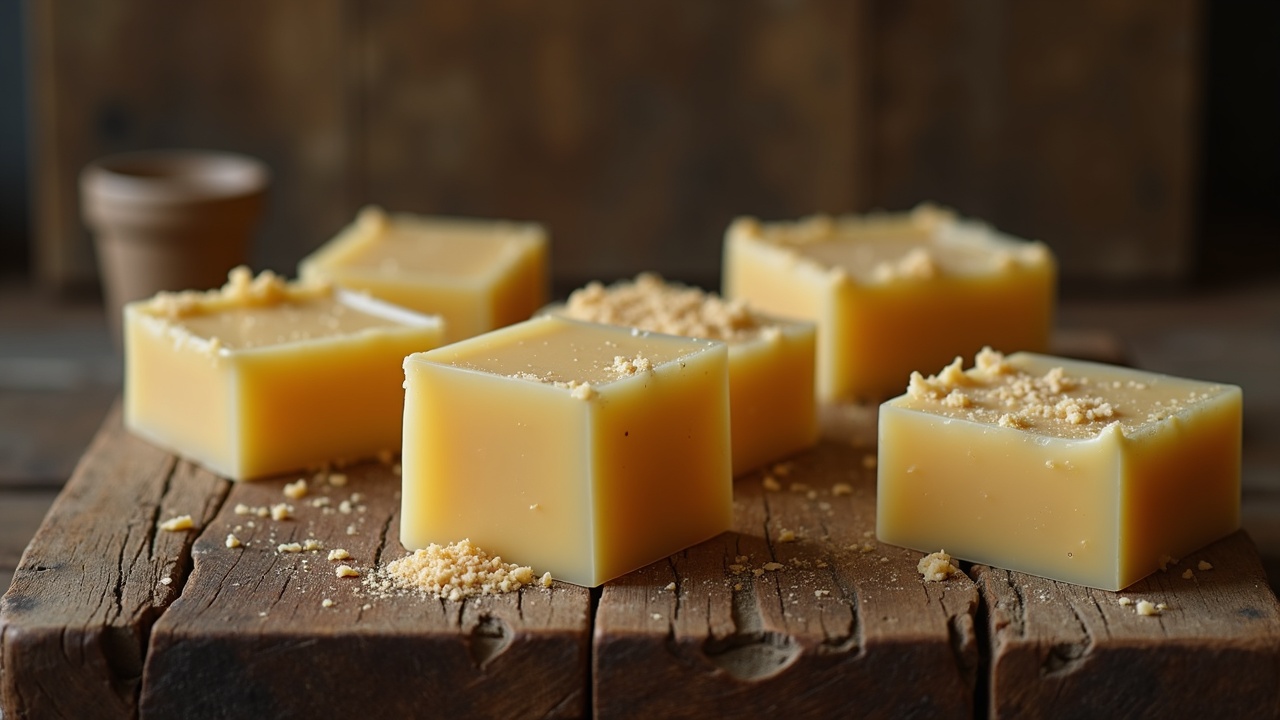
**Step 8 — Cure.** Place bars on a rack with air circulation on all sides. Cure for 4–6 weeks. During curing, excess water evaporates (bars lose 10–15% weight), the crystal structure of the soap continues to develop, and pH drops from ~10 to 8–9. The bar gets harder, milder, and longer-lasting. Do not skip or shorten the cure.
Hot Process
Hot process uses external heat to force saponification to completion in 1–3 hours instead of waiting weeks. The soap is usable immediately after cooling, though a 1–2 week cure still improves bar quality.
**Steps 1–4** are identical to cold process.
**Step 5 — Cook.** Transfer the traced batter to a slow cooker set on low. Stir every 15–20 minutes. The batter will go through stages: thin and glossy → thick and chunky → vaseline-like translucency. When the entire batch looks like translucent vaseline and a sample dissolved in water tests at pH 8–10, saponification is complete. This takes 1–3 hours.
**Step 6 — Add extras and mold.** Work quickly — hot process batter sets fast. Add essential oils and other additives, stir, and spoon into molds. Press firmly to eliminate air pockets. Hot process bars have a rougher, more rustic appearance than cold process — this is normal.
**Step 7 — Unmold.** After cooling completely (6–12 hours), unmold and cut. The soap is technically usable now, but curing for 1–2 weeks still improves hardness and mildness.
Safety and Common Problems
Lye Safety
Sodium hydroxide causes chemical burns on contact with skin, eyes, and mucous membranes. It is not optional — it is the single most dangerous material in the process and demands respect.
**Required PPE:** Chemical splash goggles (not safety glasses). Chemical-resistant gloves (nitrile or rubber). Long sleeves and pants. Closed-toe shoes. Work in a ventilated area — the initial lye-water reaction produces caustic fumes.
**If lye contacts skin:** Flush immediately with running water for 15–20 minutes. Do not use vinegar — the neutralization reaction generates additional heat and can worsen the burn. Water only.
**If lye contacts eyes:** Flush with running water for at least 20 minutes. Seek medical attention.
**Lye + aluminum = hydrogen gas.** Never use aluminum pots, utensils, or containers with lye. The reaction produces heat and flammable hydrogen gas. Stainless steel, HDPE plastic, or silicone only.
Common Problems and Diagnostics
| Problem | Cause | Fix | |---|---|---| | Soap will not trace | Temperatures too low, wrong oil/lye ratio, stick blender not working | Verify recipe with lye calculator. Check temperatures. Blend longer. | | False trace | Saturated fats (tallow, coconut) solidifying from cooling, not actual saponification | Re-warm to 110°F and continue blending. True trace holds when rewarmed. | | Lye pockets (white hard spots) | Insufficient mixing, undissolved lye granules | Rebatch: grate, melt in slow cooker with 1–2 oz water per pound, recook. | | Rancid smell (DOS — dreaded orange spots) | Unsaturated oils oxidizing, old oils, too much superfat | Use fresh oils. Keep superfat at 5% or below. Add ROE (rosemary oleoresin extract) as antioxidant. | | Soap is too soft after 48 hours | Too much water, too much soft oil, incomplete saponification | Let it cure longer. Increase tallow/coconut ratio next batch. | | Crumbly, chalite texture | Too much lye, temperatures too high | Rebatch with additional fat. Always double-check lye calculator. | | Soda ash (white powdery film) | Cosmetic only. Caused by unsaponified NaOH reacting with CO₂ in air. | Wipe off with damp cloth or spray mold surface with 91% isopropyl alcohol. |
Waste Handling and Byproducts
**Glycerin.** Cold process and hot process soap retain all glycerin in the finished bar. This is the primary advantage over commercial soap, which removes glycerin for resale. If you want to extract glycerin separately, salt out the soap (dissolve in hot water, add NaCl until the soap precipitates, collect the glycerin-rich liquid below) — but for homestead use, leaving it in the bar is the better option.
**Cracklings from rendering.** The protein solids left after rendering fat are cracklings. They are edible (season and fry crisp) or compostable. Do not waste them.
**Wash water.** Water used to clean soap-making equipment has a high pH. Neutralize with vinegar before pouring down the drain or onto soil. Small amounts are fine for drain disposal — soap is, after all, what goes down the drain anyway.
**Failed batches.** Almost any failed batch can be rebatched. Grate the soap, melt in a slow cooker with a small amount of water, add additional fat or lye as needed (depending on whether the failure was lye-heavy or fat-heavy), recook, and remold. Soap is forgiving.
Storage and Curing
**Curing environment.** Store curing bars on open wire racks or wooden drying racks in a cool, dry, well-ventilated area out of direct sunlight. Turn bars weekly for the first two weeks to ensure even drying. Temperature: 60–75°F. Humidity: below 60% if possible.
**Cure duration.** Cold process: 4–6 weeks minimum. Castile (100% olive oil) soap benefits from 6–12 months. Hot process: 1–2 weeks minimum. The longer the cure, the harder, milder, and longer-lasting the bar.
**Long-term storage.** Fully cured soap stores indefinitely if kept dry. Wrap in wax paper, kraft paper, or breathable fabric — not plastic wrap, which traps moisture. Properly stored tallow soap has been found usable after 10+ years. Soap with high percentages of unsaturated oils (olive, sunflower) may develop rancid spots (DOS) after 1–2 years — use these batches first.
**Weight loss during cure.** Expect 10–15% weight loss during the 4–6 week cure as water evaporates. This is normal and desirable. A fully cured bar will be noticeably harder and lighter than a freshly cut bar.
Using the Product
Soap Types by Fat Composition
- **Tallow or lard soap (80–100% animal fat, 0–20% coconut)** — Very hard, long-lasting bars. Creamy lather. Mild on skin. The standard homestead bar for everything: body, hands, dishes (at 0% superfat), laundry.
- **Castile soap (100% olive oil)** — Very mild, very gentle. Low lather. Soft bar that improves dramatically with extended curing (6+ months). Traditional Mediterranean soap.
- **Bastile soap (olive oil majority + coconut/tallow)** — Milder than tallow-heavy blends, better lather than pure castile. Good body bar for sensitive skin.
- **Coconut soap (100% coconut oil, 20% superfat)** — Extremely hard bar, enormous lather, lathers in salt water. At 20% superfat it is mild enough for body use. At lower superfat it strips skin. Used for marine/saltwater soap and laundry bars.
- **Laundry soap (tallow/coconut at 0–2% superfat)** — Maximum cleansing, no free oil to deposit on fabric. Grate into flakes for washing machine use. Add washing soda and borax for a complete laundry powder.
Common Additives
| Additive | Amount per lb of oils | Purpose | |---|---|---| | Essential oils (lavender, tea tree, peppermint) | 0.5–1.0 oz | Fragrance and mild antimicrobial properties | | Ground oatmeal | 1–2 tbsp | Gentle exfoliant, soothing for irritated skin | | Kaolin clay | 1 tsp | Silkier lather, slight opacity | | Activated charcoal | 1 tsp | Draws impurities, black color | | Honey | 1 tsp | Humectant, boosts lather. Accelerates trace and gel phase — use at lower temperatures. | | Coffee grounds | 1–2 tbsp | Exfoliant, deodorizer. Good for kitchen hand soap. | | Turmeric powder | 1/2–1 tsp | Natural golden-yellow colorant | | Calendula petals | 1–2 tbsp | Visual interest, mild skin-soothing | | Salt (fine sea salt, added to water before lye) | 1/2 tsp per lb oils | Harder bar. Add to water before dissolving NaOH. |
References
1. Cavitch, Susan Miller. *The Soapmaker's Companion.* Storey Publishing, 1997. 2. Dunn, Kevin. *Scientific Soapmaking.* Clavicula Press, 2010. 3. Levey, Martin. "Chemistry and Chemical Technology in Ancient Mesopotamia." Elsevier, 1959. 4. Bramble Berry. "Lye Calculator and SAP Value Chart." brambleberry.com. 5. SoapCalc. "Online Lye Calculator." soapcalc.net. 6. Failor, Catherine. *Making Natural Liquid Soaps.* Storey Publishing, 2000. 7. USDA Forest Products Laboratory. *Wood Handbook: Wood as an Engineering Material.* General Technical Report FPL-GTR-282, 2021.
**Tags:** `[practical-skills]` `[formulation]` `[self-reliance]` `[homestead]` `[beginner]`