compounds
Withanolides: The Active Steroidal Lactones of Ashwagandha
Scientific guide to withanolides from Ashwagandha (Withania somnifera). Covers their steroidal lactone structure, cortisol modulation, GABAergic effects.
What Are Withanolides?
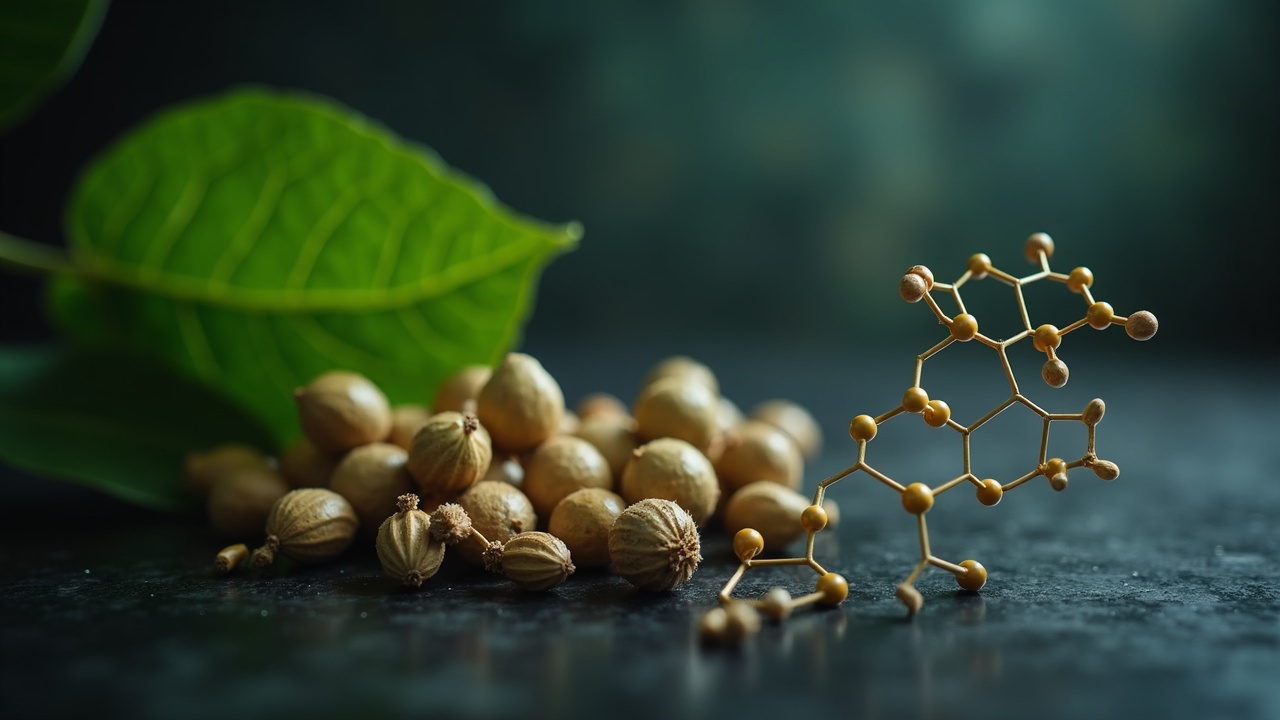
Withanolides are a large group of naturally occurring C28 steroidal lactones built on an ergostane skeleton. Over 300 withanolides have been identified across the Solanaceae (nightshade) family, but the most pharmacologically significant are found in Ashwagandha (Withania somnifera), a plant central to Ayurvedic medicine for over 3,000 years. The name “ashwagandha” translates roughly as “smell of the horse,” referring to both the root’s odor and the traditional belief that it confers the vitality and strength of a horse.
The two most studied withanolides are withaferin A and withanolide A, which have distinct pharmacological profiles. Withaferin A has attracted particular attention in cancer research for its potent anti-proliferative activity, while withanolide A is more closely associated with neuroprotective and cognitive effects. Commercial ashwagandha extracts are typically standardized to total withanolide content, usually ranging from 2.5% to 10%.
Withanolide Chemical Profile
- Chemical class: C28 steroidal lactone (ergostane-derived)
- Core structure: 22-Hydroxyergostan-26-oic acid 26,22-lactone
- Key variants: Withaferin A, Withanolide A, Withanolide D, Withanoside IV/V
- Molecular weight range: 450–550 g/mol
- Source plant: Withania somnifera (roots and leaves)
- Typical standardization: 2.5–10% total withanolides in commercial extracts
Mechanisms of Action
HPA Axis Modulation
The hypothalamic-pituitary-adrenal (HPA) axis is the body’s central stress response system, regulating cortisol production in response to perceived threats. Chronic stress leads to sustained HPA axis activation and elevated cortisol, which is associated with anxiety, impaired immune function, metabolic disruption, and cognitive decline.
Clinical trials have consistently demonstrated that ashwagandha extracts standardized for withanolides reduce serum cortisol levels by 15–30% in chronically stressed individuals. The mechanism appears to involve modulation at multiple levels of the HPA axis rather than simple cortisol suppression, which distinguishes withanolides from pharmaceutical cortisol-blockers.
GABAergic Activity
Withanolides and the related withanosides (glycosylated withanolides) demonstrate GABA-mimetic activity, meaning they can interact with GABA-A receptors to enhance inhibitory neurotransmission. This GABAergic activity contributes to the anxiolytic and sleep-promoting effects traditionally attributed to ashwagandha. Animal studies show that withanolide A, in particular, modulates GABA-A receptor subunit expression in the hippocampus and amygdala.
Neuroprotective and Neuroplasticity Effects
Withanolide A and withanoside IV promote neurite outgrowth and dendritic extension in neuronal cell cultures. In animal models of neurodegeneration, these compounds have restored impaired synaptic function, reduced beta-amyloid plaque burden, and improved spatial memory. The mechanisms involve upregulation of brain-derived neurotrophic factor (BDNF), activation of the Nrf2 antioxidant pathway, and inhibition of acetylcholinesterase.
Anti-inflammatory and Immunomodulatory Effects
Withaferin A is a potent inhibitor of NF-kB signaling, a master regulator of inflammatory gene expression. It also modulates the balance between pro-inflammatory (Th1/Th17) and anti-inflammatory (Th2/Treg) immune responses, supporting balanced immune function rather than simple immunosuppression. This immunomodulatory profile aligns with the Ayurvedic concept of ashwagandha as a “rasayana”—a rejuvenating tonic that supports the body’s natural resilience.
Adaptogenic Mechanism
Withanolides exemplify the adaptogenic concept: rather than pushing the body in a single pharmacological direction, they appear to modulate multiple stress-response systems toward homeostasis. Under chronic stress, they reduce elevated cortisol and inflammatory markers. In states of fatigue, they support energy production and cognitive function. This bidirectional, normalizing activity is the defining feature of true adaptogens and sets them apart from conventional stimulants or sedatives.
Clinical Evidence
| Study | Key Finding |
|---|---|
| Chandrasekhar et al. (2012) — 64 subjects, 60 days | 300 mg root extract twice daily reduced serum cortisol by 27.9% and anxiety scores (HAM-A) by 56.5% vs. placebo |
| Salve et al. (2019) — 60 subjects, 8 weeks | 300 mg/day of root extract (KSM-66) reduced cortisol, improved sleep quality scores by 72%, and reduced stress perception |
| Choudhary et al. (2017) — 50 subjects, 8 weeks | 300 mg twice daily improved memory, attention, and information processing speed; increased serum BDNF levels |
| Wankhede et al. (2015) — 57 subjects, 8 weeks | 300 mg twice daily significantly increased muscle strength, muscle size, and testosterone while reducing body fat percentage and exercise-induced muscle damage |
| Langade et al. (2019) — 80 subjects, 8 weeks | 300 mg twice daily improved sleep onset latency, total sleep time, and sleep quality in both healthy and insomnia populations |
Source Plant: Ashwagandha
Withania somnifera is a small evergreen shrub native to the dry regions of India, the Middle East, and parts of Africa. It thrives in arid, subtropical climates and produces small, red fruit enclosed in a papery calyx. The roots are the primary source of withanolides in traditional and commercial preparations, though leaves also contain significant amounts (particularly withaferin A).
Withanolide content varies considerably based on the plant part, cultivar, growing conditions, and harvest timing. Root withanolide content typically ranges from 0.5% to 2.0% in raw material, while standardized extracts concentrate these to 2.5–10%.
Safety and Interactions
- Generally well-tolerated: Clinical trials consistently report mild side effect profiles at standard doses (300–600 mg/day of standardized extract)
- Thyroid effects: Ashwagandha may increase thyroid hormone levels (T3, T4). Individuals with hyperthyroidism or those taking thyroid medications should use caution and monitor levels
- Immunomodulation: Because of its immune-modulating effects, ashwagandha should be used cautiously by individuals on immunosuppressive medications or with autoimmune conditions
- Sedation potential: GABAergic activity may enhance the effects of sedative medications, alcohol, and other CNS depressants
- Pregnancy: Contraindicated during pregnancy due to potential abortifacient properties documented in traditional texts and animal studies
- Gastrointestinal: Mild GI upset is the most commonly reported side effect, usually resolved by taking with food
Extraction and Standardization
Two major standardized ashwagandha extracts dominate clinical research: KSM-66 (root-only extract standardized to 5% withanolides) and Sensoril (root and leaf extract standardized to 10% withanolides with higher withaferin A content). The choice between these depends on the desired effect profile, as the root-only extract tends to have a more anxiolytic and adaptogenic profile, while the leaf-containing extract provides stronger anti-inflammatory activity.
References
- Chandrasekhar, K. et al. “A prospective, randomized double-blind, placebo-controlled study of safety and efficacy of a high-concentration full-spectrum extract of ashwagandha root.” Indian Journal of Psychological Medicine, 2012.
- Salve, J. et al. “Adaptogenic and anxiolytic effects of ashwagandha root extract in healthy adults.” Cureus, 2019.
- Choudhary, D. et al. “Efficacy and safety of ashwagandha root extract in improving memory and cognitive functions.” Journal of Dietary Supplements, 2017.
- Wankhede, S. et al. “Examining the effect of Withania somnifera supplementation on muscle strength and recovery.” Journal of the International Society of Sports Nutrition, 2015.
- Langade, D. et al. “Efficacy and safety of ashwagandha root extract in insomnia and anxiety.” Cureus, 2019.
- Dar, N.J. et al. “Pharmacologic overview of Withania somnifera, the Indian Ginseng.” Cellular and Molecular Life Sciences, 2015.