Plants
Adaptogenic Compounds: How Plants Modulate the Human Stress Response
Scientific guide to adaptogenic compounds, the bioactive molecules in plants like ashwagandha, rhodiola, eleuthero.
On this page
What Defines an Adaptogen?
The term “adaptogen” was coined in 1947 by Soviet toxicologist Nikolai Lazarev and formally defined by pharmacologist Israel Brekhman in the 1960s. An adaptogen must meet three criteria: it must be non-specific in its action (increasing resistance to a broad range of stressors, not just one); it must be normalizing (bringing physiological functions back toward homeostasis regardless of the direction of deviation); and it must be non-toxic at therapeutic doses with no significant side effects during prolonged use.
This definition is fundamentally different from how most pharmaceutical drugs work. A stimulant pushes a physiological parameter in one direction; a sedative pushes it in the other. An adaptogen does neither, it helps the body find its own balance. If cortisol is too high, adaptogens tend to lower it. If cortisol is too low (as in burnout or adrenal insufficiency), the same adaptogen may support its normalization upward. This bidirectional activity is the defining hallmark of adaptogenic action.
The Three Criteria for True Adaptogens (Brekhman & Dardymov, 1969)
- Non-specific resistance: Must increase resistance to a wide range of adverse biological, chemical, and physical factors
- Normalizing influence: Must have a normalizing effect on physiology regardless of the direction of pathological change
- Safety: Must be innocuous and cause minimal disturbance to normal biological function at therapeutic doses
The Stress Response System: HPA Axis
To understand how adaptogens work, we first need to understand the system they modulate: the hypothalamic-pituitary-adrenal (HPA) axis. This is the body’s central stress response system, a three-stage hormonal cascade.

- Hypothalamus detects stress and releases corticotropin-releasing hormone (CRH)
- Anterior pituitary receives CRH and releases adrenocorticotropic hormone (ACTH)
- Adrenal cortex receives ACTH and releases cortisol (the primary stress hormone)
Cortisol then feeds back to the hypothalamus and pituitary to suppress further CRH and ACTH release, a negative feedback loop designed to be self-limiting. Under chronic stress, this feedback loop becomes dysregulated. The system either remains chronically elevated (sustained high cortisol) or eventually collapses from exhaustion (low cortisol with impaired stress response). Both states are associated with a cascade of health problems: impaired immunity, disrupted sleep, metabolic dysfunction, cognitive impairment, mood disorders, and accelerated aging.
Where Adaptogens Intervene
Adaptogens act at multiple points in this cascade. They modulate CRH and ACTH release, regulate glucocorticoid receptor sensitivity, influence cortisol metabolism enzymes, and interact with molecular mediators of the stress response including heat shock proteins (Hsp70), JNK kinase, forkhead box O (FOXO) transcription factors, and the cortisol-activated transcription factor DAF-16. By acting at multiple levels simultaneously, adaptogens support the entire stress response system rather than blocking a single point, which is why their effects tend to be normalizing rather than directional.
Allostasis vs. Homeostasis
Modern stress physiology uses the concept of allostasis, stability through change, rather than simple homeostasis. The body doesn’t maintain fixed setpoints; it dynamically adjusts parameters based on anticipated demands. Allostatic load is the cumulative wear-and-tear from chronic stress-driven adjustments. Adaptogens may work by reducing allostatic load, helping the body return to efficient allostatic regulation rather than remaining stuck in costly high-alert states. This framework better explains the bidirectional, normalizing nature of adaptogenic action than traditional homeostatic models.
Major Adaptogenic Plants and Their Active Compounds
| Adaptogen | Primary Active Compounds | Chemical Class | Primary Mechanisms |
|---|---|---|---|
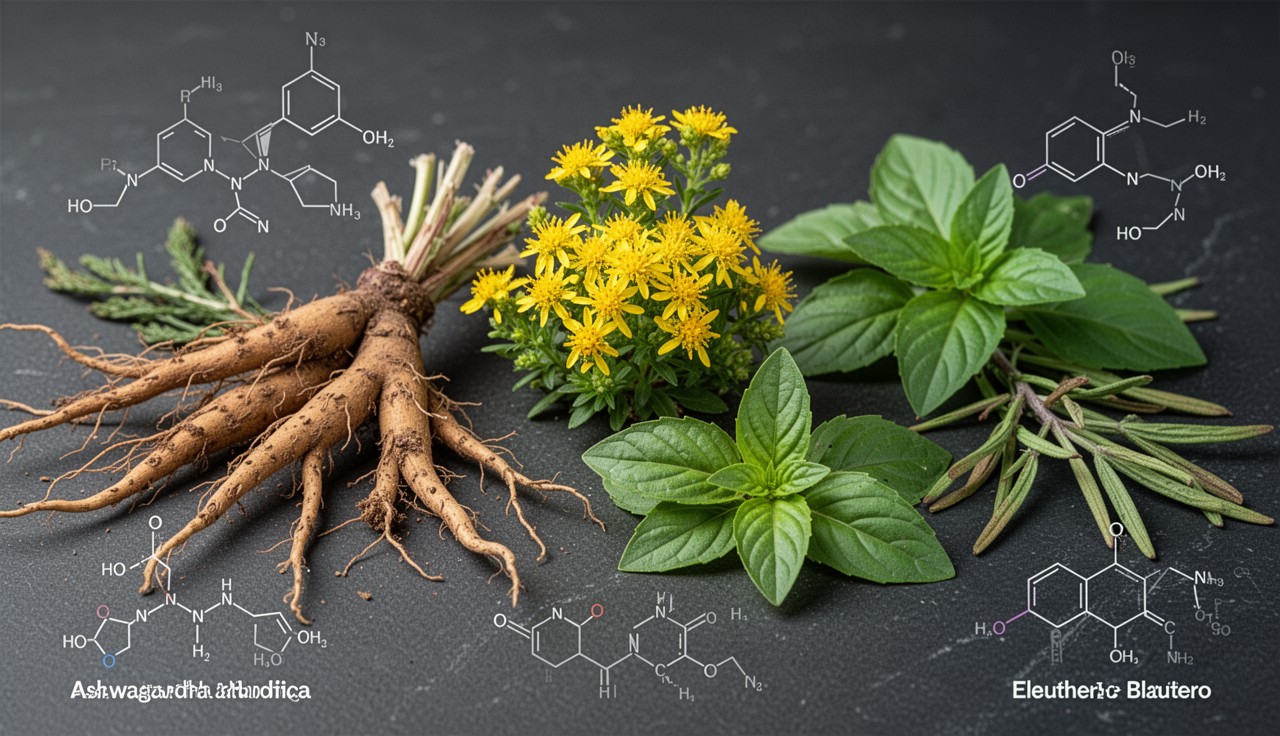
| Ashwagandha (Withania somnifera) | Withanolide A, withaferin A, withanone | Steroidal lactones | GABA-A modulation, cortisol reduction, Hsp70 induction |
| Rhodiola (Rhodiola rosea) | Salidroside, rosavins (rosavin, rosin, rosarin) | Phenylpropanoids, phenylethanoids | AMPK activation, cortisol normalization, monoamine modulation |
| Eleuthero (Eleutherococcus senticosus) | Eleutherosides B and E | Lignans, phenylpropanoids | Hsp70/72 induction, NO modulation, endurance support |
| Holy Basil (Ocimum tenuiflorum) | Ursolic acid, rosmarinic acid, eugenol, ocimumosides | Terpenoids, phenolic acids | COX-2 inhibition, cortisol normalization, blood sugar regulation |
| Schisandra (Schisandra chinensis) | Schisandrin B, gomisins | Dibenzocyclooctadiene lignans | Liver phase I/II enzyme modulation, cortisol normalization, NO signaling |
| Cordyceps (Cordyceps militaris) | Cordycepin, adenosine, cordycepic acid | Nucleoside analogues, polyols | Adenosine receptor activation, mitochondrial biogenesis, oxygen utilization |
| Reishi (Ganoderma lucidum) | Ganoderic acids, beta-glucans | Triterpenes, polysaccharides | Immune modulation, cortisol balancing, hepatoprotection |
Deep Dive: Key Adaptogenic Compound Classes
Withanolides (Ashwagandha)
Withanolides are a family of 300+ steroidal lactones built on an ergostane skeleton. The most pharmacologically important are withaferin A (anti-inflammatory, anti-tumor), withanolide A (neuroprotective, AChE inhibition), and withanone (telomerase activity, neuroprotection). Their steroidal structure allows them to interact with multiple receptor systems including GABA-A receptors, glucocorticoid receptors, and nuclear transcription factors.
Clinical trials of ashwagandha standardized to withanolide content have demonstrated 15–30% cortisol reduction in chronically stressed adults, significant improvements in perceived stress and anxiety scores, and enhanced sleep quality. For a detailed analysis of withanolide pharmacology, see our dedicated withanolides guide.
Rosavins and Salidroside (Rhodiola)
Rhodiola’s adaptogenic properties are attributed to two compound families that work synergistically. Rosavins (rosavin, rosin, rosarin) are cinnamyl alcohol glycosides unique to R. rosea. Salidroside (p-hydroxyphenethyl glucoside) is found across multiple Rhodiola species and is generally considered the more pharmacologically potent compound.
Salidroside activates AMPK (AMP-activated protein kinase), the cellular energy sensor, promoting efficient energy utilization under stress. It also modulates monoamine neurotransmitter levels (serotonin, dopamine, norepinephrine) by inhibiting catechol-O-methyltransferase (COMT) and monoamine oxidase (MAO), extending the functional half-life of these neurotransmitters without the overstimulation caused by direct receptor agonists.
The standard clinical extract is standardized to 3% rosavins and 1% salidroside, reflecting the natural ratio found in R. rosea root. Doses of 200–600 mg/day have shown benefits for fatigue, cognitive function, and stress-related burnout in clinical trials.
Eleutherosides (Eleuthero)
Eleuthero (formerly called “Siberian ginseng,” though it is not a true ginseng) contains a diverse group of compounds collectively called eleutherosides, labeled A through M. Eleutheroside B (syringin) and eleutheroside E (a lignan) are the most studied and are used as standardization markers. These compounds induce heat shock proteins (Hsp70/72), molecular chaperones that protect proteins from stress-induced damage and maintain cellular function under adverse conditions.
The most extensive adaptogen research in history was conducted on eleuthero by Soviet scientists from the 1960s through 1980s, involving thousands of subjects including soldiers, astronauts, athletes, and factory workers. While much of this research does not meet modern methodological standards, the consistent finding was improved work capacity, reduced illness rates, and enhanced stress tolerance under demanding conditions.
Triterpenes and Polysaccharides (Reishi and Cordyceps)
Medicinal mushrooms occupy a unique position in adaptogen science because their activity comes from two fundamentally different compound classes working in parallel. Triterpenes (ganoderic acids in Reishi, cordycepin in Cordyceps) provide the direct stress-modulating, anti-inflammatory, and hormone-balancing effects. Polysaccharides (beta-glucans) provide the immune-modulating foundation that supports the body’s resilience infrastructure. For detailed coverage of beta-glucan mechanisms and ginsenoside pharmacology, see our dedicated compound guides.
Clinical Evidence for Adaptogenic Action
- Cortisol reduction: A 2019 systematic review of 12 RCTs found that ashwagandha supplementation (300–600 mg/day of root extract) produced significant cortisol reduction averaging 11–32% compared to placebo in chronically stressed adults
- Fatigue and burnout: Rhodiola rosea (400 mg/day for 12 weeks) significantly improved fatigue symptoms, attention, and quality of life in individuals with burnout syndrome (Kasper & Dienel, 2017)
- Cognitive performance under stress: Rhodiola (370–555 mg) improved cognitive function, including associative thinking, short-term memory, and calculation speed during fatigue-inducing tasks (Darbinyan et al., 2000)
- Endurance and work capacity: Eleuthero and cordyceps both demonstrate improved VO2 max and time-to-exhaustion in controlled exercise trials, though effect sizes are generally modest (5–15% improvement)
- Sleep quality: Ashwagandha (300 mg 2x/day) improved sleep onset latency, sleep quality, and total sleep time in adults with insomnia (Langade et al., 2019)
- Immune resilience: Holy basil (300 mg/day for 4 weeks) enhanced T-helper and NK cell activity in healthy volunteers, consistent with improved immune surveillance under stress
- Anxiety reduction: A meta-analysis of ashwagandha for anxiety (Pratte et al., 2014) found significant effects across five RCTs, with effect sizes comparable to some pharmaceutical anxiolytics
How Adaptogens Differ from Stimulants and Sedatives
| Property | Stimulants | Sedatives | Adaptogens |
|---|---|---|---|
| Direction of action | Unidirectional (up) | Unidirectional (down) | Bidirectional (normalizing) |
| Energy pattern | Peak followed by crash | Suppression | Sustained, even energy |
| Tolerance development | Common (dose escalation needed) | Common | Minimal to none |
| Withdrawal effects | Fatigue, depression | Rebound anxiety, insomnia | Gradual return to baseline |
| HPA axis effect | Drives cortisol higher | Suppresses cortisol acutely | Normalizes cortisol rhythm |
| Ideal for chronic use | No (depleting) | No (dependency risk) | Yes (restorative) |
| Onset of full effects | Minutes to hours | Minutes to hours | 1–8 weeks (building) |
The “Stress Vaccine” Metaphor
A useful way to understand adaptogens is as a “stress vaccine.” Just as a vaccine exposes the immune system to a controlled challenge that trains it to respond more effectively to real threats, adaptogenic compounds present a mild metabolic stress signal (hormesis) that trains cellular stress defense pathways, Hsp70, FOXO, Nrf2, AMPK, to activate more efficiently when real stressors arrive. The result is not avoidance of stress but improved capacity to handle it with less physiological cost.

Practical Considerations
Timing and Cycling
Most adaptogens require 2–8 weeks of consistent use before full effects are realized, reflecting the time needed for epigenetic and cellular adaptations to manifest. Many practitioners recommend cycling protocols: 6–8 weeks on followed by 1–2 weeks off, to prevent potential receptor downregulation and maintain sensitivity. Morning dosing is generally recommended for stimulating adaptogens (rhodiola, eleuthero), while calming adaptogens (ashwagandha, reishi) may be taken in the evening.
Stacking Adaptogens
Traditional herbal systems (Ayurveda, TCM, Soviet adaptogenology) commonly combine multiple adaptogens in formulas. The rationale is that different adaptogens act through different molecular pathways: ashwagandha through GABAergic/steroidal mechanisms, rhodiola through monoamine/AMPK pathways, and reishi through triterpene/immune pathways. Combining them may produce broader stress resilience than any single compound. However, clinical evidence for specific combinations is limited compared to single-herb studies.
Extract Standardization
Because adaptogenic plants contain dozens to hundreds of bioactive compounds, extract standardization is critical for reproducible effects. Look for products standardized to the specific active compound markers listed in the table above. Root extracts generally have the highest concentrations of stress-modulating compounds, while leaf or aerial part extracts may have different compound profiles and effects.
Safety Profile
- Generally excellent safety: True adaptogens, by definition, are non-toxic at therapeutic doses. The most studied adaptogens (ashwagandha, rhodiola, eleuthero) have safety data from clinical trials lasting up to 12 months
- Thyroid interaction (ashwagandha): Ashwagandha may increase thyroid hormone levels. Monitor thyroid function if using with thyroid medications or if you have thyroid disorders. See our withanolides guide for details
- Immunostimulant caution: Adaptogens with immune-stimulating properties (eleuthero, reishi, cordyceps) should be used with caution by individuals on immunosuppressive medications or with autoimmune conditions
- Surgery considerations: Some adaptogens may affect bleeding time or interact with anesthesia. Discontinue 2 weeks before planned surgery as a precaution
- Pregnancy and lactation: Insufficient safety data for most adaptogens during pregnancy. Ashwagandha is traditionally contraindicated in pregnancy in Ayurvedic medicine. Consult a healthcare provider
- Drug interactions: Schisandra may inhibit CYP3A4 liver enzymes, potentially increasing blood levels of medications metabolized by this pathway. Rhodiola may interact with CYP2C9 substrates
- Nightshade sensitivity: Ashwagandha belongs to the Solanaceae (nightshade) family. Individuals with nightshade sensitivities should be aware
Adaptogens complement rather than compete with other compound categories covered in our article library. For deeper exploration of individual adaptogenic compounds, see our guides on withanolides, ginsenosides, and rosmarinic acid. For how adaptogens intersect with cognitive enhancement strategies, see our L-theanine guide.
References
- Panossian, A. & Wikman, G. “Effects of adaptogens on the central nervous system and the molecular mechanisms associated with their stress-protective activity.” Pharmaceuticals, 2010.
- Brekhman, I.I. & Dardymov, I.V. “New substances of plant origin which increase nonspecific resistance.” Annual Review of Pharmacology, 1969.
- Chandrasekhar, K. et al. “A prospective, randomized double-blind, placebo-controlled study of safety and efficacy of a high-concentration full-spectrum extract of Ashwagandha root.” Indian Journal of Psychological Medicine, 2012.
- Kasper, S. & Dienel, A. “Multicenter, open-label, exploratory clinical trial with Rhodiola rosea extract in patients suffering from burnout symptoms.” Neuropsychiatric Disease and Treatment, 2017.
- Darbinyan, V. et al. “Rhodiola rosea in stress induced fatigue.” Phytomedicine, 2000.
- Langade, D. et al. “Efficacy and safety of Ashwagandha root extract in insomnia and anxiety.” Cureus, 2019.
- Pratte, M.A. et al. “An alternative treatment for anxiety: a systematic review of human trial results reported for the Ayurvedic herb ashwagandha.” Journal of Alternative and Complementary Medicine, 2014.
- Panossian, A. “Understanding adaptogenic activity: specificity of the pharmacological action of adaptogens and other phytochemicals.” Annals of the New York Academy of Sciences, 2017.
Research on adaptogens
Peer reviewed studies about adaptogens, listed so you can read the original rather than take our word for it. They are background on the subject, not a source for any one sentence above.
- Rhodiola rosea: a possible plant adaptogen. (2001). read the study
- Plant adaptogens (1994). doi:10.1016/s0944-7113(11)80025-5
- Eleutherococcus senticosus (Rupr. & Maxim.) Maxim. (Araliaceae) as an adaptogen: a closer look (2000). doi:10.1016/s0378-8741(00)00181-1
- Effects of Adaptogens on the Central Nervous System and the Molecular Mechanisms Associated with Their Stress-Protective Activity (2010). doi:10.3390/ph3010188
- Plant adaptogens increase lifespan and stress resistance in C. elegans (2008). doi:10.1007/s10522-008-9151-9
Common questions
What Defines an Adaptogen?
The term “adaptogen” was coined in 1947 by Soviet toxicologist Nikolai Lazarev and formally defined by pharmacologist Israel Brekhman in the 1960s. An adaptogen must meet three criteria: it must be non-specific in its action (increasing resistance to a broad range of stressors, not just one); it must be normalizing (bringing physiological functions back toward homeostasis regardless of the direction of deviation); and it must be non-toxic at therapeutic doses with no significant side effects during prolonged use. This definition is fundamentally different from how most pharmaceutical drugs work.
What are the stress response system: hpa axis?
To understand how adaptogens work, we first need to understand the system they modulate: the hypothalamic-pituitary-adrenal (HPA) axis. This is the body’s central stress response system, a three-stage hormonal cascade. Hypothalamus detects stress and releases corticotropin-releasing hormone (CRH). Anterior pituitary receives CRH and releases adrenocorticotropic hormone (ACTH). Adrenal cortex receives ACTH and releases cortisol (the primary stress hormone).
What is the active compound in adaptogens?
Ashwagandha (Withania somnifera) (Withanolide A, withaferin A, withanone, Steroidal lactones): GABA-A modulation, cortisol reduction, Hsp70 induction. Rhodiola (Rhodiola rosea) (Salidroside, rosavins (rosavin, rosin, rosarin), Phenylpropanoids, phenylethanoids): AMPK activation, cortisol normalization, monoamine modulation. Eleuthero (Eleutherococcus senticosus) (Eleutherosides B and E, Lignans, phenylpropanoids): Hsp70/72 induction, NO modulation, endurance support.
What is clinical evidence for adaptogenic action?
Cortisol reduction: A 2019 systematic review of 12 RCTs found that ashwagandha supplementation (300–600 mg/day of root extract) produced significant cortisol reduction averaging 11–32% compared to placebo in chronically stressed adults. Fatigue and burnout: Rhodiola rosea (400 mg/day for 12 weeks) significantly improved fatigue symptoms, attention, and quality of life in individuals with burnout syndrome (Kasper & Dienel, 2017).
What are practical considerations?
Most adaptogens require 2–8 weeks of consistent use before full effects are realized, reflecting the time needed for epigenetic and cellular adaptations to manifest. Many practitioners recommend cycling protocols: 6–8 weeks on followed by 1–2 weeks off, to prevent potential receptor downregulation and maintain sensitivity. Morning dosing is generally recommended for stimulating adaptogens (rhodiola, eleuthero), while calming adaptogens (ashwagandha, reishi) may be taken in the evening. Traditional herbal systems (Ayurveda, TCM, Soviet adaptogenology) commonly combine multiple adaptogens in formulas.
Are adaptogens safe?
Generally excellent safety: True adaptogens, by definition, are non-toxic at therapeutic doses. The most studied adaptogens (ashwagandha, rhodiola, eleuthero) have safety data from clinical trials lasting up to 12 months. Thyroid interaction (ashwagandha): Ashwagandha may increase thyroid hormone levels. Monitor thyroid function if using with thyroid medications or if you have thyroid disorders. See our withanolides guide for details.