Growing
Companion Planting: Mechanisms, Guilds, and What the Research Shows
Evidence-based companion planting guide covering allelopathy, volatile compounds, Three Sisters, medicinal guilds.
On this page
Introduction
Companion planting is one of the oldest practices in agriculture and one of the most contested in modern horticulture. Three Sisters planting of corn, beans, and squash has been practiced by Indigenous agricultural cultures across the Americas for thousands of years. European cottage gardens evolved complex multi-species arrangements that combined food, medicine, and pest deterrence in the same bed. These traditions accumulated real observational knowledge over generations.
The problem is that the translation of that knowledge into modern horticultural practice happened largely without rigorous testing. Many companion planting claims that circulate widely online and in popular gardening books are not supported by reproducible evidence. Some are simply wrong. Others describe real effects that work under specific conditions but fail under different soil, climate, or pest pressure.
Understanding which claims are well-supported, which are plausible but unconfirmed, and which have been directly contradicted by research is more useful than treating the whole body of companion planting lore as equally valid.
Evidence Over Tradition
This guide distinguishes between companion planting claims supported by controlled field trials and those based on anecdotal observation. Both have value, but knowing which is which determines how much you should rely on a given combination in your garden design.
Part I: Mechanisms of Plant Interaction
How Plants Actually Affect Each Other
Plants interact with their neighbors through several distinct mechanisms. Understanding these mechanisms makes it possible to evaluate companion planting claims rationally. A claim that basil repels aphids from tomatoes through volatile compound emission is a testable hypothesis about a specific mechanism. A claim that planting garlic near roses brings good luck is not.
Allelopathy: Chemical Suppression
Allelopathy is the production of biochemicals by one plant that inhibit or suppress the growth of neighboring plants. It is real, well-documented, and frequently misunderstood. The most famous allelopathic species are black walnut, which produces juglone that kills or suppresses tomatoes, potatoes, and many other species within its root zone, and sunflowers, which produce allelopathic compounds from their roots and decaying leaf material.
What is frequently misunderstood is that allelopathy is almost entirely a negative interaction. The practical application of allelopathy in companion planting is primarily to know which plants should not be grown near each other, rather than to find positive chemical relationships. There is limited evidence for allelopathic compounds that benefit rather than harm neighboring plants.
Juglone Sensitivity
Black walnut produces juglone from its roots, leaves, and husks throughout a root zone that extends well beyond the canopy drip line. Tomatoes, potatoes, peppers, apple trees, blueberries, and rhododendrons are among the most sensitive species. Keep any of these at least 60 feet from black walnut trees. Oak, corn, beans, and most grasses are tolerant of juglone.
Volatile Organic Compound Emission
Plants release hundreds of volatile organic compounds (VOCs) into the air continuously, particularly when damaged. These compounds serve multiple biological functions: they signal stress to neighboring plants, attract or deter specific insects, and in some cases directly affect the growth of nearby plants.
The evidence is clearest for insect attraction and deterrence. Aromatic herbs including basil, lavender, rosemary, sage, and thyme emit terpenes and other volatile compounds that mask the specific odors that pest insects use to locate host plants. This masking effect is real and measurable in laboratory and controlled field conditions. Its practical significance in an outdoor garden with variable wind and high background odor complexity is more modest than the controlled studies suggest, but not negligible.
Dense plantings of aromatic herbs throughout a vegetable garden do meaningfully reduce pest pressure on nearby crops in most real-world conditions.
Physical Structure and Microclimate
Many of the most reliable companion planting benefits have nothing to do with chemistry. A tall plant shades shorter heat-sensitive plants below it. A dense ground cover underneath fruiting plants prevents soil moisture evaporation and keeps the root zone cooler in summer. A sprawling plant physically impedes pest insects from reaching the base of a neighboring plant.
The Three Sisters system works largely through physical mechanisms. Corn provides a vertical structure for beans to climb. Squash creates a dense ground cover that retains moisture, suppresses weeds, and reduces the temperature gradient at the soil surface. The bean component fixes atmospheric nitrogen that benefits the corn and squash through root exudate and leaf fall. Together the three species provide structural support, physical growing advantages, and biological inputs that each could not achieve alone.
Root Exudates and Soil Biology
Every plant root releases a continuous stream of sugars, amino acids, hormones, and other compounds into the surrounding soil. These exudates feed specific communities of bacteria and fungi in the root zone and shape the microbiology of the soil in ways that affect neighboring plants. Some plants release compounds that suppress soilborne pathogens, benefiting sensitive neighbors nearby.
Legumes release nitrogen-rich compounds from their root nodules that measurably feed neighboring non-legume plants. Marigolds (Tagetes patula specifically) release thiophene compounds from their roots that suppress certain nematode species in the surrounding soil, one of the most reproducible and commercially applied companion planting effects in agriculture.
Pest and Beneficial Insect Habitat
Diverse multi-species plantings provide habitat complexity that supports populations of predatory and parasitic insects. A monoculture of any crop provides no habitat for predatory insects between generations and essentially resets beneficial insect populations every season. A diverse planting with multiple flowering species at different heights, bloom times, and flower structures supports stable populations of parasitic wasps, predatory beetles, lacewings, and hoverflies that provide ongoing pest suppression throughout the growing season.
This mechanism is among the best-supported in companion planting research. The correlation between planting diversity and predatory insect abundance is well-documented, and the causal pathway from predatory insect abundance to reduced pest damage is established across multiple crop systems.
Part II: What the Evidence Actually Shows
Well-Supported Combinations
The following combinations are supported by controlled research, consistent farmer observation across multiple climate zones, or both.
Marigolds (Tagetes patula) with Tomatoes and Root Crops
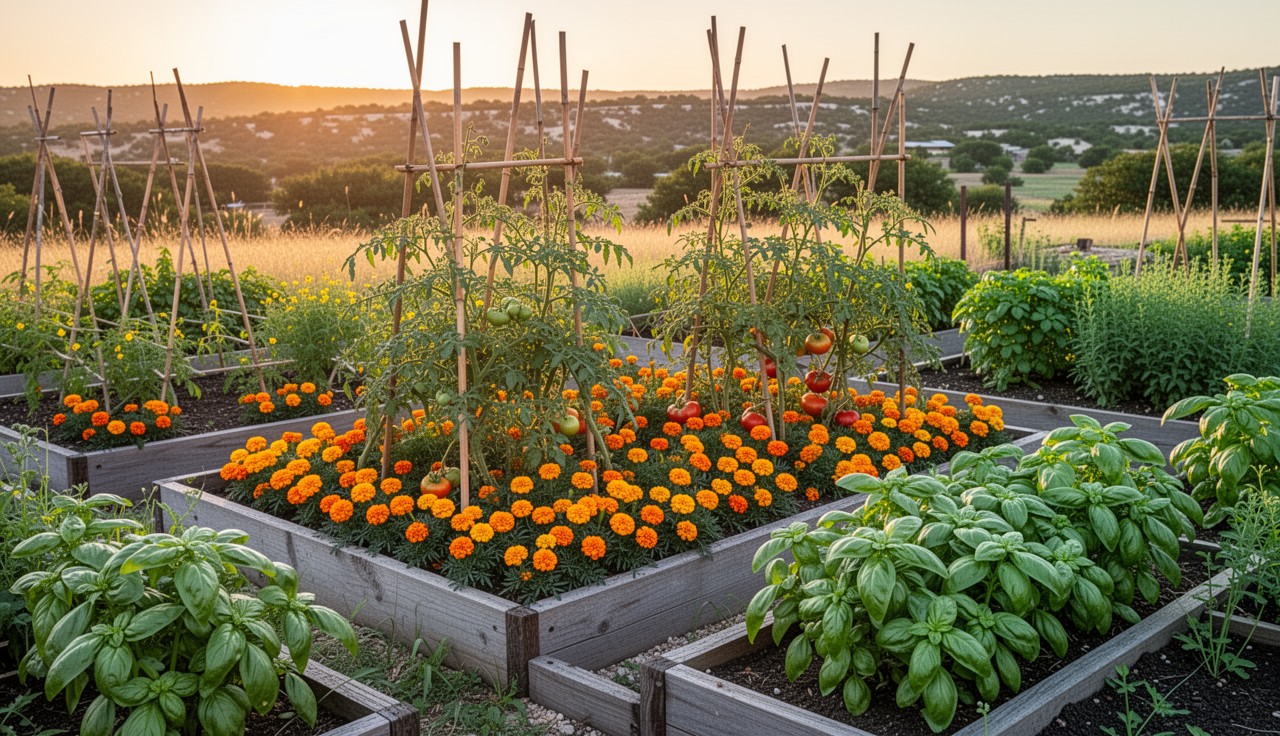
French marigold is the single best-supported companion plant in controlled research. The root exudates of Tagetes patula suppress root-knot nematode populations in the surrounding soil, a critical benefit for tomatoes and many root vegetables. The effect requires a dense planting and at least three to four weeks of establishment time before transplanting the main crop.
- Application: Plant T. patula at 6–8 inch spacing throughout the bed or as a dense border at least 4 weeks before transplanting tomatoes, peppers, or root crops
- Critical distinction: Tagetes patula (French marigold) has the nematode-suppressing root chemistry; Tagetes erecta (African marigold) does not have the same effect and should not be substituted
- Secondary benefit: Dense marigold plantings also attract beneficial hoverflies whose larvae consume aphids
Basil with Tomatoes
Controlled studies have shown that basil volatile compounds reduce the incidence of thrips and aphid colonization on nearby tomatoes. The effect is modest in outdoor conditions but consistent enough to make basil a useful companion. The physical benefits are equally real: basil planted densely at the base of tomatoes provides ground cover that reduces moisture evaporation, and the two crops have similar water, light, and temperature requirements. For more on growing basil varieties with medicinal applications, see our holy basil (tulsi) cultivation guide.
Legumes as Nitrogen Fixers Throughout the Garden
The nitrogen-fixing function of legumes is the most thoroughly supported of all companion planting mechanisms. White clover, crimson clover, bush beans, and other legumes in symbiosis with Rhizobium bacteria fix atmospheric nitrogen into plant-available ammonium in their root nodules.
- White clover as living mulch: Planted as ground cover between vegetable rows, white clover fixes 50–200 pounds of nitrogen per acre per year and suppresses weeds simultaneously
- Bush beans as interplants: Interplanted with corn at one bean plant per two corn plants delivers measurable nitrogen to the corn during the growing season
- Cover crop legumes: Crimson clover, hairy vetch, and field peas incorporated as cover crops deliver a nitrogen pulse to the following crop
Dill, Fennel, and Umbellifers with Pest-Susceptible Crops
Flowering umbelliferous herbs including dill, fennel, cilantro allowed to flower, and native wildflowers in the carrot family attract parasitic wasps and predatory hoverflies in documented and reproducible fashion. The flower structure of umbellifer plants is specifically accessible to small parasitic wasps with short mouthparts.
- Important distinction: Fennel is allelopathic to many vegetable crops and should be planted at the garden edge rather than interplanted within rows of tomatoes, peppers, or beans
- Dill and cilantro: Can be interplanted throughout the garden without the allelopathic concerns of fennel
Mostly Folklore: Claims Lacking Consistent Support
Garlic Repelling Most Insects
Garlic does produce sulfur compounds with insecticidal properties in high concentrations, the basis for garlic-based insecticidal sprays that do show effect at close range. However, the release of these compounds into the ambient air of a garden at the dilution produced by intact garlic plants has not been shown to provide meaningful pest deterrence at garden scale in outdoor conditions. Garlic sprays applied directly to foliage are a different matter and do have documented efficacy against soft-bodied insects.
Nasturtiums as Aphid Traps
Nasturtiums are widely recommended as aphid trap crops. In some settings nasturtiums do accumulate aphid populations; in others they serve as a source of aphids that then spread to adjacent crops. Whether nasturtiums function as a trap crop or a breeding ground depends on whether the heavily infested nasturtiums are removed and destroyed before aphid populations disperse, a management detail that is rarely part of the companion planting recommendation. Nasturtiums are excellent garden plants for pollinator attraction and their edible flowers and leaves are valuable, but relying on them for aphid suppression without active management is not a reliable strategy.
Petunias Repelling Asparagus Beetles and Tomato Hornworms
These claims have very limited supporting research and are largely based on anecdotal observation that is difficult to separate from other variables in a complex garden environment.
The Three Sisters in Detail
The Three Sisters system is one of the most well-documented traditional companion planting systems in the world, refined over centuries of practical use, and its mechanisms are well understood.
- Corn: Provides vertical structure for beans; takes up the nitrogen that beans make available in the soil; responds well to the moisture retained by squash ground cover
- Beans: Fix atmospheric nitrogen through Rhizobium symbiosis; nitrogen is released to adjacent corn and squash through root exudates and decomposing leaves and roots
- Squash: Sprawling large leaves create dense ground cover that retains soil moisture, moderates soil temperature, suppresses weeds, and physically impedes some pest insects
- Spacing: Corn hills spaced 3 feet apart; 4–6 bean seeds planted around the base of each corn plant when corn is 4–6 inches tall; squash planted between corn hills
- Modification for Texas: In Zone 8–9 heat, plant in the fall season starting in August for a fall harvest; summer Three Sisters plantings in central Texas face severe heat stress in July and August
Part III: Companion Planting Tables
Vegetable Companion Reference
| Crop | Good Companions | Poor Companions | Notes |
|---|---|---|---|
| Tomatoes | Basil, marigold (T. patula), carrots, parsley, borage | Fennel, brassicas, corn | Basil deters thrips; marigolds suppress nematodes; keep fennel at garden edge |
| Peppers | Basil, marigolds, carrots, parsley | Fennel | Same bed requirements as tomatoes; basil and marigolds beneficial |
| Cucumbers | Dill (before flowering), nasturtium, sunflowers, beans | Sage, potatoes | Sunflowers attract pollinators; beans add nitrogen |
| Beans | Corn, squash, carrots, cucumbers, most vegetables | Onions, garlic, fennel | Onion family inhibits bean nitrogen fixation; classic Three Sisters with corn and squash |
| Corn | Beans, squash, cucumber, melon | Tomatoes (shared pests) | Three Sisters combination; beans fix nitrogen for corn |
| Lettuce | Carrots, radishes, strawberries, chives | None significant | Radishes deter lettuce root aphids; carrots loosen soil |
| Carrots | Leeks, lettuce, onions, rosemary, sage | Dill (mature), parsnip | Leeks repel carrot fly; rosemary and sage volatile compounds deter carrot root fly |
| Brassicas | Dill, sage, rosemary, thyme, nasturtium, marigolds | Strawberries, fennel, beans | Aromatic herbs deter cabbage moths; nasturtiums as trap crop with active management |
| Onions and garlic | Carrots, beets, chamomile, roses | Beans, peas, asparagus | Onion family inhibits legume nodulation; beneficial for most other crops |
| Squash | Corn, beans, nasturtiums, borage | Potatoes | Borage deters squash vine borers with some evidence; Three Sisters partner |
Herb and Medicinal Companion Reference
| Herb or Medicinal | Good Companions | Avoid Near | Primary Function in Guild |
|---|---|---|---|
| Basil | Tomatoes, peppers, asparagus, oregano | Sage, thyme (allelopathic at high density) | Volatile compound pest deterrence; culinary harvest |
| Rosemary | Brassicas, carrots, beans, sage | Cucumbers | Deters cabbage moth and carrot fly through VOC emission |
| Lavender | Brassicas, roses, most vegetables | Shade-loving plants | Broad pollinator attraction; aphid-deterrent terpenes |
| Marigold (T. patula) | Tomatoes, peppers, root crops, beans | Nothing significant | Root nematode suppression; hoverfly attraction; best-supported companion plant |
| Comfrey | Fruit trees, dynamic accumulator throughout garden | Aggressive spreader; contain or manage spread | Deep root mineral mining; chop-and-drop fertility; no pest deterrent function |
| Chamomile | Brassicas, onions, most vegetables | None significant | Calcium and potassium accumulator; supports soil biology |
| Borage | Tomatoes, squash, strawberries, beans | None significant | Attracts pollinators and predatory insects; accumulates minerals; edible flowers |
| Dill | Brassicas, cucumbers, lettuce, onions | Tomatoes (some evidence of suppression); fennel | Parasitic wasp attraction when flowering; harvest before allowing to fully flower near tomatoes |
| Fennel | Garden edge only; self-contained | Tomatoes, peppers, beans, most vegetables | Parasitic wasp attraction; keep isolated from most vegetables due to allelopathic root exudates |
| Holy basil (Tulsi) | Tomatoes, peppers, medicinal beds | None significant | Strong volatile compound emission; pest deterrence; pollinator attraction; medicinal harvest |
| Echinacea | Most vegetables and herbs; beneficial throughout | None significant | Pollinator magnet; deep root moisture access; medicinal harvest; no negative interactions documented |
| Passionflower | Medicinal guilds; trellis companion | Aggressive spreader; manage spread | Attracts Fritillary butterflies and pollinators; no pest deterrent function |
Part IV: Companion Planting for Medicinal Production
Why Medicinal Compounds Respond to Companion Planting
The secondary metabolites that make medicinal plants valuable are not produced primarily for human benefit. They are the plant’s response to environmental pressures: UV radiation, insect feeding, microbial attack, drought stress, and competition. Plants with higher environmental challenge typically produce more concentrated secondary metabolites than pampered plants grown in ideal conditions.
The practical implication is counterintuitive. Growing ashwagandha in rich well-watered soil with no competition will produce a large plant with pale leaves and a relatively dilute root profile. Growing it in lean, well-drained soil with aromatic companions nearby, mild competition for water, and exposure to a diversity of insects including some that cause minor feeding damage will produce a smaller plant with a much more concentrated alkaloid profile. Mild biological stress drives medicinal compound production upward.
Stress and Secondary Metabolites
The same principle applies across many medicinal species. Rich, well-watered, competition-free conditions produce large plants with dilute medicinal compound profiles. Lean soil, aromatic companions, and mild environmental pressure produce smaller plants with higher concentrations of the compounds that make them medicinally valuable.
Medicinal Companion Guilds for Hill Country Production
The Nervine Guild
Skullcap, passionflower, valerian, and lemon balm all produce compounds in the nervine category, supporting nervous system regulation. They benefit from similar growing conditions (partial shade, consistent moisture, rich organic soil).
- Central medicinals: Skullcap, passionflower (trellis), lemon balm, valerian
- Aromatic companions: Lavender, rosemary, and holy basil planted at the guild edges provide volatile compound deterrence for most foliage-feeding insects
- Pollinator support: Borage and native wildflowers adjacent to the guild attract beneficials
- Ground cover: White clover as living mulch throughout the guild provides nitrogen and retains moisture
- Avoid: High-nitrogen fertilizers that push vegetative growth at the expense of medicinal compound concentration
The Adaptogen Guild
Adaptogenic plants including ashwagandha, holy basil, and eleuthero require lean to moderate soil, good drainage, and full sun to produce their highest-value alkaloid and phenolic compound profiles. Rich over-fertilized soil suppresses secondary metabolite production even while driving impressive vegetative growth.
- Central medicinals: Ashwagandha, holy basil, eleuthero, moringa
- Companions: Comfrey at the guild edge for dynamic accumulation without direct competition; white clover as ground cover
- Avoid: High-nitrogen inputs after plants are established; lean soil produces more concentrated medicine
- Zone 8–9 notes: All three species thrive in Hill Country summer heat; ashwagandha is drought-tolerant once established; holy basil and moringa benefit from consistent moisture
The Aromatic Aquatic Guild
requires an aquatic container or small pond. The surrounding land-based companion guild should be designed to attract and support the pollinators that assist with flowering while deterring aquatic pests.
- Pond edge guild: Watercress, mint, and native wetland plants at the water edge provide habitat complexity and edible harvest
- Adjacent land guild: Borage, holy basil, and native wildflowers within 10 feet of the pond attract pollinators to the lotus flowers
Part V: Implementing Companion Planting in Practice
Principles for Practical Application
Companion planting is most effective when treated as a system design principle rather than a list of individual plant pairings to memorize. The goal is to create a diverse, multi-species planting environment where:
- No single crop occupies more than 30–40 percent of the total growing area
- Flowering species are present throughout the season to maintain beneficial insect populations
- Aromatic herbs are distributed throughout to provide volatile compound effects at meaningful density
- Structural diversity provides habitat complexity
Four Key Principles
Diversity first: The single most effective companion planting intervention is simply increasing the number of species in a growing area; even randomly chosen diversity outperforms monoculture for pest suppression.Density matters: Isolated individual companion plants provide minimal benefit; a dense planting of marigolds provides nematode suppression; one marigold per 10 square feet does not.
Timing is critical: Some companion effects depend on the companion being established before or simultaneously with the main crop; retroactively adding companions to a pest-stressed crop is less effective than establishing the companion guild at planting.
Observe and adapt: Record which combinations work in your specific soil, climate, and pest environment; effects that are well-documented in research settings may be stronger or weaker in your specific conditions.
These principles apply whether you are working with raised beds, in-ground rows, or container gardening setups. On sloped terrain, terracing combined with companion planting guilds can maximize both growing space and the physical microclimate benefits that companion species provide.
Seasonal Succession of Companions
In a year-round growing climate like Zone 8–9 in Texas, the companion planting guild transitions across the two main growing seasons.
- Fall and spring companions: White clover, dill, cilantro in flower, borage, and cool-season umbellifers maintain beneficial insect populations through the primary production season
- Summer companions: Holy basil, marigolds, and native wildflowers maintain beneficials and volatile compound deterrence through the hot season when the main crops are heat-tolerant species
- Perennial infrastructure: Established perennial herbs including rosemary, lavender, and established comfrey plants form the permanent backbone of the companion guild that is present year-round regardless of annual rotation
Part VI: The Evidence Base and How to Use It
Reading Companion Planting Research
The academic literature on companion planting is large and uneven in quality. The most reliable research involves controlled field trials with replicated plots, measured outcomes including yield and pest populations, and statistical analysis. Research from Cornell, UC Davis, Wageningen University, and the Rodale Institute represents a rigorous evidence base. Popular books, gardening websites, and social media are unreliable sources for distinguishing evidence-based claims from folklore.
When evaluating any companion planting claim, ask: Was the effect observed in a controlled experiment or only in anecdotal reports? Did the study measure the actual outcome of interest such as pest damage or yield? Were the results reproduced across multiple locations and seasons? A single positive study in one specific location does not establish a general principle.
Building Your Own Evidence Base
The most valuable companion planting knowledge for any grower is site-specific. Effects that are consistent across many locations in research are still modulated by local soil biology, pest populations, climate, and microclimate.
- Minimum record: Date, planting combination, pest observations at two-week intervals, harvest date and quantity
- Comparison plots: Plant one bed with companions and one without, otherwise identical; even rough comparisons between adjacent beds are more informative than general observations across the whole garden
- Consistent variables: Change one thing at a time; adding multiple new companion species simultaneously makes it impossible to attribute observed effects to any specific companion
If you want to track companion planting effects alongside other growing variables, consider keeping records of plants that also appear in your dandelion and other wild-harvest beds, where volunteer companion species may already be delivering benefits you have not measured.
Frequently Asked Questions
What is the best companion plant for tomatoes?
French marigold (Tagetes patula) is the single best-supported companion plant for tomatoes based on controlled field trials. Its root exudates release thiophene compounds that suppress root-knot nematode populations in the surrounding soil. Plant at 6–8 inch spacing as a dense border at least 4 weeks before transplanting tomatoes. Basil is a strong secondary companion, controlled studies show its volatile compounds reduce thrips and aphid colonization on nearby tomatoes. The critical distinction: Tagetes erecta (African marigold) does not produce the same nematode-suppressing chemistry and cannot be substituted.
Does garlic really repel garden pests?
Garlic produces sulfur compounds with insecticidal properties, but the release from intact garlic plants into ambient garden air has not been shown to provide meaningful pest deterrence at garden scale in outdoor conditions. Garlic-based insecticidal sprays applied directly to foliage are a different matter, they do have documented efficacy against soft-bodied insects. The companion planting claim that simply growing garlic near other plants repels most insects is not supported by controlled research.
What is the Three Sisters planting method?
The Three Sisters is an Indigenous agricultural system practiced across the Americas for thousands of years, combining corn, beans, and squash. Corn provides vertical structure for beans to climb. Beans fix atmospheric nitrogen through Rhizobium symbiosis, feeding the corn and squash. Squash creates dense ground cover that retains soil moisture, moderates soil temperature, suppresses weeds, and physically impedes pest insects. Space corn hills 3 feet apart, plant 4–6 bean seeds around each corn stalk when corn is 4–6 inches tall, and plant squash between the corn hills. In Zone 8–9 Texas heat, plant in August for a fall harvest to avoid July, August heat stress.
How does companion planting improve medicinal herb quality?
Medicinal secondary metabolites are the plant’s response to environmental pressures, UV radiation, insect feeding, drought stress, and competition. Growing medicinal plants in lean soil with aromatic companions, mild water competition, and some insect exposure produces higher concentrations of the alkaloids and phenolic compounds that make them medicinally valuable. Rich, well-watered, competition-free conditions produce large plants with dilute medicinal profiles. This applies across species from ashwagandha to holy basil. To explore our botanical education tiers, visit the classes page.
Which companion planting combinations are actually supported by research?
The best-supported combinations include: French marigold (Tagetes patula) with tomatoes and root crops for nematode suppression; basil with tomatoes for thrips and aphid reduction; legumes (white clover, bush beans) as nitrogen fixers throughout the garden; and flowering umbellifers (dill, cilantro) for parasitic wasp attraction. The correlation between overall planting diversity and predatory insect abundance is also well-documented across multiple crop systems. Many popular claims, garlic repelling most insects, nasturtiums reliably trapping aphids, petunias repelling tomato hornworms, lack consistent support from controlled studies.
References
This article is informed by data and conclusions drawn from, but not limited to:
- Ploeg AT. 1999. Greenhouse studies on the effect of marigolds (Tagetes spp.) on four Meloidogyne species. Journal of Nematology. 31(1):62–69. PMID:19270869
- Oduor-Owino P. 1993. Nematicidal effects of Tagetes minuta on root-knot nematodes. Experimental Agriculture. 29(3):383–388. doi:10.1017/S0014479700021098
- Finch S, Collier RH. 2000. Host-plant selection by insects, a theory based on appropriate/inappropriate landings by pest insects of cruciferous plants. Entomologia Experimentalis et Applicata. 96(2):91–102. doi:10.1046/j.1570-7458.2000.00684.x
- Kaplan I. 2012. Attracting carnivorous arthropods with plant volatiles: the future of biocontrol or playing with fire? Biological Control. 60(2):77–89. doi:10.1016/j.biocontrol.2011.10.017
- Peoples MB, Herridge DF, Ladha JK. 1995. Biological nitrogen fixation: an efficient source of nitrogen for sustainable agricultural production? Plant and Soil. 174(1–2):3–28. doi:10.1007/BF00032239
- Weston LA. 1996. Utilization of allelopathy for weed management in agroecosystems. Agronomy Journal. 88(6):860–866. doi:10.2134/agronj1996.00021962008800060004x
- Altieri MA. 1999. The ecological role of biodiversity in agroecosystems. Agriculture, Ecosystems & Environment. 74(1–3):19–31. doi:10.1016/S0167-8809(99)00028-6
- Hooks CRR, Johnson MW. 2003. Impact of agricultural diversification on the insect community of cruciferous crops. Crop Protection. 22(2):223–238. doi:10.1016/S0261-2194(02)00132-2
- Mt. Pleasant J. 2006. The science behind the Three Sisters mound system: an agronomic assessment of an Indigenous agricultural system in the northeast. In: Staller J, Tykot R, Benz B, eds. Histories of Maize. Academic Press. pp. 529–537.
Research on companion planting
Peer reviewed studies about companion planting, listed so you can read the original rather than take our word for it. They are background on the subject, not a source for any one sentence above.
- Companion Planting and Insect Pest Control (2013). doi:10.5772/55044
- Companion planting effects of insecticidal marigolds and nitrogen fixing legumes on growth and protection. (2014). read the study
Common questions
What is part i: mechanisms of plant interaction?
How Plants Actually Affect Each Other. Plants interact with their neighbors through several distinct mechanisms. Understanding these mechanisms makes it possible to evaluate companion planting claims rationally. A claim that basil repels aphids from tomatoes through volatile compound emission is a testable hypothesis about a specific mechanism. A claim that planting garlic near roses brings good luck is not.
How do I grow companion planting?
Vegetable Companion Reference. Tomatoes (Basil, marigold (T. patula), carrots, parsley, borage, Fennel, brassicas, corn): Basil deters thrips; marigolds suppress nematodes; keep fennel at garden edge. Peppers (Basil, marigolds, carrots, parsley, Fennel): Same bed requirements as tomatoes; basil and marigolds beneficial. Cucumbers (Dill (before flowering), nasturtium, sunflowers, beans, Sage, potatoes): Sunflowers attract pollinators; beans add nitrogen.
What can I make from companion planting?
Why Medicinal Compounds Respond to Companion Planting. The secondary metabolites that make medicinal plants valuable are not produced primarily for human benefit. They are the plant’s response to environmental pressures: UV radiation, insect feeding, microbial attack, drought stress, and competition. Plants with higher environmental challenge typically produce more concentrated secondary metabolites than pampered plants grown in ideal conditions. The practical implication is counterintuitive.
What are frequently asked questions?
What is the best companion plant for tomatoes?. French marigold ( Tagetes patula ) is the single best-supported companion plant for tomatoes based on controlled field trials. Its root exudates release thiophene compounds that suppress root-knot nematode populations in the surrounding soil. Plant at 6–8 inch spacing as a dense border at least 4 weeks before transplanting tomatoes. Basil is a strong secondary companion, controlled studies show its volatile compounds reduce thrips and aphid colonization on nearby tomatoes.