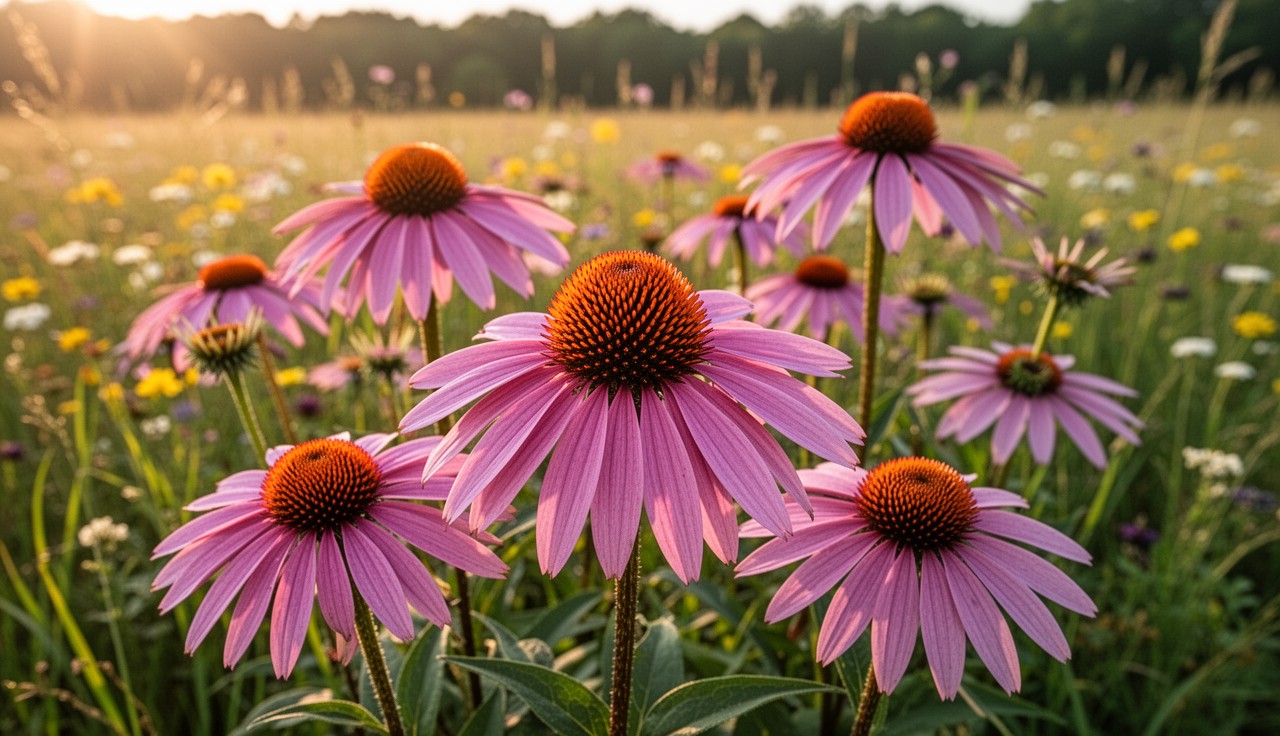
Echinacea (Echinacea purpurea) is a robust, long-lived perennial in the Asteraceae family, native to the tallgrass prairies and open woodlands of eastern and central North America. Plants grow 2–4 feet tall with coarse, dark green leaves and large, showy flower heads featuring drooping pink-to-purple ray petals surrounding a distinctive raised, spiny central cone that gives the genus its name (from the Greek echinos, meaning hedgehog).
Nine species of Echinacea are recognized, all native to North America. Three are used medicinally: E. purpurea (the most commonly cultivated and studied), E. angustifolia (narrow-leaf coneflower, preferred by many herbalists), and E. pallida (pale purple coneflower). Each species has a somewhat different phytochemical profile, which complicates research interpretation considerably.
Ecological and Garden Value
Pollinator Powerhouse Before discussing echinacea’s medicinal controversy, it’s worth emphasizing its exceptional ecological value. Echinacea is one of the top 10 pollinator-attracting native plants in North America. The flowers provide nectar for butterflies (especially monarchs and swallowtails), native bees, and hummingbirds. The spiny seed heads feed goldfinches through winter. A patch of echinacea in bloom is a living insectary that benefits the entire garden ecosystem.
Climate and Growing Requirements
Parameter
Range / Tolerance
USDA Hardiness Zones
3–9
Light
Full sun (6+ hours); tolerates light shade
Soil
Well-drained; tolerates poor, rocky, and clay soils; pH 6.0–8.0
Moisture
Low to moderate; drought-tolerant once established
Frost Tolerance
Excellent; deep taproot system ensures winter survival
Heat Tolerance
Excellent; native to hot prairie environments
Echinacea is superbly adapted to Texas growing conditions. It handles heat, drought, poor soil, and full sun with ease. In fact, it is native to the southern Great Plains and may already be growing wild in your area. The primary challenge is establishment in the first year, once the deep taproot develops, plants are essentially indestructible and will persist for 10+ years.
The numbers at a glance The same numbers the table beside this gives, drawn on their real scales so the band each one sits in is visible rather than read. Nothing here is added to the guide: it is what the guide already says.
Cultivation
Factor
Details
Propagation
Seed (cold stratify 4–6 weeks for best germination), division, or root cuttings
Germination
10–21 days at 65–70°F after stratification
Spacing
18–24 inches; plants form substantial clumps over time
Establishment
First-year plants focus on root development; expect minimal flowering
Harvest leaves, stems, and flowers during peak bloom in the second year or later. Cut stems back to 6–8 inches above ground. Multiple harvests per season are possible.
Roots
Root harvest is typically done in fall of the third or fourth year, when the taproot has developed substantial mass. The roots contain the highest concentration of alkamides and produce the characteristic tingling sensation on the tongue that herbalists use as a quality indicator.
Phytochemistry
Compound Class
Key Members
Alkamides (Alkylamides)
Isobutylamides (cause tongue tingling); primary in E. purpurea and E. angustifolia roots
Caffeic Acid Derivatives
Cichoric acid (E. purpurea), echinacoside (E. angustifolia, E. pallida)
Why Studies Disagree Echinacea research has produced famously inconsistent results, with some trials showing significant cold prevention and others showing no benefit. The primary explanation is that studies have used different species, different plant parts, different extraction methods, different doses, and different outcome measures. Comparing an aerial-part tea of E. purpurea with a root extract of E. angustifolia is essentially comparing two different herbal medicines. The best-designed trials using well-characterized extracts tend to show modest positive effects.
The chemistry, grouped The guide's own compound table, drawn as groups rather than listed, so the shape of what this plant carries is visible before any of the names are read. Nothing is added to what the table already says.
Cold prevention: A comprehensive 2014 Cochrane review concluded that some echinacea products may offer modest benefits for preventing colds, but no single product has been convincingly demonstrated to be effective. The heterogeneity of products tested was the primary limitation.
Cold duration and severity: Better evidence exists for reducing the duration and severity of colds when echinacea is started at the first sign of symptoms, with several trials showing 1–2 day reductions in cold duration.
Immune markers: Well-designed studies consistently show that echinacea preparations increase markers of innate immune activity (natural killer cell activity, phagocytosis), providing mechanistic plausibility for the traditional use.
Precautions
Autoimmune conditions: Due to immunostimulatory properties, echinacea is traditionally contraindicated in autoimmune disorders, though clinical evidence for this concern is limited.
Duration of use: Traditional Western herbalism recommends limiting continuous echinacea use to 8–10 weeks, followed by a rest period. German Commission E recommends no more than 8 weeks of continuous use.
Asteraceae allergy: Rare allergic reactions reported, primarily in individuals with ragweed or other daisy-family allergies.
References
Karsch-Völk et al., Cochrane Database of Systematic Reviews (2014), echinacea for preventing colds
Shah et al., The Lancet Infectious Diseases (2007), meta-analysis of echinacea for colds
German Commission E Monograph, Echinacea purpurea herb and root
Kindscher, Echinacea: Herbal Medicine with a Wild History (University Press of Kansas)
USDA PLANTS Database, native range and distribution data
Common questions
What is botanical description?
Echinacea ( Echinacea purpurea ) is a robust, long-lived perennial in the Asteraceae family, native to the tallgrass prairies and open woodlands of eastern and central North America. Plants grow 2–4 feet tall with coarse, dark green leaves and large, showy flower heads featuring drooping pink-to-purple ray petals surrounding a distinctive raised, spiny central cone that gives the genus its name (from the Greek echinos , meaning hedgehog). Nine species of Echinacea are recognized, all native to North America. Three are used medicinally: E. purpurea (the most commonly cultivated and studied), E.
What climate does echinacea tolerate?
USDA Hardiness Zones: 3–9. Light: Full sun (6+ hours); tolerates light shade. Soil: Well-drained; tolerates poor, rocky, and clay soils; pH 6.0–8.0. Moisture: Low to moderate; drought-tolerant once established. Frost Tolerance: Excellent; deep taproot system ensures winter survival.
How do I grow echinacea?
Propagation: Seed (cold stratify 4–6 weeks for best germination), division, or root cuttings. Germination: 10–21 days at 65–70°F after stratification. Spacing: 18–24 inches; plants form substantial clumps over time. Establishment: First-year plants focus on root development; expect minimal flowering. Fertilization: None needed; excess fertility produces weak, floppy growth.
When should I harvest echinacea?
Harvest leaves, stems, and flowers during peak bloom in the second year or later. Cut stems back to 6–8 inches above ground. Multiple harvests per season are possible. Root harvest is typically done in fall of the third or fourth year, when the taproot has developed substantial mass. The roots contain the highest concentration of alkamides and produce the characteristic tingling sensation on the tongue that herbalists use as a quality indicator.
What is the clinical controversy?
Echinacea research has produced famously inconsistent results, with some trials showing significant cold prevention and others showing no benefit. The primary explanation is that studies have used different species, different plant parts, different extraction methods, different doses, and different outcome measures. Comparing an aerial-part tea of E. purpurea with a root extract of E. angustifolia is essentially comparing two different herbal medicines.