extraction
Steam Distillation: The Ancient Art and Modern Science of Essential Oil Production
How steam distillation carries volatile compounds from plant material to produce essential oils and hydrosols.
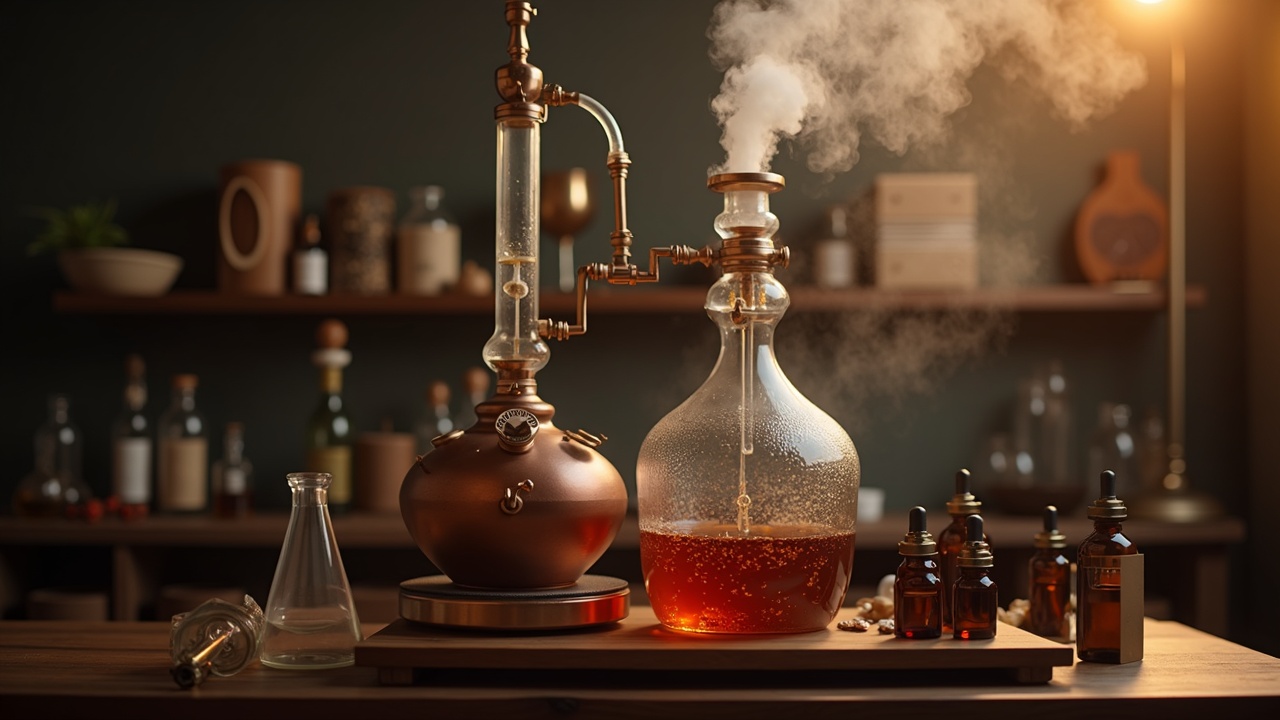
How Steam Carries Volatile Compounds
Steam distillation exploits a physical phenomenon called co-distillation: when steam passes through plant material containing essential oils, the volatile aromatic compounds vaporize at temperatures lower than their individual boiling points. This happens because the steam and essential oil vapors form an immiscible mixture whose combined vapor pressure reaches atmospheric pressure at a temperature below 100°C — lower than either component would boil on its own.
In practical terms, this means that even compounds with boiling points of 150–300°C can be carried out of plant material by steam at around 100°C. The steam acts as a gentle carrier gas, enveloping the volatile molecules and transporting them out of the distillation vessel without subjecting them to their full individual boiling temperatures. The mixed steam-and-oil vapor then passes through a condenser where it cools back to liquid form, and the essential oil — being immiscible with water — separates into a distinct layer that can be collected.
Why Only Volatile Compounds
Steam distillation is selective for volatile compounds: molecules small enough and volatile enough to become gaseous at or near 100°C. This includes most terpenes, terpenoids, phenylpropanoids, and other small aromatic molecules that define a plant's scent. Non-volatile compounds — alkaloids, flavonoids, sugars, proteins — remain in the plant material. This natural selectivity is both the strength and the limitation of the method.
The Distillation Process
Three Variations
Water Distillation (Hydrodistillation): Plant material is submerged directly in water, which is then boiled. The steam generated rises through the plant material, carrying volatile compounds. This is the simplest setup and is used for delicate flowers (rose, jasmine, neroli) that could be damaged by direct steam contact. The disadvantage is longer processing time and potential thermal degradation from the extended contact with boiling water.
Water-and-Steam Distillation: Plant material sits on a grate above the water level. Steam rises through the material from below. This prevents direct contact between the plant material and boiling water, reducing hydrolysis of sensitive compounds while maintaining efficient extraction. Most small to medium artisanal distillers use this configuration.
Direct Steam Distillation: Steam is generated in a separate boiler and injected through the plant material at controlled pressure and temperature. This is the standard for industrial essential oil production because it offers precise control over steam quality, flow rate, and temperature. Plant material never contacts liquid water, preserving the most delicate aromatic compounds.
Step-by-Step Process
- Loading: Fresh or partially dried plant material is packed into the distillation vessel (still or retort). Packing density matters — too tight restricts steam flow, too loose allows channeling where steam bypasses material.
- Steam generation: Water is heated to produce steam, either in the same vessel (hydrodistillation) or a separate boiler (direct steam).
- Extraction: Steam passes through the plant material, volatilizing essential oil compounds. Duration ranges from 30 minutes for herbs to several hours for woods and roots.
- Condensation: The steam-oil vapor mixture passes through a condenser (typically a coiled tube submerged in cold water) where it cools to liquid form.
- Separation: The condensed liquid flows into a separator (Florentine flask or separating funnel). Essential oils are less dense than water and float to the top (except for a few oils like clove that sink). The oil layer is drawn off.
- Hydrosol collection: The water layer, which contains dissolved water-soluble aromatic compounds, is the hydrosol — a valuable byproduct.
Essential Oil Production Plants
Steam distillation is the primary production method for the vast majority of the world's essential oils:
Lavender (Lavandula angustifolia)
The iconic essential oil crop. Lavender flowers are harvested at peak bloom and distilled within hours. Steam distillation at moderate temperatures preserves linalool and linalyl acetate, the compounds responsible for lavender's calming aroma and documented effects on anxiety and sleep quality. France's Provence region and Bulgaria are major production centers, though lavender is grown and distilled worldwide.
Eucalyptus (Eucalyptus globulus)
Eucalyptus leaves yield an essential oil dominated by 1,8-cineole (eucalyptol), a potent respiratory compound. Steam distillation efficiently captures this volatile terpenoid. Eucalyptus oil is used in aromatherapy for respiratory support, in topical preparations for muscle pain, and as a natural insect repellent. Australia, China, and India are major producers.
Peppermint (Mentha piperita)
Peppermint herb is distilled to produce an oil rich in menthol (30–55%) and menthone. The cooling, analgesic properties of menthol make peppermint oil one of the most commercially important essential oils, used in food, pharmaceutical, and personal care products. The Pacific Northwest region of the United States produces the majority of the world's peppermint oil.
Tea Tree (Melaleuca alternifolia)
Australian tea tree oil is produced by steam distillation of leaves and twigs. The oil's antimicrobial properties, attributed primarily to terpinen-4-ol, have made it one of the most widely used essential oils in natural skin care and first aid products.
Other Major Essential Oil Crops
- Rosemary: High in 1,8-cineole, camphor, and carnosic acid precursors. Used in aromatherapy for focus and cognitive support.
- Thyme: Contains thymol and carvacrol with strong antimicrobial properties.
- Ylang-ylang: Distilled from flowers in a unique fractional distillation process that separates the oil into several grades by collection time.
- Frankincense: Resin distilled to produce an oil valued in spiritual practices and skin care.
- Sandalwood: Heartwood distilled for its rich, warm oil containing alpha-santalol.
- Clary sage, geranium, vetiver, patchouli: Each produces distinctive essential oils through steam distillation.
Hydrosol: The Valuable Byproduct
Every steam distillation produces two products: essential oil and hydrosol (also called floral water, hydrolat, or distillate water). Hydrosols contain the water-soluble aromatic compounds and trace amounts of essential oil (typically 0.02–0.05%) that dissolved in the condensed steam during distillation.
Hydrosols are gentler than essential oils and can be applied directly to skin without dilution. Common hydrosols and their uses include:
- Rose hydrosol: Used as a facial toner, skin refresher, and in culinary applications (rose water in Middle Eastern and South Asian cuisines).
- Lavender hydrosol: A gentle skin spray for sunburn, minor irritation, and relaxation.
- Witch hazel hydrosol: A natural astringent widely used in skin care.
- Chamomile hydrosol: A gentle, soothing preparation used for sensitive skin and as a calming room spray.
- Peppermint hydrosol: A cooling, refreshing spray used for headaches, heat, and as a natural energizer.
The Economics of Hydrosol
Many small distillers find that hydrosol sales are as profitable as essential oil sales — or more so. A distillation run that produces 5 mL of expensive essential oil might simultaneously produce 5 liters of hydrosol that sells for $15–30 per liter in the natural products market. Capturing and bottling hydrosol turns a waste stream into a revenue stream.
Product Uses and Applications
Essential oils produced by steam distillation serve a wide range of industries and applications:
- Aromatherapy: Diffused, inhaled, or applied topically (diluted in carrier oil) for stress reduction, sleep support, respiratory health, and mood enhancement. Aromatherapy is one of the fastest-growing segments of the natural products industry.
- Topical therapeutics: Diluted in carrier oils for massage, pain relief, skin care, and wound care. Tea tree, lavender, and peppermint are among the most commonly used therapeutic oils.
- Natural cleaning products: Antimicrobial essential oils (thyme, tea tree, eucalyptus, lemon) are used in natural cleaning formulations as alternatives to synthetic disinfectants.
- Perfumery and fragrance: Essential oils are foundational materials in natural perfumery. Hundreds of distinct oils provide the aromatic palette that perfumers work with.
- Food and beverage: Peppermint, spearmint, and various citrus and spice essential oils are used as natural flavorings in food, candy, and beverages.
- Insect repellents: Citronella, eucalyptus, lemongrass, and other essential oils are used as natural insect deterrents.
Advantages and Limitations
Key Advantages
- Selectivity for volatiles: Produces pure aromatic compounds without extracting non-volatile material. The resulting essential oils are highly concentrated and aromatic.
- No organic solvents: Steam is the only extraction medium. No solvent residues in the final product.
- Dual products: Simultaneously produces both essential oil and hydrosol, maximizing value from each distillation run.
- Established technology: Over 1,000 years of refinement. Protocols exist for hundreds of plant species. Equipment is widely available and well-understood.
- Scalable: From small copper alembics processing a few kilograms to industrial stainless steel systems processing tons of material per day.
- Consumer recognition: "Steam distilled" is a trusted quality indicator in the essential oil market.
Key Limitations
- Only volatile compounds: Cannot extract non-volatile bioactives like alkaloids, flavonoids, polysaccharides, or heavy terpenes. These require solvent-based methods.
- Thermal modification: Despite the gentle co-distillation mechanism, the sustained 100°C steam exposure can cause some compounds to degrade, isomerize, or react. Chamazulene in chamomile, for example, is actually formed during distillation from a precursor — it does not exist in the living plant.
- Low yields: Most plants produce very small quantities of essential oil relative to biomass. Rose requires approximately 3,000–5,000 kg of petals to produce 1 kg of essential oil. Lavender yields about 1–3% by weight. This makes essential oils inherently expensive for low-yield species.
- Time-intensive: Distillation runs typically last 1–6 hours depending on the plant material. Thick, woody materials like sandalwood may require 24+ hours.
- Energy consumption: Continuous steam generation requires significant energy input. Solar and biomass-fired distillers are increasingly used in producing regions to reduce costs and environmental impact.
Steam Distillation at Nored Farms
While our primary extraction methods for concentrated botanical products are CO2 and ethanol, we recognize the essential role steam distillation plays in the broader plant medicine ecosystem. Many of the aromatic herbs we grow and source — lavender, rosemary, peppermint — are traditionally distilled plants. As our farm operations expand, small-batch artisanal distillation of Texas-grown aromatics is a natural extension of our mission to connect people with the full chemistry of plants.