Growing
Rhodiola (Rhodiola rosea): The Arctic Adaptogen That Vikings Used to Survive the North
Complete rhodiola cultivation guide covering arctic-alpine growing, roseroot propagation, salidroside and rosavin chemistry, Viking history.
On this page
Botanical Description
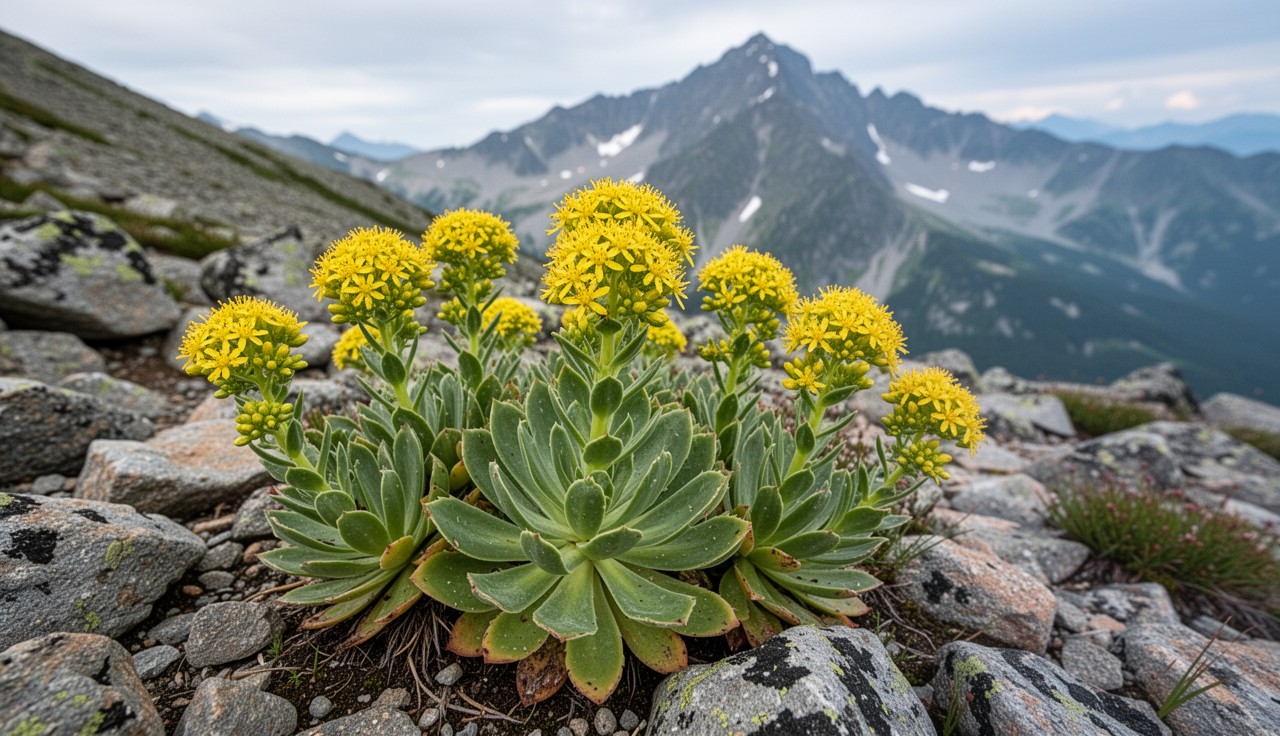
Rhodiola (Rhodiola rosea), also called roseroot, golden root, or arctic root, is a succulent perennial in the Crassulaceae family native to high-altitude and arctic regions of Europe, Asia, and North America. The plant forms compact rosettes of fleshy, blue-green leaves on short stems rising from a thick, knotted rhizome. When cut or scraped, the rhizome releases a distinctive rose-like fragrance, the source of both the species name rosea and the common name roseroot.
Plants are typically dioecious (separate male and female plants), with small yellow-to-greenish flowers clustered at stem tips. The entire plant rarely exceeds 12–16 inches in height, an adaptation to the extreme wind, cold, and UV exposure of its native high-altitude and arctic habitats. Rhodiola is found growing wild on sea cliffs in Scandinavia, alpine scree slopes in the Alps, and rocky tundra across Siberia and northern Canada.
A Genuinely Difficult Crop
Unlike most herbs in this guide, rhodiola presents real cultivation challenges for lowland growers. The plant evolved in environments with long winter dormancy, cool summers, intense UV, thin rocky soil, and excellent drainage. Replicating these conditions in Texas or the Southeast is possible but requires deliberate effort. Container culture in a gritty, mineral-rich substrate with winter cold exposure is the most reliable approach for warm-climate growers.
Origin and Traditional Use
Rhodiola has a documented history spanning at least 2,000 years across multiple cultures that independently discovered its energizing properties. Greek physician Dioscorides described rodia riza in 77 CE. Vikings consumed rhodiola to enhance physical endurance during long voyages and raids. Siberian shamans used it as a tonic and offered it as a wedding gift to promote fertility and resilience.
The modern scientific interest in rhodiola emerged from Soviet military and space program research during the Cold War. Soviet scientists classified it as an adaptogen, a substance that increases non-specific resistance to stress, and studied it extensively for improving performance of soldiers, athletes, and cosmonauts. Much of this research remained classified or published only in Russian until the 1990s.
Climate and Growing Requirements
| Parameter | Range / Tolerance |
|---|---|
| USDA Hardiness Zones | 1–7 (native); struggles in zones 8+ |
| Light | Full sun (required); tolerates extreme UV |
| Moisture | Low to moderate; excellent drainage essential |
| Temperature | Optimal growth at 50–65°F; heat above 80°F stresses plants |
| Frost Tolerance | Exceptional; survives -50°F and below |
| Winter Requirement | Mandatory cold dormancy period of 12–16 weeks below 40°F |
Soil and Cultivation
| Factor | Details |
|---|---|
| Soil Type | Rocky, mineral-rich, fast-draining; 70% mineral (gravel, perlite, pumice), 30% organic |
| pH | 5.5–7.0 |
| Propagation | Seed (cold stratify 4–6 weeks; slow germination), division of mature rhizomes |
| Spacing | 8–12 inches; slow-growing |
| Time to Harvest | 5–7 years from seed to harvestable rhizome |
| Fertilization | None to minimal; lean growing increases compound concentration |
The 5–7 year timeline from seed to harvest is the single largest barrier to rhodiola cultivation. The plant grows extremely slowly, particularly in its first 2–3 years. Commercial rhodiola farming in Scandinavia and Alberta, Canada uses field-scale operations with multi-year crop rotations. Home growers should view rhodiola as a long-term perennial investment rather than an annual crop.
Phytochemical Profile
| Compound Class | Key Members |
|---|---|
| Phenylpropanoids | Rosavin, rosin, rosarin (unique to R. rosea) |
| Phenylethanoids | Salidroside (tyrosol glycoside; shared with other Rhodiola species) |
| Flavonoids | Rhodiolin, rhodionin, rhodiosin, acetylrodalgin |
| Monoterpenes | Rosiridol, rosaridin |
| Organic Acids | Gallic acid, caffeic acid, chlorogenic acid |
Commercial rhodiola extracts are typically standardized to contain a minimum 3% rosavins and 1% salidroside, reflecting the naturally occurring ratio in high-quality root material. This standardization is important because different Rhodiola species (there are over 90) contain varying profiles, and only R. rosea contains the rosavin family of compounds.
Clinical Research
Research Quality Note
Rhodiola has a strong clinical evidence base by adaptogen standards, with multiple well-designed RCTs conducted in Scandinavia, Russia, and the UK. However, the Soviet-era research (which forms the historical foundation) was often published without the methodological transparency expected by modern standards. Post-2000 Western trials have generally confirmed earlier findings on fatigue and mental performance.
- Mental fatigue: Multiple RCTs demonstrate significant improvements in cognitive function, attention, and mental work capacity under stressful conditions including sleep deprivation, academic examinations, and military training.
- Physical endurance: Evidence for improved exercise capacity and reduced perceived exertion, though effect sizes are modest and some studies show null results.
- Stress-related fatigue: The strongest clinical domain, with several trials showing significant improvements in burnout symptoms, fatigue scores, and quality of life measures in chronically stressed adults.
- Mild-to-moderate depression: Preliminary clinical evidence suggests antidepressant effects, with one notable trial comparing rhodiola favorably to sertraline with fewer side effects.
Precautions
- Stimulating nature: Rhodiola is energizing rather than calming. Take in the morning; evening doses may interfere with sleep.
- Bipolar disorder: May trigger manic episodes in susceptible individuals due to stimulating properties.
- Autoimmune conditions: Immunomodulatory effects warrant caution in autoimmune disorders.
- Blood pressure: May lower blood pressure; caution with antihypertensive medications.
Extraction & Preparation
Rhodiola root contains two primary active compound classes: rosavins (rosavin, rosin, rosarin, phenylpropanoids unique to R. rosea) and salidroside (a phenethylglycoside). Standardized extracts specify both: 3% rosavins and 1% salidroside is the ratio found in the wild root and the standard used in most clinical research. Geography matters, Siberian and Tibetan material consistently shows higher rosavin and salidroside concentrations than Eastern European cultivated material.
Simple Home Methods
Rhodiola root contains rosavins (somewhat water-soluble) and salidroside (water-soluble). Both work in water and ethanol preparations. The characteristic rose scent of fresh root indicates rosavin content. All preparations should be taken in the morning; rhodiola is stimulating and will disrupt sleep if taken in the afternoon or evening.
Tea: Slice or coarsely chop 1–2 teaspoons of dried rhodiola root. Steep in a covered cup of near-boiled water for 15–20 minutes. Strain and drink in the morning on an empty stomach. The flavor is mildly astringent with a faint floral note. Effective for the salidroside fraction. Add 3–4 minutes of simmering if the root pieces are thick to improve rosavin extraction.
Mason jar tincture: Fill a jar with dried sliced root, top with 80-proof vodka or Everclear diluted to 60%, seal, and macerate 4–6 weeks in a dark cabinet. Shake every few days. The finished tincture should have a distinct rose aroma, absence of this scent indicates poor-quality root. Strain and press. Dose: 2–3 mL in water each morning. Cycle 3 months on, 2 weeks off.
Vinegar tincture (alcohol-free): Both rosavins and salidroside have reasonable solubility in mildly acidic aqueous solvents. Pack a jar with dried root, cover with raw apple cider vinegar, seal, and macerate 4–6 weeks. Strain and press through cheesecloth. Take 1–2 tablespoons in water each morning. Stores 1–2 years in a cool dark location. A practical option for those avoiding alcohol who still want a liquid preparation.
Cold water extraction: Salidroside is highly water-soluble and extracts efficiently even in cold water. Soak 1 tablespoon of dried sliced root in 2 cups of cold water overnight in the refrigerator. Strain in the morning and drink. Less complete than a hot extraction for the rosavin fraction, but fast and practical for daily use. Replace the water and let it soak again the same afternoon. One batch of root can yield two extractions before it’s spent.
Root Tincture
Macerate dried rhodiola root (sliced or coarsely powdered) in 60–70% ethanol at a 1:5 ratio for 4–6 weeks. Both rosavins and salidroside are ethanol-soluble. This preparation produces a characteristic rose-scented tincture, the rose odor indicates rosavin presence and is a rough quality marker. Dose: 2–3 mL daily in the morning (rhodiola is stimulating; evening dosing disrupts sleep). Do not exceed 600 mg equivalent dry root per day.
Hot Water Extraction
Salidroside is water-soluble; rosavins are partially water-soluble. A decoction (simmer sliced dried root 20 minutes, steep 30 minutes more covered) extracts a meaningful portion of both compound classes. Traditional Siberian use was as a tea. The rosavin-to-salidroside ratio shifts in water extraction, more salidroside, less rosavin relative to the ethanol fraction. Neither preparation is complete; the tincture is more consistent for full-spectrum effects.
Standardized Extract
Commercial extracts standardized to 3% rosavins and 1% salidroside are the most clinically validated preparations. The clinical research on rhodiola for stress, fatigue, and cognitive performance used extracts in this standardization range at 200–600 mg daily. When sourcing, verify the product specifies R. rosea (not R. crenulata or generic “rhodiola”) and states rosavins. Salidroside alone does not distinguish R. rosea from inferior species.
Product Use
Rhodiola is among the best-characterized adaptogens in clinical research. Effects: reduced perceived exertion and fatigue in physical stress, improved cognitive performance under mental workload, reduced cortisol response to acute stress. The mechanism involves modulation of the HPA axis (hypothalamic-pituitary-adrenal), increasing stress hormone resilience rather than suppressing cortisol entirely. Take in the morning on an empty stomach for cognitive use, or 30–60 minutes before demanding physical or mental tasks. Cycle: 3 months on, 2–4 weeks off.
References
- Panossian et al., Phytomedicine (2010), systematic review of rhodiola clinical trials
- Mao et al., Journal of Clinical Psychiatry (2015), rhodiola vs. sertraline for depression
- Darbinyan et al., Phytomedicine (2000), mental fatigue RCT
- Olsson et al., Planta Medica (2009), stress-related fatigue
- European Medicines Agency, Herbal Monograph on Rhodiola rosea
- Galambosi, Medicinal and Aromatic Plants, rhodiola cultivation in Finland
Common questions
What is botanical description?
Rhodiola ( Rhodiola rosea ), also called roseroot, golden root, or arctic root, is a succulent perennial in the Crassulaceae family native to high-altitude and arctic regions of Europe, Asia, and North America. The plant forms compact rosettes of fleshy, blue-green leaves on short stems rising from a thick, knotted rhizome. When cut or scraped, the rhizome releases a distinctive rose-like fragrance, the source of both the species name rosea and the common name roseroot. Plants are typically dioecious (separate male and female plants), with small yellow-to-greenish flowers clustered at stem tips.
What has rhodiola traditionally been used for?
Rhodiola has a documented history spanning at least 2,000 years across multiple cultures that independently discovered its energizing properties. Greek physician Dioscorides described rodia riza in 77 CE. Vikings consumed rhodiola to enhance physical endurance during long voyages and raids. Siberian shamans used it as a tonic and offered it as a wedding gift to promote fertility and resilience. The modern scientific interest in rhodiola emerged from Soviet military and space program research during the Cold War.
What climate does rhodiola tolerate?
USDA Hardiness Zones: 1–7 (native); struggles in zones 8+. Light: Full sun (required); tolerates extreme UV. Moisture: Low to moderate; excellent drainage essential. Temperature: Optimal growth at 50–65°F; heat above 80°F stresses plants. Frost Tolerance: Exceptional; survives -50°F and below.
What soil does rhodiola need?
Soil Type: Rocky, mineral-rich, fast-draining; 70% mineral (gravel, perlite, pumice), 30% organic. Propagation: Seed (cold stratify 4–6 weeks; slow germination), division of mature rhizomes. Spacing: 8–12 inches; slow-growing. Time to Harvest: 5–7 years from seed to harvestable rhizome. Fertilization: None to minimal; lean growing increases compound concentration.
What is phytochemical profile?
Phenylpropanoids: Rosavin, rosin, rosarin (unique to R. Phenylethanoids: Salidroside (tyrosol glycoside; shared with other Rhodiola species). Flavonoids: Rhodiolin, rhodionin, rhodiosin, acetylrodalgin. Monoterpenes: Rosiridol, rosaridin. Organic Acids: Gallic acid, caffeic acid, chlorogenic acid.
What is clinical research?
Rhodiola has a strong clinical evidence base by adaptogen standards, with multiple well-designed RCTs conducted in Scandinavia, Russia, and the UK. However, the Soviet-era research (which forms the historical foundation) was often published without the methodological transparency expected by modern standards. Post-2000 Western trials have generally confirmed earlier findings on fatigue and mental performance.
What can I make from rhodiola?
Rhodiola root contains two primary active compound classes: rosavins (rosavin, rosin, rosarin, phenylpropanoids unique to R. rosea ) and salidroside (a phenethylglycoside). Standardized extracts specify both: 3% rosavins and 1% salidroside is the ratio found in the wild root and the standard used in most clinical research. Geography matters, Siberian and Tibetan material consistently shows higher rosavin and salidroside concentrations than Eastern European cultivated material. Rhodiola root contains rosavins (somewhat water-soluble) and salidroside (water-soluble).