Growing
St. John’s Wort (Hypericum perforatum): The Herbal Antidepressant With More Clinical Trials Than Most Pharmaceuticals
Complete St. John's Wort cultivation guide covering Hypericum perforatum botany, sun-loving growing, hypericin and hyperforin chemistry, the landmark depression clinical trials, and critical drug interaction warnings.
On this page
Botanical Description
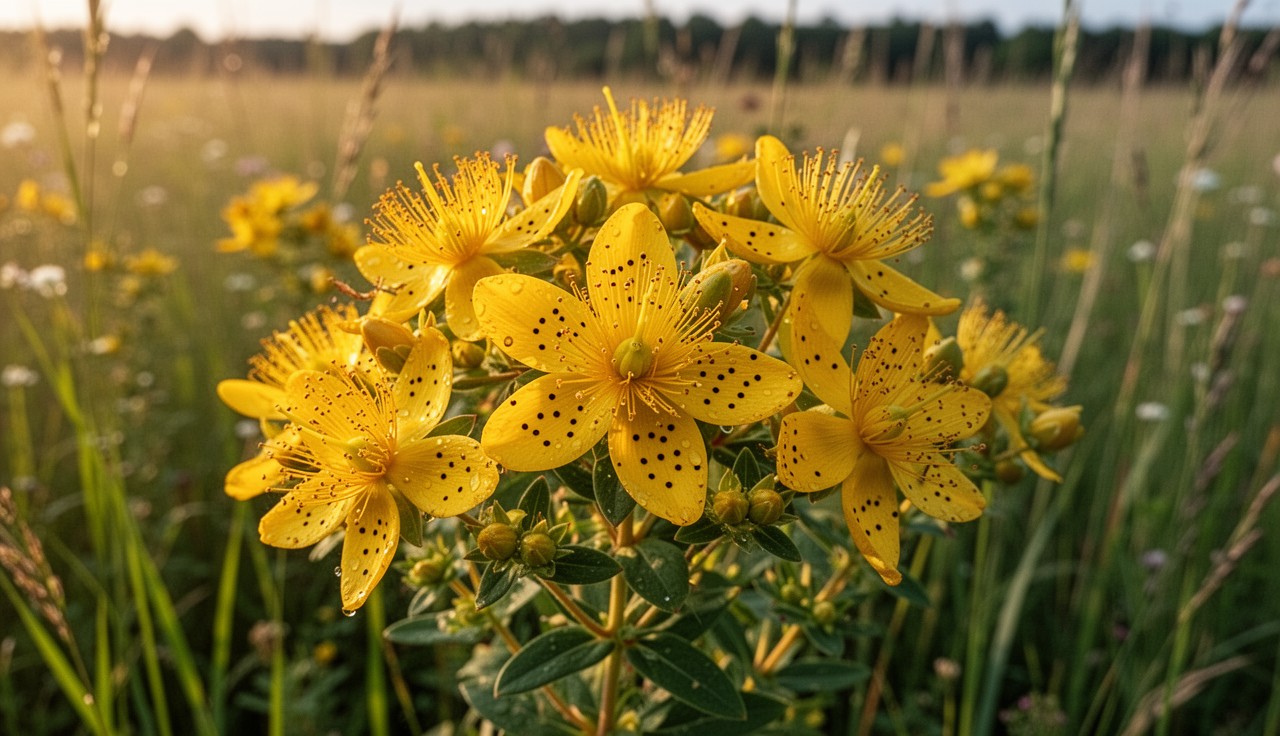
St. John’s Wort (Hypericum perforatum) is an upright, branching perennial growing 1–3 feet tall with distinctive botanical features that make identification straightforward. The leaves appear perforated when held up to light, tiny translucent glands containing essential oils create the illusion of holes (hence perforatum). The bright yellow, five-petaled flowers contain dark glands along their margins that release a deep red pigment when crushed, hypericin, the compound that gives the plant its signature blood-red tincture.
Native to Europe, the plant has naturalized aggressively across North America, Australia, and New Zealand, where it is considered an invasive weed in many regions. Its common name refers to the traditional harvest date: the feast of St. John the Baptist (June 24), when the plant is typically in peak bloom.
The Red Pigment Test
To identify genuine St. John’s Wort, crush a flower bud between your fingers. It should stain your skin bright red to purple. This is hypericin being released from the dark marginal glands. If there is no red staining, you may have a different Hypericum species or a misidentified plant. The intensity of the red color is also used as a rough quality indicator by herbalists, more intense staining generally indicates higher hypericin content.
Growing Requirements
| Parameter | Range / Tolerance |
|---|---|
| USDA Hardiness Zones | 3–9 |
| Light | Full sun required for maximum hypericin production |
| Soil | Well-drained, slightly acidic to neutral; pH 5.5–7.0; tolerates poor soils |
| Moisture | Low to moderate; drought-tolerant once established |
| Propagation | Seed (surface sow; needs light), stem cuttings, or division |
| Invasiveness | High; self-seeds prolifically and spreads by runners. Contain or manage actively. |
Harvesting
Harvest flowering tops (top 4–6 inches including buds, open flowers, and immature seed capsules) when approximately two-thirds of flowers are open. This stage captures peak concentrations of both hypericin and hyperforin. Dry quickly at low temperatures or macerate immediately into alcohol or oil for maximum compound preservation.
A fresh plant tincture in high-proof alcohol produces the characteristic deep red color that indicates successful extraction. Oil infusions made with fresh flowering tops in olive oil over 4–6 weeks produce the famous “red oil” of St. John’s Wort, used topically for nerve pain, burns, and wound healing.
Phytochemistry
| Compound | Notes |
|---|---|
| Hypericin | Naphthodianthrone; photosensitizer; 0.1–0.3% of dry weight; standardization marker |
| Hyperforin | Phloroglucinol derivative; now considered the primary antidepressant compound; 2–5% of dry weight; unstable in light and heat |
| Flavonoids | Quercetin, quercitrin, isoquercitrin, rutin, hyperoside, amentoflavone |
| Biflavonoids | Amentoflavone, I3,II8-biapigenin |
| Xanthones | Minor components with MAO-inhibitory activity |
The mechanism of antidepressant action is now understood to involve hyperforin’s inhibition of serotonin, norepinephrine, dopamine, GABA, and glutamate reuptake, making it a broad-spectrum reuptake inhibitor affecting multiple neurotransmitter systems simultaneously, a mechanism distinct from any single pharmaceutical antidepressant.
Clinical Research on Depression
Extraordinary Clinical Evidence
St. John’s Wort has been evaluated in over 30 randomized controlled trials involving more than 5,000 patients for major depressive disorder. This evidence base exceeds that of many approved pharmaceutical antidepressants at the time of their initial approval. The data consistently supports efficacy for mild-to-moderate depression, with the debate centering on whether it works for severe depression.
- Mild-to-moderate depression: Multiple meta-analyses, including a definitive Cochrane review (2008, updated), conclude that St. John’s Wort is significantly more effective than placebo and similarly effective to standard antidepressants (SSRIs) for mild-to-moderate depression, with fewer side effects.
- Comparison with SSRIs: Head-to-head trials against fluoxetine (Prozac), sertraline (Zoloft), and paroxetine (Paxil) have generally shown comparable efficacy with significantly better tolerability. Drop-out rates due to side effects are consistently lower with St. John’s Wort.
- Severe depression: Two large U.S. NIH-funded trials found St. John’s Wort no more effective than placebo for severe major depression. However, the SSRI comparators in these same trials also failed to separate from placebo, making interpretation complex.
Critical Drug Interactions
This Section Is Non-Negotiable Reading
St. John’s Wort is one of the most pharmacologically active herbs known. Hyperforin is a potent inducer of cytochrome P450 enzymes (CYP3A4, CYP2C9) and the P-glycoprotein drug transporter. This means it accelerates the metabolism of many pharmaceutical drugs, potentially reducing their blood levels to sub-therapeutic concentrations. The interaction list is extensive and clinically significant.
Drugs with documented clinically significant interactions include:
- Oral contraceptives: Reduced efficacy; breakthrough bleeding and unplanned pregnancies reported.
- Immunosuppressants: Cyclosporine, tacrolimus, transplant rejection risk.
- Anticoagulants: Warfarin levels reduced; increased clotting risk.
- HIV antiretrovirals: Indinavir, nevirapine, reduced drug levels, viral resistance risk.
- SSRIs/SNRIs: Risk of serotonin syndrome when combined.
- Cancer chemotherapy: Imatinib, irinotecan, reduced efficacy.
- Cardiac drugs: Digoxin, verapamil, amiodarone, reduced levels.
- Sedatives: Midazolam, alprazolam, reduced efficacy.
References
- Linde et al., Cochrane Database of Systematic Reviews (2008), definitive meta-analysis
- Hypericum Depression Trial Study Group, JAMA (2002), NIH-funded severe depression trial
- Gastpar, Journal of Affective Disorders (2006), hypericum vs. citalopram
- Henderson et al., British Journal of Clinical Pharmacology, CYP3A4 induction review
- European Medicines Agency, Herbal Monograph on Hypericum perforatum
- FDA MedWatch Alerts, St. John’s Wort drug interactions
Common questions
What is botanical description?
John’s Wort ( Hypericum perforatum ) is an upright, branching perennial growing 1–3 feet tall with distinctive botanical features that make identification straightforward. The leaves appear perforated when held up to light, tiny translucent glands containing essential oils create the illusion of holes (hence perforatum ). The bright yellow, five-petaled flowers contain dark glands along their margins that release a deep red pigment when crushed, hypericin, the compound that gives the plant its signature blood-red tincture.
How do I grow st johns wort?
USDA Hardiness Zones: 3–9. Light: Full sun required for maximum hypericin production. Soil: Well-drained, slightly acidic to neutral; pH 5.5–7.0; tolerates poor soils. Moisture: Low to moderate; drought-tolerant once established. Propagation: Seed (surface sow; needs light), stem cuttings, or division.
When should I harvest st johns wort?
Harvest flowering tops (top 4–6 inches including buds, open flowers, and immature seed capsules) when approximately two-thirds of flowers are open. This stage captures peak concentrations of both hypericin and hyperforin. Dry quickly at low temperatures or macerate immediately into alcohol or oil for maximum compound preservation. A fresh plant tincture in high-proof alcohol produces the characteristic deep red color that indicates successful extraction. Oil infusions made with fresh flowering tops in olive oil over 4–6 weeks produce the famous “red oil” of St.
What is clinical research on depression?
Extraordinary Clinical Evidence. John’s Wort has been evaluated in over 30 randomized controlled trials involving more than 5,000 patients for major depressive disorder. This evidence base exceeds that of many approved pharmaceutical antidepressants at the time of their initial approval. The data consistently supports efficacy for mild-to-moderate depression, with the debate centering on whether it works for severe depression. Mild-to-moderate depression: Multiple meta-analyses, including a definitive Cochrane review (2008, updated), conclude that St.
What are critical drug interactions?
This Section Is Non-Negotiable Reading. John’s Wort is one of the most pharmacologically active herbs known. Hyperforin is a potent inducer of cytochrome P450 enzymes (CYP3A4, CYP2C9) and the P-glycoprotein drug transporter. This means it accelerates the metabolism of many pharmaceutical drugs, potentially reducing their blood levels to sub-therapeutic concentrations. The interaction list is extensive and clinically significant.