Growing
Turkey Tail (Trametes versicolor): The Most Scientifically Validated Medicinal Mushroom You Can Find in Your Backyard
Complete turkey tail mushroom guide covering Trametes versicolor identification, wild foraging and log cultivation, PSK and PSP polysaccharide chemistry.
On this page
Identification and Biology
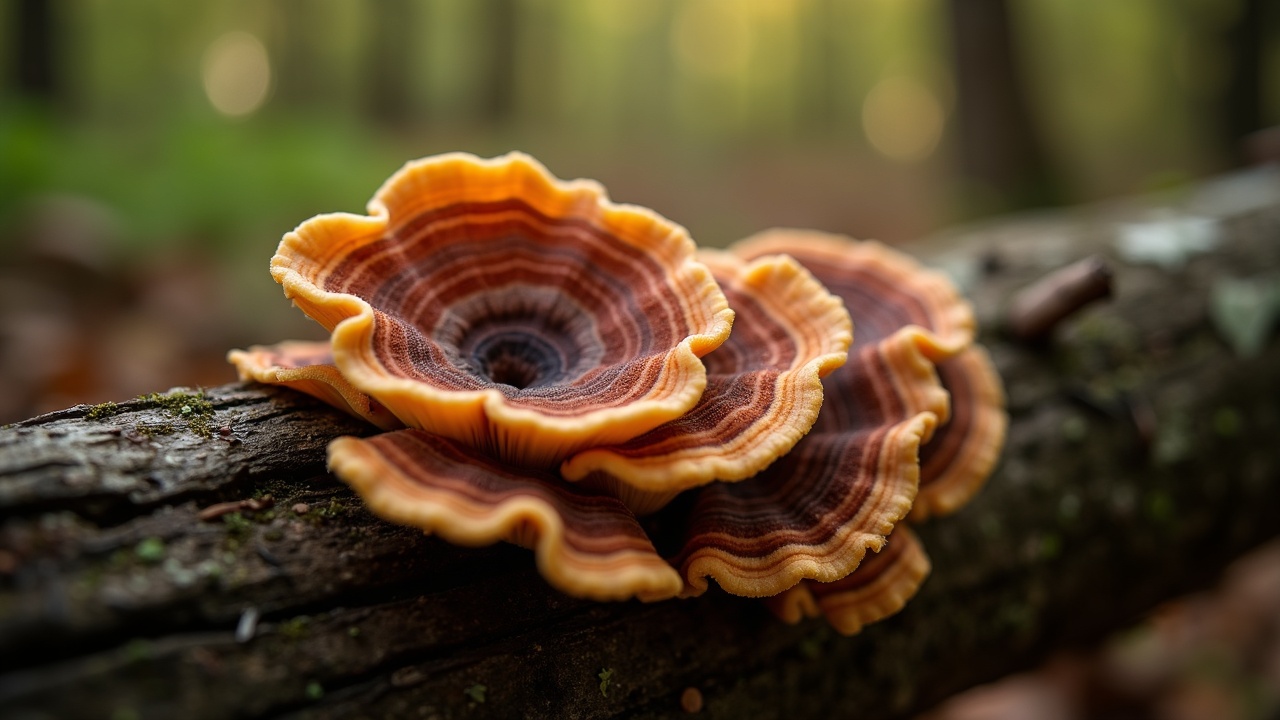
Turkey tail (Trametes versicolor) is one of the most common and recognizable bracket fungi in the world, found on dead and dying hardwood trees, stumps, and fallen logs across all temperate and many tropical regions. The fan-shaped fruiting bodies grow in overlapping clusters and display concentric zones of color in stunning patterns of brown, tan, cream, blue, green, and gray, resembling the fanned tail of a wild turkey. The pore surface underneath is white to cream with very fine pores (3–5 per millimeter).
Correct identification is important because several look-alike species exist. True turkey tail has: (1) concentric color zones, (2) a velvety to slightly fuzzy upper surface, (3) white pore surface (not smooth or gilled), and (4) thin, flexible fruiting bodies. The most common look-alike, Stereum ostrea (false turkey tail), has a smooth underside rather than pores.
Prescription Drug Status
Turkey tail holds a unique distinction among medicinal mushrooms: its polysaccharide extracts have been developed into prescription drugs. PSK (Krestin/polysaccharide-K) has been an approved cancer adjunct therapy in Japan since 1977, covered by Japanese national health insurance. PSP (polysaccharopeptide) holds similar status in China. Annual sales of PSK in Japan have exceeded $600 million. No other mushroom compound has achieved this level of pharmaceutical validation.
Cultivation
Turkey tail is among the easiest medicinal mushrooms to cultivate. Its natural substrate is dead hardwood, and it colonizes vigorously with minimal intervention.
| Method | Details |
|---|---|
| Log inoculation | Drill and plug fresh-cut hardwood logs; place in shaded, humid area; fruits in 6–12 months |
| Stump inoculation | Inoculate fresh stumps with sawdust spawn; lowest effort, longest timeline |
| Substrate bags | Supplemented hardwood sawdust; fastest method (60–90 days) |
| Wild harvest | Common on fallen hardwood; harvest fresh, colorful specimens; avoid old, dark, or waterlogged ones |
| Temperature | 65–75°F optimal for fruiting; very cold-tolerant |
Active Compounds
| Compound | Notes |
|---|---|
| PSK (Krestin) | Protein-bound polysaccharide; beta-1,4-glucan backbone with peptide portion; prescription drug in Japan |
| PSP | Polysaccharopeptide; similar to PSK but with different peptide composition; prescription drug in China |
| Beta-glucans | Multiple beta-1,3 and beta-1,6-glucan structures with immunomodulatory activity |
| Ergosterol | Vitamin D2 precursor; converts to vitamin D when exposed to UV light |
Clinical Research
- Colorectal cancer: Multiple large Japanese clinical trials demonstrate that PSK added to standard chemotherapy improves disease-free survival and overall survival in stage II and III colorectal cancer patients.
- Gastric cancer: Similar survival improvements demonstrated with PSK as adjuvant to chemotherapy in gastric cancer.
- Breast cancer: An NIH-funded Phase I trial at the University of Washington (2012) demonstrated dose-dependent increases in natural killer cell activity and CD8+ T-cells in breast cancer patients taking turkey tail extract after radiation therapy.
- HPV: A small clinical trial found that turkey tail supplementation improved HPV clearance rates compared to control, suggesting immunomodulatory effects relevant to viral infections.
Processing for Home Use
Turkey tail is too tough to eat directly. The bioactive polysaccharides must be extracted through prolonged hot water decoction. Simmer dried, chopped turkey tail in water for 2–4 hours at a gentle boil, then strain. The resulting dark tea can be consumed directly or concentrated. For a more complete extract, follow the hot water decoction with an alcohol tincture of the marc (leftover material) to capture any remaining non-water-soluble compounds.
Precautions
- Generally well-tolerated: Clinical trials report minimal side effects, primarily mild GI disturbance.
- Identification accuracy: Ensure correct identification before consuming wild-harvested specimens.
- Immunosuppressant interactions: As with all immunomodulatory mushrooms, caution with immunosuppressive medications.
- Contaminants: Wild-harvested mushrooms accumulate heavy metals and environmental toxins. Harvest from clean environments away from roadsides and industrial areas.
References
- Torisu et al., Cancer Immunology and Immunotherapy, PSK adjuvant therapy in colorectal cancer
- Standish et al., ISRN Oncology (2012), Phase I trial in breast cancer
- Tsukagoshi et al., Cancer Treatment Reviews, PSK comprehensive review
- Fritz et al., Integrative Cancer Therapies, Trametes versicolor safety and dosing
- Stamets, Mycelium Running (Ten Speed Press), cultivation methods
Common questions
How do I grow turkey tail mushroom?
Turkey tail is among the easiest medicinal mushrooms to cultivate. Its natural substrate is dead hardwood, and it colonizes vigorously with minimal intervention. Log inoculation: Drill and plug fresh-cut hardwood logs; place in shaded, humid area; fruits in 6–12 months. Stump inoculation: Inoculate fresh stumps with sawdust spawn; lowest effort, longest timeline. Substrate bags: Supplemented hardwood sawdust; fastest method (60–90 days).
What is the active compound in turkey tail mushroom?
PSK (Krestin): Protein-bound polysaccharide; beta-1,4-glucan backbone with peptide portion; prescription drug in Japan. PSP: Polysaccharopeptide; similar to PSK but with different peptide composition; prescription drug in China. Beta-glucans: Multiple beta-1,3 and beta-1,6-glucan structures with immunomodulatory activity. Ergosterol: Vitamin D2 precursor; converts to vitamin D when exposed to UV light.
What is clinical research?
Colorectal cancer: Multiple large Japanese clinical trials demonstrate that PSK added to standard chemotherapy improves disease-free survival and overall survival in stage II and III colorectal cancer patients. Gastric cancer: Similar survival improvements demonstrated with PSK as adjuvant to chemotherapy in gastric cancer. Breast cancer: An NIH-funded Phase I trial at the University of Washington (2012) demonstrated dose-dependent increases in natural killer cell activity and CD8+ T-cells in breast cancer patients taking turkey tail extract after radiation therapy.
What can I make from turkey tail mushroom?
Turkey tail is too tough to eat directly. The bioactive polysaccharides must be extracted through prolonged hot water decoction. Simmer dried, chopped turkey tail in water for 2–4 hours at a gentle boil, then strain. The resulting dark tea can be consumed directly or concentrated. For a more complete extract, follow the hot water decoction with an alcohol tincture of the marc (leftover material) to capture any remaining non-water-soluble compounds.