Growing
Turmeric (Curcuma longa): Rhizome Cultivation, the Bioavailability Problem, and Why Your Kitchen Spice Is a Biochemical Marvel
Complete guide to turmeric cultivation covering Curcuma longa rhizome propagation, tropical growing requirements, curcumin extraction.
On this page
Botanical Description
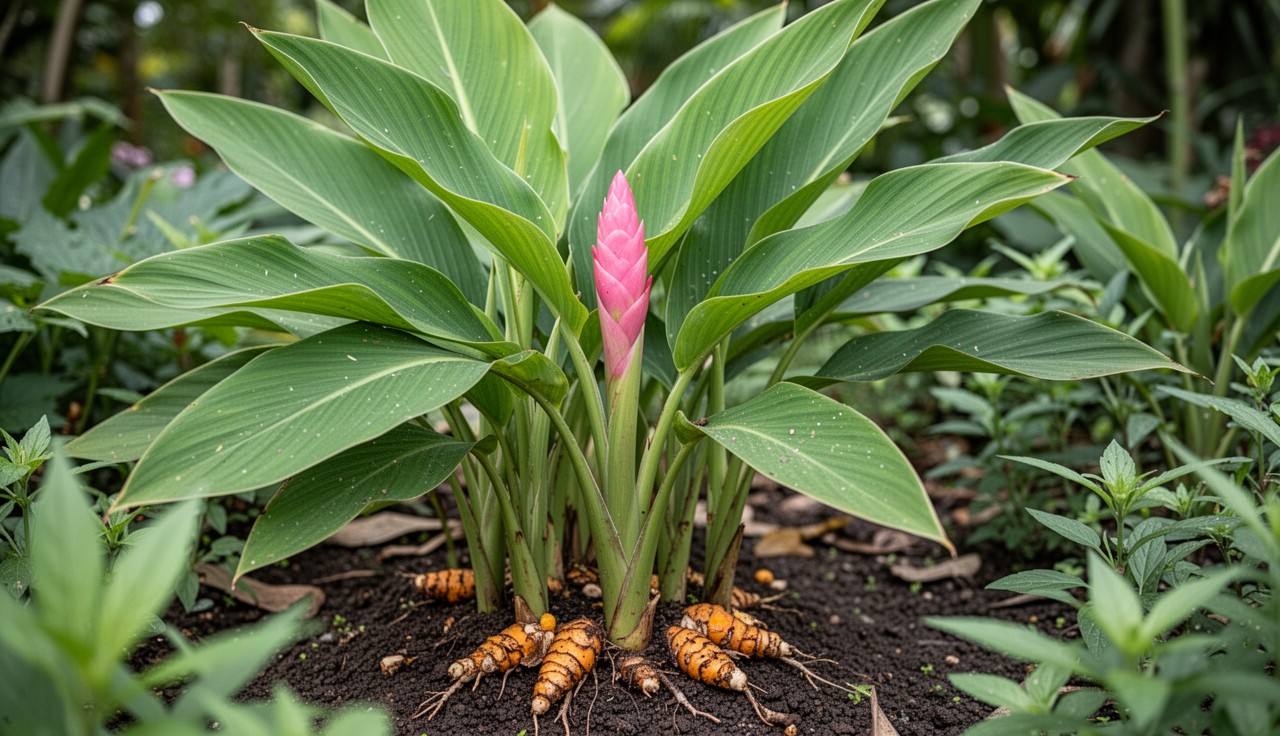
Turmeric (Curcuma longa) is a tropical perennial in the ginger family (Zingiberaceae), cultivated for its underground rhizomes, thick, knobby, branching structures that, when cut open, reveal a vivid deep-orange flesh that stains virtually everything it contacts. The plant produces large, paddle-shaped leaves that emerge directly from the rhizome and can reach 3–4 feet in height, creating a lush, tropical canopy.
Turmeric rarely flowers in cultivation, and when it does, produces a striking cone-shaped inflorescence with pale yellow flowers nestled among pink-to-green bracts. The plant is sterile in most cultivated forms and reproduces exclusively by vegetative division of rhizomes, a fact that means every piece of turmeric you have ever eaten is a clone of the original domesticated plant.
The World’s Most Staining Plant
Curcumin’s intense pigmentation has been used as a textile dye for millennia. Buddhist monks’ saffron-colored robes were historically dyed with turmeric (true saffron being far too expensive for everyday cloth). The staining power is so tenacious that cutting boards, countertops, and clothing can be permanently marked. Wearing gloves during harvest and processing is not optional, it is essential.
Origin and Global Significance
Turmeric has been cultivated in the Indian subcontinent for at least 4,000 years, with archaeological evidence of its use found in residues on ancient cooking vessels. India remains the world’s largest producer, consumer, and exporter of turmeric, with the city of Erode in Tamil Nadu serving as the global trading center.
The spice is central to South Asian cuisine, giving curry its characteristic golden color. But turmeric’s role extends far beyond flavor: in Ayurvedic medicine it is considered a universal remedy, used for wound healing, digestive complaints, respiratory conditions, and as an anti-inflammatory. In traditional Chinese medicine, it is used similarly to move stagnant blood and relieve pain. Indonesian jamu preparations feature turmeric prominently, and the plant plays significant ceremonial roles in Hindu wedding rituals and religious festivals.
Global annual production exceeds 1.2 million metric tons, with India accounting for roughly 80% of world supply. The rapid growth of the supplement industry since the 2010s has created new demand pressure that is reshaping turmeric agriculture worldwide.
Climate Requirements
Turmeric is unambiguously a tropical plant. It requires a long, warm, humid growing season with consistent moisture and warm soil temperatures. This makes it one of the more challenging crops for temperate-zone growers.
| Parameter | Range / Tolerance |
|---|---|
| USDA Hardiness Zones | 8b–12 (perennial); grown as annual in zones 7–8a with season extension |
| Optimal Temperature | 68–95°F (20–35°C) soil and air |
| Light Preference | Filtered sun to partial shade; scorches in intense direct sun |
| Moisture | High; requires 60–80 inches of rainfall or equivalent irrigation |
| Frost Tolerance | None; foliage dies at first frost, rhizomes damaged below 50°F sustained |
| Growing Season | 7–10 months of warm, frost-free conditions |
Texas Hill Country Strategy
In Central Texas, turmeric can be grown successfully with a few adaptations: start rhizomes indoors 6–8 weeks before last frost, transplant to a sheltered east-facing bed with afternoon shade, mulch heavily to retain moisture, and harvest before the first fall cold snap. Container culture with a winter move indoors is the most reliable method. Expect smaller yields than tropical growers achieve, but the freshness and quality of homegrown turmeric more than compensates.
Soil and Cultivation
| Factor | Details |
|---|---|
| Soil Type | Rich, well-drained loam with high organic matter; pH 5.5–7.5 |
| Propagation | Rhizome division only; plant pieces 2–3 inches long with 1–2 buds |
| Planting Depth | 2–3 inches deep, buds facing up |
| Spacing | 12–18 inches between plants; 24–36 inches between rows |
| Fertilization | Heavy feeder; side-dress monthly with compost or balanced organic fertilizer |
| Watering | Keep consistently moist but never waterlogged; drip irrigation ideal |
Turmeric is a hungry plant that depletes soil rapidly. In traditional Indian cultivation, it is rotated with legumes and rice to restore soil nitrogen. For home growers, generous compost applications and monthly feeding are essential for decent rhizome yields. Raised beds with rich, amended soil outperform in-ground planting in most non-tropical locations.
Harvesting and Curing
Harvest Timing
Rhizomes are ready 7–10 months after planting, when leaves begin to yellow and dry down. In temperate zones, harvest before the first frost regardless of leaf condition. Carefully dig around the clump with a garden fork, lifting the entire root mass. Brush off soil and separate the “fingers” from the mother rhizome.
Curing Process
Traditional Indian processing involves boiling the rhizomes for 30–60 minutes in water, then sun-drying for 7–14 days. This boiling step gelatinizes the starch, distributes curcumin throughout the rhizome, and produces the uniform golden color expected in commercial turmeric powder. For home use, fresh turmeric can be used immediately (grated into dishes or juiced) or sliced thin and dehydrated at 135°F for 6–8 hours.
Yield Expectations
A single rhizome piece planted in spring can produce 1–3 pounds of fresh rhizome by fall in good conditions. Dried turmeric yields are roughly 15–20% of fresh weight. Tropical farmers achieve 8,000–10,000 kg per acre; temperate-zone growers should expect significantly less.
Curcumin Chemistry and the Bioavailability Challenge
Curcumin (diferuloylmethane) is the primary curcuminoid in turmeric, responsible for the golden color and the focus of over 13,000 published research papers. However, curcumin presents one of the most significant bioavailability challenges in natural products chemistry.
| Compound | Proportion in Turmeric |
|---|---|
| Curcumin (curcuminoid I) | ~77% of total curcuminoids; ~3–5% of dried rhizome by weight |
| Demethoxycurcumin | ~17% of total curcuminoids |
| Bisdemethoxycurcumin | ~3–6% of total curcuminoids |
| Turmerones (volatile oils) | Variable; ar-turmerone is the primary volatile |
| Total curcuminoid content | Varies 2–9% depending on cultivar and growing conditions |
The Bioavailability Problem
Curcumin is poorly absorbed from the GI tract, rapidly metabolized by the liver, and quickly eliminated from the body. Oral bioavailability in humans is extremely low, often less than 1% of ingested curcumin reaches systemic circulation. This has driven the development of enhanced-absorption formulations using piperine (from black pepper, which inhibits hepatic metabolism), lipid encapsulation, nanoparticles, and phytosomal delivery systems. Traditional cuisines that combine turmeric with fat and black pepper may have empirically optimized absorption centuries ago.
Culinary Traditions
- Indian cuisine: Foundation spice in curries, dal, rice dishes, and golden milk (haldi doodh). Almost always combined with fat and other spices that may enhance absorption.
- Southeast Asian: Fresh turmeric is grated into Thai, Indonesian, and Malaysian dishes, lending both color and a distinct earthy pungency distinct from the dried form.
- Middle Eastern: Used in rice pilafs, stews, and spice blends including some versions of ras el hanout.
- Modern Western: Turmeric lattes (“golden milk”), smoothie additions, and wellness shots have driven dramatic increases in Western consumption since approximately 2015.
Clinical Research Landscape
Context on Research Volume
Curcumin is one of the most studied natural compounds in history, with over 13,000 publications. However, a significant proportion of this research is preclinical. Several prominent scientists have raised concerns about curcumin’s behavior as a PAINS compound (pan-assay interference compound) that can produce false positives in many laboratory screening assays. This does not invalidate all curcumin research, but does require careful interpretation of in vitro results.
- Anti-inflammatory effects: The most robust clinical evidence supports modest anti-inflammatory activity, particularly in osteoarthritis, where several RCTs show improvements in pain and function comparable to or slightly less effective than NSAIDs.
- Metabolic syndrome: Some clinical trials report improvements in markers of metabolic syndrome including blood lipids, blood sugar regulation, and inflammatory markers.
- Depression: A small number of RCTs suggest curcumin may have antidepressant effects as an adjunct to conventional treatment, but evidence remains preliminary.
- Cancer: Extensive preclinical evidence; very limited human clinical trial data with mixed results. The bioavailability barrier remains the primary obstacle to translational research.
Precautions
- Gallbladder: Turmeric stimulates bile production and should be avoided by individuals with gallstones or bile duct obstruction.
- Blood thinning: Curcumin may enhance the effects of anticoagulant medications. Discontinue supplemental doses before surgery.
- Iron absorption: High-dose curcumin can chelate iron and may reduce iron absorption in susceptible individuals.
- Culinary vs. supplemental doses: Culinary amounts (1–3 grams of turmeric powder daily) have an extensive safety record. Concentrated curcumin supplements (500–2,000 mg curcuminoids daily) represent a different exposure level with less historical safety data.
References
- Hewlings & Kalman, Foods (2017), curcumin review covering bioavailability and efficacy
- Nelson et al., Journal of Medicinal Chemistry (2017), PAINS analysis of curcumin
- Daily et al., Journal of Medicinal Food (2016), meta-analysis of curcumin in arthritis
- Anand et al., Molecular Pharmaceutics (2007), bioavailability challenge
- Prasad et al., Cancer Research and Treatment, clinical cancer trials review
- Ravindran et al., Indian Journal of Pharmaceutical Sciences, turmeric agronomy and processing
- FAOSTAT, global turmeric production data
Common questions
What is botanical description?
Turmeric ( Curcuma longa ) is a tropical perennial in the ginger family (Zingiberaceae), cultivated for its underground rhizomes, thick, knobby, branching structures that, when cut open, reveal a vivid deep-orange flesh that stains virtually everything it contacts. The plant produces large, paddle-shaped leaves that emerge directly from the rhizome and can reach 3–4 feet in height, creating a lush, tropical canopy. Turmeric rarely flowers in cultivation, and when it does, produces a striking cone-shaped inflorescence with pale yellow flowers nestled among pink-to-green bracts.
What has turmeric traditionally been used for?
Turmeric has been cultivated in the Indian subcontinent for at least 4,000 years, with archaeological evidence of its use found in residues on ancient cooking vessels. India remains the world’s largest producer, consumer, and exporter of turmeric, with the city of Erode in Tamil Nadu serving as the global trading center. The spice is central to South Asian cuisine, giving curry its characteristic golden color. But turmeric’s role extends far beyond flavor: in Ayurvedic medicine it is considered a universal remedy, used for wound healing, digestive complaints, respiratory conditions, and as an anti-inflammatory.
What climate does turmeric tolerate?
Turmeric is unambiguously a tropical plant. It requires a long, warm, humid growing season with consistent moisture and warm soil temperatures. This makes it one of the more challenging crops for temperate-zone growers. USDA Hardiness Zones: 8b–12 (perennial); grown as annual in zones 7–8a with season extension. Optimal Temperature: 68–95°F (20–35°C) soil and air.
What soil does turmeric need?
Soil Type: Rich, well-drained loam with high organic matter; pH 5.5–7.5. Propagation: Rhizome division only; plant pieces 2–3 inches long with 1–2 buds. Planting Depth: 2–3 inches deep, buds facing up. Spacing: 12–18 inches between plants; 24–36 inches between rows. Fertilization: Heavy feeder; side-dress monthly with compost or balanced organic fertilizer.
When should I harvest turmeric?
Rhizomes are ready 7–10 months after planting, when leaves begin to yellow and dry down. In temperate zones, harvest before the first frost regardless of leaf condition. Carefully dig around the clump with a garden fork, lifting the entire root mass. Brush off soil and separate the “fingers” from the mother rhizome. Traditional Indian processing involves boiling the rhizomes for 30–60 minutes in water, then sun-drying for 7–14 days.
What is the active compound in turmeric?
Curcumin (diferuloylmethane) is the primary curcuminoid in turmeric, responsible for the golden color and the focus of over 13,000 published research papers. However, curcumin presents one of the most significant bioavailability challenges in natural products chemistry. Curcumin (curcuminoid I): ~77% of total curcuminoids; ~3–5% of dried rhizome by weight. Demethoxycurcumin: ~17% of total curcuminoids. Bisdemethoxycurcumin: ~3–6% of total curcuminoids.
What can I make from turmeric?
Indian cuisine: Foundation spice in curries, dal, rice dishes, and golden milk (haldi doodh). Almost always combined with fat and other spices that may enhance absorption. Southeast Asian: Fresh turmeric is grated into Thai, Indonesian, and Malaysian dishes, lending both color and a distinct earthy pungency distinct from the dried form. Middle Eastern: Used in rice pilafs, stews, and spice blends including some versions of ras el hanout. Modern Western: Turmeric lattes (“golden milk”), smoothie additions, and wellness shots have driven dramatic increases in Western consumption since approximately 2015.
What is clinical research landscape?
Context on Research Volume. Curcumin is one of the most studied natural compounds in history, with over 13,000 publications. However, a significant proportion of this research is preclinical. Several prominent scientists have raised concerns about curcumin’s behavior as a PAINS compound (pan-assay interference compound) that can produce false positives in many laboratory screening assays. This does not invalidate all curcumin research, but does require careful interpretation of in vitro results.