Growing
Valerian (Valeriana officinalis): A Full Guide to Cultivation, Sleep Science, and Herbal Tradition
Complete guide to valerian cultivation covering Valeriana officinalis botany, cool-climate growing, root harvest timing, valerenic acid profiles, traditional sleep remedy use, and modern clinical research on insomnia.
On this page
Botanical Description and Identification
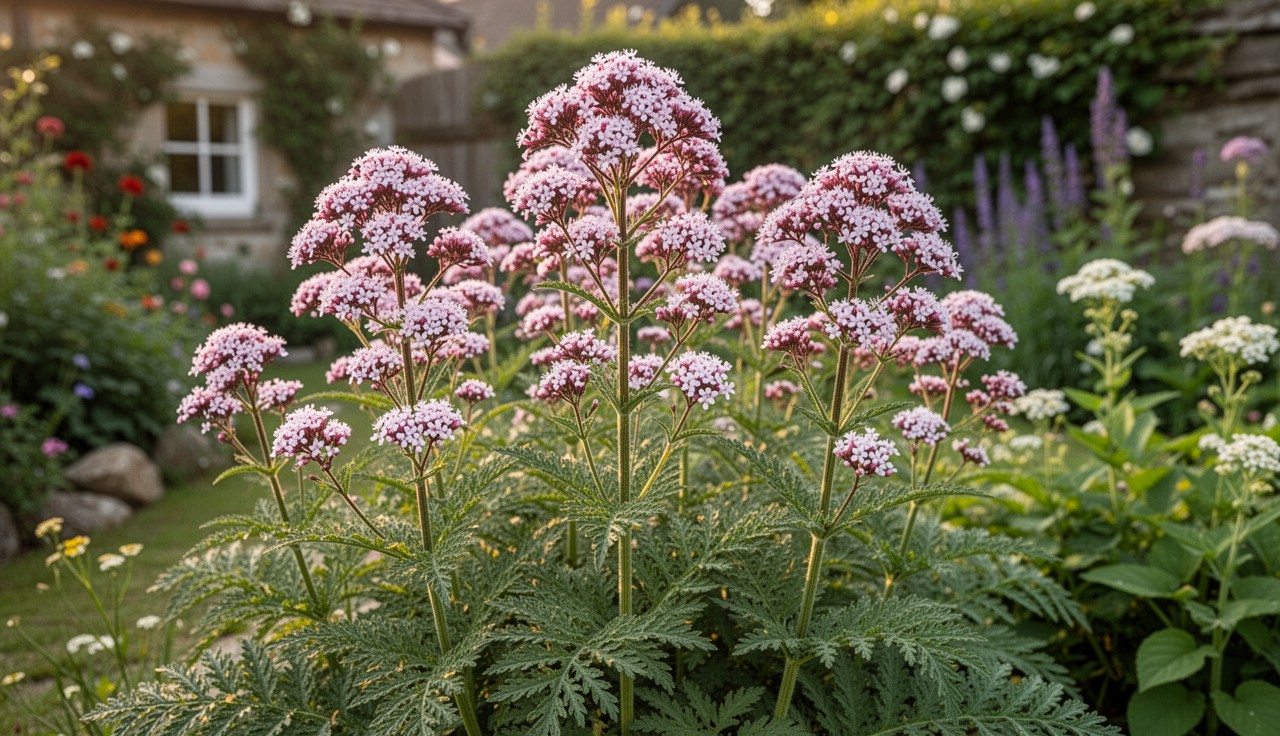
Valerian (Valeriana officinalis) is a tall, clump-forming perennial native to Europe and western Asia, recognized by its pinnately divided leaves, clusters of small white-to-pink flowers, and an unmistakable musky odor emanating from the roots. The plant can reach 4–5 feet in height under favorable conditions, making it one of the taller herbs in a typical medicinal garden.
The root system is the medicinal part: a dense, tangled mass of fibrous roots and rhizomes that develop a progressively stronger smell as they age and dry. The odor, often compared to aged cheese or dirty socks, is caused by isovaleric acid released during the drying process. Cats are notably attracted to valerian root, responding to it similarly to catnip.
The Cat Connection
The volatile compounds in valerian root, particularly actinidine, stimulate the same feline olfactory receptors as nepetalactone in catnip. Medieval herbalists noted that rats were also attracted to valerian, and legend holds that the Pied Piper of Hamelin used valerian to lure the rats from the city, a story that likely reflects genuine observation of the plant’s effect on rodents.
Origin and Historical Use
Valerian’s medicinal use dates to at least ancient Greece and Rome. Hippocrates described its properties, and Galen later prescribed it specifically for insomnia. The name may derive from the Latin valere (“to be strong” or “to be healthy”), though some scholars link it to the Roman province of Valeria.
During the medieval period, valerian was a staple of European monastic herb gardens. It gained particular prominence during World War I and World War II, when it was administered to civilians and soldiers to treat shell shock, nervous anxiety, and insomnia caused by air raids. The British Pharmacopoeia listed valerian as an official sedative until relatively recently.
Unlike many historical herbs whose traditional uses are narrowly regional, valerian’s sedative reputation spans virtually every European culture, from Scandinavian folk medicine to Mediterranean herbalism, suggesting genuine and independently recognized biological activity.
Climate and Growing Zone Requirements
Valerian is a temperate-zone plant that prefers cool, moist conditions. It thrives in climates with distinct seasons and cool nights, making it better suited to northern growing regions than the arid Southwest.
| Parameter | Range / Tolerance |
|---|---|
| USDA Hardiness Zones | 4–8 |
| Light Preference | Full sun to partial shade |
| Moisture | Consistently moist; does not tolerate prolonged drought |
| Frost Tolerance | Excellent, fully winter-hardy to -30°F |
| Heat Tolerance | Moderate; suffers above 90°F sustained temperatures |
| Preferred Climate | Cool-temperate with regular rainfall |
In Texas and other warm-climate regions, valerian can be grown as a fall-to-spring crop or in shaded, irrigated beds. Container culture allows growers to move plants to cooler microclimates during summer heat. Partial shade becomes essential in zones 7b and warmer.
Soil, Propagation, and Cultivation
Unlike the lean, dry soils preferred by ashwagandha and many Mediterranean herbs, valerian demands rich, moist, organic-matter-laden soil. This plant is a heavy feeder that rewards generous composting.
| Factor | Details |
|---|---|
| Preferred Soil | Rich, moist loam with high organic matter; pH 5.5–7.0 |
| Propagation | Seed (surface sow, needs light), division (spring/fall), or root offsets |
| Germination | 14–21 days at 65–70°F; seed viability drops rapidly after 1 year |
| Spacing | 12–18 inches between plants; clumps expand yearly |
| Fertilization | Moderate; side-dress with compost in spring; benefits from balanced NPK |
| Watering | Regular and consistent; mulch heavily to retain soil moisture |
Division is the easiest propagation method for home growers. Established clumps can be divided every 2–3 years in early spring, which also prevents overcrowding and promotes vigorous root growth. Seed-grown plants require patience, germination is often erratic and seedlings grow slowly in their first year.
Harvesting and Root Processing
Valerian root harvest is an exercise in timing and patience. The compounds responsible for its sedative effects accumulate gradually, and premature harvest yields inferior material.
Harvest Timing
Roots are optimally harvested in the fall of the second or third year, after the above-ground growth has died back and the plant has redirected energy into root storage. Some growers also harvest in early spring before new growth emerges. First-year roots are generally too small and underdeveloped to be worth harvesting.
Processing
Dig the entire root mass, shake off soil, and wash thoroughly under cold running water. Cut roots into 1/4-inch slices or split larger roots lengthwise. Dry at low temperatures (under 105°F / 40°C) to preserve volatile compounds. The drying process intensifies the characteristic odor significantly, many growers dry valerian in a well-ventilated outbuilding rather than indoors.
Storage
Store dried root in airtight glass containers away from light and heat. Properly dried valerian root retains potency for 2–3 years. The strong odor makes contamination of nearby herbs a concern, store valerian separately from other dried botanicals.
The Smell Factor
Valerian’s strong odor is both a quality indicator and a practical consideration. Fresh root smells earthy and mild; the intense musky odor develops during drying as valerenic acid and isovaleric acid concentrate. If your dried valerian barely smells, it may have been processed at too high a temperature or stored too long.
Phytochemical Profile
Valerian’s complex chemistry involves multiple compound classes working in concert, which has made isolating a single “active ingredient” challenging for researchers.
| Compound Class | Key Members |
|---|---|
| Sesquiterpenes | Valerenic acid, acetoxyvalerenic acid, hydroxyvalerenic acid |
| Iridoids (Valepotriates) | Valtrate, isovaltrate, acevaltrate (unstable, degrade in processing) |
| Amino Acids | GABA (present in root tissue itself), glutamine |
| Volatile Oils | Bornyl acetate, isovaleric acid, valeranol |
| Lignans | Olivil, pinoresinol (minor components with potential synergy) |
Valerenic acid is the most studied individual compound and is thought to modulate GABA-A receptors in the brain, enhancing inhibitory neurotransmission. However, many researchers believe valerian’s effects arise from the synergistic interaction of multiple compound classes rather than any single molecule.
Traditional and Modern Functional Uses
- Sleep onset: The primary traditional and modern use. Valerian is typically taken 30–60 minutes before bed, often as a tea, tincture, or capsule. Effects may take 2–4 weeks of consistent use to fully manifest.
- Anxiety and nervous tension: Used traditionally during the day in lower doses for mild anxiety, test stress, and nervous restlessness. Unlike pharmaceutical anxiolytics, valerian is not associated with significant daytime drowsiness at standard doses.
- Muscle relaxation: Included in European herbal formulations for menstrual cramps, tension headaches, and stress-related muscle tightness.
- Herbal combinations: Commonly paired with hops, passionflower, or lemon balm in commercial sleep formulations, with some evidence suggesting improved efficacy in combination versus valerian alone.
Clinical Research Summary
Mixed Evidence
Valerian has been studied in numerous clinical trials with notably inconsistent results. This variability likely reflects differences in extract types, dosages, treatment duration, and study populations. The overall evidence is suggestive but not conclusive for most outcomes.
- Sleep quality: A number of RCTs report subjective improvements in sleep quality, particularly after 2–4 weeks of use. Objective measures (polysomnography) have shown less consistent results. A Cochrane review concluded that evidence is suggestive but insufficient to draw definitive conclusions.
- Anxiety: Limited clinical trial data suggests modest anxiolytic effects comparable to low-dose benzodiazepines in some populations, without the associated dependence risk.
- Safety profile: Clinical trials consistently report a favorable safety profile, with adverse effects similar to placebo. Valerian does not appear to impair morning alertness or cause rebound insomnia upon discontinuation.
Health Precautions
- Drug interactions: May potentiate sedatives, benzodiazepines, and alcohol. Avoid combining with other CNS depressants without medical guidance.
- Surgery: Discontinue 2 weeks before scheduled surgery due to potential interactions with anesthesia.
- Pregnancy: Insufficient safety data; generally advised against during pregnancy and breastfeeding.
- Driving: While standard doses rarely cause drowsiness, individual sensitivity varies. Assess personal response before driving or operating machinery.
Garden Design and Companion Planting
Valerian is an attractive garden plant beyond its medicinal value. The tall flower stalks with clusters of white or pink blossoms attract beneficial insects and make excellent cut flowers.
- Pollinator garden: Valerian flowers attract butterflies, bees, and hoverflies, making it a valuable addition to pollinator-focused plantings.
- Companion effects: Traditional gardeners believe valerian stimulates earthworm activity and phosphorus availability in surrounding soil, though scientific evidence for these effects is limited.
- Biodynamic use: Valerian preparation (BD 507) is one of the six compost preparations in biodynamic agriculture, applied as a diluted flower extract to compost piles.
Scientific and Authoritative References
- Bent et al., American Journal of Medicine (2006), systematic review of valerian for sleep
- Fernandez-San-Martin et al., Sleep Medicine Reviews (2010), meta-analysis of valerian RCTs
- European Medicines Agency, Herbal Monograph on Valeriana officinalis
- WHO Monographs on Selected Medicinal Plants, Vol. 1, valerian root
- Bos et al., Phytochemistry, valerenic acid and GABA receptor interactions
- German Commission E Monograph, valerian
- PFAF Plant Database, cultivation parameters for Valeriana officinalis
Common questions
What has valerian traditionally been used for?
Valerian’s medicinal use dates to at least ancient Greece and Rome. Hippocrates described its properties, and Galen later prescribed it specifically for insomnia. The name may derive from the Latin valere (“to be strong” or “to be healthy”), though some scholars link it to the Roman province of Valeria. During the medieval period, valerian was a staple of European monastic herb gardens. It gained particular prominence during World War I and World War II, when it was administered to civilians and soldiers to treat shell shock, nervous anxiety, and insomnia caused by air raids.
What climate does valerian tolerate?
Valerian is a temperate-zone plant that prefers cool, moist conditions. It thrives in climates with distinct seasons and cool nights, making it better suited to northern growing regions than the arid Southwest. USDA Hardiness Zones: 4–8. Light Preference: Full sun to partial shade. Moisture: Consistently moist; does not tolerate prolonged drought.
What soil does valerian need?
Unlike the lean, dry soils preferred by ashwagandha and many Mediterranean herbs, valerian demands rich, moist, organic-matter-laden soil. This plant is a heavy feeder that rewards generous composting. Preferred Soil: Rich, moist loam with high organic matter; pH 5.5–7.0. Propagation: Seed (surface sow, needs light), division (spring/fall), or root offsets. Germination: 14–21 days at 65–70°F; seed viability drops rapidly after 1 year.
When should I harvest valerian?
Valerian root harvest is an exercise in timing and patience. The compounds responsible for its sedative effects accumulate gradually, and premature harvest yields inferior material. Roots are optimally harvested in the fall of the second or third year, after the above-ground growth has died back and the plant has redirected energy into root storage. Some growers also harvest in early spring before new growth emerges. First-year roots are generally too small and underdeveloped to be worth harvesting.
What is phytochemical profile?
Valerian’s complex chemistry involves multiple compound classes working in concert, which has made isolating a single “active ingredient” challenging for researchers. Sesquiterpenes: Valerenic acid, acetoxyvalerenic acid, hydroxyvalerenic acid. Iridoids (Valepotriates): Valtrate, isovaltrate, acevaltrate (unstable, degrade in processing). Amino Acids: GABA (present in root tissue itself), glutamine. Volatile Oils: Bornyl acetate, isovaleric acid, valeranol.
What is clinical research summary?
Valerian has been studied in numerous clinical trials with notably inconsistent results. This variability likely reflects differences in extract types, dosages, treatment duration, and study populations. The overall evidence is suggestive but not conclusive for most outcomes. Sleep quality: A number of RCTs report subjective improvements in sleep quality, particularly after 2–4 weeks of use. Objective measures (polysomnography) have shown less consistent results.
What are health precautions?
Drug interactions: May potentiate sedatives, benzodiazepines, and alcohol. Avoid combining with other CNS depressants without medical guidance. Surgery: Discontinue 2 weeks before scheduled surgery due to potential interactions with anesthesia. Pregnancy: Insufficient safety data; generally advised against during pregnancy and breastfeeding. Driving: While standard doses rarely cause drowsiness, individual sensitivity varies.
How do I grow valerian?
Valerian is an attractive garden plant beyond its medicinal value. The tall flower stalks with clusters of white or pink blossoms attract beneficial insects and make excellent cut flowers. Pollinator garden: Valerian flowers attract butterflies, bees, and hoverflies, making it a valuable addition to pollinator-focused plantings. Companion effects: Traditional gardeners believe valerian stimulates earthworm activity and phosphorus availability in surrounding soil, though scientific evidence for these effects is limited.